What Is an AI Control Plane? (July 2026)
You've deployed AI models and agents across your stack, and now they're making decisions in production. But when you ask who controls what those systems are allowed to do, the answer is usually a patchwork: one team runs evaluations, another watches dashboards, and a third writes policy docs no system actually enforces. AI observability tools like Fiddler AI, AI observability Dynatrace, and AI observability software from Datadog or Snowflake give you metrics. AI monitoring tools like New Relic AI monitoring and Datadog AI monitoring send alerts when something drifts. Platforms like Microsoft Foundry control plane and agent control plane software handle orchestration. But metrics and alerts are not enforcement. An AI control plane is the layer that actually governs behavior: it blocks unsafe outputs before they ship, enforces thresholds across every model and agent, and produces the audit trail compliance teams need when regulators show up. It's the connective tissue between development-time evaluation and production-time enforcement, between observing drift and stopping a non-compliant response. Whether you're assessing Fiddler AI funding, comparing Fiddler AI revenue and Fiddler AI valuation against competitors, checking Fiddler AI Glassdoor reviews, or researching platforms like GitHub agent control plane and agentic AI control plane architecture, the question is the same: do you have visibility, or do you have control? This guide explains what an AI control plane is, why enterprises running multi-agent systems need one, and how it works across evaluation, runtime enforcement, and governance.
TLDR:
- An AI control plane governs model and agent behavior across three layers: evaluation gates pre-deployment, active guardrails in production that block unsafe outputs, and audit trail generation for compliance.
- Monitoring tools track performance; a control plane enforces policy before outputs reach users, bridging the gap between observation and runtime action.
- For agentic systems, the control plane needs action-level tracing and interrupt mechanisms that halt workflows mid-execution when thresholds are breached.
- Openlayer spans evaluation, observability, and governance in a unified workflow, blocking non-compliant outputs at the API boundary and generating audit-ready compliance artifacts.
What Is an AI Control Plane?
An AI control plane is the governance and orchestration layer that sits above individual AI models, agents, and pipelines, giving teams a single point of control over what gets deployed, how it behaves in production, and whether it stays within defined policy boundaries. For instance, when a customer-facing agent generates a response, the control plane tests that output against groundedness thresholds (blocking deployment if the score falls below a configured threshold, for example 85%), checks it for toxicity or demographic bias, and logs the entire decision path to an audit trail before the response ever reaches the user.
The term borrows from networking, where a control plane manages routing decisions while the data plane handles actual traffic. In AI infrastructure, the split works similarly. The data plane is where inference happens: tokens are generated, agents execute tool calls, embeddings are retrieved. The control plane is where decisions about that behavior are made and enforced: which models are approved to run, what output policies apply, when a response gets blocked, and who gets notified when something drifts outside acceptable bounds. The architectural parallel to Kubernetes cluster architecture is direct: just as Kubernetes manages container workloads through scheduling and policy enforcement, an AI control plane manages model workloads through routing and behavioral governance.
There are a few distinct layers worth separating out here:
- Model-level control covers the individual inference layer: evaluation gates, behavioral thresholds, version tracking, and rollback authority for a single model endpoint.
- Agent-level control extends that scope to multi-step, tool-using AI systems where outputs from one step become inputs to the next. Here, the control plane has to track intermediate reasoning, tool call success rates, and whether the agent's final output reflects the intent of its original instructions.
- Enterprise control spans both, adding policy enforcement across all models and agents in an organization, audit trail generation, and compliance mapping against regulatory requirements.
Most teams building AI in 2026 already have pieces of this in place. What they often lack is the connective layer that ties evaluation during development to enforcement in production.
Why Enterprises Need an AI Control Plane
Enterprise AI deployments have grown from isolated experiments into sprawling, interconnected systems running dozens of models, agents, and pipelines across business-critical functions. That scale introduces a category of risk that traditional software infrastructure was never designed to handle: models drift, agents make autonomous decisions with real downstream consequences, and teams lose visibility into what's actually running in production.
Three pressure points define why this matters now.
- Regulatory exposure is compounding: frameworks like the EU AI Act impose documentation, monitoring, and human oversight obligations tied to specific lifecycle stages. Conformity assessment requirements demand technical documentation covering system architecture, training data sources, and risk management procedures before market release. Without a control layer that tracks model behavior continuously, teams produce no audit evidence and face gaps that are, by definition, unresolvable after the fact.
- Agentic systems behave differently than APIs: an LLM responding to a prompt is stateless; an agent executing multi-step workflows is not. A control plane governs behavioral boundaries beyond uptime, which is what agentic AI actually requires.
- Fragmented tooling creates blind spots: when evaluation lives in one tool, monitoring in another, and governance in a third, no single view of model health exists. Incidents surface late, and remediation is reactive.
Core Capabilities: The Three Layers of an AI Control Plane
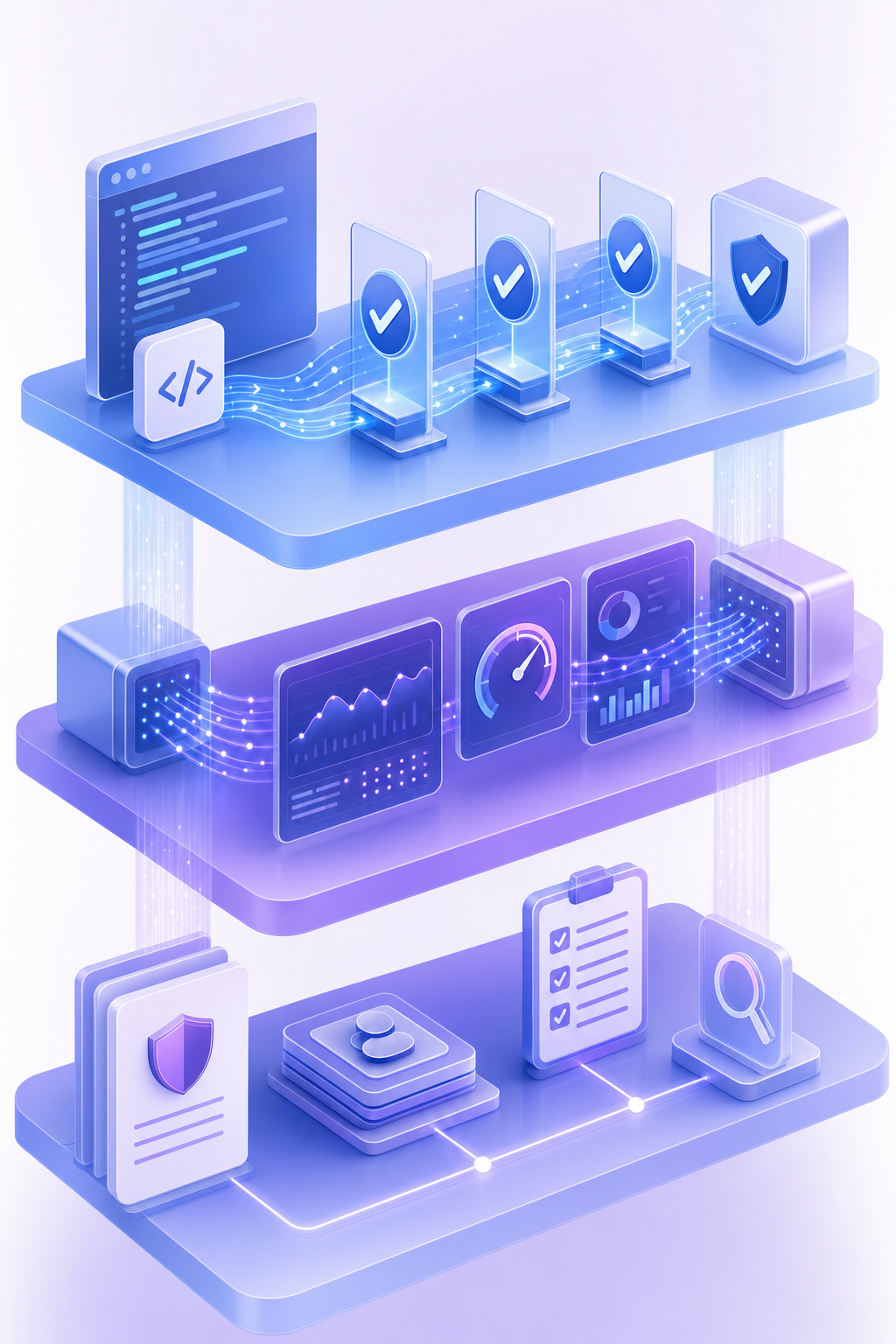
An AI control plane operates across three distinct layers, each handling a different phase of the AI lifecycle. Together they give teams the instrumentation, enforcement, and audit coverage that individual monitoring or evaluation tools leave incomplete.
Evaluation and Testing
Before any model or agent reaches production, the control plane runs structured evaluation: behavioral tests, adversarial probes, regression checks against prior versions, and LLM-as-a-judge scoring on quality dimensions like groundedness, toxicity, and relevance. The gate is explicit, not implicit. A model that scores below a defined threshold, say groundedness below 85% or toxicity probability above 0.15, does not advance.
Runtime Observability and Enforcement
Once deployed, the control plane monitors live inference continuously. Drift in input distributions, output quality regressions, demographic parity gaps exceeding approved limits, and latency spikes all surface as structured signals instead of raw logs. Critically, enforcement here is active: guardrails block non-compliant outputs before they leave the API boundary, instead of flagging them after delivery.
Governance and Audit Trail
Every evaluation result, deployment event, threshold breach, and remediation action writes to a structured record. That record is not a byproduct of monitoring; it is a first-class artifact. Auditors reviewing conformity assessments get pass/fail scores, metric histories, and flagged failure modes instead of narrative summaries. Compliance evidence accumulates continuously, not retrospectively when a review is scheduled.
AI Control Plane vs Adjacent Technologies
Positioning an AI control plane relative to adjacent tech categories helps clarify what actually belongs in scope and what sits outside it. There are several categories that overlap in marketing language but diverge sharply in what they do at runtime.
Here is how the main categories compare:
| Category | What It Does | What It Misses |
|---|---|---|
| AI observability tools | Track output quality, drift, and behavioral signals in production | Do not enforce policy or block unsafe outputs |
| AI monitoring software | Alert on performance degradation and system health metrics | Operate reactively; no pre-deployment gates |
| MLOps platforms | Manage model training, versioning, and deployment pipelines | Focused on delivery, not runtime governance |
| Data governance tools | Classify and control data assets and access policies | Do not govern model behavior post-deployment |
| AI control plane | Spans evaluation, enforcement, and governance across the full lifecycle | Requires deliberate integration across tooling layers |
Where the Boundaries Get Fuzzy
The confusion usually surfaces between AI monitoring and control plane functionality. AI monitoring tools like Datadog AI monitoring or New Relic AI monitoring track latency, error rates, and throughput. An AI control plane goes deeper: it governs what the model is allowed to produce, beyond whether the API stayed up.
Similarly, agent control plane software handles orchestration and routing for multi-agent systems, but orchestration is not governance. Routing an agent to the right tool call is a different problem than enforcing output safety thresholds before a response reaches the user.
The distinction matters because teams assembling a stack from observability, monitoring, and orchestration components often find they have coverage across every layer except enforcement.
How an AI Control Plane Works: Architecture and Enforcement
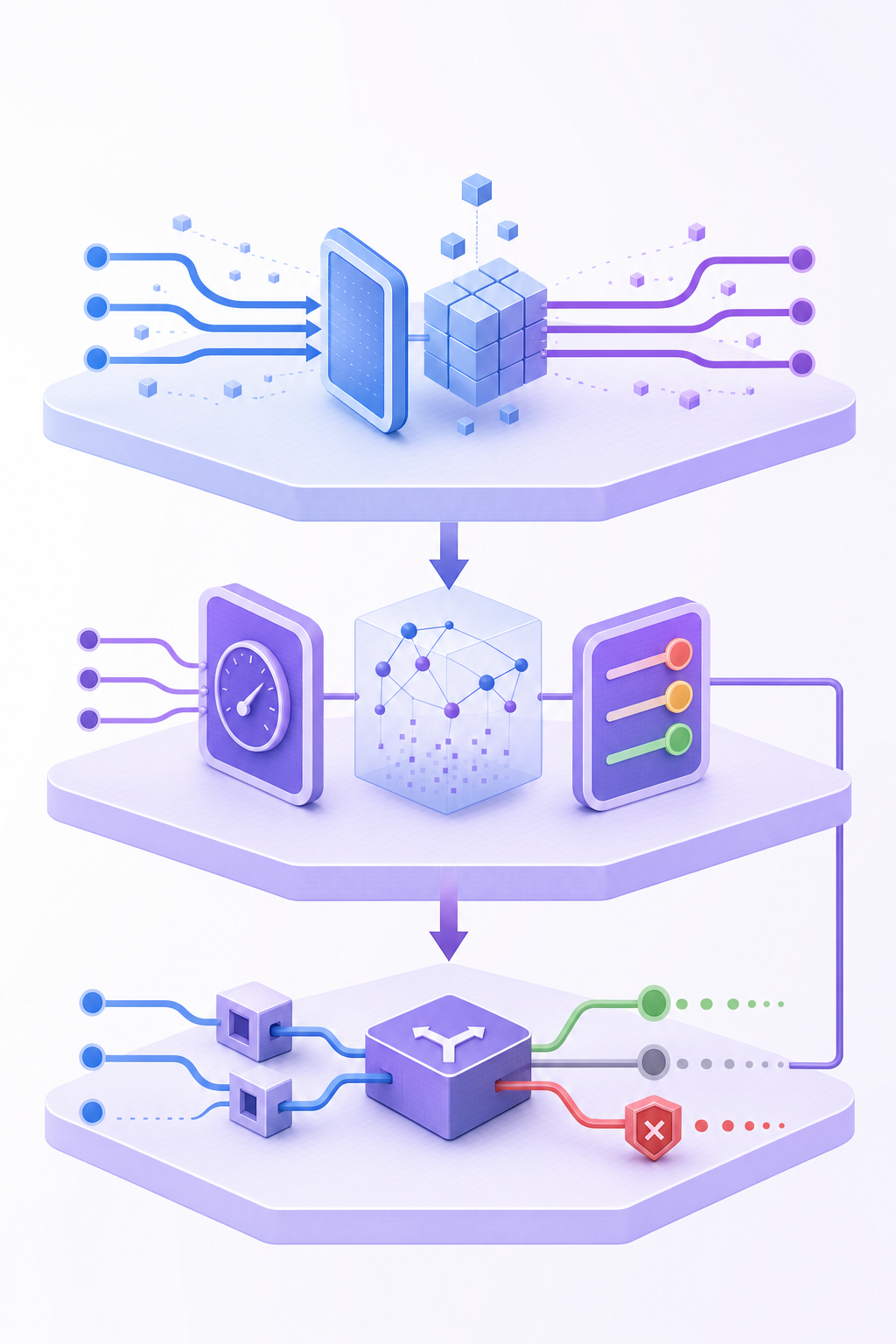
An AI control plane sits between your AI systems and the infrastructure they run on, acting as the governance and enforcement layer that connects model behavior to organizational policy. Where traditional software infrastructure uses a control plane to manage routing, scaling, and configuration, an AI control plane extends that concept to cover what models actually do: what outputs they produce, whether those outputs meet defined quality thresholds, and whether the system's behavior has drifted from its deployment baseline.
The architecture has three core layers worth understanding before getting into enforcement specifics.
Ingestion and Instrumentation
Every AI control plane starts with data collection. Requests, responses, latency metrics, token usage, and metadata from every model invocation get captured and routed to a central store. For agentic systems, this includes tool calls, reasoning traces, and multi-step decision paths: every intermediate step, including final outputs. The fidelity of this layer determines what's visible downstream.
Policy Evaluation and Scoring
Captured outputs pass through an evaluation layer that scores them against defined criteria: groundedness, toxicity, demographic parity, task completion, and custom metrics specific to the deployment context. This is where LLM-as-a-judge patterns, statistical tests, and threshold comparisons run. A score below a defined floor, say a groundedness score under 85%, triggers a policy action instead of passing through silently.
Enforcement and Routing
Scores produce decisions. Enforcement actions range from flagging and logging at the low end, to routing outputs to a human reviewer, to blocking a response before it reaches the end user. The distinction between a control plane that observes and one that enforces lives here: observation records the score; enforcement acts on it before downstream systems or users see the result.
| Layer | Function | Output |
|---|---|---|
| Ingestion | Captures requests, responses, traces | Raw event stream |
| Policy Evaluation | Scores outputs against thresholds | Pass / flag / block decision |
| Enforcement | Routes or blocks based on decision | Audit log, guardrail action, alert |
AI Control Plane for Agentic Deployments
Agentic AI deployments introduce a different class of control problem. A single LLM responding to a prompt is one thing; a network of autonomous agents calling tools, spawning subagents, and writing to external systems across multi-step workflows is another. The control plane has to extend accordingly.
There are three structural requirements that separate an agent control plane from standard AI monitoring:
- Action-level tracing across the full agent graph, beyond input/output pairs at the model boundary. Every tool call, handoff between agents, and memory read or write needs a timestamped record so you can reconstruct exactly what happened and why.
- Interrupt and override mechanisms that can halt a running agent mid-task when behavioral thresholds are breached, before downstream tools execute consequential actions.
- Cross-agent policy enforcement, where a guardrail defined once applies consistently whether a capability runs as a primary agent, a subagent, or a tool-wrapped LLM call buried three layers deep in the graph.
Why Standard Monitoring Falls Short
Most observability tooling was built for request-response systems. You send a request, you get a response, you log both. But an agent workflow may run for minutes, branch conditionally, and issue dozens of external calls before producing any user-facing output. By the time a monitoring system logs the final response, the actions that caused a problem have already happened.
The control plane for agentic deployments needs to sit inside the execution loop, not outside it. That means policy checks run before tool calls execute, not after outputs are returned.
Implementation Considerations for Enterprise AI Teams
Before standing up an AI control plane, enterprise teams need to account for several architectural and organizational realities that determine whether the investment pays off.
There are four main areas to work through:
- Latency overhead: Adding an inference interception layer introduces measurable latency. For synchronous, customer-facing applications, that overhead matters. Teams should benchmark control plane latency against their SLA requirements before committing to a synchronous enforcement architecture.
- Data residency and privacy: Many control plane tools route inference logs to external services. If your agents process regulated data, PII, or proprietary content, confirm whether the tool supports self-hosted or on-premises deployment before signing a contract.
- Coverage across heterogeneous stacks: Most enterprise AI environments run multiple model providers, agent frameworks, and deployment targets simultaneously. A control plane that covers only one provider or one framework leaves gaps that accumulate quickly.
- Organizational ownership: Control planes sit at the intersection of ML engineering, security, and compliance. If no team owns the governance layer end to end, alert thresholds go unreviewed, policy updates stall, and the audit trail becomes incomplete precisely when it matters most.
Getting the architecture right is only half the problem. The other half is making sure someone owns it.
Frequently Asked Questions
What is an AI control plane?
An AI control plane is the governance and orchestration layer that sits above your AI models and agents, handling policy enforcement, observability, routing, and compliance tracking across your entire AI stack. Think of it as the control backbone that keeps deployed AI systems behaving within defined boundaries, from individual LLM calls to multi-step agentic workflows.
How does an AI control plane differ from AI monitoring?
AI monitoring tracks what a model is doing. An AI control plane acts on it. Monitoring surfaces drift, latency, or output quality issues; a control plane enforces thresholds, blocks non-compliant outputs, and routes decisions to human reviewers when predefined conditions are met.
Do I need a control plane if I already use observability tools?
Observability tools give you visibility. A control plane gives you enforcement. If your observability stack can flag a policy violation but cannot stop the output from reaching a user, you have detection without control. Enterprise teams subject to EU AI Act or internal risk thresholds typically need both layers working together.
How Openlayer Implements the AI Control Plane for Enterprise AI Teams
Openlayer sits at the control plane layer for AI teams that need more than dashboards and alerts. It brings together evaluation, observability, and governance into a single workflow that runs from pre-deployment testing through live production monitoring, so the same standards that gate a model release also govern its behavior once it's running.
Here's what that looks like in practice across the AI lifecycle:
- Pre-deployment evaluation runs 100+ pre-built tests covering hallucination, toxicity, bias, groundedness, and task-specific quality metrics before any model reaches production. Pass/fail records and metric scores from these runs become the evidentiary record that feeds conformity assessment and audit documentation.
- Production observability tracks output quality, drift, and behavioral thresholds on live traffic. When a groundedness score falls below a configured floor or a demographic parity gap exceeds an approved limit, Openlayer flags the incident and routes it to the right owner automatically.
- Guardrail enforcement blocks unsafe outputs before they leave the API boundary. This is active runtime enforcement, not post-hoc logging.
- Governance and compliance mapping ties evaluation results to regulatory obligations, generating audit-ready evidence artifacts instead of requiring teams to reconstruct compliance records manually after the fact.
The agent-specific layer matters here too. As multi-step agentic workflows become standard, Openlayer tracks tool call success rates, reasoning path quality, and session-level metrics across 13 dimensions, giving teams visibility into exactly where an agent pipeline breaks down instead of just whether it did.
For enterprise teams running AI agents, fine-tuned models, and third-party LLM integrations in parallel, the control plane architecture means a single governance perimeter covers all of them, with no shadow deployment channels slipping past unmonitored.
Final Thoughts on Moving From Observation to Action
You can monitor every model in your stack and still lack control. The moment that matters is when a threshold gets breached and something has to happen before the output ships. That decision layer is what separates observability from governance. Most teams have the instrumentation but not the enforcement mechanism, which is why policy violations surface in retrospectives instead of getting stopped at runtime. If that gap sounds familiar, let's talk about closing it with a layer that actually enforces.
FAQ
What is an AI control plane?
An AI control plane is the governance and orchestration layer that spans evaluation, enforcement, and audit across your AI stack: from individual models to multi-step agent workflows. It handles policy enforcement, runtime observability, deployment gates, and compliance evidence generation in a single unified layer, instead of requiring you to stitch together separate tools for testing, monitoring, and governance.
AI control plane vs AI observability tools: what's the actual difference?
AI observability tools surface drift, quality regressions, and behavioral anomalies after inference happens. An AI control plane acts on those signals in real time: blocking non-compliant outputs before they reach users, gating deployments when evaluation thresholds fail, and routing flagged decisions to human reviewers based on predefined risk scores. Observability tells you what went wrong; a control plane prevents it from leaving your perimeter.
Can I build an AI control plane if my stack runs OpenAI, Anthropic, and custom fine-tuned models simultaneously?
Yes, if the control plane is model-agnostic at the ingestion layer. A framework-locked control plane that only covers one LLM provider or orchestration framework leaves gaps wherever your stack diverges. Look for platforms that instrument across providers and custom models through a unified API or SDK layer, so policy enforcement applies consistently regardless of which model served the request.
How does an agent control plane handle tool-calling errors that schema validation misses?
An agent control plane needs semantic tool-error detection, beyond schema checks. Schema validation confirms an agent passed the right argument types; semantic detection catches when an agent picked a valid tool in the wrong context, like invoking a delete operation when retrieval was required. This requires behavioral evaluation at the tool-call level, ideally with test coverage for unauthorized tool invocations and context-appropriate tool selection, beyond syntactic correctness alone.
When should we implement an AI control plane instead of adding more monitoring dashboards?
When you need enforcement beyond visibility. If your current observability stack can flag a policy violation but cannot stop the output from reaching production, you have detection without control. Teams subject to EU AI Act conformity assessment deadlines, operating agents with write access to production systems, or managing AI portfolios across regulated verticals typically need both layers working together: monitoring for diagnosis, control plane for prevention.