LLM Coding Benchmarks: The Complete Guide September 2026 (Updated)


Everyone checks the AI coding benchmark leaderboard to compare models, but those rankings often measure the wrong things for real-world coding tasks. A model topping the charts on function-level tests might score 60 points lower on repository edits, and contamination from training data can inflate scores by 15-20 percentage points. Before you pick a model based on leaderboard position, you need to know which benchmarks align with your use case and where public test suites stop being predictive.
TLDR:
- Benchmarks test if LLM-generated code works by running it against hidden test suites
- HumanEval and similar benchmarks are saturated at 90%+ scores, making rankings meaningless
- SWE-bench shows real gaps: top models reach 80%, most struggle below 20% on repository tasks
- Public leaderboards don't predict performance on your codebase or internal APIs
- Openlayer's unified evaluation, observability, and governance platform runs 100+ automated tests on code generation across development and production, with real-time guardrails and continuous monitoring
What are AI coding benchmarks
AI coding benchmarks are systematic evaluation frameworks that test whether LLM-generated code actually works. They measure functional correctness by running test cases against code outputs, checking if the code solves the problem as specified. These benchmarks focus on execution:
- Does the function return the correct result?
- Does it handle edge cases?
- Can it pass a test suite?
When you test an LLM for coding tasks, benchmarks provide repeatable, objective measurements. They replace subjective code review with automated testing, letting you compare models based on how often they generate working code.
How AI coding benchmarks work
AI coding benchmarks test LLMs by running generated code against hidden test suites. The model receives a problem description and function signature, generates a solution, and passes only if all test cases succeed.
Pass@k is the standard metric. Pass@1 measures success on the first attempt. Pass@10 samples ten completions and checks if any pass, accounting for the probabilistic nature of LLM outputs.
Test suites verify functionality across edge cases like empty inputs, duplicates, and boundary conditions. Benchmarks may track compilation rates and runtime errors, but functional correctness is the primary signal. Code that fails tests is marked as a failure, regardless of partial accuracy.
Major types of AI coding benchmarks
Coding benchmarks fall into distinct categories based on the task they measure. Each type tests different capabilities, from single-function completion to full repository work:
- Function-level benchmarks like HumanEval test isolated code generation. The model writes a standalone function from a docstring.
- Repository-level benchmarks like SWE-bench test software engineering at scale. The model receives a GitHub issue and must modify an existing codebase to resolve it.
- Competitive programming benchmarks like CodeContests use algorithmic problems from contests. They measure problem-solving ability and algorithmic reasoning under constraints.
- Scientific computing benchmarks like DS-1000 focus on domain-specific libraries. They test whether models can generate correct data science code using frameworks like NumPy and Pandas.
The table below provides an overview of the different benchmarks, their task focus, difficulty level, and what it measures.
| Benchmark | Task Focus | Sample Size | Difficulty Level | What It Measures |
|---|---|---|---|---|
| HumanEval | Standalone function completion from docstrings | 164 hand-crafted Python problems | Basic to intermediate, under 20 lines per solution | Foundational coding ability: loops, conditionals, list operations, basic algorithms |
| MBPP | Entry-level Python function generation | 974 basic programming problems | Entry-level, focusing on fundamental concepts | Basic logic, string manipulation, and simple data structure operations |
| SWE-bench | Real GitHub issue resolution in production repositories | 2,294 problems from popular Python projects | Advanced, requires multi-file edits across thousands of lines | Software engineering at scale: architecture understanding, API contracts, regression prevention |
| SWE-bench Verified | Human-validated repository-level fixes | 500 manually reviewed problems | Advanced, unambiguous fixes with reliable tests | Production-ready software engineering capability with verified test suites |
| LiveCodeBench | Contamination-free evaluation using post-cutoff problems | Monthly updates from LeetCode and AtCoder contests | Variable, time-segmented by model training dates | Actual generation capability versus memorization, with code generation and self-repair tracking |
| CodeContests | Competitive programming challenges | Problems from programming competitions | Advanced algorithmic reasoning under constraints | Problem-solving ability and algorithmic thinking for optimization tasks |
| DS-1000 | Domain-specific data science code generation | 1,000 problems using NumPy, Pandas, and similar libraries | Intermediate to advanced domain knowledge | Correctness in scientific computing frameworks and library-specific API usage |
HumanEval and function-level benchmarks
HumanEval includes 164 hand-crafted programming problems that test basic Python function generation. Each problem provides a docstring with a specification, and the model must complete the function body. Test cases verify correctness across typical inputs and edge cases. The benchmark focuses on standalone functions with no external dependencies. Problems range from string manipulation to basic algorithms, measuring whether an LLM can translate specifications into working code. Most tasks require under 20 lines.
MBPP (Mostly Basic Python Problems) follows a similar structure with 974 entry-level problems. Both test foundational coding ability: loops, conditionals, list operations, and basic logic.
Function-level benchmarks serve as gatekeepers. High scores don't guarantee real-world performance. These benchmarks ignore code structure, maintainability, and integration with existing systems.
SWE-bench for real-world software engineering
SWE-bench tests whether LLMs can resolve real GitHub issues in production repositories. The model receives an issue description and must edit the codebase to fix it. Success requires reading thousands of lines across multiple files, understanding project architecture, and generating a patch that passes the repository's test suite. SWE-bench Verified narrows the original dataset to 500 human-validated samples. Each problem has been manually reviewed to confirm the fix is unambiguous and tests are reliable.
The benchmark covers popular Python repositories like Django, Flask, and Matplotlib. Models must understand API contracts, follow existing code patterns, and avoid breaking unrelated functionality. A passing solution means the patch resolves the issue without introducing regressions.
SWE-bench exposes the gap between function completion and software engineering. Models that score above 80% on HumanEval often struggle to reach 20% on SWE-bench, revealing the need for specialized evaluation tools that measure repository-scale performance.
LiveCodeBench and contamination-free evaluation
LiveCodeBench collects problems released after model training cutoff dates, sourcing new coding challenges monthly from competitive programming contests like LeetCode and AtCoder. This creates time-segmented test sets that models could not have seen during training.
When training data includes test problems, models memorize solutions instead of generating them. LiveCodeBench uses problems published after each model's knowledge cutoff to measure actual coding capability. The benchmark tracks code generation, self-repair, and test output prediction across multiple difficulty levels and programming languages.
Models often score 15-20 percentage points lower on post-cutoff problems compared to older benchmarks, revealing the gap between memorization and generation when using proper agent evaluation.
Leaderboard performance as of March 2026
SWE-bench Verified has become the standard for measuring practical coding capability. While function-level benchmarks show saturation with scores above 90%, SWE-bench reveals sharper differences between models on repository-scale work. As of March 2026, MiniMax M2.5 leads at 80.2%, followed by Anthropic's Claude 3.7 Sonnet and OpenAI's GPT-4.5. The gap between top performers and mid-tier models is narrow, with a five-point difference separating first from tenth place. Note: Benchmark leaderboards shift frequently as new models release. These rankings reflect March 2026 performance; verify current standings before making model selection decisions.
Models in the 70-80% range handle most common coding patterns but still fail on multi-file refactors, API migrations, and complex dependency chains, requiring full-stack GenAI testing. HumanEval scores no longer separate capabilities, with most frontier models scoring above 85%. SWE-bench performance better predicts real-world coding utility.
Understanding benchmark limitations and saturation
Benchmark saturation happens when models cluster above 90%, making rankings meaningless. HumanEval reached this point, with GPT-4, Claude, and Gemini all exceeding 90%. What causes this?
- Training data leakage compounds the problem. Models trained on web-scraped data encounter benchmark problems during training, inflating scores through memorization instead of reasoning.
- Single benchmarks test narrow slices. HumanEval tests standalone functions. SWE-bench measures repository edits. Neither captures code review quality, API design decisions, or debugging workflows.
- Production requirements diverge from academic benchmarks. If you need SQL generation, infrastructure-as-code templates, or legacy system integration, public leaderboards won't predict performance. Custom test suites that mirror your actual workflows, coding standards, and edge cases provide better signals than generalized rankings when paired with continuous monitoring.
Choosing the right benchmarks for your use case
Benchmarks are an important part of selecting a model for your application. Here are a few best practices to consider when selecting the benchmark to use:
- Match benchmarks to your deployment scenario. If you're building code completion tools, function-level benchmarks like HumanEval measure relevance. For repository editing or agent-based development tools, SWE-bench better predicts performance.
- Leaderboard rankings don't map directly to business needs. A model that scores high on competitive programming benchmarks may fail at generating SQL queries or infrastructure code. If your use case involves domain-specific languages, internal APIs, or legacy codebases, public benchmarks provide limited signal.
- Build task-specific test suites that reflect actual usage. Sample real prompts from your engineers, extract common patterns, and create ground truth test cases. Run these evaluations during model selection and again after each update to catch regressions before they reach production.
Validating AI coding systems with Openlayer
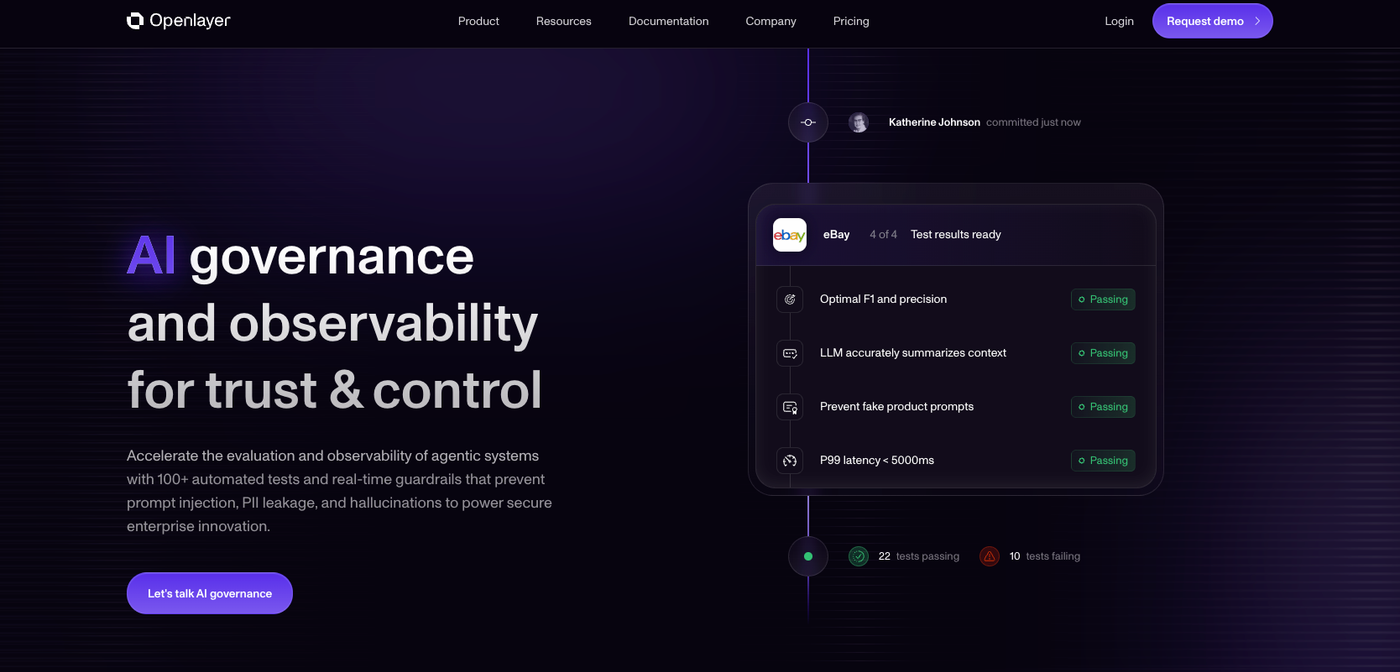
Openlayer extends benchmark-style testing into CI/CD pipelines with custom evaluations matched to your codebase, security requirements, and deployment patterns. As a unified evaluation, observability, and governance platform, Openlayer also monitors production performance and enforces coding standards at runtime. Each code generation request runs through 100+ automated tests checking functional correctness, security vulnerabilities, and adherence to internal coding standards. The platform tracks 13 session-level metrics for multi-turn coding interactions, including session coherence, goal achievement, and task progression, giving teams the visibility to assess agent-based development tools across entire conversation flows and individual code generations alike.
Teams define custom test suites reflecting actual usage patterns, from API integrations to legacy system compatibility. Production monitoring tracks coding agent performance in real time, including native tracing for embedding models used in code retrieval and RAG-based coding assistants, with distinct visibility into vector generation versus text generation within the pipeline. Real-time guardrails block prompt injections, PII leakage in generated code, and toxic content before code reaches downstream systems. When other quality issues arise, such as functional incorrectness or deviation from coding standards, alerts trigger immediately, connecting pre-deployment testing with live observability.
Unlike governance platforms like Credo AI or IBM watsonx that focus on policy documentation and framework mapping, Openlayer combines compliance automation with active runtime enforcement: blocking unsafe code generation before it reaches production and automatically mapping test results to regulatory requirements. Governance platforms document what your policies say; Openlayer enforces what your policies require at the moment of inference, where the risk actually lives.
Final thoughts on measuring LLM coding performance
Benchmark leaderboards show you what models can do in controlled settings, but AI coding benchmarks alone won't guarantee production success. Your deployment context matters more than any single score. Extract common patterns from actual developer workflows, turn them into automated tests, and run them continuously. Start with public benchmarks to shortlist models, then validate with tests that reflect your real requirements.
FAQ
What is the difference between HumanEval and SWE-bench?
HumanEval tests isolated function completion with 164 standalone Python problems, while SWE-bench tests repository-scale software engineering by requiring models to resolve real GitHub issues across thousands of lines of code. SWE-bench better predicts production performance.
How do I know if a benchmark is contaminated?
Contamination occurs when models see test problems during training, inflating scores through memorization. LiveCodeBench solves this by using problems published after each model's training cutoff date, typically revealing 15-20 percentage point drops compared to older benchmarks.
Should I rely on public leaderboards when selecting a coding model?
Public leaderboards provide limited signal for specific use cases. If you need SQL generation, infrastructure-as-code, or legacy system integration, build custom test suites that mirror your actual workflows, coding standards, and edge cases instead of relying solely on general rankings.
What does Pass@k measure in coding benchmarks?
Pass@k measures whether any of k generated samples passes all test cases. See the How AI Coding Benchmarks Work section above for full detail.
Why do models score 90% on HumanEval but only 20% on SWE-bench?
HumanEval tests basic function completion in isolation, while SWE-bench requires understanding project architecture, editing multiple files, and generating patches that pass existing test suites without breaking functionality. The gap exposes the difference between function generation and software engineering.