
Prove the AI you build and
defend can be trusted.
Openlayer helps cybersecurity teams and vendors evaluate, monitor, and harden AI systems against prompt injection, data leakage, and drift, with automated compliance built in.
Book a demo


69%
of cybersecurity teams have adopted, tested, or begun evaluating AI security tools
Source: 2025 ISC2 Cybersecurity Workforce Study
97%
of organizations reporting an AI-related breach lacked proper AI access controls
Source: IBM Cost of a Data Breach Report, 2025
87%
of leaders identify AI-related vulnerabilities as the fastest-growing cyber risk
Source: WEF, Global Cybersecurity Outlook 2026
Security teams are relying on AI they cannot fully test or control.
Security teams are both shipping AI products and defending against AI-specific attacks.
Prompt injection, jailbreaks, and data leakage are novel failure modes that SIEM, DLP, and CASB tools do not understand, and there is no consistent way to test or enforce against them.
Security AI can produce confidently wrong conclusions.
Models can misclassify threats, miss malicious activity, hallucinate indicators, or recommend the wrong response during an active incident.
Sensitive data and credentials can surface through AI.
Source code, access keys, incident details, customer data, and internal infrastructure information can leak through prompts, retrieval context, tool calls, and outputs.
Attackers can manipulate AI behavior.
Prompt injection, jailbreaks, poisoned context, and adversarial inputs can bypass safeguards or cause agents to expose data and misuse connected tools.
AI security is becoming part of every security program.
AI is now embedded in security products, employee workflows, customer applications, and autonomous agents. Security teams are responsible for both using these systems safely and protecting them from attack.
Frameworks such as the NIST AI RMF, OWASP Top 10 for LLM Applications, MITRE ATLAS, ISO/IEC 42001, and the EU AI Act are establishing expectations for testing, monitoring, access controls, and documented AI risk management.
Security testing that
follows AI into production
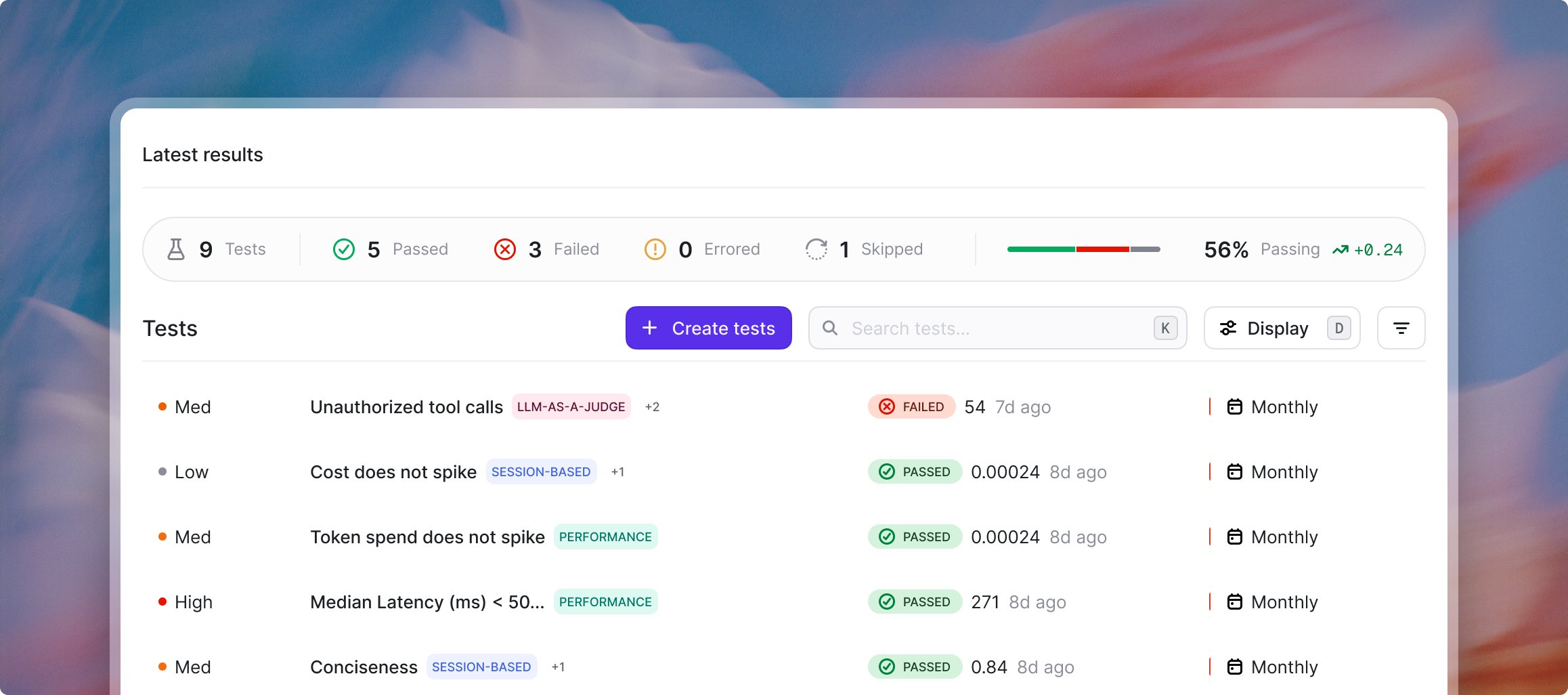
Openlayer connects adversarial testing with runtime protection, continuous monitoring, and automatically generated evidence. Security teams can find vulnerabilities before deployment and enforce the same safeguards on live AI traffic.
AI security products
Evaluate detection accuracy, false positives, missed threats, and response quality before every release.
SOC and analyst copilots
Test investigation quality, alert prioritization, threat summaries, and recommended actions against real security scenarios.
Adversarial testing
Continuously test prompt injection, jailbreaks, data extraction, harmful outputs, and tool misuse with maintained attack suites.
Runtime guardrails
Detect and block malicious inputs, sensitive-data exposure, policy violations, and unsafe agent behavior in real time.
Autonomous security agents
Verify agent decisions, restrict tool access, and prevent unsafe actions such as disabling users or changing production systems without approval.
Audit evidence by default
Answer customer security reviews and auditors in minutes.

Named in the 2026 Gartner Market Guide for AI Evaluation and Observability Platforms.

Backed by Y Combinator and Race Capital. SOC 2 Type II and GDPR compliant.
Regular third-party penetration testing, daily code review, static analysis, and dependency scanning.
Openlayer tests and monitors the AI inside security products themselves, including SOC copilots, analyst assistants, and autonomous security agents, so security vendors and buyers can verify these systems work as intended.
Openlayer includes adversarial testing that probes for prompt injection and jailbreak attempts, failure modes that traditional tools such as SIEM, DLP, and CASB were not built to detect.
Openlayer's evaluation and monitoring are designed to catch cases where a security model misclassifies a threat, misses malicious activity, or hallucinates an indicator during incident response.
Openlayer's guardrails inspect inputs and outputs in real time and can block sensitive data exposure and manipulation attempts as they happen, in addition to the testing done before a system ships.
Openlayer evaluates autonomous agents on task completion, tool usage, and error recovery, which gives security leaders concrete evidence before granting an agent broader permissions.
Test results and monitored interactions are logged and available as evidence, supporting both internal security reviews and external audits of AI-enabled security products.
Industry surveys indicate that a majority of cybersecurity teams have already adopted, tested, or begun evaluating AI security tools, meaning the attack surface Openlayer is built to test is already in active use at most organizations.
IBM's research on AI security has found that most organizations that experienced an AI-related breach lacked proper AI access controls at the time, which underscores why runtime enforcement matters as much as pre-launch testing.
Industry surveys of security leaders frequently rank AI-related vulnerabilities among the fastest-growing categories of cyber risk they face.
They get adversarial testing, runtime guardrails, and audit evidence in one platform, letting them verify AI security products and internal AI-enabled tools with the same rigor applied to any other security control.

Make AI your advantage.
Improve security operations while testing, protecting, and monitoring every AI system you deploy.