The 10 best AI agent frameworks for production teams (updated September 2026)
Most AI agent frameworks focus on building and deploying agents quickly. That works fine until your agent leaks customer data, hallucinates in front of users, or fails an audit. Building agents is the easy part. Keeping them reliable, secure, and compliant in production requires different capabilities entirely -- see our guide to production agent governance for what that entails. This comparison shows you what each framework actually provides for production deployments.
TLDR:
- Production failures: agents fail through hallucinations, PII leaks, and drift, requiring automated tests in CI/CD
- Runtime guardrails: block prompt injections and data exfiltration before they reach your systems
- Framework gaps: agent frameworks like LangGraph and CrewAI lack security, compliance mapping, and production observability
- Openlayer coverage: unifies behavioral testing, real-time guardrails, observability, and automated compliance mapping for production AI agents
Best overall AI agent framework for production teams: Openlayer
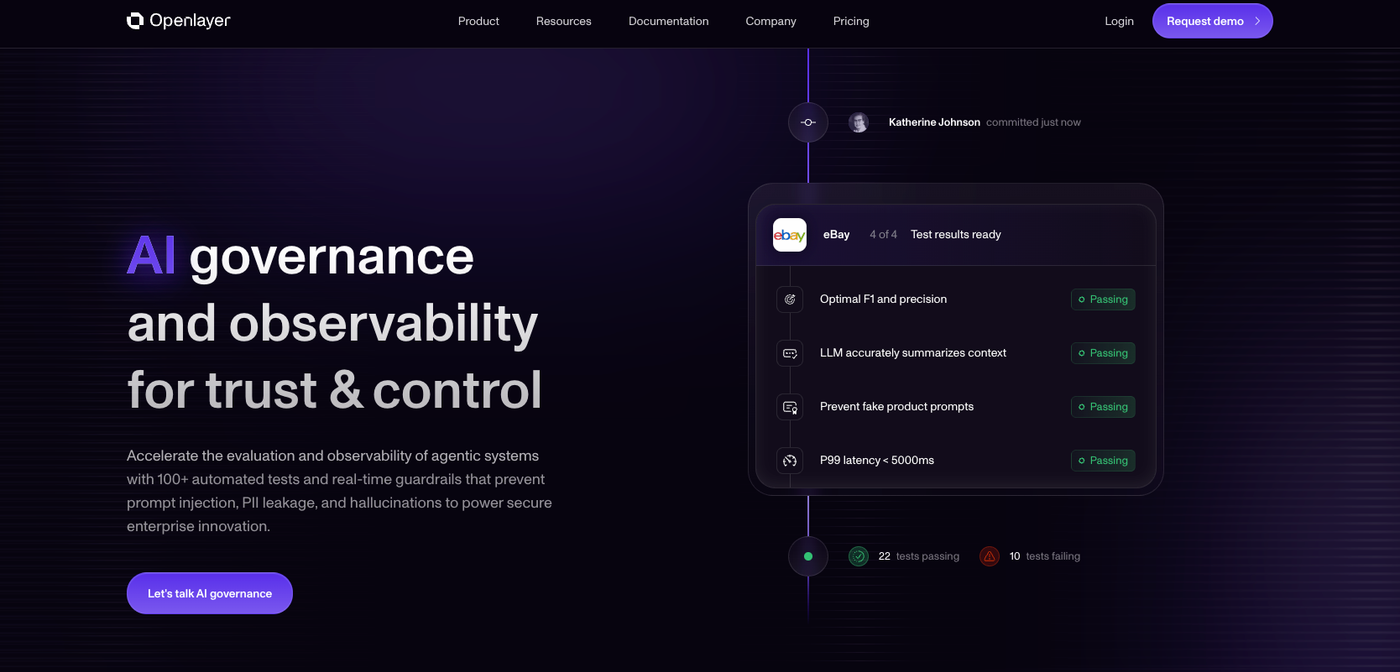
Production agent systems fail in ways traditional software doesn't. They hallucinate, leak sensitive data, and drift unpredictably. Openlayer treats agent reliability as an engineering discipline, not an afterthought. Catch hallucinations, bias, toxicity, and PII leakage before they reach users: our AI agent evaluation platform runs over 175 automated behavioral tests in CI/CD pipelines and against live production traffic, applying the same rigor to agents that engineering teams expect from application code.
Here is how that plays out in practice:
Real-time guardrails block prompt injections and data exfiltration attempts before they reach your systems. Continuous monitoring tracks agent behavior across every workflow, with anomaly detection and drift alerts that surface regressions before customers notice them. Automated compliance mapping aligns projects to EU AI Act, NIST RMF, and ISO 42001 with audit-ready documentation. For example, a high-risk financial services model under EU AI Act Article 9 risk management obligations gets continuous risk assessment and structured evidence capture automatically, without a manual mapping exercise before each audit cycle.
The bottom line is that Openlayer provides the governance, security, and compliance capabilities that agent frameworks leave out. Production teams in regulated industries benefit from complete testing, real-time protection, and automated regulatory alignment that other solutions require you to build yourself. Openlayer is not an agent orchestration framework; teams still need LangGraph, CrewAI, or AutoGen to build and run the agent workflows that Openlayer then governs.
LangGraph
LangGraph is the go-to choice for teams building multi-step agents that need explicit, debuggable control over state transitions and workflow sequencing. Graph-based state management gives engineering teams precise visibility into how agents move between operations, while built-in checkpointing lets workflows pause and resume without losing context. Human-in-the-loop capabilities allow teams to inspect and intervene in agent state during execution, and LangSmith integration provides tracing and debugging across execution paths. For teams whose primary challenge is wiring together complex, stateful agent logic, LangGraph handles that well.
That orchestration precision is real. Where LangGraph stops is at orchestration. It coordinates what agents do but does not govern whether they should. As of this writing, the framework ships with no automated behavioral testing to catch hallucinations or PII leakage before deployment, no real-time guardrails that block prompt injections or data exfiltration at the API boundary, no compliance framework mapping for regulatory requirements, and currently provides no agent observability beyond basic tracing through LangSmith. Teams get precise workflow control but must build the entire enforcement layer themselves.
The bottom line is that LangGraph excels at coordinating complex agent workflows with stateful control flow. Teams deploying agents in regulated environments need separate solutions for security, compliance, and production monitoring.
CrewAI
CrewAI is a multi-agent framework built around role-based collaboration where specialized agents work together on complex tasks. It genuinely handles multi-agent coordination well. Role-based specialization lets teams assign distinct responsibilities to each agent, a visual builder lowers the barrier for rapid prototyping, and structured task delegation makes the framework approachable for teams new to multi-agent patterns. Integration with external APIs and third-party tools rounds out a solid coordination layer.
That coordination layer is genuinely well built. Where it stops is at coordination itself, which covers how agents collaborate, not governance, which concerns what happens to their outputs. There is no built-in evaluation testing to catch hallucinations or PII leakage, no security guardrails to block prompt injections or data exfiltration, no compliance framework mapping, and no production observability. Policy enforcement and runtime controls are not part of CrewAI's scope, so every production deployment requires separate tooling to cover those gaps. Teams need dedicated AI agent evaluation tools to validate agent behavior in production.
The bottom line is that CrewAI handles agent coordination well but leaves the governance layer entirely to the teams deploying it. Teams need separate solutions for evaluation, security, and compliance before running CrewAI agents in regulated environments.
AutoGen
AutoGen is Microsoft's multi-agent conversation framework that handles flexible multi-agent conversation patterns well. The framework provides customizable agent roles, flexible tool integration, and support for both synchronous and asynchronous task execution. Its strong human-in-the-loop support makes it practical for research teams prototyping collaborative workflows where agents coordinate through message exchanges.
AutoGen stops at conversation coordination. The framework does not govern what agents do with their decisions. There is no real-time anomaly detection, no automated compliance mapping, no security guardrails for prompt attacks, and no behavioral testing suites. Teams operating AutoGen in production must build the entire governance layer on top of the framework, covering assessment, security, and enforcement that the framework itself does not supply. Without these controls, deployments are exposed to agent failure modes that are difficult to detect after the fact.
The bottom line is that AutoGen suits research and prototyping teams; production deployments need separate security, compliance, and monitoring tooling. Production deployments require additional solutions for security guardrails, compliance automation, and continuous monitoring that AutoGen does not provide.
PydanticAI
PydanticAI is a type-safe Python agent framework from the Pydantic team that offers a developer-friendly path into agent development. It is model-agnostic across OpenAI, Anthropic, and Gemini, with dependency injection that makes testing workflows straightforward. Built-in support for Model Context Protocol and Agent2Agent standards makes it a practical choice for teams building interoperable agents.
PydanticAI covers developer ergonomics, not governance. The framework includes no automated agent evaluation guide or behavioral testing, no compliance framework mapping, no production AI observability with anomaly detection, and no real-time security guardrails. Type safety at the code layer does not substitute for behavioral controls at the API boundary, so teams must build the enforcement layer separately before deploying in regulated environments.
The bottom line is that PydanticAI delivers strong type safety and developer experience for Python teams building agent applications. Teams need separate solutions for production security, compliance validation, and continuous monitoring before deploying PydanticAI agents in regulated industries.
Galileo
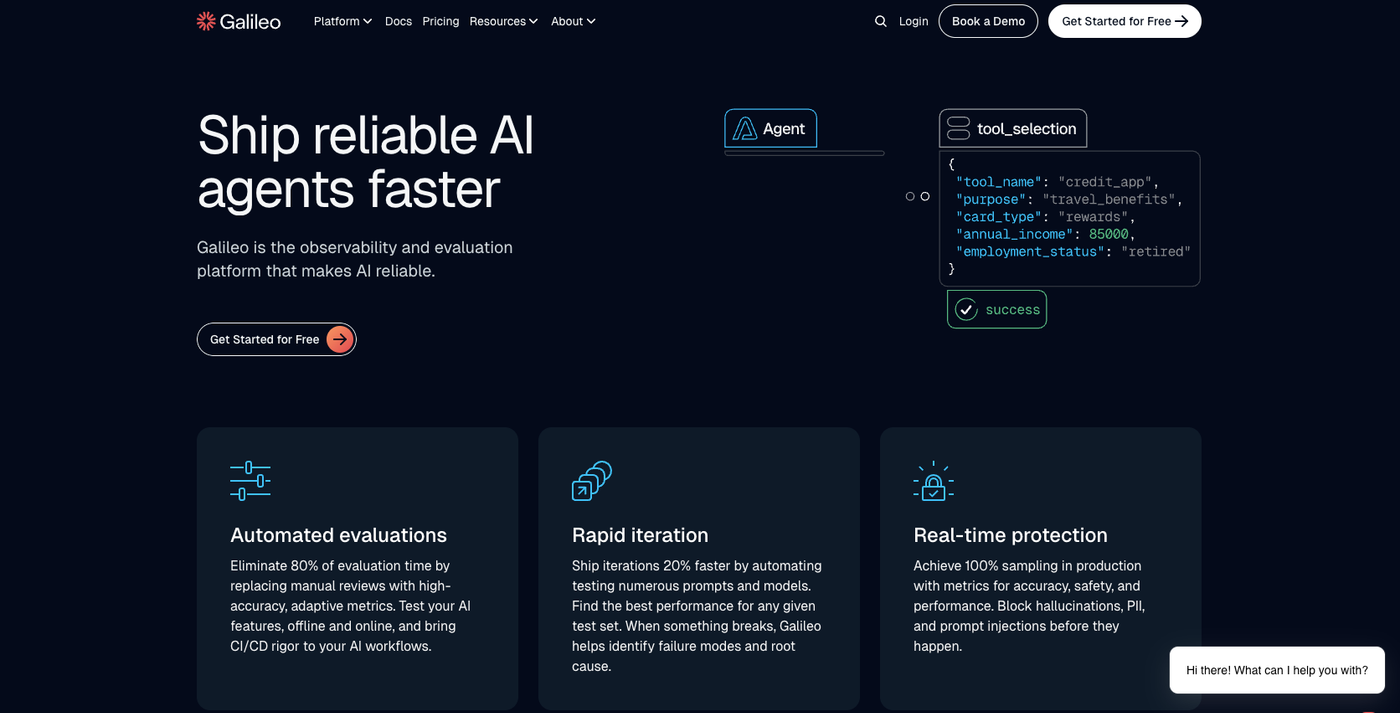
Galileo delivers strong agent evaluation and observability, with Luna-2 models powering cost-efficient production monitoring, agentic evaluations at both system and step levels, and tracing for tool calls and planning assessment that gives teams genuine visibility into multi-step agent decision-making. For teams whose primary need is understanding what agents are doing and why, that depth is real. It integrates with the AI compliance automation layer teams need to build separately.
Galileo's coverage stops at observation. The platform surfaces evaluation metrics and traces but does not cross into enforcement: no guardrails blocking prompt injections or data exfiltration in real time, no automated compliance mapping to EU AI Act or NIST RMF, and no policy enforcement or risk scoring for production governance. Teams get strong diagnostic signal but must build the control layer separately.
The bottom line is that Galileo delivers strong agent evaluation and observability for teams focused on understanding and optimizing multi-step workflows. Production deployments in regulated industries require additional tooling for security guardrails, compliance automation, and governance controls.
Credo AI
Credo AI is a responsible AI governance platform built for compliance and legal teams that need structured policy workflows and audit artifact organization. The platform offers Policy Packs that translate EU AI Act, NIST AI RMF, and other regulatory requirements into evidence-collection checklists, a structured intake workflow for registering AI systems, and a compliance-team-friendly interface for coordinating cross-functional governance processes. For organizations that need to get documentation organized before a regulatory review, Credo AI provides a clear and usable starting point.
Credo AI's design stops at policy coordination. The platform organizes governance paperwork without touching the model pipeline, which means no real-time blocking of unsafe outputs, no native behavioral testing, no continuous production monitoring, and no automated compliance mapping from live model behavior. Enforcement is delegated entirely to external tools. Teams get structured documentation of what should happen, but no active control at the API boundary governing what actually does. That gap between policy and enforcement is where prompt injections execute, PII leaks, and audit findings originate.
The bottom line is that Credo AI suits compliance and legal teams who need structured policy workflows and audit artifact organization. Teams deploying agents in regulated environments need a separate enforcement layer, including automated testing, runtime guardrails, and behavioral monitoring, that Credo AI does not provide.
IBM watsonx.governance
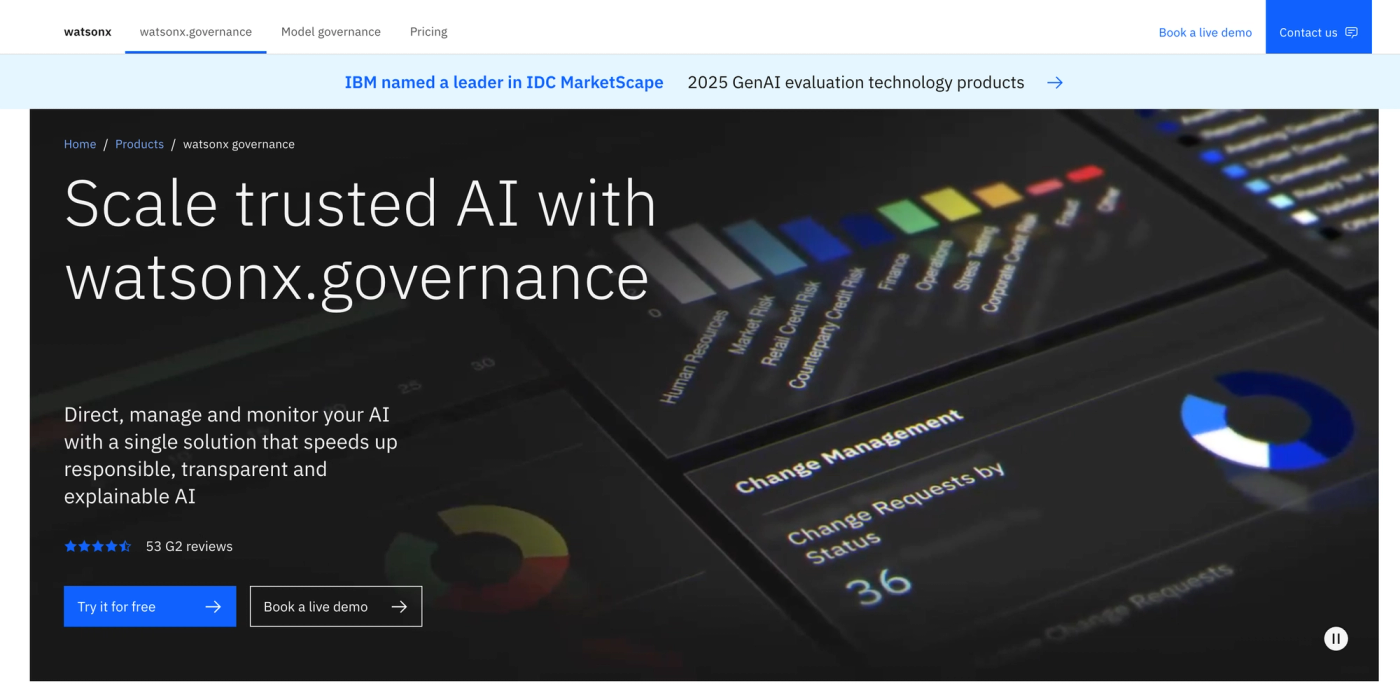
IBM watsonx.governance delivers policy-driven AI governance with genuine framework mapping to EU AI Act, NIST, and ISO standards, plus fairness and explainability checks built into its oversight dashboards. For large enterprises already standardized on IBM infrastructure, the native integration across the IBM watsonx suite and model-lineage tracking are real advantages that reduce setup friction and give compliance teams a consistent record of model provenance.
IBM watsonx.governance's coverage is bounded by the IBM ecosystem and stops short of active enforcement. No real-time guardrails block prompt injections or data exfiltration; monitoring within the IBM stack does not extend to multi-cloud or third-party LLM deployments. Compliance mapping setup is manual and services-heavy, and teams operating outside IBM infrastructure find coverage narrow.
The bottom line is that IBM watsonx.governance suits large enterprises already committed to IBM infrastructure that need policy-driven governance and compliance documentation. Teams requiring real-time security guardrails, automated compliance mapping, or multi-vendor AI system support need additional solutions beyond what IBM watsonx.governance provides natively.
LangSmith
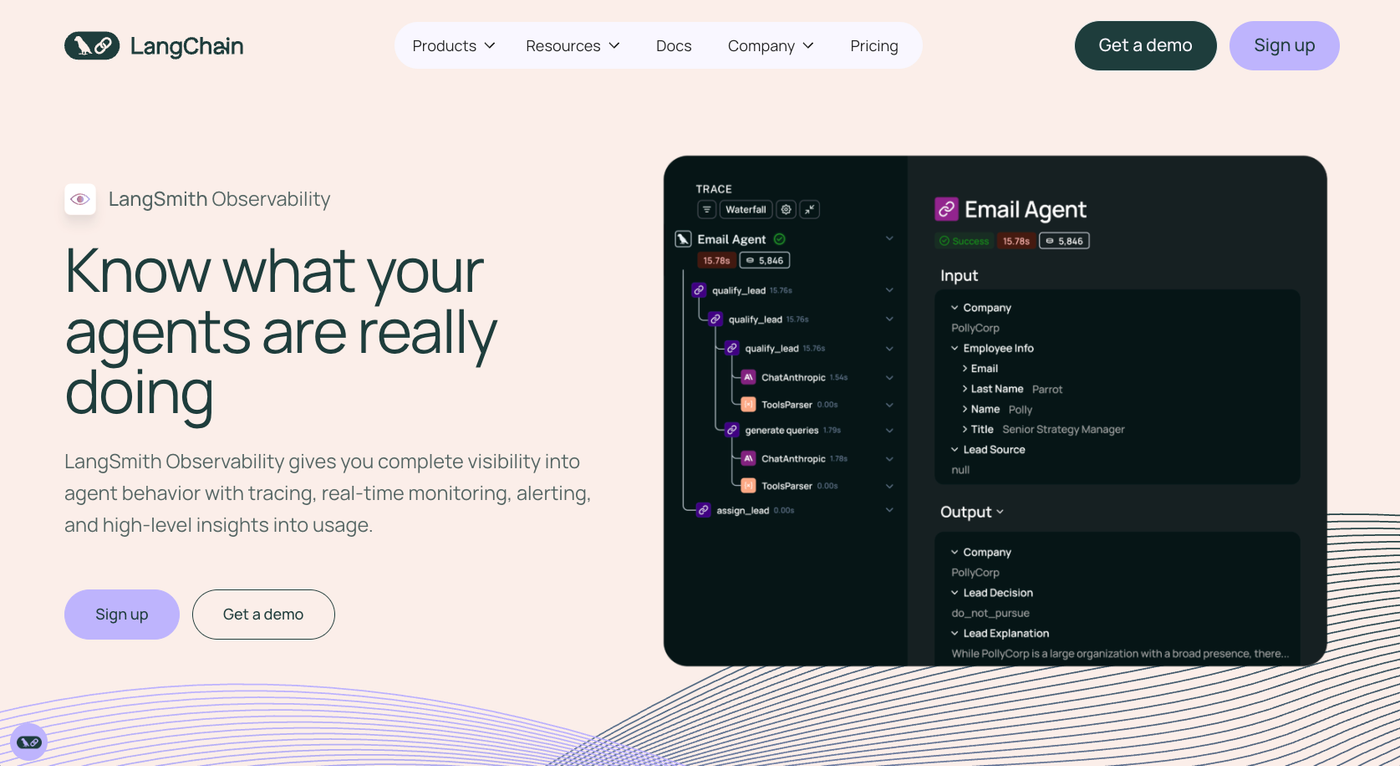
LangSmith is a developer-focused observability and debugging tool built tightly into the LangChain ecosystem. It provides detailed trace logging for LangChain agent workflows, prompt-level evaluation and comparison testing, and granular monitoring of latency and token usage. For teams actively building and debugging LangChain-based agents, that depth of visibility during development is a genuine strength.
LangSmith's architecture is scoped to observability within LangChain, and it does not govern what agents do. The platform carries no risk scoring, no policy enforcement, no compliance framework alignment, and no real-time guardrails for blocking unsafe outputs. It observes but does not enforce, and its coverage boundary is the LangChain ecosystem. Teams deploying agents in regulated environments or handling sensitive data need separate tooling to supply the controls LangSmith does not provide.
The bottom line is that LangSmith excels at providing detailed observability and debugging for LangChain-based agent development. Production deployments require separate solutions for security guardrails, compliance automation, and complete governance that LangSmith does not provide.
MLflow
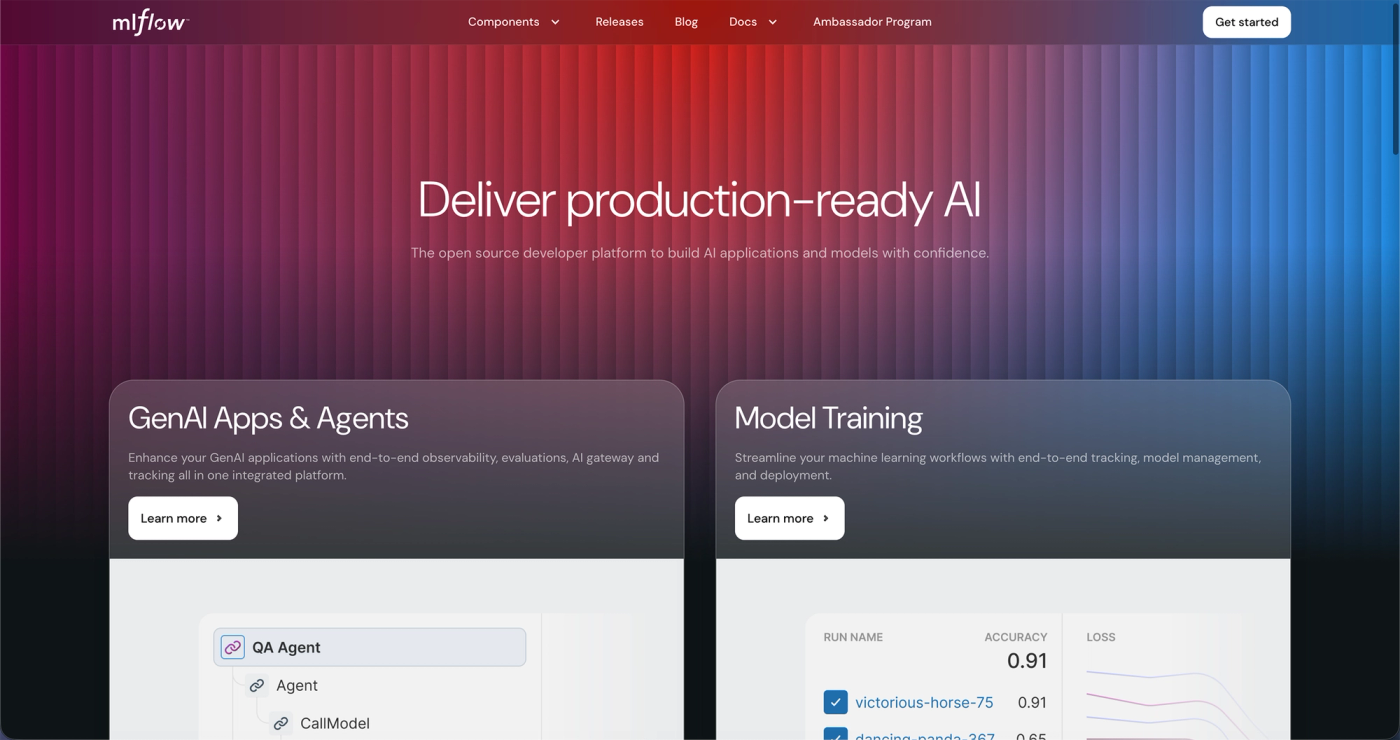
MLflow handles traditional ML experiment tracking well. Parameters, metrics, and artifacts across runs are tracked reliably, the model registry with lineage tracking through Unity Catalog is mature, and integrations with major ML frameworks and cloud providers are broad. For data science teams managing classical ML lifecycles, this coverage is solid.
MLflow's design predates the agentic AI problem space. It tracks experiments but does not govern agent behavior. There is no GenAI testing for agentic systems, no real-time security guardrails against prompt attacks, no production anomaly detection, and no compliance framework mapping. Teams deploying agents or LLM-based systems are working outside what MLflow was built to cover.
The bottom line is that MLflow handles traditional ML workflows well but lacks the agent evaluation and security capabilities needed for agentic AI systems. Teams deploying agents or LLM-based systems need separate solutions for behavioral testing, security guardrails, and compliance automation.
Deepchecks
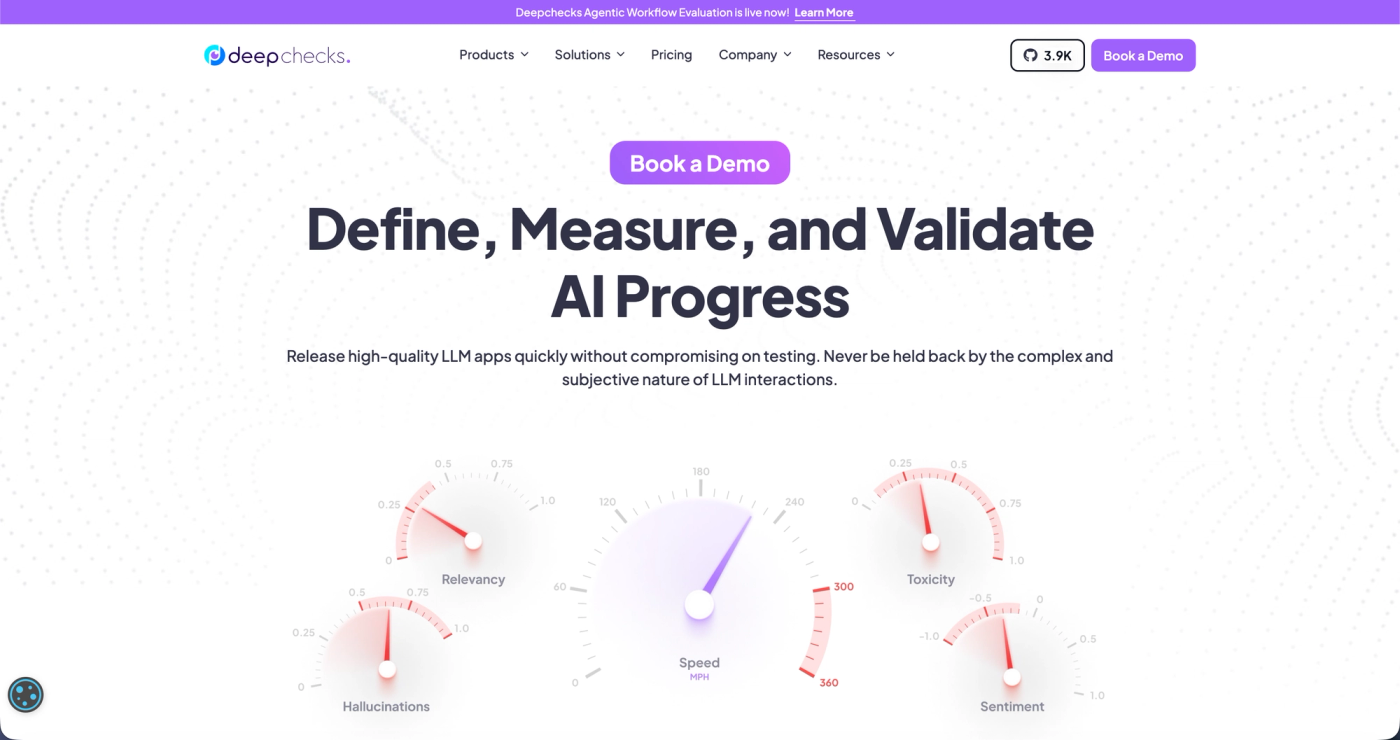
Deepchecks provides structured pre-deployment validation with data quality checks, distribution monitoring, and LLM evaluation metrics. For teams that need a systematic gating process before launch, the structured test suite approach catches agent failure modes before any user is exposed. The tool works well when the goal is a repeatable, methodical validation workflow that surfaces data and model quality problems during development rather than after deployment.
Deepchecks stops at pre-deployment validation. It identifies issues before launch but provides no active enforcement once models are running. There is no real-time security protection against prompt injections, no compliance framework mapping or audit trails, and no system-level anomaly detection in production. The platform observes the pre-deployment state but does not govern the runtime environment, leaving teams to build separate controls for security, regulatory alignment, and continuous monitoring.
The bottom line is that Deepchecks validates models before launch but teams need separate solutions for runtime security, regulatory compliance, and continuous governance in production. Organizations focused on thorough pre-deployment validation benefit from the structured testing approach, but regulated deployments require additional platforms for real-time guardrails and compliance automation.
Feature comparison table of AI agent frameworks for production teams
The table below compares popular AI agent frameworks and testing tools by their production readiness. Frameworks like LangGraph, CrewAI, AutoGen, and PydanticAI cover agent building and leave testing, security, and governance capabilities out of scope. Tools like Openlayer, Galileo, and Deepchecks provide LLM evaluation platforms for assessing agent behavior in production. IBM watsonx.governance and LangSmith offer monitoring features but serve different use cases.
| Framework/Tool | Primary Focus | Automated Behavioral Testing | Real-Time Security Guardrails | Compliance Mapping | Production Observability | Best For |
|---|---|---|---|---|---|---|
| Openlayer | Production governance and security for AI agents | Over 175 pre-built tests for hallucinations, bias, toxicity, PII leakage in CI/CD and production | Blocks prompt injections and data exfiltration attempts before reaching systems | Automated mapping to EU AI Act, NIST RMF, ISO 42001 with audit trails | Anomaly detection, drift alerts, continuous monitoring across all workflows | Regulated industries requiring governance, security, and compliance for production agents |
| LangGraph | Graph-based agent orchestration with stateful control flow | None | None | None | Basic tracing through LangSmith integration | Engineering teams building custom multi-step agents with explicit state management |
| CrewAI | Multi-agent collaboration with role-based specialization | None | None | None | None | Teams building collaborative multi-agent systems with task delegation |
| AutoGen | Conversational multi-agent frameworks with flexible interaction patterns | None | None | None | None | Research teams prototyping conversational multi-agent systems |
| PydanticAI | Type-safe Python agent development with model-agnostic support | None | None | None | None | Python teams focusing on type safety for straightforward agent applications |
| Galileo | Agent evaluation and observability with workflow metrics | Luna-2 models for agentic evaluations at system and step levels | None | None | Tracing for tool calls, planning assessment, and decision-making visibility | Teams needing deep visibility into agent workflows and performance optimization |
| IBM watsonx.governance | Policy-driven governance within IBM ecosystem | Fairness and explainability checks with manual setup | None | Framework mapping for EU AI Act, NIST, ISO standards (service-heavy setup) | Policy-based oversight dashboards for IBM systems | Large enterprises standardized on IBM infrastructure requiring integrated governance |
| LangSmith | Developer observability and debugging for LangChain applications | Prompt-level evaluation and comparison testing | None | None | Detailed trace logging, latency and token usage monitoring for LangChain | Development teams building and debugging LangChain-based agents |
| MLflow | ML experiment tracking and model registry for traditional ML | None for agents | None | None | Experiment tracking for parameters and metrics, model versioning | Engineering teams managing classical ML experiments and model lifecycles |
| Deepchecks | Pre-deployment validation and testing for ML and LLM applications | Structured test suites for pre-deployment validation, data quality checks | None | None | Basic production monitoring for deployed models | Teams requiring thorough pre-deployment validation with minimal governance overhead |
Why Openlayer is the best AI agent framework for production teams
Agent frameworks get teams to production. Openlayer keeps them there.
Building agents with LangGraph, CrewAI, or AutoGen is one thing. Running them safely in regulated environments is another. Openlayer fills the gap those frameworks leave: automated testing that catches failures before deployment, real-time guardrails that block attacks, and compliance mapping that satisfies regulators.
The result is audit trails, anomaly detection, and security controls that production teams need to deploy agents with accountability.
Final thoughts on comparing AI agent frameworks
The right framework depends on the build target and deployment context. Teams that need open-source AI agent frameworks for prototyping will find LangGraph and CrewAI capable options. But production deployments require behavioral testing, security guardrails, and compliance mapping that these frameworks do not provide. Production agents require continuous validation and anomaly detection to surface regressions before customers encounter them. Get in touch for help moving agents from development to production safely.
FAQ
How do I choose the best AI agent framework for my production needs?
Start by separating orchestration from governance. Frameworks like LangGraph and CrewAI handle agent building, while Openlayer, Galileo, and Deepchecks handle evaluation and security. If you're in a regulated industry or need compliance mapping, focus on tools with automated testing, real-time guardrails, and audit trails, capabilities most agent frameworks don't provide.
Which framework works best for teams new to building AI agents?
PydanticAI offers the easiest entry point for Python teams due to its type safety and familiar developer experience. CrewAI provides a visual builder for rapid prototyping. However, neither includes production monitoring or security controls, so plan to add evaluation tooling before deploying to production environments.
Can I use multiple frameworks together in a production system?
Yes, and most production teams do. You'll typically combine an orchestration framework (LangGraph, AutoGen) with an evaluation and governance layer (Openlayer). Multi-framework support matters here. Openlayer works across different agent frameworks, while tools like LangSmith only integrate with LangChain-based systems.
What's the difference between agent orchestration and agent governance?
Orchestration frameworks (LangGraph, CrewAI, AutoGen) define how agents execute tasks, manage state, and coordinate workflows. Governance tools (Openlayer, IBM watsonx.governance) validate agent behavior, enforce security policies, and maintain compliance. Both are required: orchestration gets agents running; governance keeps them safe and auditable in production.
When should I add security guardrails to my agent system?
Before you process any sensitive data or production traffic. Real-time guardrails that block prompt injections and PII leakage should run from day one in production environments, not added retroactively after an incident. Frameworks like LangGraph and AutoGen don't include these protections, requiring separate security tooling.