
Put AI to work across healthcare,
with confidence in every outcome.
Openlayer helps healthcare and life-sciences teams evaluate, monitor, and govern AI systems with safety testing, PHI guardrails, and automated compliance, from prototype to production.
See what it can do


81%
of physicians use AI in their professional work
Source: American Medical Association, 2026
84%
of health insurers use AI or machine learning
Source: National Association of Insurance Commissioners, 2025
48%
of health systems are not operationally ready to implement AI
Source: Guidehouse and HIMSS, 2026
Healthcare AI is scaling faster than the safeguards around it.
AI is already processing claims, supporting authorization, improving coding, assisting clinicians, and powering patient and provider operations.
But most healthcare organizations lack one consistent way to test accuracy, enforce policy, protect sensitive data, and monitor how every AI system behaves in production.
Accuracy varies across workflows and populations.
AI can perform well in testing but produce inaccurate or inconsistent results across claims, conditions, patient populations, and real-world use cases.
PII and PHI can surface in model inputs and outputs.
Sensitive information can pass through prompts, retrieval data, tool calls, and responses without consistent controls to detect or block exposure.
Safeguards do not follow AI into production.
Teams lack continuous visibility into how live systems behave, whether policies are being enforced, and when accuracy, safety, or compliance begins to drift.
Scaling healthcare AI requires a higher standard of trust.
HIPAA governs how sensitive health information is protected. HTI-1 introduces transparency and risk-management requirements for certain predictive decision-support systems. FDA oversight, the EU AI Act, and emerging state laws add further obligations for AI used in regulated healthcare environments.
Healthcare organizations now need continuous evidence that every AI system remains accurate, safe, compliant, and protected as models, data, and workflows change.
Safety, accuracy, and compliance
in one platform
Openlayer applies the same standards from evaluation through production, with PII and PHI protection, live policy enforcement, and evidence generated automatically.
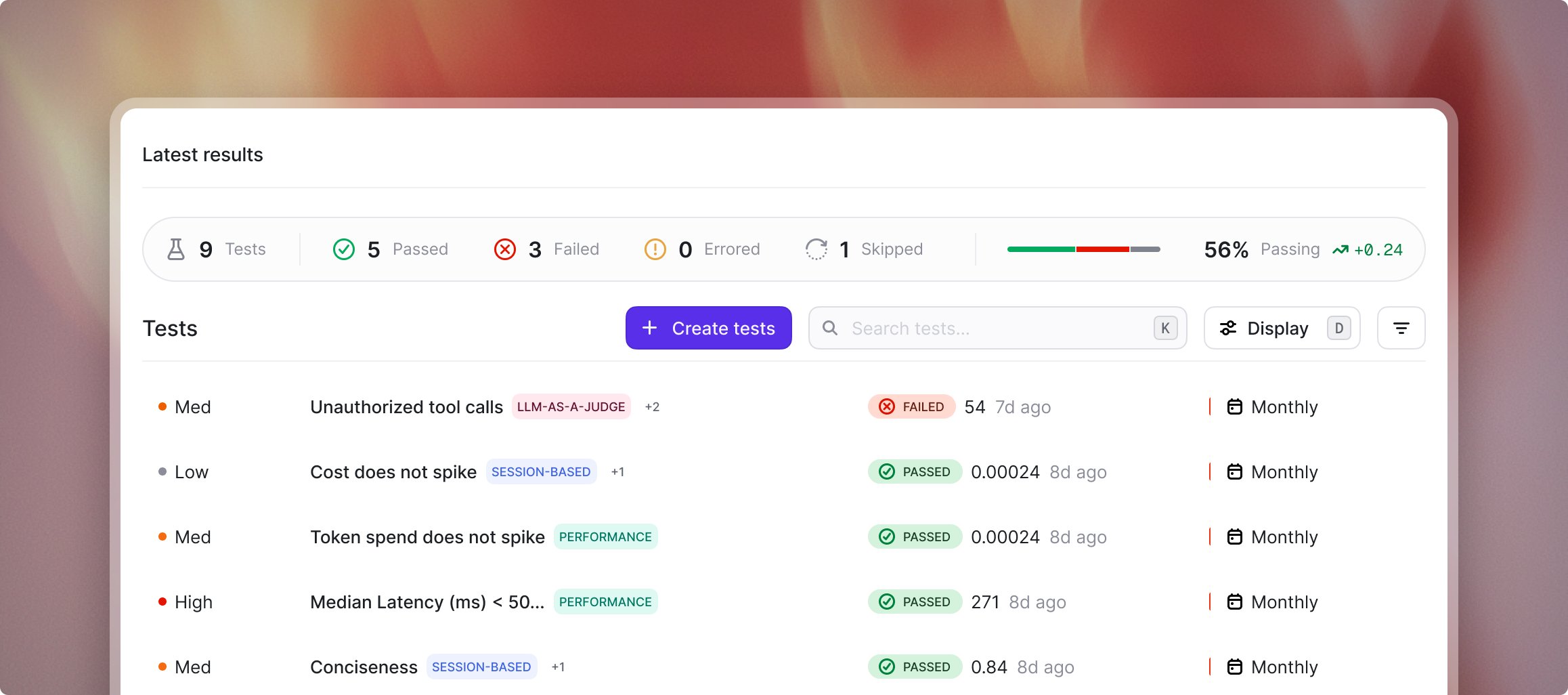
Claims processing
Test extraction, classification, and routing accuracy. Monitor exceptions, sensitive-data exposure, and cost in production.
Prior authorization
Evaluate document extraction and workflow consistency across diagnoses, plans, and authorization types.
Medical coding and denials
Test suggested codes against source documentation and monitor denial classification, appeals, and resolution.
Patient operations
Monitor patient chat, scheduling, intake, navigation, and support agents for accuracy, appropriate escalation, task completion, and PII or PHI exposure.
Provider operations
Evaluate AI used in credentialing, provider data management, network operations, documentation, and clinician support.
Clinical AI
Test documentation assistants, clinical copilots, and decision-support systems for accuracy, safety, and performance across patient populations.
“Openlayer gives us a consistent way to evaluate and monitor AI across healthcare workflows. We can move faster while maintaining the accuracy, privacy, and oversight our industry requires.”
Healthcare Leader

Named in the 2026 Gartner Market Guide for AI Evaluation and Observability Platforms.

Backed by Y Combinator and Race Capital. SOC 2 Type II and GDPR compliant.

Air-gapped and private-VPC deployment for sensitive financial data.
Regular third-party penetration testing, daily code review, static analysis, and dependency scanning.
Openlayer governs AI across clinical, operational, and administrative use cases, including claims processing, prior authorization, medical coding, patient facing chat and scheduling, and clinical documentation assistants.
Openlayer includes guardrails built to detect and block sensitive health information from leaking through prompts, retrieval systems, or model outputs.
Openlayer supports governance aligned with HIPAA expectations, the NIST AI Risk Management Framework, and ISO 42001, and the company holds SOC 2 Type II certification and is GDPR compliant.
Openlayer continuously monitors production AI systems for accuracy, safety, and policy compliance, which matters because a model can perform well in testing and still behave inconsistently across different real-world patient populations.
Openlayer supports large language models, retrieval augmented generation, AI assistants, predictive models, and other operational AI, from a claims routing model to a patient-facing chatbot.
It combines pre-release testing, production observability, governance workflows, compliance mappings, and real-time guardrails, so risk is addressed at every stage, not only at launch.
Openlayer integrates with existing infrastructure and compliance programs, adding the AI-specific testing, monitoring, and evidence layer that general purpose tools were not built to provide.
Openlayer is built for enterprise scale, with a unified inventory that keeps AI systems accounted for as an organization adds facilities and business lines.
Healthcare AI touches patient safety and highly sensitive data. According to the American Medical Association, a large majority of physicians already use AI in their professional work, and research from Guidehouse and HIMSS has found that many health systems are not yet operationally ready to manage AI at scale, which makes ongoing oversight more important than a one-time review.
They get lifecycle AI governance, testing, and observability from one platform rather than separate tools for evaluation, monitoring, PHI protection, and compliance evidence.

Advance healthcare AI with confidence.
Keep every system accurate, protected, and compliant from development through production.