
Build the intelligence behind
every journey.
Evaluate, monitor, and govern AI across automotive and transportation operations, with performance, safety, and compliance continuously measured.
See it in action


70%
of transportation and logistics companies have adopted AI
Source: Penske Transportation Leaders Survey, 2025
95%
of automakers are making significant investments in AI
Source: Gartner research reported by Reuters, 2025
23%
of automotive software professionals report repeated exposure to code vulnerabilities
Source: Perforce State of Automotive Software Development, 2026
AI is making operational decisions faster than teams can verify them.
AI now influences routing, maintenance, production quality, inventory, warranty decisions, and customer operations.
But performance can change as data, models, suppliers, and operating conditions evolve. Most companies lack one consistent way to test these systems, monitor them in production, and trace every outcome to the model and version behind it.
Operational performance changes over time.
Forecasting, routing, maintenance, and quality models can lose accuracy as demand, assets, suppliers, and production conditions change.
AI is fragmented across teams and suppliers.
Internal models, embedded vendor AI, and third-party tools operate without one inventory, evaluation standard, or approval process.
Failures are difficult to trace and correct.
When AI contributes to a delay, defect, unnecessary repair, or customer issue, teams struggle to identify the model, version, data, and decision behind it.
Transportation companies are putting AI at the center of operations.
AI is routing fleets, forecasting demand, scheduling maintenance, and managing critical workflows. When it fails, errors can spread across an entire operation.
ISO 26262, UNECE and NHTSA expectations, NIST AI RMF, and the EU AI Act are raising the standard for documented, ongoing evidence of AI behavior. EU AI Act penalties can reach 7% of global revenue.
Continuous assurance for the AI
running your operations
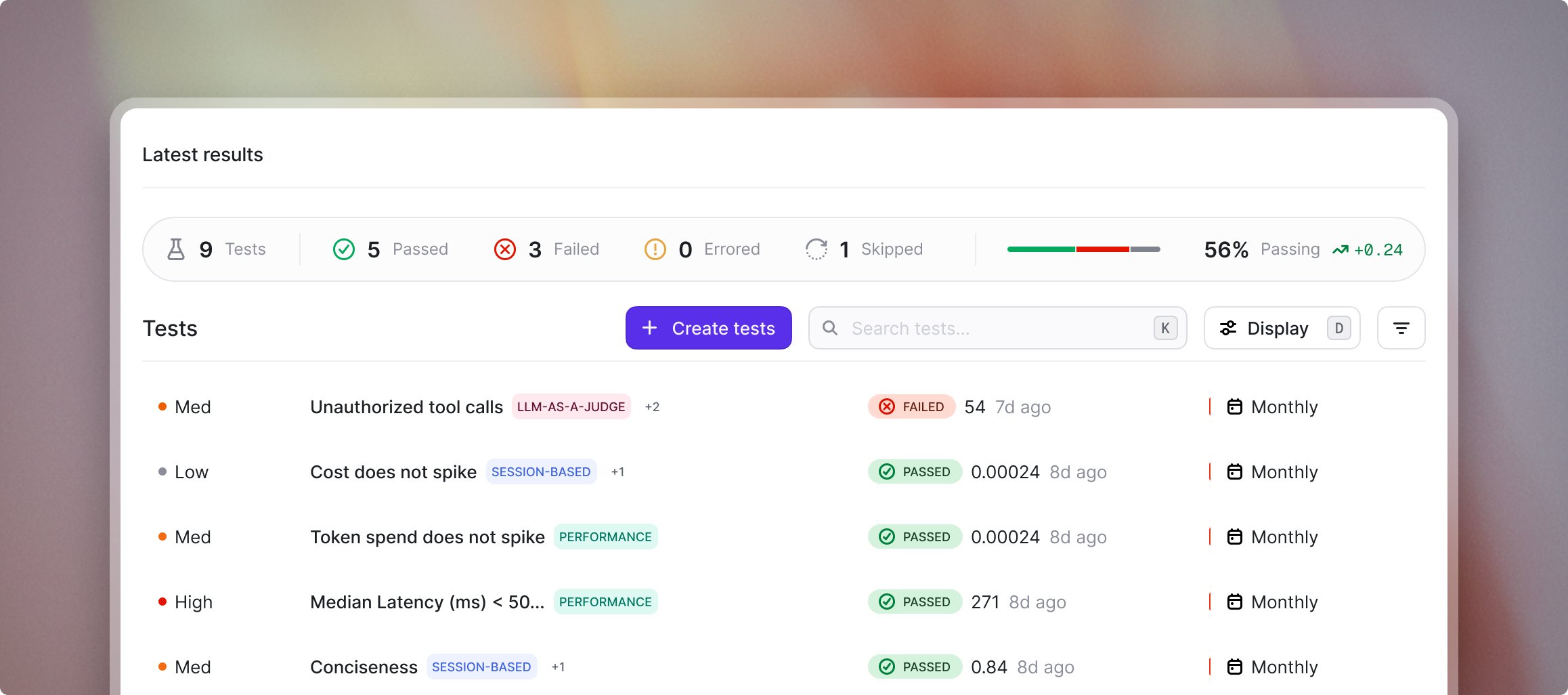
Openlayer connects evaluation, production monitoring, governance, and evidence across every model and version. Catch regressions before release, detect changing performance in production, and prove each system remains accurate, reliable, and within policy.
Fleet and route optimization
Evaluate routing, dispatch, load planning, and fuel optimization across fleets, regions, and changing demand.
Predictive maintenance
Test failure predictions and maintenance recommendations against real asset performance and service outcomes.
Manufacturing and quality
Monitor computer vision, robotics, and production AI for detection accuracy, defects, failures, and performance drift.
Supply chain forecasting
Track demand, inventory, sourcing, and planning models as suppliers, markets, and production requirements change.
Customer operations
Test diagnostics, service assistants, warranty tools, and customer communications for accuracy, privacy, and successful resolution.
Supplier and third-party AI
Track every internal and vendor model with its owner, approved use, risk, evaluations, version, and production evidence.

Named in the 2026 Gartner Market Guide for AI Evaluation and Observability Platforms.

Backed by Y Combinator and Race Capital. SOC 2 Type II and GDPR compliant.

Vendor registry and third-party AI tracking for complex supply chains.

Air-gapped and private-VPC deployment for sensitive financial data.
Openlayer governs AI used in fleet and route optimization, predictive maintenance, manufacturing quality inspection, supply chain forecasting, and customer service and warranty tools, covering both internally built models and vendor supplied AI.
Continuous production monitoring can flag drift as demand patterns, asset conditions, or production environments evolve, rather than assuming a model performing well at launch will keep performing well indefinitely.
Openlayer maintains a vendor registry that tracks third-party AI tools alongside internally built models, which matters because embedded vendor AI and internal models often lack a shared evaluation standard.
Because Openlayer keeps a version and evaluation history, teams can trace an operational failure back to the specific model version and dataset involved.
Openlayer evaluates and monitors computer vision and robotics-based quality monitoring systems the same way it does language models, tracking accuracy and drift over time on the production floor.
Openlayer's compliance support extends to frameworks including ISO 26262, the NIST AI Risk Management Framework, and the EU AI Act.
Openlayer supports air-gapped deployment options for organizations with strict data residency, security, or operational technology requirements.
Pre-release regression testing compares a new model version against an approved baseline, built to catch a quality drop before it reaches a vehicle, a production line, or a customer-facing tool.
Industry surveys show most transportation and logistics companies have already adopted AI, and a large majority of automakers report making significant AI investments, often ahead of having a mature governance program in place.
They get continuous evaluation, governance, and vendor oversight in one platform, helping AI systems stay accurate, reliable, and compliant as they scale across fleets, factories, and customer touchpoints.

Keep every operation moving forward.
Keep performance, reliability, and compliance measurable across every fleet, facility, workflow, and AI system.