LangSmith Pricing & Alternatives: September 2026 Guide (Updated)
LangSmith helps you trace LLM calls and debug prompt chains, which is useful during development. But once your AI systems hit production, you'll face questions about blocking unsafe outputs, monitoring for drift, and mapping to compliance frameworks. If you're researching unified evaluation, observability, and governance platforms and wondering what LangSmith actually covers, this guide walks through its capabilities, pricing tiers, and alternatives that add the security and governance layers production systems need.
TLDR:
- LangSmith provides tracing and evaluation for LangChain apps but lacks pre-built tests, drift detection, and runtime guardrails
- Self-hosting requires Enterprise pricing, blocking teams with data residency needs from lower tiers
- Alternatives like Langfuse offer open source flexibility while Braintrust adds CI/CD evaluation gates
- Openlayer, a unified evaluation, observability, and governance platform, delivers 100+ automated tests, real-time security guardrails, and compliance mapping to EU AI Act and NIST RMF for regulated enterprises
AI observability market growth
The global observability market reached $5.1 billion in 2021 and projects to $20.5 billion by 2028. AI complexity is accelerating demand faster than traditional infrastructure monitoring ever did. But the gap between recognizing observability's importance and achieving it is stark. 90% of IT professionals consider observability important to their business, yet only 26% rate their practice as mature. Organizations with advanced observability deployments reduce downtime costs by 90%, dropping from $23.8M to $2.5M annually.
Organizations deploying AI at scale find that basic logging falls short. Multi-step agent workflows, RAG pipelines, and third-party API dependencies create challenges that simple trace collection can't solve. ML observability becomes necessary to track model behavior across production systems. The EU AI Act is already creating hard deadlines: GPAI provider obligations (including technical documentation, adversarial testing, and incident reporting to the European AI Office) are enforceable now, effective August 2025. High-risk system obligations, covering use cases like credit scoring, fraud detection, and insurance pricing, carry an August 2026 deadline. NIST AI RMF adds a parallel governance layer. Together, these frameworks mandate continuous monitoring, risk scoring, and audit trails across the full AI lifecycle.
What is LangSmith and how does it work?
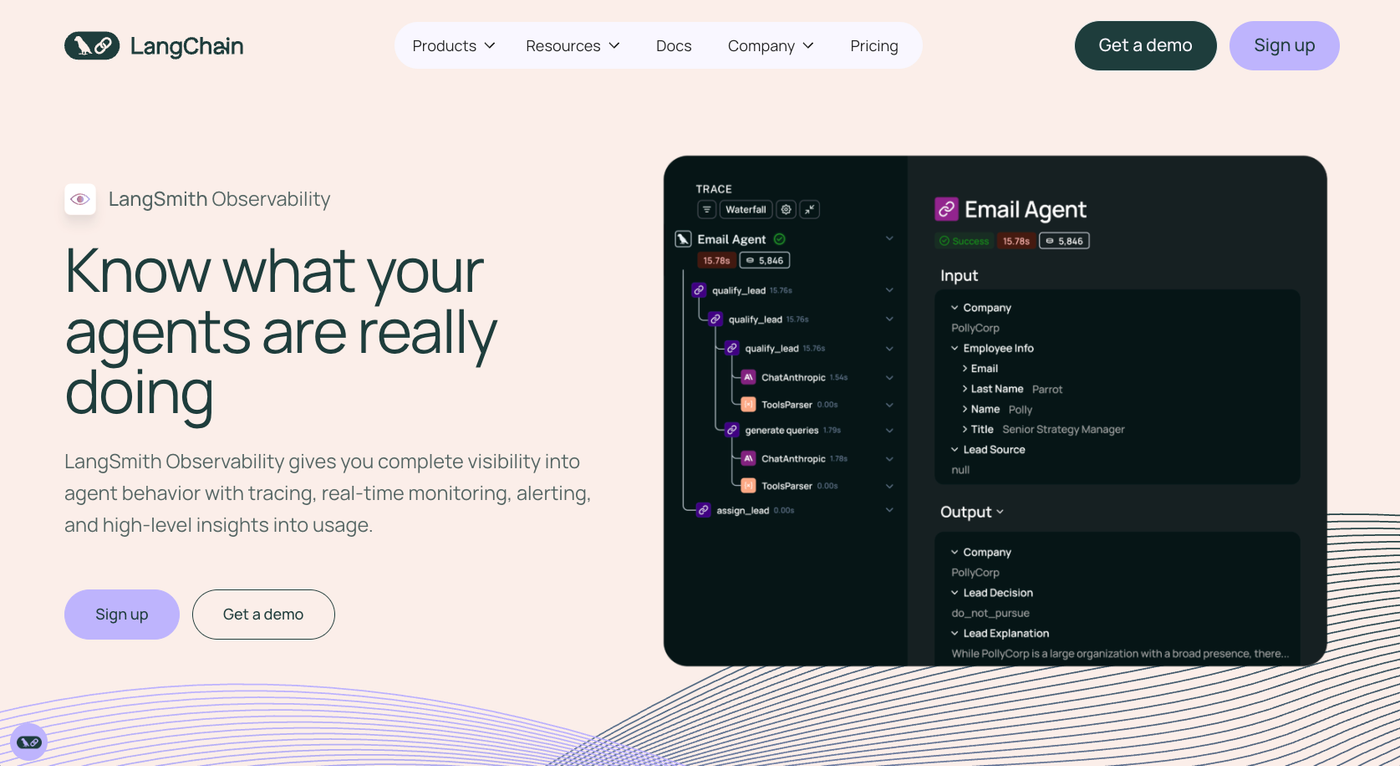
LangSmith is a developer tool for debugging, testing, and monitoring AI applications built with LangChain. It captures detailed traces of LLM calls, chain executions, and retrieval steps, letting you inspect inputs, outputs, and latency across each component. The tool provides datasets for offline testing, an evaluation framework for comparing prompts or model versions, and production dashboards to track live application performance. Engineers use it to iterate on prompt chains, catch regressions, and monitor deployed systems.
LangSmith is developer-centric and optimized for LangChain ecosystems. Recent OpenTelemetry support extends compatibility to other frameworks, though core workflows remain tightly integrated with LangChain's abstractions and agent structures.
When LangSmith makes sense for your team
LangSmith serves teams building LLM applications on LangChain who need trace-level debugging for prompt iteration and chain optimization. Engineers comfortable writing custom evaluation logic without pre-built test suites will find the evaluation primitives flexible enough. Single-team projects focused on developer workflows work well when compliance and governance are handled separately. Teams that don't require drift detection, real-time security enforcement, or regulatory framework mapping can rely on the tracing and dataset capabilities.
The transition point arrives when AI systems move from experimentation to production at scale. Risk stakeholders, compliance teams, and security officers introduce requirements around multi-framework governance, automated behavioral testing, runtime guardrails, and audit-ready compliance reporting. Organizations managing multiple AI projects across departments, third-party integrations, or operating in regulated industries typically outgrow trace-only workflows and need AI governance and compliance capabilities.
LangSmith integration and setup considerations
LangSmith integrates with LangChain applications through built-in callbacks. Add the SDK, configure environment variables for your API key and project name, and traces begin capturing automatically across chains, agents, and retrieval steps. Alternatively, non-LangChain applications connect through OpenTelemetry instrumentation. This extends compatibility to custom frameworks and third-party services but requires manual span creation and context propagation for complete trace visibility.
Setup covers three workflows:
- trace instrumentation for debugging,
- dataset creation for evaluation runs, and
- dashboard configuration for production monitoring.
Keep in mind that datasets require manually curated examples with inputs, expected outputs, and custom scorers written as functions or LLM-as-judge prompts. And teams should budget engineering time for defining evaluation logic. LangSmith provides the framework but no pre-configured test suites for adversarial attacks, safety checks, or behavioral validation. You build and maintain your own metrics, datasets, and scoring functions. Finally, self-hosting requires an Enterprise contract. Developer and Plus tiers run on LangSmith's infrastructure only, which may conflict with data residency policies or compliance requirements.
Why consider LangSmith alternatives?
LangSmith has no statistical drift detection: it cannot identify when output distributions shift, when model behavior degrades over time, or when a production system has drifted from its tested baseline. It does not monitor bias or enforce runtime guardrails that stop harmful outputs before they reach production. There's no built-in compliance mapping to AI governance frameworks like EU AI Act, NIST RMF, or ISO 42001. Teams managing multi-framework compliance, real-time security enforcement, or enterprise risk workflows often need more than tracing tools. When governance, automated testing, and production safeguards become requirements, alternatives that combine observability with security and regulatory controls become relevant.
Key features to assess in AI observability tools
We assessed LLM observability tools as alternatives to LangSmith along the following criteria:
- Automated testing. This includes pre-built tests that validate hallucinations, bias, toxicity, adversarial robustness, and PII exposure without manual dataset creation. Look for tests that run continuously across development and production with CI/CD integration.
- Real-time security. This feature blocks prompt injections, jailbreaks, and data exfiltration before reaching downstream systems. Passive detection shows what happened. Active guardrails prevent it.
- Monitoring. This tracks output quality, latency, anomalies, and regressions across agents, RAG pipelines, and multi-step workflows with configurable alerts tied to risk thresholds.
- Cross-system governance. This provides unified visibility across internally built models, third-party AI embedded in SaaS products, and agentic systems. Centralized risk scoring and approval workflows matter when managing hundreds of AI components.
- Compliance automation. Maps projects to EU AI Act, NIST RMF, ISO 42001, and OWASP automatically, capturing evidence and generating audit-ready reports.
Best overall LangSmith alternative: Openlayer
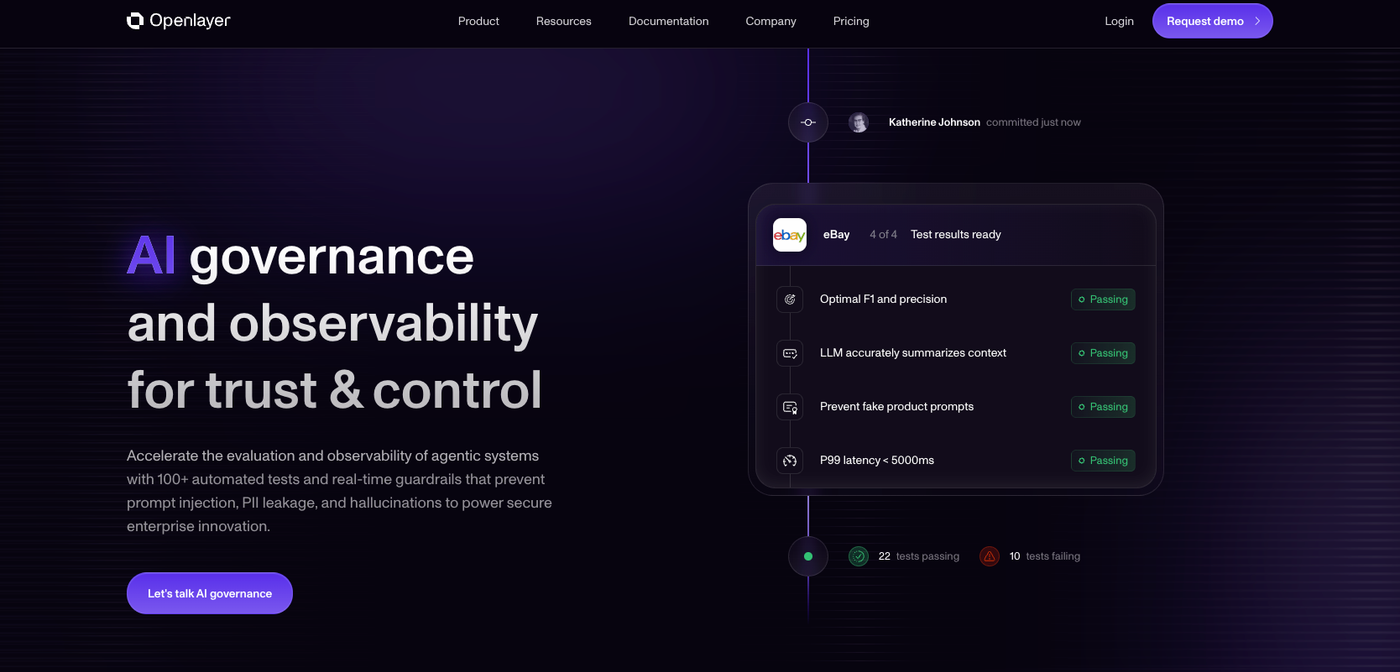
Openlayer is a unified evaluation, observability, and governance platform with automated behavioral tests, real-time security guardrails, continuous monitoring, and compliance mapping across ML, LLM, and agentic systems.
Key strengths
Openlayer has a number of key strengths when considering it an alternative to LangSmith:
- 100+ automated tests for hallucinations, bias, toxicity, PII leakage, prompt injection, drift, and robustness across text, vision, tabular, audio, and agents with CI/CD integration
- 13 session-level metrics for multi-turn and agentic systems, measuring goal completion, context retention, and reasoning coherence across the full interaction sequence rather than individual steps alone, a capability LangSmith's trace-level tooling does not provide
- Component-level evaluation that isolates and tests individual reasoning components (retrieval accuracy, tool selection precision, reasoning quality) separately from end-to-end flows, supporting precise fault isolation in RAG pipelines and multi-step agent workflows where a failing end-to-end trace may not reveal which component is responsible
- CI/CD deployment gates via GitHub integration that block merges and deployments when evaluation thresholds fail, a control LangSmith does not provide
- Real-time guardrails that block prompt injections, data exfiltration, and PII/IP leakage before reaching downstream systems
- Continuous monitoring of outputs, latency, regressions, and anomalies with risk scoring and policy-based alerts
- Native integrations with enterprise conversational AI platforms including Salesforce Agentforce, Microsoft Copilot Studio, and Google Dialogflow, providing unified cross-system governance across multi-vendor AI portfolios without custom instrumentation
- Automated compliance mapping to EU AI Act, NIST RMF, ISO 42001, OWASP, TRAIGA with audit-ready dashboards and continuous evidence capture
Bottom line
Openlayer is best suited for regulated enterprises in financial services, healthcare, telecom, and insurance deploying AI systems that require unified governance across internal and third-party AI with security, risk management, and regulatory compliance.
Credo AI
Credo AI is a responsible AI governance and compliance platform built around policy-driven workflows, structured evidence collection, and automated audit artifact generation.
Key strengths
Credo AI has a number of key strengths when considering it an alternative to LangSmith:
- Policy Packs that translate EU AI Act, NIST AI RMF, ISO 42001, Colorado SB21-169, and NYC Local Law 144 into structured governance workflows and audit checklists
- AI Registry providing a central inventory of AI systems, use cases, and associated risk assessments across the organization
- Policy Intelligence engine that auto-suggests risks and mitigating controls per use case and routes evidence collection to the right stakeholders
- Automated generation of model cards, bias and fairness reports, and compliance summaries from collected evidence, covering documentation requirements most LLM tracing tools leave entirely manual
Bottom line
Credo AI covers AI governance at the policy and documentation layer: it coordinates who must do what, by when, and with what evidence. What it does not do is touch the model pipeline. There is no pre-built behavioral test library, no real-time monitoring of live outputs, and no runtime enforcement; policies are documented but not enforced at the API boundary. Teams in regulated industries using Credo for compliance workflows commonly adopt a second tool to handle technical testing and production guardrails; Credo AI and an enforcement-capable platform are often deployed together and not as a direct substitution. Best suited for compliance and legal teams that need policy-driven governance workflows and audit-ready documentation, particularly where EU AI Act and NIST AI RMF readiness is the primary mandate.
IBM watsonx.governance
IBM watsonx.governance is an AI and data governance platform offering fairness monitoring, model lifecycle tracking, and regulatory framework mapping within the IBM ecosystem.
Key strengths
IBM watsonx.governance has a number of key strengths when considering it an alternative to LangSmith:
- Fairness monitoring and bias detection with model lineage tracking tightly integrated across the IBM Watson, OpenScale, and watsonx model-serving stack
- Framework mapping to EU AI Act, NIST AI RMF, and ISO 42001 with structured risk assessments and governance dashboards for compliance teams
- Both AI governance and data governance coverage within the IBM ecosystem, a dual-layer capability that pure AI-governance tools do not match
- Proven enterprise footprint with mature tooling for organizations already standardized on IBM infrastructure
Bottom line
IBM watsonx.governance's coverage boundary is the IBM stack. Monitoring and enforcement couple to IBM's model-serving infrastructure, so multi-cloud deployments and third-party LLM integrations sit outside its coverage perimeter. Real-time blocking of prompt injection or PII leakage is not available, and setup is typically services-heavy, requiring substantial implementation effort before governance workflows are running. Agent governance controls are limited to the watsonx agent environment and do not span custom-built or third-party agentic systems. For organizations outside the IBM ecosystem, the portability constraint is structural, not a configuration gap. Adjacent governance tools like OneTrust and Collibra cover specific intake and data-lineage use cases respectively, but share the same limitation: none cross from observation and documentation into active runtime enforcement at the API boundary. Best suited for large enterprises already standardized on IBM infrastructure that need integrated AI and data governance within that ecosystem.
Langfuse
Langfuse is an open source tracing and evaluation tool for AI applications with flexible scoring and dataset-based testing.
Key strengths
Langfuse has a number of key strengths when considering it an alternative to LangSmith:
- Detailed tracing of AI calls with performance metrics dashboards
- Dataset creation and experiment runs for offline testing and A/B comparisons
- Human and AI-based feedback loops for output evaluation with prompt templating
- Self-hosting options with Apache 2.0 license for data control
Bottom line
Langfuse is a detect-and-inform tool: it surfaces what happened in a trace and records it for review. It does not block unsafe outputs before they reach downstream systems, enforce behavioral thresholds at inference time, or map to EU AI Act, NIST RMF, or ISO 42001. Teams must build all eval datasets, metrics, and scorers themselves; there is no pre-built behavioral test library, no drift detection, and no fairness monitoring. That logging capability is observation, not enforcement. Openlayer closes that gap with active runtime guardrails that block prompt injections and PII leakage before execution, and with automated compliance mapping that generates audit-ready evidence instead of leaving regulatory documentation to manual effort. Langfuse is a strong fit for teams that focus on open source flexibility and need self-hosted deployment with developer-driven evaluation, provided compliance and runtime protection are handled separately.
Braintrust
Braintrust is an evaluation and observability tool with datasets, scorers, and CI/CD-integrated evaluation gates.
Key strengths
Braintrust has a number of key strengths when considering it an alternative to LangSmith:
- Flexible evaluation framework with custom scorers and LLM-as-judge support
- Production logging with trace analysis and quality threshold alerts
- Regression detection and evaluation gates in CI/CD workflows
- Brainstore system for fast full-text trace analysis
Bottom line
Braintrust operates in detect-and-inform territory: it checks outputs and flags regressions in CI/CD pipelines, but it does not block unsafe behavior at inference time or map results to compliance frameworks. There is no pre-built test library; teams write all safety and quality scorers themselves. Its deployment gates stop a bad model from being promoted; they do not stop a live model from producing a harmful output mid-inference. That distinction matters for production risk. Openlayer goes further with active runtime guardrails that intercept prompt injections and data exfiltration before they reach downstream systems, and with automated compliance mapping to EU AI Act, NIST RMF, ISO 42001, and OWASP, converting evaluation results into audit-ready evidence instead of engineering-only signal. Braintrust is well suited for engineering teams that need flexible evaluation tooling with strong CI/CD integration and want to define quality gates for model releases.
Deepchecks
Deepchecks is a pre-deployment evaluation tool with structured test suites for ML and AI along with basic ML monitoring.
Key Strengths
Deepchecks has a number of key strengths when considering it an alternative to LangSmith:
- Structured pre-deployment test suites for AI and traditional ML validation
- AI evaluation checks alongside traditional ML monitoring capabilities
- Data quality validation for identifying issues before deployment
- Framework for offline validation as primary risk control
Bottom line
Deepchecks is a pre-deployment validation tool: its structured test suites run point-in-time checks before a model ships, but the coverage stops at the deployment boundary. Once a model is live, there is no production-grade anomaly detection, no real-time blocking of prompt attacks or data exfiltration, and no alignment to regulatory frameworks like EU AI Act, NIST RMF, or ISO 42001. Pre-deployment testing is observation before the fact; it cannot prevent a model from producing harmful outputs in production or generate the continuous audit evidence regulators require. Openlayer's active runtime guardrails and automated compliance mapping cover exactly that gap, intercepting unsafe outputs at inference time and continuously capturing evidence against EU AI Act, NIST RMF, ISO 42001, and OWASP instead of leaving compliance documentation to a manual, post-hoc effort. Deepchecks is a good fit for teams focused on pre-deployment validation who need structured testing before model release, where runtime protection and compliance reporting are handled by a separate layer.
Credo AI
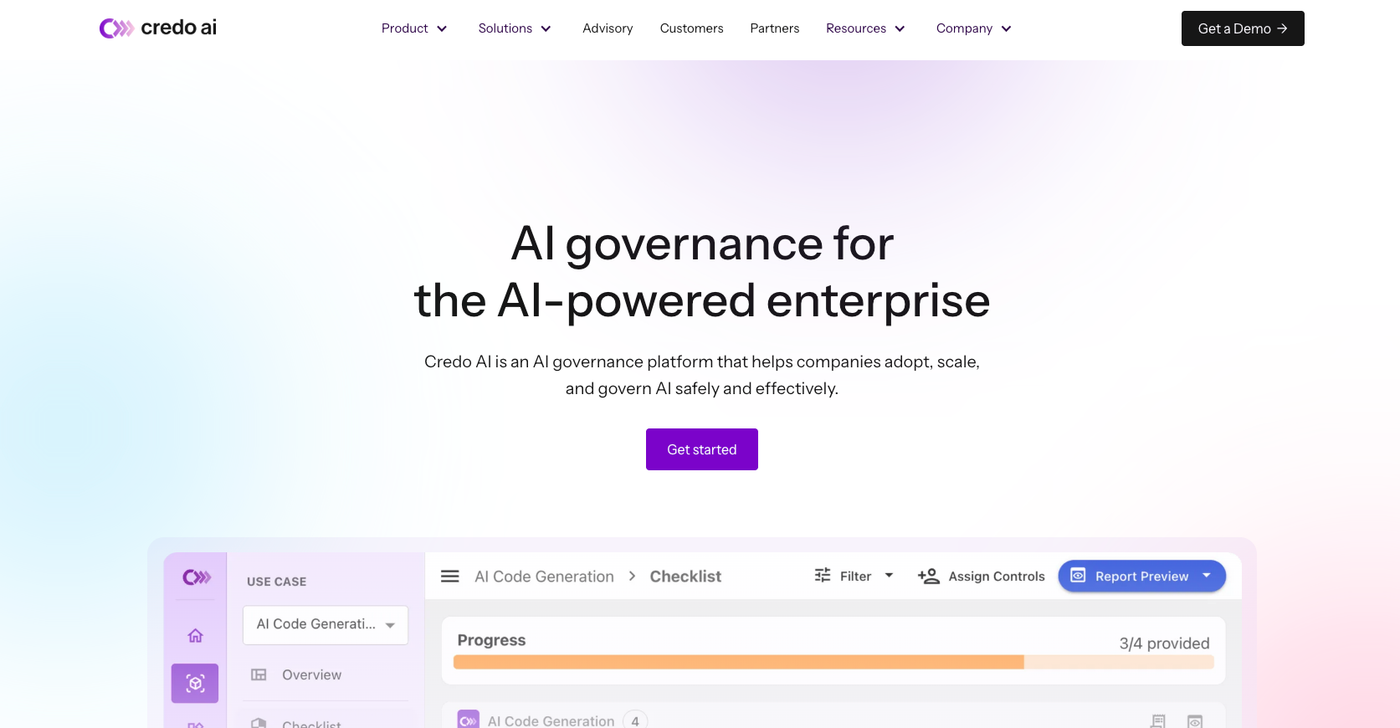
Credo AI is a responsible AI governance solution focused on policy-driven workflows, risk assessments, and compliance documentation. For instance, a bank can register its credit-scoring model and auto-generate an EU AI Act gap report with the required audit artifacts.
Key strengths
- Provides a central repository where organizations can register all AI systems, models, datasets, vendors, and use cases
- Credo AI includes policy intelligence that translates global regulations, standards, and internal governance policies into actionable requirements and workflows,
- Automates risk assessments, mitigation workflows, and real-time dashboards to monitor and manage AI risk across development and deployment stages.
Bottom line
While Credo AI is a strong enterprise governance solution, it has a few notable limitations. First, integration complexity can be substantial: deploying and integrating Credo AI with existing MLOps, model registries, and technical pipelines often requires considerable technical knowledge and coordination, especially for organizations without mature infra teams. Second, the solution focuses on governance and documentation instead of technical enforcement. Third, pricing transparency is limited, with costs typically available only through sales engagements. Credo AI is especially valuable for large enterprises and regulated industries where AI is deployed across multiple teams, use cases, and jurisdictions
LangSmith pricing breakdown
LangSmith pricing combines per-seat fees with consumption-based charges tied to trace volume. A trace captures one complete execution of your application, including all LLM calls, tool invocations, and retrieval operations. There are three pricing tiers:
- The free tier includes one seat, 5,000 traces monthly, and 14-day retention. This suits initial prototyping but retention limits prevent longitudinal performance analysis.
- The Developer plan costs $39 per user monthly and includes 10,000 traces, with overages at $0.50 per 1,000 traces. Retention extends to 400 days. The Plus plan maintains $39 per seat pricing for teams up to 10 users with higher rate limits and email support.
- Enterprise plans require custom pricing and unlock self-hosting, single sign-on, service level agreements, and dedicated support. Teams with data residency or compliance requirements must commit to Enterprise tiers.
Feature comparison: LangSmith vs top alternatives
| Capability | LangSmith | Openlayer | Langfuse | Braintrust | Deepchecks | Credo AI | IBM watsonx |
|---|---|---|---|---|---|---|---|
| Pre-built test library | Partial | Yes | Partial | Partial | Yes | No | No |
| Real-time guardrails | No | Yes | No | No | Partial | Yes | No |
| Drift detection | Yes | Yes | Yes | Yes | Yes | Partial | Yes (IBM stack only) |
| Compliance mapping | No | Yes | No | No | No | Yes | Yes (IBM stack only) |
| Self-hosting | Partial (enterprise) | Yes | Yes | No | Yes | Yes (enterprise) | Yes (IBM ecosystem) |
| Multimodal support | Partial | Partial | Partial | Partial | Yes | No | Partial |
| Production monitoring | Yes | Yes | Yes | Yes | Yes | Yes | Yes (IBM stack only) |
LangSmith, Langfuse, and Braintrust focus on tracing and evaluation. Deepchecks adds structured pre-deployment testing but stops short of runtime protection.
Why Openlayer is the best LangSmith alternative
LangSmith works well for debugging LangChain workflows. Tracing tells you what happened after the fact. But production AI demands more: real-time guardrails that block prompt injections before execution, 100+ automated tests for hallucinations, bias, toxicity, PII leakage, prompt injection, drift, and robustness across text, vision, tabular, audio, and agents with CI/CD integration, and compliance reporting that maps to EU AI Act and NIST frameworks.
Openlayer is a unified evaluation, observability, and governance platform, one that covers the full production lifecycle from behavioral testing and drift monitoring to real-time guardrails and audit-ready compliance reporting. CI/CD deployment gates via GitHub integration block merges and deployments when evaluation thresholds fail, turning quality and safety checks into hard enforcement gates instead of post-hoc observations. LangSmith has no equivalent control. Where LangSmith surfaces a failing trace, Openlayer goes deeper: component-level evaluation isolates and tests individual reasoning components, retrieval accuracy, tool selection precision, reasoning quality, separately from end-to-end flows, so teams debugging RAG pipelines or multi-step agent workflows can pinpoint which component failed instead of reviewing the entire execution chain from scratch. We unify risk scoring across ML, LLM, and agentic systems with approval workflows and audit trails that meet enterprise requirements. For teams managing multi-vendor AI portfolios, native integrations with Salesforce Agentforce, Microsoft Copilot Studio, and Google Dialogflow mean third-party conversational AI systems come under the same governance perimeter as internally built models, with no custom instrumentation required and no coverage gap where a vendor's platform sits outside your risk scoring. When you're deploying AI across teams or answering regulator questions about safety controls, a tracing tool alone isn't enough.
Final thoughts on LangSmith and observability tooling
Most teams start with tracing and realize they need governance when regulators or security teams get involved. A solid LangSmith review should weigh debugging capabilities against production requirements like compliance mapping and runtime protection. Pick the tool that matches where your AI systems are headed, not where they are today.
FAQ
How does LangSmith pricing scale with production usage?
LangSmith charges per seat plus consumption fees based on trace volume. The Developer plan starts at $39/user/month with 10,000 traces included, then $0.50 per 1,000 additional traces. Self-hosting requires an Enterprise contract with custom pricing.
What's the main difference between tracing tools and governance platforms?
Tracing tools like LangSmith capture execution logs for debugging and analysis after the fact. Governance platforms like Openlayer add real-time guardrails that block unsafe outputs, automated behavioral tests, and compliance mapping to regulatory frameworks before issues reach production.
Can I use LangSmith with frameworks other than LangChain?
Yes, through OpenTelemetry instrumentation, though this requires manual span creation and context propagation. LangSmith's core workflows remain optimized for LangChain applications with built-in callbacks and native integration.
When should I consider moving beyond basic observability tools?
When your AI systems require real-time security enforcement, automated safety testing without custom scorers, drift detection, or compliance reporting for EU AI Act, NIST RMF, or ISO 42001. Regulated industries typically need these controls before production deployment.
Do LangSmith alternatives provide pre-built test suites?
Most don't. LangSmith, Langfuse, and Braintrust require you to write custom evaluation datasets and scorers. Openlayer provides 100+ automated tests for hallucinations, bias, toxicity, PII leakage, prompt injection, drift, and robustness across text, vision, tabular, audio, and agents with CI/CD integration, while Deepchecks offers structured pre-deployment checks.