Production AI Hallucination Detection (July 2026)

LLM hallucinations don't announce themselves. A model outputs a fabricated citation in the same confident tone it uses for verified facts, and without an external detection layer, the only people who catch the error are your users. By mid-2026, detection methods have matured enough that most production systems layer at least three approaches: deterministic checks for schema validation and known hallucination patterns, semantic scoring through embedding similarity or LLM-as-judge evaluation, and real-time guardrails that block responses when groundedness falls below threshold. Research has pushed detection accuracy higher, ChainPoll offers a high-efficacy method for hallucination detection through multi-sample polling, HaloScope supports detection by using unlabeled LLM generations, and papers on hallucination detection have shown that combining signals catches more failure modes than any single method alone. But the detection field still leaves practical questions open: which types of LLM hallucinations does each method actually catch, how do you configure sampling at scale when LLM-as-judge scoring costs real money per inference, and where do current benchmarks like the Vectara hallucination leaderboard or AI hallucination rate benchmarks fall short on domain-specific accuracy. This guide covers what works in production systems handling real query volume, walks through hallucination examples and solutions from public leaderboards and GitHub repositories, and explains how to build detection that enforces output quality instead of only logging it.
TLDR:
- LLMs produce hallucinations (factually incorrect or unsupported outputs) with confident tone, requiring external detection since models don't reliably flag their own uncertainty
- Detection requires multiple approaches: deterministic checks for schema validation, LLM-as-judge scoring with ~81% human correlation for faithfulness, and semantic entropy for uncertainty signals across repeated generations
- Production systems layer three defenses: fast deterministic filters, groundedness scoring at ~85% thresholds for high-stakes domains, and runtime guardrails that block low-confidence responses before they reach users
- RAG pipelines need two-stage detection: faithfulness checks comparing outputs to retrieved documents, and upstream relevance scoring to catch retriever failures before generation runs
- Openlayer runs hallucination-specific tests pre-deployment, monitors live inference for groundedness and faithfulness continuously, and blocks responses below configured thresholds at the API boundary before end users see them
What Is Hallucination Detection and Why It Matters in Production AI
Hallucination detection is the process of identifying when an LLM produces output that is factually incorrect, fabricated, or unsupported by its source context. In production, that definition has real consequences: a customer-facing chatbot that confidently cites a nonexistent policy, a code assistant that invents a function signature, or a RAG pipeline that generates an answer contradicted by the retrieved documents.
The stakes scale with deployment volume. A hallucination rate of even 2% across millions of daily queries means tens of thousands of incorrect outputs reaching real users, with no automatic signal that anything went wrong.
Detection matters because LLMs do not flag their own uncertainty reliably. A model can output a fabricated citation in the same confident tone it uses for a verified fact. Without an external detection layer, the only people who catch errors are end users, and by then the damage is already done.
Types of Hallucinations and What Detection Must Catch
Hallucinations don't all look the same, and detection systems that treat them as a single failure mode will miss the ones that matter most. There are several distinct categories worth knowing, each with different causes and different implications for how you catch them.
Factual hallucinations
These are the most recognized type: the model asserts something false as if it were fact. A chatbot claiming a drug has no known side effects, or a legal assistant citing a case that doesn't exist, falls into this category. Detection typically requires grounding checks against a verified knowledge source.
Faithfulness hallucinations
Here, the model contradicts or fabricates information relative to the input it was given. In a RAG pipeline, the generated answer diverges from the retrieved documents. The model's output is wrong both in the world and relative to the context it was handed. Groundedness scores are the standard detection signal.
Instruction hallucinations
The model produces content that ignores or misrepresents what was asked. A summarization task that introduces new claims not in the source document is a classic example. These are harder to catch with retrieval-based checks because the failure is relational, not factual, requiring LLM evaluation metrics that capture task completion.
Contextual and temporal hallucinations
Models trained on data with a knowledge cutoff will confidently state outdated information as current. Detection here depends on flagging outputs that make time-sensitive claims without acknowledgment of uncertainty.
Each category requires a different detection signal. Factual errors need external grounding; faithfulness failures need input-output comparison; instruction failures need task-completion scoring. Treating all hallucinations as the same problem produces a detection layer with predictable blind spots.
Deterministic Detection Methods: Schema Validation and Pattern Matching
Deterministic methods catch a meaningful slice of hallucinations before any model-based scorer runs. They work by checking outputs against fixed rules instead of learned representations, which makes them fast, cheap, and auditable.
Two approaches carry most of the weight here:
- Schema validation checks whether structured outputs conform to expected types, formats, and value ranges. If a model is supposed to return a JSON object with a numeric confidence field between 0 and 1 and instead returns a string or a value of 1.4, that's a detectable failure with zero inference cost. Flag responses when any required field is missing, mistyped, or out of range.
- Pattern matching uses regex or keyword rules to catch known hallucination signatures: citations to non-existent URLs, dates formatted in impossible ranges, or named entities that appear nowhere in the source context. A response referencing "Dr. Elena Voronova, 2019" when no such name appears in the retrieved documents is a cheap signal worth catching before a judge model scores it.
The tradeoff is coverage. Deterministic checks only catch what you've anticipated. They miss paraphrase-level fabrications, plausible-sounding but incorrect facts, and any hallucination pattern not yet represented in your rule set. Run them as a first filter, not a complete solution, and route flagged outputs to a model-based scorer for cases that clear the rule layer but still warrant review.
Semantic Detection: LLM-as-Judge and Embedding Similarity
Two broad techniques power most hallucination detection systems in production: semantic similarity scoring and LLM-as-judge evaluation. Each has a different operating assumption, and each fails in different ways.

Embedding similarity works by converting both the model's output and a reference source into vector representations, then measuring cosine distance between them. When that distance exceeds a configured threshold, say a cosine similarity below 0.75, the response gets flagged for review. The approach is fast and cheap to run at scale, but it struggles with paraphrasing that preserves meaning and with factual errors that are semantically adjacent to the truth. A response claiming a drug was approved in 2019 instead of 2021 may score well on similarity while being materially wrong.
LLM-as-judge flips the mechanism: a separate, typically stronger model reads both the generated response and the source context, then scores the response on a defined rubric, groundedness, completeness, or factual consistency. Research from Openlayer's evaluation work puts LLM-as-judge correlation with human raters at around 81.3%, which makes it practical for production use without requiring human review of every output. The tradeoff is cost and latency. Running a grader model on every inference adds overhead that compounds quickly at scale.
Choosing Between the Two
Neither approach works well in isolation for high-stakes applications. Here is how the tradeoffs break down in practice:
| Criterion | Embedding Similarity | LLM-as-Judge |
|---|---|---|
| Speed | Fast (milliseconds) | Slower (depends on grader model) |
| Cost | Low | Higher per inference |
| Catches semantic drift | Moderate | Strong |
| Catches near-miss factual errors | Weak | Strong |
| Requires reference document | Yes | Yes (for groundedness) |
| Human correlation | Lower | ~81.3% |
For high-volume, lower-stakes pipelines, embedding similarity works as a first-pass filter. For anything where factual accuracy carries real consequences, medical, legal, financial, LLM-as-judge should be the primary gate, with a threshold like blocking responses when groundedness scores fall below 80%.
Semantic Entropy: Detecting Uncertainty Through Multiple Generations
Semantic entropy measures how much an LLM's meaning varies across multiple independent generations of the same prompt. The core intuition is straightforward: if a model is confident about a fact, it will express that fact consistently across repeated samples. If it's uncertain or confabulating, its outputs will diverge in meaning even when the surface wording looks similar.
The method works by clustering generated responses by semantic equivalence, then computing entropy over those clusters. High entropy across clusters signals that the model has no stable internal representation of the answer, which is a strong proxy for hallucination risk.
There are a few practical considerations worth knowing before you build this into a pipeline.
How Semantic Entropy Works in Practice
The process has three steps:
- Generate N independent samples from the model at moderate temperature (typically 0.5 to 0.8), using the same prompt each time. Too low and samples collapse to near-identical text; too high and noise dominates the entropy signal.
- Cluster samples by semantic equivalence using a bidirectional NLI model. Two responses belong to the same cluster if each logically implies the other, meaning they express the same underlying claim regardless of surface variation.
- Compute entropy over the cluster distribution. A response that falls into a singleton cluster in a high-entropy distribution is a candidate hallucination, not a confident but unusual answer.
Tradeoffs and Failure Modes
The capability here is real: semantic entropy produces a grounded uncertainty signal without requiring labeled data or a separate reference corpus, which makes it applicable in domains where ground truth is expensive to collect. Research has shown it outperforms sequence-level probability as a hallucination predictor on open-domain QA benchmarks.
But the limitations matter for production decisions:
- Inference cost scales linearly with N. Running five to ten generations per user query is often impractical in latency-sensitive applications without aggressive caching or asynchronous evaluation paths.
- NLI-based clustering can fail on highly technical or domain-specific language where the entailment model has weak coverage. A biomedical claim and its paraphrase may not register as semantically equivalent to a general-purpose NLI classifier.
- Entropy is a signal of uncertainty, not a direct detector of falsehood. A model can produce low-entropy, confidently wrong outputs when it has learned a systematic error. Semantic entropy catches confabulation; it does not catch confident misinformation baked in during training.
Use this method when you need an unsupervised hallucination signal in domains without labeled evaluation sets, and when you can absorb the inference overhead through batching or offline evaluation. Avoid relying on it as the sole gate in real-time, high-throughput pipelines.
Real-Time Guardrails: Blocking Hallucinations at the API Boundary
Detection alone doesn't stop a hallucination from reaching a user. The gap between catching a bad output and preventing it from leaving the API boundary is where most monitoring setups fall short. Openlayer closes that gap with guardrails that enforce output quality thresholds before a response is returned, not after it's already been served.
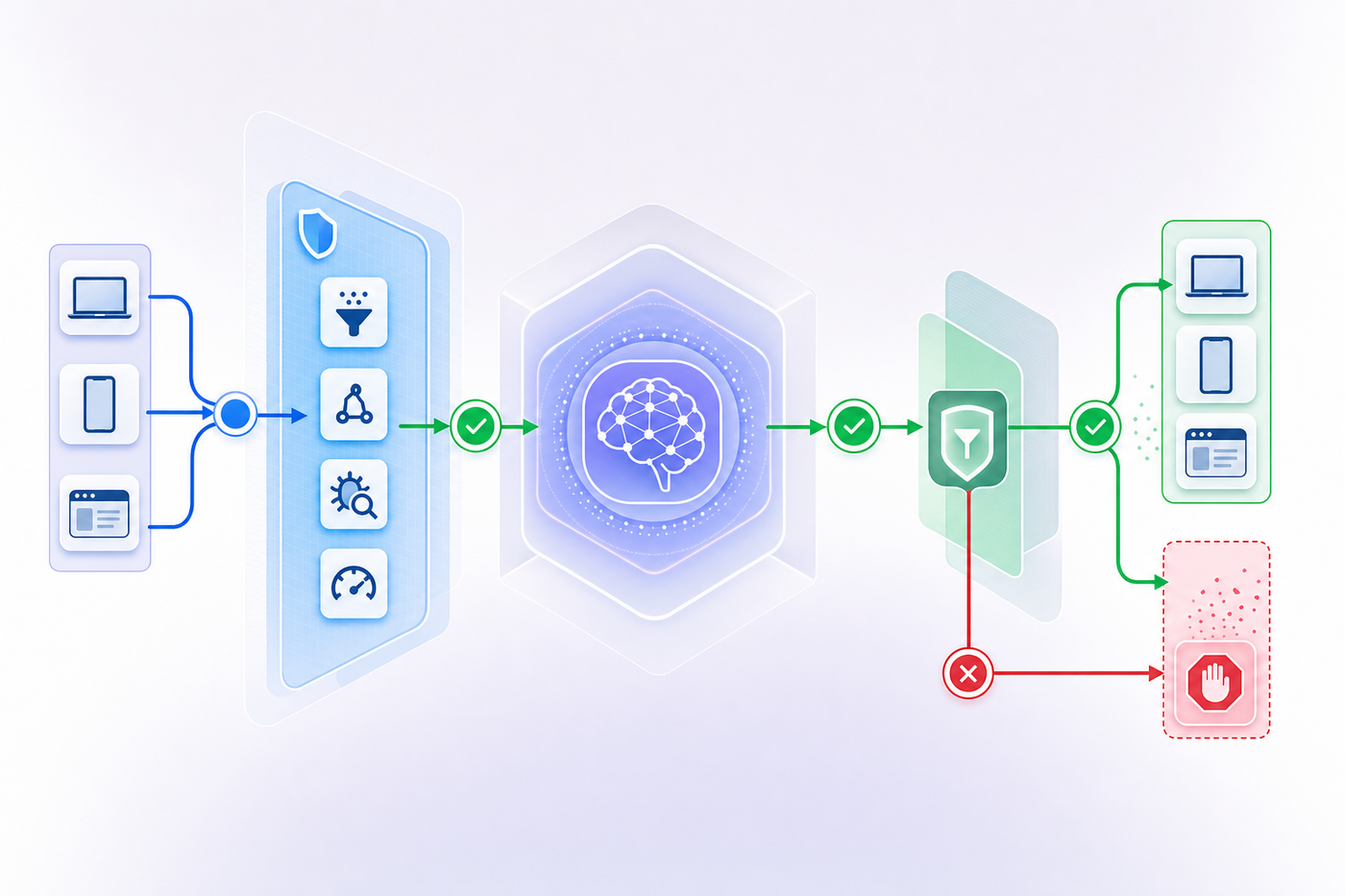
When a groundedness score falls below a configured threshold, say 85%, the guardrail blocks the response entirely instead of logging it for later review. The same logic applies to factual consistency checks, citation verification, and confidence scoring. Each metric has a deployment gate; outputs that fail it don't pass through.
There are two main routes teams configure these gates:
- Threshold-based blocking: set a minimum score per metric using LLM guardrails, such as a factual consistency floor of 0.80, and any response scoring below that value is rejected at inference time before reaching the end user.
- Composite scoring: combine multiple signals, groundedness, citation coverage, and semantic coherence, into a weighted score, then block responses that fall below the composite floor. This catches outputs that pass one check but fail collectively.
Both approaches generate an immutable audit record for every blocked response, including the input, the raw model output, the metric scores that triggered the block, and the model version hash. That record satisfies the evidentiary requirements auditors expect under frameworks like the EU AI Act, where documentation of active oversight measures is a formal obligation, not a best practice.
Hallucination Detection in RAG Pipelines
Retrieval-augmented generation introduces a specific hallucination failure mode that pure generative pipelines don't share: the model retrieves accurate source documents, then generates a response that contradicts or ignores them. This is sometimes called a faithfulness failure, and it's one of the harder problems to catch because the retrieved context looks correct when you inspect it.
There are two distinct failure patterns to account for here.
Faithfulness vs. Relevance Failures
Faithfulness failures happen when the model's output conflicts with the retrieved context it was given. The documents say one thing; the response says another. Relevance failures happen upstream, when the retriever pulls documents that don't actually answer the query, and the model then hallucinates a plausible-sounding answer to fill the gap.
Both require different detection approaches:
- Faithfulness detection compares the generated response against the retrieved chunks directly, checking whether every claim in the output is grounded in the source material. A groundedness score below roughly 85% is a reasonable threshold to flag for review before a response reaches the user.
- Relevance detection scores whether retrieved documents are actually pertinent to the query before generation runs, a capability covered in RAG pipeline assessment. If retrieval quality is low, you can intervene at that stage instead of trying to catch the downstream hallucination after it's already been generated.
What to Monitor in Production RAG Systems
In a live RAG pipeline, static pre-deployment testing catches some failure modes but misses the distribution of real queries users actually send. Production monitoring needs to track several signals continuously using a GenAI testing platform:
- Citation grounding rate: the share of factual claims in generated responses that can be traced back to a specific retrieved chunk instead of to the model's parametric knowledge
- Retrieval relevance score: a per-query measure of whether the top-k documents retrieved are semantically appropriate for the question asked
- Hallucination rate by query category: broken down by topic cluster or user intent, since some query types consistently produce higher hallucination rates than others and warrant separate thresholds
The interaction between retrieval quality and generation quality is what makes RAG hallucination detection a two-stage problem. Fixing only the generation layer while ignoring retrieval failures leaves a structural gap in your detection coverage.
Configurable Sampling for Production Scale
Running LLM-as-judge scoring on every inference is expensive, and at production volume, cost compounds fast. A pipeline handling 500,000 daily queries at even $0.002 per evaluation call adds up to $1,000 per day in evaluation overhead alone. Sampling solves this, but the configuration choices matter more than the rate itself.
There are a few practical approaches worth knowing:
- Per-endpoint sampling lets you assign different rates based on risk profile. A customer-facing medical information endpoint warrants a higher sample rate, say 30-50%, than an internal search summarizer where the stakes are lower and you can tolerate 5-10%.
- Stratified sampling by query type captures the hallucination-prone categories without scoring everything. Segment traffic by topic cluster or intent label, then oversample the categories where your baseline hallucination rate is highest.
- Time-windowed sampling catches drift without continuous full coverage. Run dense evaluation for a window after each model update, then taper back once the distribution stabilizes.
To estimate portfolio-wide hallucination rates from sampled data, weight results by the inverse of the sampling probability per stratum. This gives you an unbiased estimate of the true rate across all traffic, beyond just the sampled subset.
The tradeoff is real. Hallucinations in unsampled requests go undetected, and if your sampling strategy is uniform instead of risk-weighted, you may be measuring low-risk traffic while high-risk queries slip through unchecked. Openlayer's configurable sampling for custom metrics lets you set per-metric sample rates independently within an LLM evaluation platform, so resource-intensive LLM-as-judge evaluations run on a targeted subset while cheaper deterministic checks continue at full volume.
Measuring Detection Accuracy: Benchmarks and Human Correlation
Benchmarks give detection work something to anchor to, but the field is still settling on which ones actually matter in production.
The Vectara hallucination leaderboard has become one of the most-referenced public benchmarks for summarization faithfulness, ranking models by how often they introduce unsupported content when condensing source material. Vectara's leaderboard scores vary widely across model families, making it a useful starting point for model selection decisions.
For teams that want to go deeper, the hallucination rate benchmark field includes several research-grade evaluations. The key signal to watch is human correlation: a detection method that agrees with human judgment 81% of the time meaningfully outperforms one at 60%, especially when the latter produces false negatives on factual errors that reach users.
There are a few dimensions worth tracking across any benchmark you rely on:
- Coverage across hallucination types: a benchmark that only tests summarization faithfulness will miss attribution errors, temporal drift, and entity confabulation entirely.
- Human agreement rate: higher correlation with expert annotators is the most direct proxy for real-world reliability, since ground truth in open-domain tasks is defined by human judgment.
- Domain specificity: general-purpose benchmarks score models on broad corpora, but a model performing well on news summarization may still hallucinate heavily on medical or legal content where factual precision carries higher stakes.
No single benchmark settles the question for every deployment context. The right approach is to treat published leaderboard scores as a prior, then validate against your own domain distribution through LLM observability before drawing conclusions about production-readiness.
Frequently Asked Questions About Hallucination Detection
Partially. Through self-consistency checking, a model can compare outputs across multiple independent generations and flag cases where answers diverge considerably. Internal state probing, which inspects activation patterns associated with uncertainty, offers another signal. Both have real accuracy limits, though: a model that has learned a systematic error will self-consistently produce that error, and internal probes aren't yet reliable enough for production detection without external validation. Self-checking raises confidence in high-agreement outputs; it doesn't replace grounding against an authoritative source.
What is the best tool for hallucination detection in 2026?
No single tool covers the full problem. Production systems that perform well typically layer at least three components: deterministic checks for structured output validation, semantic scoring for faithfulness against retrieved context, and runtime guardrails that block low-confidence responses before they reach users. The right configuration depends on use case risk, query volume, and budget. A medical or legal pipeline warrants heavier LLM-as-judge coverage; an internal search summarizer can run lighter deterministic checks with sampled scoring on top.
How accurate is LLM-as-judge for detecting hallucinations?
It depends on the judge model and the task. Openlayer's LLM-as-judge achieves 81.3% human correlation, making it practical for production faithfulness scoring. Accuracy improves when evaluation prompts are task-specific and when the judge has access to the source context instead of scoring the response in isolation. Blind grading without a reference document produces considerably lower precision on faithfulness tasks.
How do I detect hallucinations in a RAG pipeline automatically?
Faithfulness scoring is the standard approach: an LLM judge checks whether each claim in the generated response is grounded in the retrieved documents, flagging responses that introduce facts not present in the source context. A groundedness score below roughly 85% is a reasonable threshold to trigger review or block delivery. Pair that with answer relevance scoring to catch responses that technically avoid fabrication but fail to answer the query.
Detection in Production: Openlayer's Approach to Hallucination Detection at Scale
Openlayer approaches hallucination detection as an enforcement problem, beyond mere measurement. The distinction matters in production: knowing a response hallucinated after it reached a user is a logging capability. Stopping it before it does is a control.
Here is how that control layer works in practice.
Evaluation at Development Time
Before any model ships, Openlayer runs hallucination-specific tests against your evaluation dataset. These include groundedness checks that verify every factual claim in a response traces back to a provided source, faithfulness scoring that flags responses where the model introduces content beyond what the retrieved context supports, and context relevance evaluation that confirms the retrieval step actually surfaced material the response should be grounded in. A deployment gate blocks promotion if groundedness scores fall below your configured threshold, for example 85%, before the model ever reaches production.
Real-Time Detection in Production
Once deployed, Openlayer monitors live inference traffic for hallucination signals continuously. Each response is scored against the same groundedness and faithfulness metrics used during development, so production behavior is comparable to pre-deployment baselines. When a response falls below threshold, Openlayer's guardrails intercept it at the API boundary before it reaches the end user. Teams configure the sensitivity of that gate: a customer-facing medical information assistant warrants a tighter threshold than an internal summarization tool.
Metrics Tracked Across Both Phases
| Metric | What It Measures | Alert Trigger |
|---|---|---|
| Groundedness | Whether response claims are supported by retrieved context | Score below configured floor |
| Faithfulness | Whether the response stays within the scope of source material | Score below configured floor |
| Context relevance | Whether retrieved chunks actually match the query | Low relevance signals retrieval failure upstream |
| Hallucination rate trend | Rolling rate of flagged responses over time | Spike beyond baseline variance |
Connecting Detection to the Audit Trail
Every flagged response, threshold breach, and guardrail intervention is logged to a structured audit trail. That record includes the input, the raw model output, the metric scores, the version hash of the model that produced it, and the action taken. Teams using Openlayer for compliance reporting can produce that evidence on demand, linking each incident back to the evaluation history that preceded deployment.
Final Thoughts on Detection Architecture for Live LLM Systems
Hallucination detection works when you layer multiple signals and enforce thresholds before responses leave your API, not after users see them. The right detection stack combines cheap deterministic checks with targeted semantic scoring and configures sampling by risk tier instead of applying uniform rates across all traffic. If you're designing detection for a production system and need help mapping failure modes to the right detection methods or setting enforcement thresholds that match your risk tolerance, reach out and we can work through it with you. The gap between logging a problem and preventing it is where most monitoring setups fail, and closing that gap is what separates observability from control.
FAQ
Can LLMs detect their own hallucinations reliably?
Partially. LLMs can use self-consistency checking by comparing outputs across multiple independent generations and flagging cases where answers diverge considerably, but a model that has learned a systematic error will self-consistently produce that error. Self-checking raises confidence in high-agreement outputs; it doesn't replace grounding against an authoritative source, especially for factual claims in high-stakes domains like medical or legal AI.
What's the most practical way to detect hallucinations in a RAG pipeline without checking every response?
Configure stratified sampling weighted by risk: score densely on query categories where your baseline hallucination rate is highest (medical questions, policy citations, financial calculations), then run lighter checks on lower-risk traffic like general search. Pair that with faithfulness scoring that checks whether each claim in the generated response is grounded in the retrieved documents, blocking responses when groundedness scores fall below 85%. This catches the RAG-specific failure mode where retrieval returns correct documents but generation contradicts them.
Semantic entropy vs LLM-as-judge for production hallucination detection?
Semantic entropy measures uncertainty by generating multiple responses and computing entropy over their semantic clusters, making it well-suited for unsupervised detection in domains without labeled data, but inference cost scales linearly with the number of generations (typically five to ten per query). LLM-as-judge scores a single response against source context using a grader model, achieving around 81% human correlation with lower per-query cost. Use semantic entropy for offline evaluation and batch workflows where latency budgets are flexible; use LLM-as-judge for real-time guardrails in production pipelines.
How do real-time guardrails block hallucinations before they reach users?
Guardrails enforce output quality thresholds at the API boundary: when a groundedness score falls below a configured floor (say, 85%), the guardrail blocks the response entirely instead of logging it for later review. Each blocked response generates an immutable audit record capturing the input, raw model output, metric scores that triggered the block, and model version hash. This moves detection from diagnostic observation to active control, satisfying EU AI Act oversight requirements by preventing unsafe outputs from escaping instead of documenting them after delivery.
What hallucination rate should trigger a production alert?
It depends on deployment stakes and volume. For customer-facing systems in regulated domains (medical, legal, financial), flag when hallucination rate exceeds 2-3% of scored traffic, since even small percentages at scale mean thousands of incorrect outputs reaching real users. For internal tools with lower consequences, a 5-8% threshold is more practical. Set thresholds per query category instead of uniformly across all traffic, since some query types consistently produce higher hallucination rates and warrant separate monitoring.