LLM evaluation metrics: Complete guide for March 2026
Your LLM passes unit tests but fails in production because you measured precision instead of groundedness, BLEU scores instead of semantic quality, and leaderboard rank instead of prompt injection resistance. LLM evaluation metrics that work in research don't translate to enterprise deployments where you need coverage across accuracy, latency, cost, safety, and compliance. We're breaking down statistical versus model-based scoring, RAG-specific checks, agent evaluation, continuous monitoring, and governance requirements so you know exactly which metrics matter for your use case.
TLDR:
- LLM evaluation requires layered metrics across accuracy, safety, and performance dimensions.
- Statistical metrics like BLEU miss semantic meaning; LLM-as-a-judge scoring achieves 81.3% human correlation.
- RAG systems need retrieval metrics (context precision) and generation metrics (groundedness) to catch failures.
- Production monitoring detects drift and degradation that offline benchmarks miss entirely.
- Openlayer runs 100+ automated tests across development and production with built-in compliance mapping.
Understanding AI evaluation metrics
AI evaluation metrics are quantitative measures that score how well your AI system performs against specific criteria. They answer questions like: Is the model accurate? Does it hallucinate? Is it safe from prompt injection? How fast does it respond?
These metrics span multiple dimensions:
- Accuracy metrics check if outputs match expected results.
- Safety metrics detect toxicity, bias, or leaked PII.
- Performance metrics track latency and cost per inference.
Together, these dimensions provide visibility into model behavior before and after deployment.
Statistical metrics vs. model-based scoring

Statistical metrics like BLEU, ROUGE, METEOR, and Levenshtein distance compare outputs to reference texts using string overlap or edit distance. They're fast, deterministic, and reproducible, but they miss meaning. A paraphrase that's semantically identical scores poorly if words don't match.
Model-based scoring fixes this. Embedding similarity, BERTScore, and LLM-as-a-judge capture semantic alignment and reasoning. LLM-as-a-judge approaches achieved 81.3% correlation with human scores on code translation tasks, compared to just 34.2% from ChrF++ metrics.
The trade-off? Model-based methods add latency, cost, and variability. Use statistical metrics for quick regression checks. Use model-based scoring when semantic quality matters.
Core accuracy and performance metrics
As you assess your LLM, it's important to understand the distinction between accuracy and performance.
Core accuracy metrics measure whether your LLM produces correct outputs. Precision calculates what percentage of positive predictions are actually correct. Recall tracks what percentage of actual positives your model identified. F1 score combines both when you need a single metric. Perplexity measures how confident a model is in its predictions. Lower scores mean the model assigns higher probability to the correct next token. It helps compare language models during training but doesn't verify factual correctness or safety.
Task-specific accuracy, though, depends on your use case. Classification tasks use categorical accuracy. Code generation counts executable outputs without errors. Summarization tracks how many key facts appear in generated text.
RAG-specific evaluation metrics
For agentic systems that use RAG, there are specific evaluation metrics which are different that just general LLM evaluation metrics.
RAG systems fail when they retrieve irrelevant documents or misuse correct ones. Retrieval metrics like context precision and context recall verify your system found the right information. Generation metrics like groundedness and faithfulness check whether the LLM used retrieved context accurately. Context relevance scores how much retrieved data relates to the query. When retrieval fails, the LLM hallucinates or hedges without proper grounding.
Agent and multi-turn evaluation metrics
Agents execute across multiple steps, calling tools, managing state, and adapting plans based on intermediate results. Single-turn metrics like accuracy or F1 score miss this complexity. Tool calling accuracy tracks whether the agent selected the correct function and passed valid parameters. Task completion rate measures end-to-end success: did the agent reach the goal, loop, or fail? Multi-turn conversations require coherence metrics to check consistency across dialogue history and state management metrics to verify the agent remembers context without contradiction.
Benchmark datasets and leaderboards
Assessing your LLM is a critical part of optimization and improvement. But metrics are meaningless if you can't compare them with something. How do you know if the LLM you chose is performing better than another? Thankfully, there are benchmark datasets which provide standardized tests to compare LLM capabilities. Six benchmarks dominate industry testing:
- GPQA (graduate-level science),
- MMLU (multitask language understanding),
- AIME 2025 (math reasoning),
- LiveCodeBench (code generation),
- MMMU (multimodal understanding), and
- TAU-bench Retail (agent reasoning).
Other benchmarks include HumanEval for code, TruthfulQA for factuality, HellaSwag for commonsense reasoning, and SuperGLUE for language understanding. Leaderboard scores climbed from GPT-3.5's 70% to GPT-4's 86.4% on MMLU, but models trained on benchmark data overfit to test distributions that don't match real production queries.
But keep in mind that custom datasets built from production logs, user feedback, and edge cases matter more than leaderboard rank for your deployment.
LLM-as-a-judge evaluation techniques
When designing AI systems you will soon run into the problem of the agent using the LLM to assess itself. This can create bad, repeating loops of hallucination. It can be helpful to use another LLM to assess what the initial LLM produced. This is called LLM-as-a-judge.
When using LLM-as-a-judge, there are three common approaches:
- rubric-based scoring that assigns numerical grades based on predefined criteria,
- pairwise comparison that ranks two outputs against each other, and
- rationale generation that asks the judge to explain its score before assigning it.
LLM-as-a-judge works best for subjective dimensions like tone, helpfulness, or coherence where no ground truth exists. It scales better than human review when scoring thousands of outputs daily and costs less than hiring annotators for every iteration.
Evaluation challenges and pitfalls
Relying on a single metric hides failure modes. A model with strong BLEU scores can still hallucinate facts, leak PII, or fail on edge cases. You need coverage across accuracy, safety, performance, and security dimensions. And, leaderboard scores don't predict production readiness. Models trained on benchmark datasets overfit to test distributions that don't match real user queries or multi-turn conversations. High MMLU scores say nothing about prompt injection resistance or latency under load.
While hallucination rates dropped 96% since 2021, you only capture this through continuous measurement. Many teams test once during development and never refresh their datasets as models and prompts evolve. And this leads to another issue: ignoring statistical significance (which can lead to false confidence). Small sample sizes produce noisy metrics. Run enough samples to detect real regressions before deploying changes.
Human annotation remains the gold standard for subjective quality, but it doesn't scale. LLM-as-a-judge fills the gap for tone and coherence, but judge models inherit their own biases and need calibration against human feedback.
Evaluation frameworks and tools
Braintrust, LangSmith, and Langfuse lead in observability for GenAI testing. Braintrust offers tracing, dataset versioning, and CI/CD integration with scoring functions defined in code. LangSmith debugs agent workflows with visual trace trees and feedback collection. Langfuse provides open-source tracing and prompt management with built-in analytics dashboards.
| Platform | Core Capabilities | Primary Use Case | Integration Approach |
|---|---|---|---|
| Openlayer | Unified testing and monitoring with 100+ automated tests across accuracy, safety, and security. Built-in compliance mapping to EU AI Act, NIST RMF, ISO 42001. Production monitoring with drift detection and human feedback loops. | Enterprise governance and end-to-end evaluation from development through production with regulatory compliance | GitHub integration for CI/CD gates, real-time production monitoring, framework-agnostic deployment |
| Braintrust | Tracing and observability with dataset versioning. Scoring functions defined in code. CI/CD pipeline integration for automated testing. | Development teams requiring version control for evaluation datasets and code-based test definitions | SDK-based integration with custom scoring logic, works across multiple LLM providers |
| LangSmith | Visual trace trees for debugging agent workflows. Feedback collection system. Detailed execution path analysis for multi-step reasoning. | Debugging complex agent systems and multi-turn conversations with step-by-step visibility | Native LangChain integration, trace visualization for workflow inspection |
| Langfuse | Open-source tracing and prompt management. Built-in analytics dashboards. Self-hosted deployment options with full data control. | Teams requiring open-source solutions with self-hosted infrastructure and prompt versioning | Open-source SDK with self-hosted or cloud deployment, language-agnostic tracing |
| MLflow | Experiment tracking and metric logging across training runs. Model registry and versioning. Parameter comparison for optimization. | Traditional ML workflows and LLM fine-tuning experiments requiring reproducibility tracking | Python SDK integration, works with existing ML pipelines and training frameworks |
| Deepchecks | Data quality validation and distribution analysis. Detects data drift and schema violations before model retraining. | Pre-deployment data validation to catch distribution changes and quality issues in training data | Python library for batch validation, integrates with data pipelines and training workflows |
MLflow tracks experiments and logs metrics across training runs. Deepchecks validates data quality, detecting distribution changes before retraining. At the end of the day, you should pick based on your stack. LangChain users integrate fastest with LangSmith. Self-hosted needs favor Langfuse. Teams requiring scoring templates start with Braintrust.
Safety and security evaluation metrics
There are a lot of ways that bad actors can take advantage of agents. Thankfully, safety and security metrics can help identify where this might happen in your AI system. For example:
- Safety metrics track failure modes instead of ideal outputs.
- Toxicity scores flag hate speech, profanity, and offensive content.
- Bias detection identifies outputs that favor or discriminate against demographic groups.
- PII leakage scans catch credit card numbers, Social Security numbers, and contact details.
- Prompt injection tests verify whether adversarial instructions can override system prompts.
- Jailbreak resistance measures how often adversarial queries bypass safety filters, a key concern in LLM agent evaluation.
In short, offline testing identifies known attack patterns while real-time guardrails block exploits before they reach production.
Production evaluation and continuous monitoring
To make sure that your agent is not simply operating optimally, providing the best user experience, and remaining secure, you need to continuously monitor your agent in production. In other words, track model behavior after deployment when real traffic, distribution changes, and edge cases surface. Offline tests validate pre-release quality, but production evaluation detects degradation over time.
And with production, you'll want to keep an eye on drift. Drift detection compares live input distributions against training data. When feature distributions shift, model accuracy degrades even if code remains unchanged. Track p50, p95, and p99 response times to catch slowdowns before users notice. Log cost per request to detect runaway token usage from poorly controlled prompts or infinite agent loops.
Human feedback closes the loop through an AI agent evaluation platform. Thumbs up/down signals, escalations, and manual corrections provide ground truth for retraining and test dataset refreshment.
Implementing evaluation in CI/CD pipelines
Building evaluation into your CI/CD pipelines makes sure you are continuously monitoring before and after deployment.
First, CI-integrated evaluations act as deployment gates. You should set hard thresholds for accuracy, latency, and safety metrics. When a prompt or model version fails groundedness below 90% or triggers PII leakage, the pipeline blocks merges until fixed.
Then, automated regression testing compares each commit against baseline performance. Version dashboards show whether changes improved F1 by 2% or increased hallucinations by 5%. You should link results to pull requests so reviewers see quality impact before approving.
Finally, it's best to use an eval-driven development approach. In this approach, you write tests first which define expected behavior. Then, you iterate prompts until outputs pass. This prevents regressions, surfaces issues before manual review, and cuts iteration cycles in half.
Evaluation for enterprise governance and compliance
Regulators require documented proof that AI systems operate safely, fairly, and transparently. Test results show bias detection coverage. Monitoring logs track drift and anomalies. Risk scores classify systems by harm potential under frameworks like EU AI Act and NIST RMF:
- EU AI Act requires high-risk systems to undergo conformity assessments with technical documentation proving accuracy, robustness, and bias mitigation. Automated evaluations map your test library to Article 15 requirements, generating audit trails that show what you tested, when, and which thresholds passed or failed.
- ISO 42001 certification needs continuous risk monitoring and impact assessment. Running scheduled evaluations on production traffic creates timestamped records of model performance across fairness, security, and accuracy dimensions.
Accelerating evaluation with Openlayer
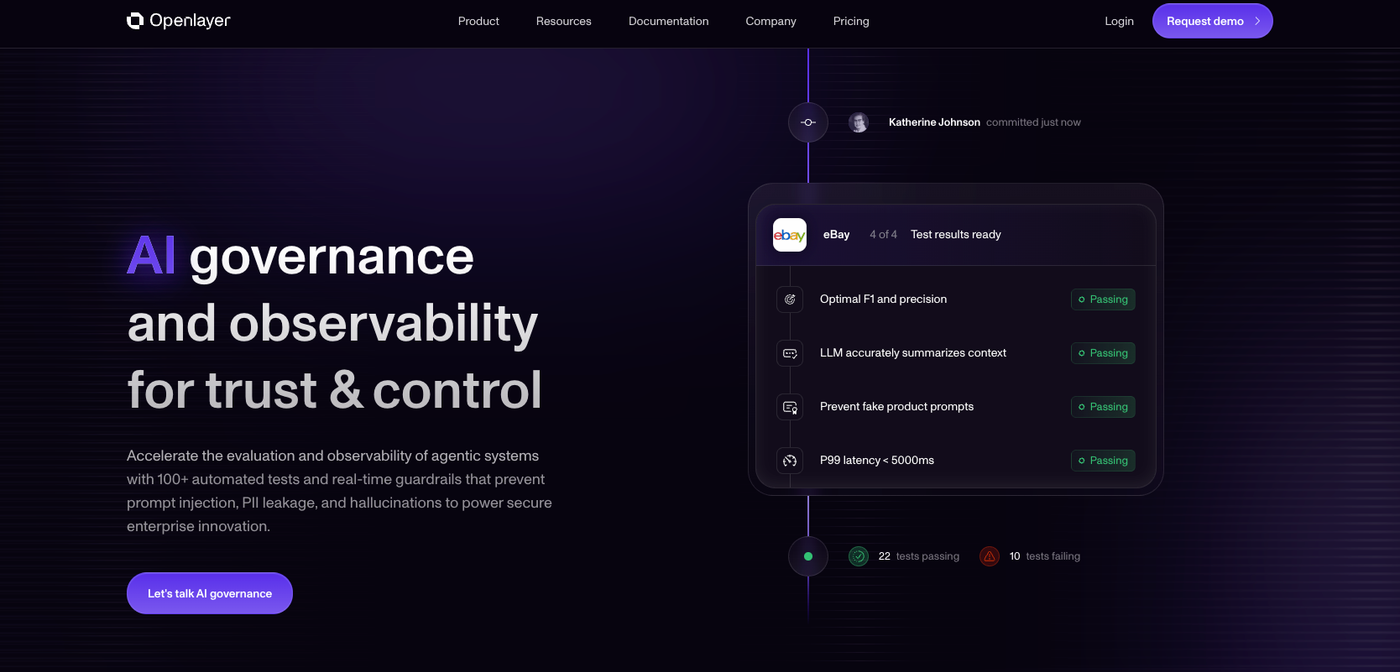
Openlayer unifies testing, monitoring, and governance in a single system. Our test library covers hallucinations, bias, toxicity, groundedness, context relevance, and PII leakage across text, vision, audio, and agent workflows.Development mode runs tests offline with version tracking. Connect your GitHub repo, define must-pass criteria, and every commit triggers automatic validation. Production monitoring runs identical tests on live traffic, tracking latency and flagging anomalies in real time. Human feedback loops back into test datasets. Results map directly to EU AI Act, NIST RMF, OWASP, and ISO 42001, generating audit trails that show what you tested, when, and which thresholds passed or failed.
Final thoughts on implementing evaluation
A strong LLM evaluation framework combines offline testing with continuous production monitoring to catch regressions, drift, and new failure modes. Your choice of metrics should reflect actual risks, whether that's hallucinations in RAG systems, tool-calling errors in agents, or bias in customer-facing outputs. Test early, automate validation in your CI/CD pipeline, and treat evaluation datasets as living artifacts that grow with your system.
FAQ
What's the difference between statistical and model-based evaluation metrics?
Statistical metrics like BLEU and ROUGE compare outputs using string overlap and run fast but miss semantic meaning, while model-based scoring like LLM-as-a-judge captures reasoning and context but adds latency and cost.
How do I test RAG systems beyond basic accuracy metrics?
Test both retrieval quality (context precision, context recall) and generation quality (groundedness, faithfulness) to verify your system found relevant documents and used them correctly without hallucinating.
When should I use LLM-as-a-judge instead of reference-based metrics?
Use LLM-as-a-judge for subjective dimensions like tone, helpfulness, or coherence where no ground truth exists, or when semantic quality matters more than exact word matching.
Can benchmark leaderboard scores predict production performance?
No. Models trained on benchmark datasets overfit to test distributions that don't match real user queries, multi-turn conversations, or production edge cases like prompt injection resistance.
How do I integrate evaluations into CI/CD pipelines?
Set hard thresholds for accuracy, latency, and safety metrics that block deployments when tests fail, then run automated regression testing on every commit to catch quality drops before code merges.