High-risk AI systems under the EU AI Act: A complete guide for April 2026
Figuring out if your AI system qualifies as high-risk under the EU AI Act isn't a binary lookup in Annex III. It's a classification exercise that depends on whether you're embedding AI into a regulated product or deploying a standalone system in one of eight specific sectors, and the edge cases between ancillary and influential are where most compliance officers get stuck. The Commission was supposed to publish classification guidance in February to help with those borderline calls, but that deadline passed without publication. With August 2026 still locked in as the enforcement date, you need a functioning risk management system, complete technical documentation, and active post-market monitoring regardless of whether official guidance ever shows up.
TLDR:
- High-risk AI under the EU AI Act applies via two paths: safety components in regulated products or standalone systems in eight Annex III sectors including biometrics, employment, credit scoring, and law enforcement.
- By August 2, 2026, providers must complete conformity assessment, register systems in the EU database, and maintain continuous risk management, logging, and post-market monitoring across the full lifecycle.
- Non-compliance triggers fines up to €35M or 7% of global revenue, plus potential market suspension and civil liability when violations cause demonstrable harm.
- Openlayer automatically maps AI projects to EU AI Act requirements and runs 100+ behavioral tests for bias, toxicity, and PII leakage with real-time guardrails that block prompt injections before they reach production systems.
What qualifies as a high-risk AI system under Article 6
Article 6 of the EU AI Act defines two distinct pathways to high-risk classification, and knowing which one applies to your system shapes everything that follows. Keep in mind that product-embedded systems carry dual compliance burdens from both sector-specific legislation and the AI Act. Standalone Annex III systems face AI Act obligations exclusively, but those obligations are no lighter.
Pathway 1: safety components in regulated products
The first pathway covers AI systems embedded in products that already fall under existing EU safety legislation listed in Annex I, including medical devices, machinery, aviation equipment, and vehicles. If your AI system functions as a safety component of one of these regulated products and that product requires a third-party conformity assessment, it automatically qualifies as high-risk. Being embedded in a regulated product is enough.
Pathway 2: standalone systems listed in Annex III
The second pathway captures standalone AI systems deployed in specific high-stakes contexts defined in Annex III, spanning eight sectors: biometric identification, critical infrastructure, education, employment, public services, law enforcement, migration, and administration of justice. A credit scoring model, a resume screening tool, or a system influencing access to public benefits can each fall here without being part of any hardware product.
Understanding Annex III use cases and sectors
Annex III is where most organizations find themselves asking hard questions. The eight sectors listed below are where standalone AI systems trigger high-risk classification automatically, though context matters when drawing the line on borderline cases.
The eight Annex III sectors

- Biometrics: remote identification systems, emotion recognition, and biometric categorization based on sensitive attributes
- Critical infrastructure: safety management in energy, water, gas, transport, and digital infrastructure
- Education: systems that determine access, admission, or assessment outcomes for students
- Employment: CV filtering, interview evaluation, and promotion or termination recommendation tools
- Public services: creditworthiness scoring, insurance risk assessment, and access to public benefits
- Law enforcement: risk profiling, polygraph-type tools, and crime analytics used by police
- Migration and border control: risk assessment, document verification, and asylum application processing
- Administration of justice: AI assisting courts in research, interpreting facts, or applying law
Where the gray areas live
The trickiest classification calls usually involve employment and public services. A tool that ranks job applicants touches the employment category; one that merely schedules interviews probably does not. A credit scoring engine is squarely high-risk; a fraud detection flag that a human reviews before any decision is less clear. The Act includes a general-purpose carve-out: systems that are purely ancillary to a human decision, with no material influence on the outcome, may fall outside the classification. Human oversight runs through every borderline case. If your system shapes who gets hired, who gets credit, or who crosses a border, assume high-risk until you can prove otherwise.
Exceptions and derogations from high-risk classification
Not every system listed in Annex III automatically carries the full compliance burden. Article 6(3) carves out a narrow path for providers to self-declare that their system does not pose substantial risk, even when it falls within a covered sector. Four conditions can qualify a system for this exception:
- The AI system performs a narrow procedural task with no material bearing on a substantive outcome.
- It improves or reviews a decision a human has already completed, without shaping one yet to be made.
- It detects patterns or anomalies in prior decisions without generating any decision or recommendation itself.
- It performs a preparatory assessment that a human reviews entirely before any consequential action is taken.
These conditions are intentionally tight. A system must fit cleanly into one of them, and the provider carries the burden of proving that fit. Regulatory authorities can challenge the self-declaration, and if the justification fails, the system reverts to full high-risk obligations.
One hard rule applies, though, without exception: profiling systems never qualify. If your system builds profiles of natural persons based on behavioral, demographic, or inferred characteristics, Article 6(3) is off the table regardless of how narrow the stated use case appears.
Core obligations for providers of high-risk systems
Before any high-risk system reaches the EU market, six obligations must be in place and operating as a system, not a checklist.
The six core obligations
- Risk management system: a continuous, documented process for identifying, estimating, and mitigating risks throughout the entire lifecycle, updated as new evidence surfaces in production
- Data governance: training, validation, and test datasets must meet defined quality criteria, with documented provenance and bias evaluation before deployment
- Technical documentation: a complete record of system design, architecture, intended purpose, performance benchmarks, and known limitations, maintained in a regulator-accessible format
- Logging and record-keeping: automatic logging of system operation at sufficient granularity to support post-deployment traceability and incident reconstruction
- Human oversight by design: systems must be built so that natural persons can intervene, override, or shut down the AI at any point, not as an afterthought
- Accuracy, robustness, and cybersecurity: systems must perform consistently across the declared operating conditions and resist adversarial inputs, data poisoning, and model evasion
"AI systems shall be designed and developed in such a way that they achieve an appropriate level of accuracy, robustness, and cybersecurity... throughout their lifecycle." (EU AI Act, Article 15)
These obligations apply across the full lifecycle. For instance, a risk management process built at design time must stay active through deployment, updates, and eventual decommissioning; documentation is never a one-time artifact; and logging must work in production and during evaluation. Each obligation is continuous by design. The table below provides a high-level overview of each core obligation.
| Core Obligation | Implementation Requirement | Lifecycle Phase | Compliance Evidence Required |
|---|---|---|---|
| Risk management system | Continuous process for identifying, estimating, and mitigating risks with documented updates as production evidence accumulates | Design through decommissioning | Risk assessment records, mitigation strategies, update logs, post-deployment risk reviews |
| Data governance | Training, validation, and test datasets meet quality criteria with documented provenance and bias evaluation before deployment | Pre-deployment and model updates | Dataset quality reports, provenance documentation, bias evaluation results, sampling methodology |
| Technical documentation | Complete record of system design, architecture, intended purpose, performance benchmarks, and known limitations in regulator-accessible format | Pre-deployment through ten years post-market | System architecture diagrams, design specifications, performance test results, limitation disclosures |
| Logging and record-keeping | Automatic logging of system operation at sufficient granularity to support post-deployment traceability and incident reconstruction | Deployment through active operation | System logs, decision audit trails, input-output records, timestamp documentation |
| Human oversight by design | Systems built so natural persons can intervene, override, or shut down the AI at any point, not as afterthought | Design through deployment | Oversight interface documentation, intervention mechanisms, override procedures, personnel assignment records |
| Accuracy, robustness, and cybersecurity | Consistent performance across declared operating conditions with resistance to adversarial inputs, data poisoning, and model evasion | Design through post-market monitoring | Performance benchmarks, robustness test results, security assessments, adversarial testing records |
Deployer responsibilities and runtime requirements
Providers build the system. Deployers run it, and the Act treats that distinction seriously. If your organization deploys a high-risk AI system built by someone else, your obligations include:
- Following the provider's instructions for use without deviation, as any modifications can shift liability back to your organization.
- Assigning qualified personnel to human oversight roles before go-live, with documented accountability for those individuals.
- Monitoring system behavior in operation and acting on anomalies as they arise.
- Retaining automatically generated logs for at least six months.
- Reporting serious incidents or malfunctions to the provider and relevant authorities promptly.
Input data quality sits with whoever controls it. If you feed the system, you own that layer. The provider-deployer split matters most when incidents occur. Providers are accountable for system design; deployers are accountable for how it runs. Regulators will look at both.
Conformity assessment and CE marking requirements
Before any high-risk AI system enters the EU market, it needs documented proof of EU AI Act compliance. How you generate that proof depends on which pathway classified your system as high-risk. There are two main routes, internal assessment and third-party review, and they operate very differently.
Internal assessment vs. third-party review
Most standalone Annex III systems, such as credit scoring engines, recruitment tools, and education access systems, can follow an internal conformity assessment under Annex VI. No notified body required. The provider conducts the assessment, prepares technical documentation, and self-certifies compliance.
Annex I systems work differently. When a high-risk AI component is embedded in a regulated product already requiring third-party certification under sectoral legislation, that same notified body typically covers the AI assessment too.
CE marking and the declaration of conformity
Once assessment is complete, providers must:
- Draw up an EU declaration of conformity confirming the system meets all applicable requirements.
- Affix the CE marking before placing the system on the market.
- Keep the declaration and supporting technical documentation available to authorities for ten years after market entry.
The CE mark carries real weight. If documentation is incomplete, a notified body or market surveillance authority can challenge the declaration. Providers must maintain the full evidence trail behind the mark and the mark itself. Keep in mind as well that substantial modifications after deployment restart the process. Updating a model architecture or expanding its intended use resets the conformity clock entirely.
Registration and EU database requirements
Registration happens before market entry, not after. Providers must register themselves and their high-risk AI systems in the EU database maintained by the European Commission prior to placing any system on the EU market. Annex VIII defines what that registration record must include: the provider's identity and contact details, the system's intended purpose, the risk classification rationale, a summary of conformity assessment, and post-market monitoring information. Some fields are publicly accessible; commercially sensitive technical details remain confidential but must still be submitted. Deployers of high-risk systems used in law enforcement, migration, or administration of justice carry their own separate registration obligation, reflecting the heightened public accountability in those sectors.
Post-market monitoring and incident reporting
Deployment is not a finish line. Providers must operate a post-market monitoring system throughout a high-risk AI system's active life, scaled to the actual risk level of the system and updated as evidence accumulates from real-world use. When something goes wrong, the Act requires immediate action. Providers must report serious incidents to the relevant market surveillance authority without undue delay after confirming, or reasonably suspecting, a causal link between the system and the incident. A serious incident is any malfunction that results in death, serious injury, substantial property damage, or a violation of fundamental rights at scale. Following a serious incident, providers must:
- Suspend or restrict the system if the incident cannot be contained.
- Investigate root cause and document findings.
- Issue corrective action, which may include a patch, a configuration change, or a full withdrawal from market.
- Notify downstream deployers of the corrective measures taken.
Deployers carry a parallel obligation. If they observe behavior that could constitute a serious incident, they report to the provider first. If the provider fails to act, the reporting duty moves directly to authorities.
The monitoring system itself must be documented in technical records and tied directly to the post-market monitoring plan submitted during conformity assessment. Continuous logging, the same obligation set before deployment, feeds this process. You cannot report what you did not record.
Current compliance timeline and August 2026 deadline
The EU AI Act's phased rollout has created real confusion about what applies when. For high-risk systems under Article 6, August 2, 2026 is the date that matters. The European Commission was required to publish guidance on high-risk classification rules by February 2, 2026. It missed that deadline entirely. The Digital Omnibus package has proposed delays for certain obligations, but those proposals are not finalized law. Treat August 2026 as binding until told otherwise. By that date, providers of high-risk systems must have:
- A functioning risk management system in place, covering the full lifecycle of the AI system.
- Complete technical documentation ready for review by national authorities.
- Conformity assessment complete and CE marking affixed before any market placement.
- Registration submitted to the EU database of high-risk AI systems.
- Post-market monitoring active from day one of deployment, with logging and incident tracking in place.
The Commission's silence creates interpretive risk, not a compliance holiday. Regulators in member states can still act under existing provisions, and courts will look unfavorably on organizations that used procedural delays as reasons to wait.
Penalties and enforcement mechanisms for non-compliance
Penalties shouldn't be trivialized. For example, fines can reach up to EUR 35 million or 7% of global annual turnover for the most serious violations, such as deploying a prohibited system or providing false information to regulators. High-risk obligation failures sit at EUR 15 million or 3%, still substantial for large enterprises.
But, financial exposure is only part of the risk. Regulators can order recalls, suspend deployment rights, and restrict market access. Affected individuals can bring civil claims where violations cause demonstrable harm. When personal data is involved, AI Act enforcement runs alongside GDPR, so data protection authorities and AI regulators may coordinate actions against the same organization for the same incident.
Automated testing and continuous monitoring for EU AI Act compliance with Openlayer
Meeting high-risk obligations on paper is one thing. Proving continuous compliance to a regulator is another.
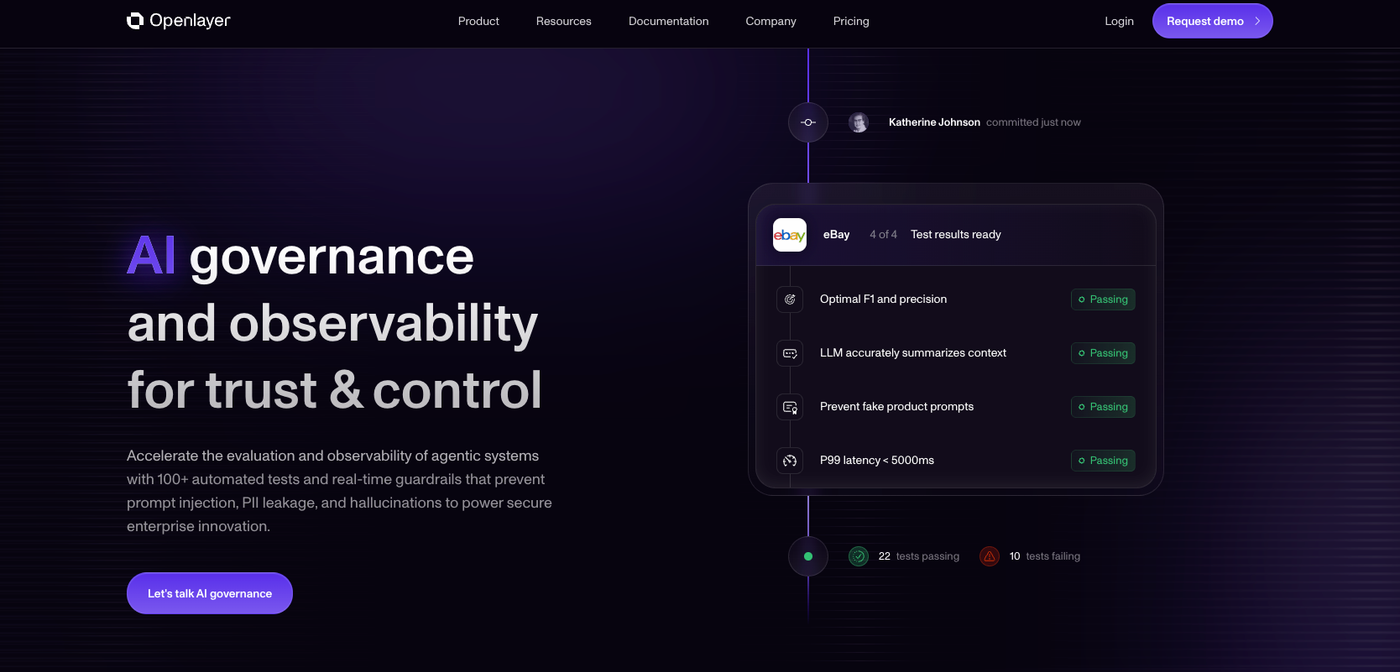
Openlayer maps AI projects directly to the EU AI Act and other frameworks, automatically aligning system behavior against regulatory requirements without manual configuration through AI model evaluation. The 100+ behavioral tests cover bias, hallucinations, PII leakage, toxicity, and adversarial robustness: the same risk categories Article 6 obligations demand you document and control across the full lifecycle.
CI/CD integration means validation runs before deployment. If a model update introduces bias or degrades robustness, the test suite catches it before the change reaches production. Post-deployment, continuous monitoring tracks live performance against the same standards, feeding the post-market monitoring obligation with production data regulators expect to see.
Security guardrails run in real time, blocking prompt injections and PII leakage before they reach downstream systems, directly supporting cybersecurity requirements under Article 15. Risk classification, approval workflows, and compliance evidence all live in one governance interface accessible to compliance officers and technical teams alike.
Final thoughts on preparing for EU AI Act high-risk obligations
The EU AI Act's high-risk systems framework forces a shift from periodic audits to continuous runtime proof. You can't retroactively generate logs, risk assessments, or bias evaluations when a regulator comes asking, so the infrastructure has to be live from the start. August 2026 is your hard deadline, but the real work is designing systems that stay compliant through model updates, deployment changes, and incident responses. Connect with our team if you want help automating the testing and monitoring work that high-risk obligations demand. Treat compliance as engineering, not paperwork, and you'll be ready when the deadline hits.
FAQ
How do I know if my AI system qualifies as high-risk under the EU AI Act?
Your system qualifies through one of two pathways: either it's a safety component in a product already covered by Annex I sectoral legislation (like medical devices or aviation equipment), or it's a standalone system operating in one of the eight Annex III sectors (biometrics, employment, credit scoring, law enforcement, education, public services, migration, or justice). If your system materially influences decisions in these areas, assume high-risk classification until proven otherwise.
What's the difference between provider and deployer obligations?
Providers build the system and own design-level compliance: risk management, documentation, conformity assessment, and CE marking. Deployers run the system in production and are responsible for following instructions for use, assigning human oversight personnel, monitoring live behavior, retaining logs for six months, and reporting incidents. Both carry distinct legal obligations, and regulators review both when incidents occur.
When does the August 2026 deadline actually require compliance to be complete?
By August 2, 2026, your high-risk system must have a functioning risk management process, complete technical documentation, finished conformity assessment with CE marking affixed, registration submitted to the EU database, and post-market monitoring active in production. The European Commission missed its February 2026 guidance deadline, but that creates interpretive risk, not a compliance extension. Treat August 2026 as binding.
Can I self-certify conformity for a high-risk recruitment screening tool?
Yes, if it's a standalone Annex III system like most recruitment tools. You can follow internal conformity assessment under Annex VI without a notified body, prepare technical documentation yourself, and self-certify compliance before placing the system on the market. Product-embedded Annex I systems require third-party certification, but standalone employment, credit, or education systems do not.
What happens if my system causes a serious incident after deployment?
You must report it to the relevant market surveillance authority without delay once you confirm or reasonably suspect a causal link between your system and the incident. Then suspend or restrict the system if the incident cannot be contained, investigate root cause, document findings, issue corrective action (which may include withdrawal from market), and notify all downstream deployers of the corrective measures taken.