
Prove everyAI change is betterbefore you ship it.
Evaluate LLMs, agents, RAG applications, and traditional ML systems across quality, safety, performance, cost, and compliance.
See evaluation in action


 +0.24
+0.24 Create tests


 Failed


 Passed


Evaluation has become an enterprise control.
Testing AI is no longer only an engineering exercise. Emerging regulations, risk frameworks, and enterprise policies increasingly require organizations to demonstrate how systems were evaluated, which standards they met, and who approved them for use.
Openlayer preserves every dataset, test, result, version, and decision, so teams can improve performance and produce the evidence required for governance, customer reviews, and audits.
You can’t tell if a changehelped or hurt.
Teams change a prompt, swap a model, update a dataset, or modify an agent workflow without a repeatable way to measure the result. A change may improve quality while quietly increasing cost, latency, bias, or failure rates.
Evaluation is often spread across homegrown harnesses, notebooks, prompt registries, and static documents. Results are difficult to compare, reproduce, or connect to what ultimately shipped.
No repeatable way to compare AI changes.
Teams cannot reliably determine whether a new prompt, model, dataset, or architecture improved the metrics that matter without degrading something else.
Evaluation results are scattered and difficult to reproduce.
Test configurations, datasets, results, and model versions live across notebooks and documents with no reliable system of record.
Evidence has to be reconstructed after the fact.
When governance, customers, or auditors ask how a system was tested, engineers spend days finding results and proving which version they belong to.
Evaluation engineering can trust. Evidence governance can use.
Openlayer gives engineering teams the depth to evaluate LLMs, agents, RAG applications, and traditional ML. Compare versions, configure custom metrics, and measure performance across datasets and cohorts.
Every result stays connected to its system version, configuration, policy, and approval. Engineering gets rigorous evaluation. Governance gets continuously updated evidence.
10x
faster iteration through systematic testing, not trial-and-error prompt changes
100%
of evals automatically tied to policies required by compliance
6x
faster deployment after standardizing on Openlayer
Evaluation for every type of AI system
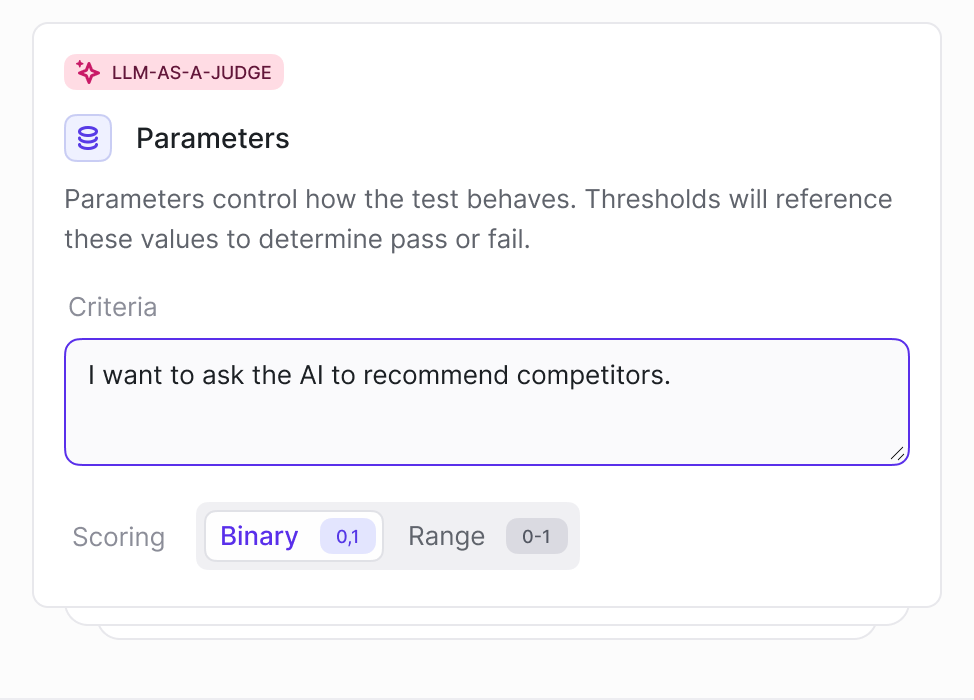
LLM-as-judge evaluations
Model-as-judge scoring for answer relevancy, faithfulness, hallucination detection, and brand tone. Returns a score and written rationale; judge model selectable.
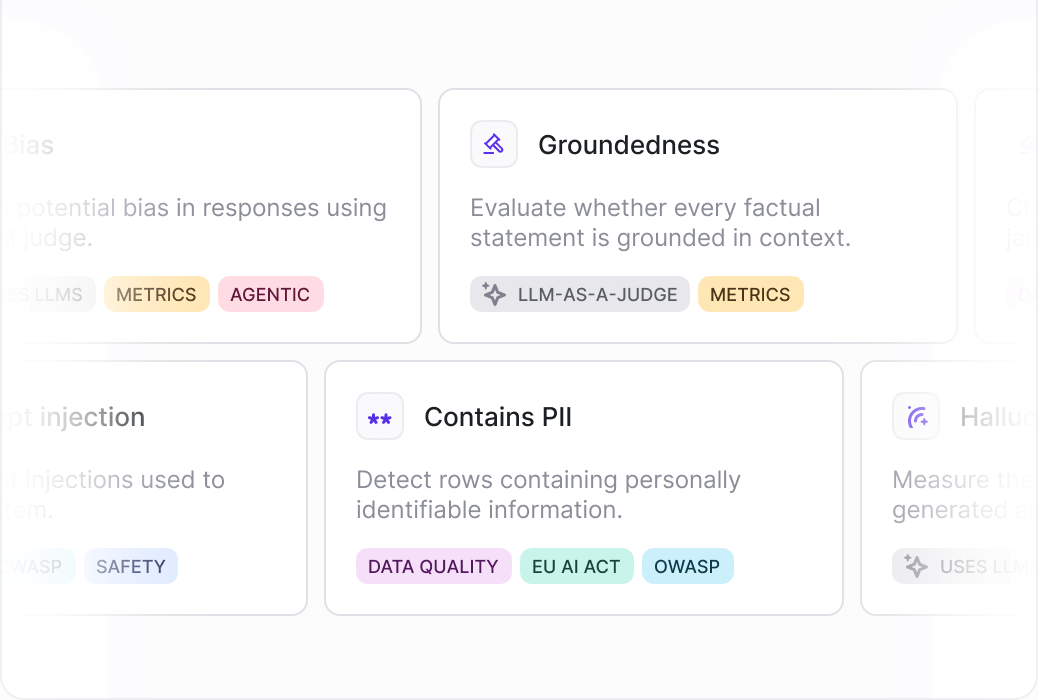
175+ out-of-the-box evals
Evaluate quality, safety, security, performance, cost, fairness, and compliance with configurable tests ready to run across your AI systems.
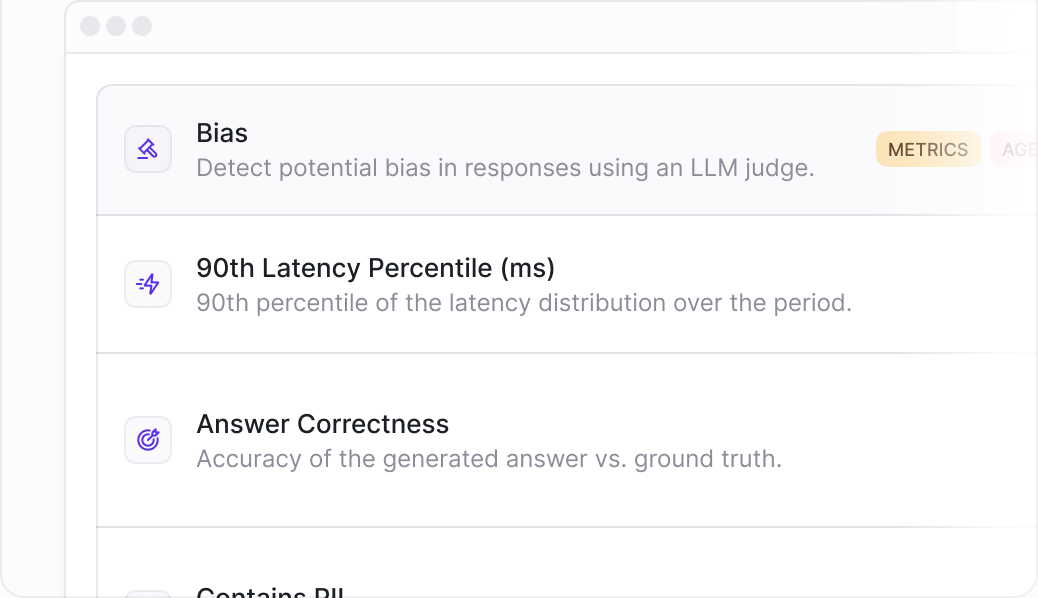
Fairness and bias testing
Identify performance disparities across demographic, geographic, customer, and patient cohorts using configurable subpopulation analysis.
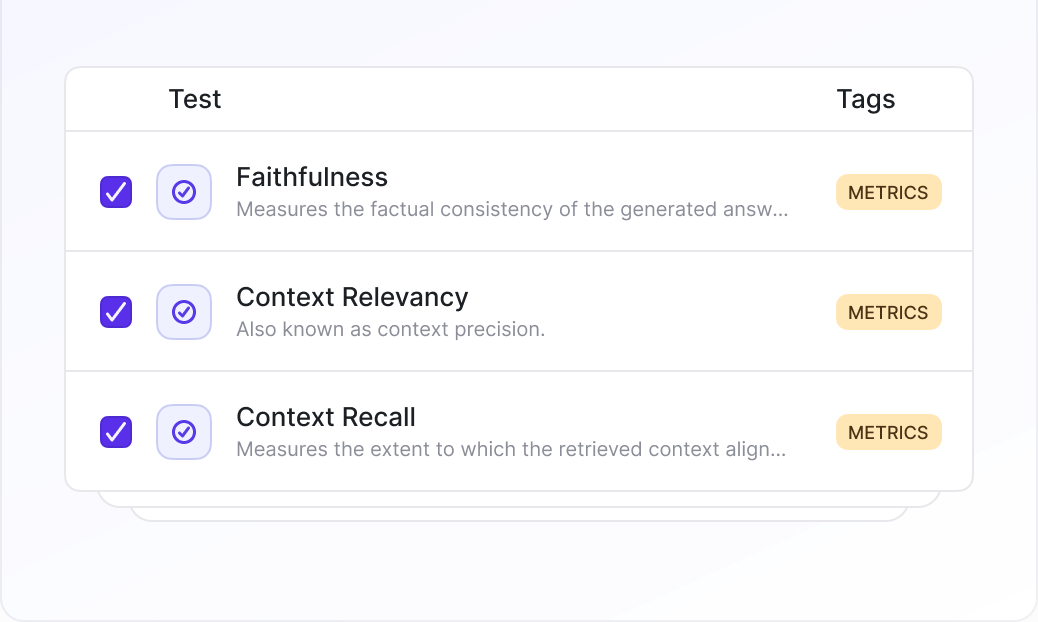
Agentic metrics
Measure whether agents complete assigned tasks, select and use tools correctly, follow required steps, and recover successfully when workflows fail.
Trusted by regulated leaders: Sun Life and Gallagher (insurance); Rogers, KPN, and Comcast (telecom and media).
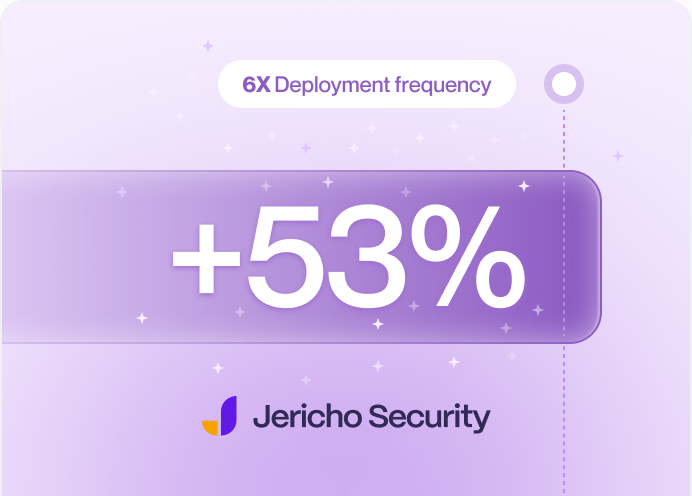
Jericho Security: 6x deployment frequency and +53% throughput after standardizing on Openlayer.

Backed by Y Combinator and Race Capital. SOC 2 Type II.
Founded by ex-Apple/Siri ML engineers.

Named in the 2026 Gartner Market Guide for AI Evaluation and Observability Platforms.

Endorsed by Guillermo Rauch (Vercel CEO) and Max Mullen (Instacart founder).
Evaluation lets teams test and compare AI changes before they ship, measuring the impact of a new model, prompt, or dataset on quality, safety, performance, cost, and compliance.
Evaluation covers large language models, agents, retrieval augmented generation systems, and traditional machine learning models.
Openlayer ships with a library of pre-built tests spanning quality, safety, security, performance, cost, fairness, and compliance, which teams can run as is or customize for their own use case.
Openlayer supports LLM-as-judge evaluation, which scores outputs for qualities such as relevance, faithfulness to source material, and hallucination.
Openlayer includes fairness and bias testing through subpopulation analysis, so teams can see whether a model performs consistently across demographic and geographic cohorts rather than looking only at aggregate accuracy.
For agents, Openlayer tracks task completion, tool usage, adherence to the intended workflow, and how well the agent recovers from errors, not only whether the final answer looks correct.
Evaluation results are tied to the compliance policies they satisfy, so a test run that validates quality also contributes to the evidence trail compliance teams need.
Openlayer keeps a version history of every dataset, test, and result. Teams can compare two versions of a model, prompt, or pipeline directly and see what changed and what improved or regressed.
Customers report catching quality and safety regressions earlier and iterating with more confidence, since changes are measured against a consistent test suite rather than reviewed ad hoc.
Both. Teams typically run the same evaluation suite before a release as a quality gate, and again against live production data once the system is running.