Set Up an AI Governance Committee: Charters & RACI Roles October 2026

In November 2025, a proposed class-action lawsuit in San Diego Superior Court alleges that a California health system used an AI medical scribe to record patient-clinician conversations without notice or consent and send the audio to the vendor. The complaint also alleges the generated notes falsely stated that patients had been informed and agreed, and the named plaintiff said he discovered the recording through his medical notes (AI Incident Database, Incident #1754). These are allegations, not findings. But they show why, before the first appointment, teams need documented answers on who approves the tool, who reviews its consent and privacy implications, and who has authority to halt it.
TLDR:
- In the recommended governance model, the AI governance committee has delegated authority to approve, suspend, or require remediation of AI deployments, while the steering committee focuses on strategic direction.
- EU AI Act Article 26 requires deployers of high-risk systems to assign human oversight to people with the competence, training, and authority to act. A committee can oversee these assignments, with the governance record documenting named individuals and their responsibilities.
- Effective committees draw from six functions, including an executive sponsor with suspension authority, and work best with roughly 7-9 members.
- A RACI matrix cross-referenced in the charter is what separates a deliberation record from a decision record auditors can actually inspect.
- Openlayer's unified evaluation, observability, and governance platform provides per-request audit records at inference time, automated compliance mapping across the EU AI Act, NIST AI RMF, and ISO 42001, and over 175 pre-built tests, so committees review documented results instead of assembling evidence by hand.
What an AI governance committee is (and what it's not)
For the operating model in this guide, an AI governance committee is a cross-functional body with delegated authority to approve, suspend, or require remediation of AI deployments. Organizations may assign those decisions differently, but the committee's mandate should identify who has final authority and how decisions become enforceable. It sets policies, approves use cases, manages risk classifications, and keeps an auditable record of every decision. The audit trail is what separates a governance committee from a recurring calendar invite.
What it's not: a steering group, an advisory forum, or a monthly roundtable where stakeholders share updates. Without delegated authority, the committee may identify risks but cannot independently require remediation or suspend a deployment. EU AI Act Article 26 places obligations on deployers, including using high-risk systems according to the provider's instructions, assigning competent human oversight, and monitoring their operation. A committee can coordinate and document these responsibilities, while the deployer remains accountable for fulfilling them.
The practical test is whether the committee's responsibilities and decisions have defined consequences. If another authority can override its recommendations, the charter should identify that authority and document how overrides are reviewed and recorded. For the model recommended here, a named chair, documented mandate, quorum rules, and delegated decision rights make that accountability enforceable.
Why organizations are forming AI governance committees now
Regulation is the first driver. The EU AI Act's obligations for providers of general-purpose AI models (GPAI) have applied since August 2025, and the Commission's power to enforce them, including fines under Article 101, began on August 2, 2026. Those providers must maintain technical documentation covering architecture, training data, compute, and known limitations. Providers of models carrying systemic risk take on added duties, including adversarial testing and incident reporting to the European AI Office. Deployers face a separate obligation: for high-risk systems, Article 26 deployer obligations apply from December 2, 2027, for Annex III systems and August 2, 2028, for Annex I systems, and require assigning human oversight to natural persons with the competence, training, authority, and support needed to do the job. A governance committee provides a documented home for those assignments.
Disclosure is the second signal. A March 2026 ISS-Stoxx review of 3,048 U.S. companies across the Russell 3000 and S&P 500 found that only 8% (245 companies) disclosed board-level AI oversight and only 9% (275 companies) acknowledged having AI policies in place. Few companies publicly disclose AI oversight or formal AI policies, leaving limited visibility into how those organizations govern AI deployments.
Operations is the third. Informal approvals (email chains, verbal sign-offs, one-off reviews) leave no durable, searchable record of who approved what, and each unreviewed deployment is a gap in the audit record.
AI governance committee vs. AI steering committee
A steering committee sets strategic direction. This group ranks AI initiatives, allocates resources, and aligns business units around a shared roadmap. Its output is plans, recommendations, and investment decisions.
In the recommended operating model, the governance committee has delegated authority to approve deployments, classify risk, and require remediation. It produces decisions with named owners, timestamps, and documented rationale. When the committee determines that a system is not ready for production, its decision acts as a deployment gate.
Many organizations need both, operating in coordinated but separate roles. The steering committee surfaces which AI initiatives to pursue; the governance committee determines whether each one can proceed and under what conditions. Conflating them creates a structural problem: governance review moves slower than strategic planning, so separate roles keep each body's output clear.
If your organization has one body handling both functions, check whether approval rights, escalation paths, and decision records are defined. Business units may obtain sign-off from the committee or another designated authority, but the approval process needs a named decision-maker and an auditable record.
Who should serve on an AI governance committee?
Membership determines whether the committee can actually govern or just deliberate. A body composed only of engineers and data scientists can miss legal exposure. One composed only of compliance and legal staff can approve or block deployments without understanding what they're approving or blocking. Neither configuration produces defensible decisions.
A working committee draws from at minimum six functions:
- Legal and compliance: owns regulatory interpretation and documentation requirements
- Security: assesses data handling, access controls, and runtime risk
- Data science and engineering: assesses technical feasibility and failure modes
- Business unit leadership: represents day-to-day business context and downstream impact
- Privacy: flags data residency, consent, and PII handling obligations
- Executive sponsor: holds escalation authority and board-level accountability
Finance belongs on the committee when AI systems carry material cost or liability exposure. A single agent workflow burning tokens in an infinite loop is a finance problem before it becomes a compliance problem.
As a working guideline, seven to nine members with clear quorum rules cover most enterprise configurations. Below five, too few functions sit at the table to cover the six areas above; above ten, it gets harder to name one owner per decision. These are sizing guidelines, not legal requirements: Article 26 of the EU AI Act sets no committee size.
For organizations in regulated industries, an external advisor with domain-specific regulatory experience may cover expertise internal staff lack. Internal teams know the systems they run. But an advisor adds regulatory context, and the committee still makes the decision.
Core responsibilities of an AI governance committee
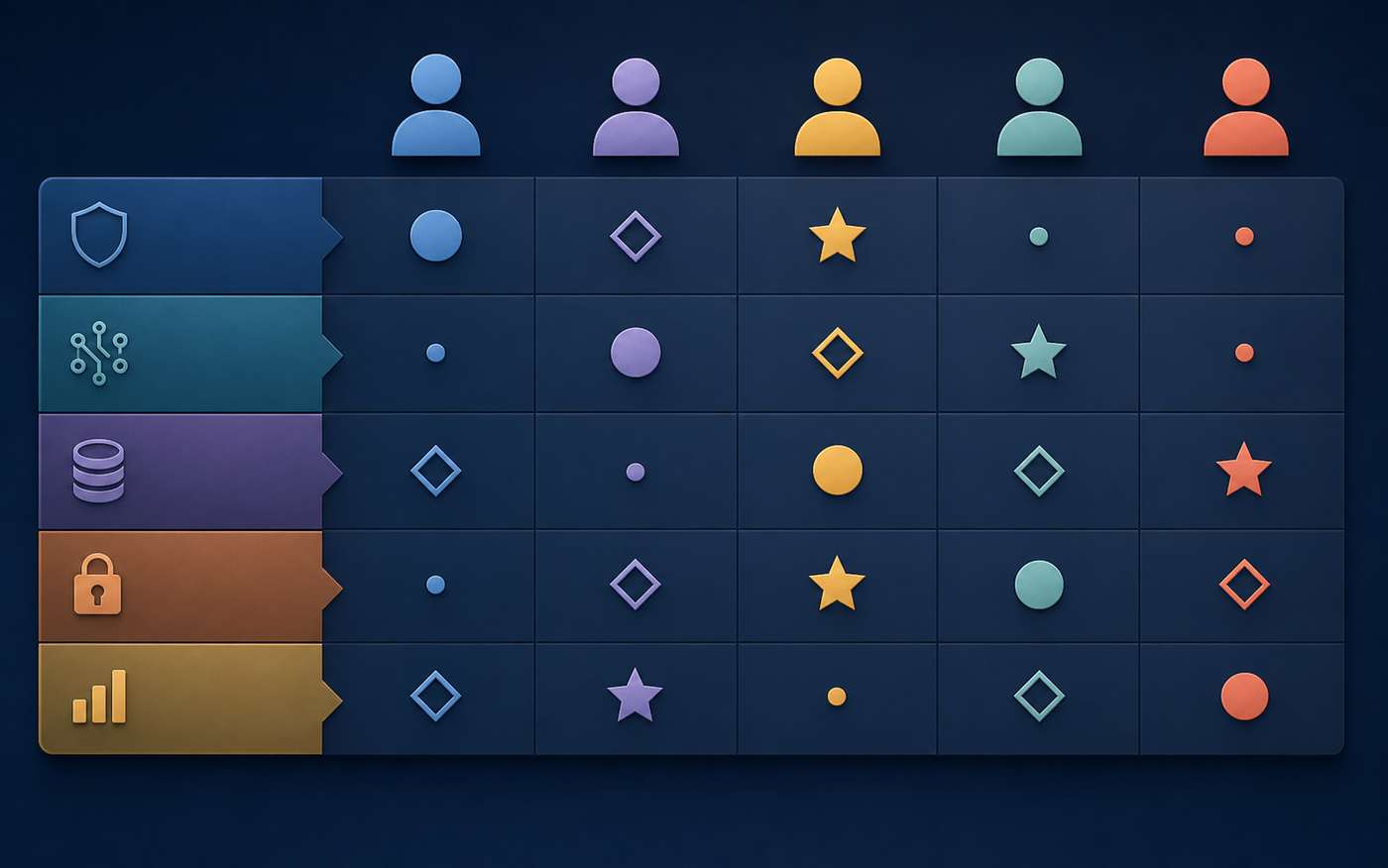
Under this operating model, the committee holds delegated authority over intake classification, use-case approval, exceptions, suspension, and evidence. Unclassified systems cannot enter the development queue, and business units must follow its approval decisions. Policy review differs: the committee sets policy and reviews it on a fixed schedule that business units cannot override. Blurring these two decision types creates accountability gaps auditors will find. The committee's seven responsibilities are:
- Intake and risk classification: review every proposed AI system before development or procurement begins; assign an internal risk tier by scoring impact scope, failure severity, observability, and regulatory exposure; use the EU AI Act classification as a reference point; and record the written rationale for each score.
- Use-case approval: grant or deny formal authorization for each AI use case with documented reasoning. Denials must name the specific failure condition; approvals must name the owner and any attached conditions.
- Exception handling: run a structured waiver process for systems that cannot satisfy standard requirements. Exceptions require a named approver, compensating controls, an expiration date, and an immutable record.
- Policy enforcement and review cycles: own the organization's AI acceptable-use policy, data handling standards, and vendor assessment criteria. Review each on a defined schedule, annually at minimum, sooner when regulatory requirements shift.
- Oversight of deployed systems: monitor production AI systems against approved risk thresholds. When drift, demographic parity gaps, or safety failures surface, the committee decides whether to approve continued operation, require remediation, suspend it, or escalate.
- Incident escalation authority: hold binding power to suspend a system, require rollback, or escalate to the board. A committee without suspension authority can document a failure but cannot stop it. Runtime AI controls can act before a human reviews the case, so the committee's suspension decision is a review step that follows enforcement action.
- Regulatory compliance evidence: own the audit trail of approval records, risk assessments, test results, and incident reports regulators will inspect. Collecting evidence after an audit request arrives is too late.
How to structure decision rights: the RACI matrix
A charter tells you who sits on the committee. A RACI matrix tells you who decides.
| Decision | Responsible | Accountable | Consulted | Informed |
|---|---|---|---|---|
| New AI system intake and classification | Data science lead | Executive sponsor | Governance lead (validates the score before approval), legal and compliance, security, privacy | Business unit owner |
| High-risk deployment gate | Governance lead | Executive sponsor | Engineering, legal and compliance, security, privacy | All committee members |
| Policy exception grant | Compliance officer | Executive sponsor | Security, privacy | Model owner, business unit |
| Post-incident remediation sign-off | Model owner | Governance lead | Engineering, security, legal and compliance | Executive sponsor |
| Audit evidence submission | Governance lead | Executive sponsor | Legal and compliance | Board AI liaison |
| System suspension or rollback | Governance lead | Executive sponsor | Engineering, security, legal and compliance | All committee members, business unit owner |
| Human oversight assignment and verification | Business unit owner | Executive sponsor | Governance lead, legal and compliance, security, designated system operators | Model owner, all committee members |
| Serious-incident notification to provider and authorities | Compliance officer | Executive sponsor | Governance lead, security, model owner | All committee members |
Role key: the governance lead is the committee chair, who runs intake and records each decision. The compliance officer, data science lead, engineering, and business unit owner correspond to the legal and compliance, data science and engineering, and business unit leadership seats. The model owner is the person named at intake as responsible for the AI system; this role is not a committee seat. The board AI liaison relays committee outputs to the board, and the roster records who holds the role; the executive sponsor keeps board-level accountability. The executive sponsor is only informed on post-incident remediation sign-off because suspension and sign-off are separate decisions: the sponsor decides whether a system stops, and the governance lead decides whether the fix is sufficient.
For high-risk AI systems, the executive sponsor is accountable for documenting the oversight assignment; designated natural persons perform the operational oversight required by Article 26(2), with the necessary competence, training, authority, and support.
Without this matrix, the committee produces deliberation records, not decision records. An auditor reviewing a deployment approval needs to see who was accountable, who was consulted, and when. "The committee reviewed it" does not show who decided or when. A named accountable party and a timestamp do.
The eight decisions above cover the minimum viable decision surface. Article 9 risk management and Article 14 human oversight design are provider obligations. Deployer duties sit in Article 26: use per the provider's instructions, assign human oversight to competent, trained, authorized people, and monitor operation. High-risk systems need additional owned decisions mapped to those duties, drawing on the provider's Article 9 risk management documentation and Article 14 measures. Add those rows before your first regulated deployment, not after.
How to write an AI governance committee charter
A workable charter covers seven sections. No regulation or standard mandates this exact list, but skipping one leaves a gap an auditor can ask about.
ISO 42001 Clause 5 assigns accountability for the AI management system to top management; the charter makes that accountability concrete and traceable. EU AI Act Article 26(2) requires deployers to assign human oversight to natural persons with the competence, training, authority, and support to carry it out. The charter can identify who manages those assignments, while system-level records identify the designated individuals.
The seven recommended sections:
- Purpose and authority: two sentences stating why the body exists and what it can compel. Vague purpose language ("promote responsible AI") fails; binding authority language ("approve, require, or halt AI deployments") passes.
- Scope: define what counts as AI for this charter. Include LLMs, agents, embedded models, and third-party AI tools, covering vendor AI governance alongside internally built systems. Anything left undefined is outside governance by default.
- Membership: list roles, not names, so the charter stays stable as people change. Maintain a separate roster outside the charter that records the named individual for each role, including the chair, and update it as assignments change. Include a quorum rule in the charter itself. Without quorum, decisions made by a partial committee have no documented authority.
- Decision rights: map which decisions the committee makes, which it advises on, and which it delegates. Cross-reference your RACI matrix here.
- Meeting cadence: set a regular frequency and name the conditions that trigger an out-of-cycle meeting, including a security incident, a new high-risk deployment request, or a regulatory deadline.
- Outputs and reporting: specify what the committee produces: approval records, risk assessments, exception logs, escalation summaries. Name the audience for each.
- Revision procedures: state when the charter is reviewed and who must approve changes. A charter that cannot be updated is a governance artifact, not a governance tool.
The three lines of defense: where the committee fits
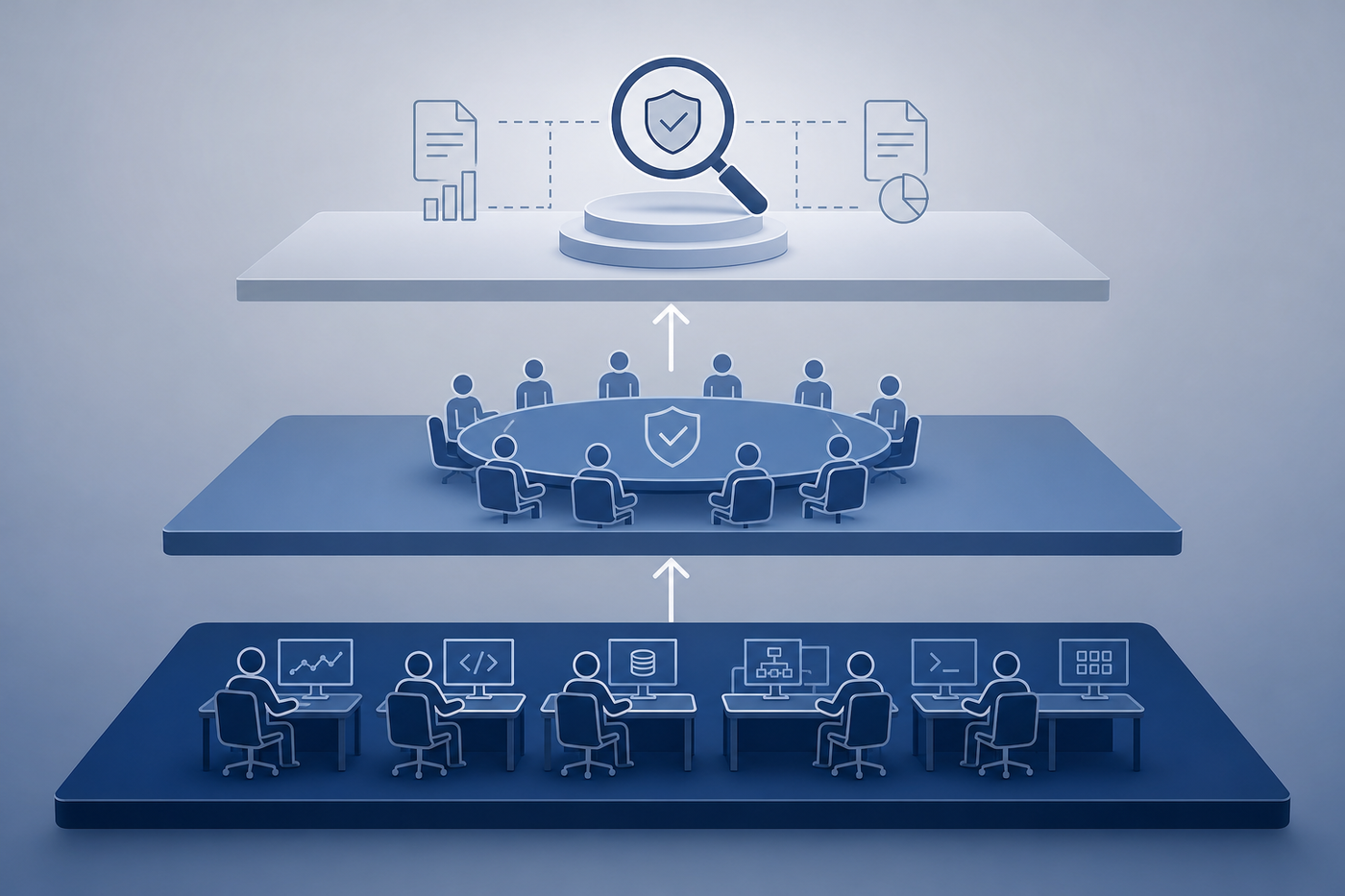
The three lines of defense model gives the governance committee a structural home and clarifies what it cannot replace.
First line: the AI builders, product teams, and business units who deploy and operate AI systems day to day. They own the immediate risk controls: prompt configurations, access permissions, output monitoring, and incident escalation.
Second line: risk and compliance functions establish oversight policies, assess whether controls meet organizational requirements, and challenge first-line decisions. A cross-functional AI governance committee can coordinate these activities and exercise delegated approval or suspension authority, but it does not automatically belong entirely to the second line. The charter should distinguish members representing first-line operations from those providing independent risk oversight and document how conflicts of interest are handled.
Third line: internal audit, which independently validates whether first-line controls are functioning and second-line oversight is producing reliable evidence. Audit reviews the committee's outputs (approval records, risk assessments, exception logs) to assess whether governance is real or documentary.
Avoid letting AI builders approve their own deployments without independent challenge. Cross-functional committees can include first- and second-line representatives, but the charter must preserve separation between operational ownership and independent risk oversight. A committee member should recuse from the approval vote on any system they build, own, or sponsor. Two examples: the data science lead who prepared a system's intake classification, and the business unit leader who requested its deployment. The charter's decision rights and quorum rules should record how the committee notes a recusal and meets quorum when it happens.
How to form an AI governance committee: seven considerations
Here are seven considerations as you set up the committee, ideally before the first regulated deployment. The order matters because the sponsor and scope shape every later decision, but you can adjust the later steps to fit how your organization already approves technology.
- Secure an executive sponsor with suspension authority: without a sponsor who can halt a deployment, the committee has no enforcement backstop. Name this person first; all other formation decisions flow from that accountability anchor.
- Define scope explicitly: draft a one-page scope statement listing what counts as AI for governance purposes: internal LLMs, third-party AI tools, agents, embedded models, and vendor-supplied systems processing regulated data. Systems left undefined are outside governance by default.
- Draft and ratify the charter: circulate for comment, then get the executive sponsor's signature on record. An unsigned charter is a working document; a signed one is an organizational commitment.
- Constitute membership with named role owners: the charter defines the roles; the roster records one named individual for each of the six functions (legal and compliance, security, data science and engineering, privacy, business unit leadership, and executive sponsor). Every seat needs a named backup, and quorum requires at least half the named members.
- Build the AI system inventory as the committee's first working artifact: pull deployments from IT, product teams, and business units before approving anything new. Unregistered systems may have technical controls, but the committee lacks a reliable inventory record connecting each system to its owner, risk assessment, monitoring status, and suspension procedures.
- Set the approval workflow for new use cases: define what triggers a submission, what the intake form captures, how risk is classified, and what constitutes approval. New systems should not enter development without a submission on record.
- Set the operating cadence: hold monthly meetings for routine intake and policy review; hold out-of-cycle sessions for high-risk deployment gates, security incidents, and regulatory deadlines. Name the trigger conditions so no one has to debate whether a meeting is warranted.
Operating cadence: meetings, decisions, and escalation
Cadence design determines whether the output is audit-ready.
Monthly meetings cover routine workload: new use-case intake reviews, risk reclassifications, policy updates, exception renewals, and a standing review of production systems flagged by monitoring. Each agenda item closes with a documented decision (approve, deny, require remediation, suspend, or escalate) carrying the accountable party's name and a timestamp. "The committee discussed" is not a decision record.
Quarterly sessions handle the slower cycle: charter review, KPI metrics review, a full audit of the AI system inventory for unregistered or stale entries, and board reporting preparation.
Out-of-cycle escalations need a pre-defined trigger list. Name the conditions: a security incident involving a deployed AI system, a high-risk deployment request that cannot wait for the next monthly session, a regulatory deadline, or an adverse monitoring alert crossing a defined severity threshold. Without named triggers, teams hesitate to call an emergency meeting until the incident has already compounded.
Written decisions require four fields to be audit-ready:
- Decision: approve, deny, require remediation, suspend, or escalate
- Accountable party: named by role and name
- Date: the date of the decision
- Rationale: the specific condition the decision turned on, such as a risk score exceeding the approval threshold, a missing data privacy assessment, or a failed evaluation result for a regulated use case
Auditors reviewing a deployment approval need to reconstruct the decision from the record alone, without interviewing anyone who was in the room.
Common reasons AI governance committees fail
A committee can fail before it governs a single system. Most of the failure modes below are structural: fixing them requires changing what the committee is authorized to do, not how often it meets. Two are procedural: a missing AI system inventory and slow intake; fixing them requires changing how the committee operates day to day.
- Advisory-only authority: when a committee makes recommendations without a defined approval or escalation process, business units may proceed without meaningful governance review. The charter should specify which decisions the committee makes, which it escalates, and who can suspend a deployment.
- No AI system inventory: a committee cannot govern systems it cannot see. Build the inventory as the committee's first working artifact, before approving anything new.
- Shadow AI entering production unreviewed: an MIT report, summarized by hrbrain.ai, quotes MIT Sloan's Robert C. Pozen on the mechanism: centralized approval creates bottlenecks, teams wait, and workarounds proliferate. The same report found 72% of business leaders believe headquarters should set broad guidelines while teams define specific usage rules. A tiered fast-track fixes this: minimal-risk systems get a lightweight registration step, higher-risk systems go through full review, and the committee still gates what needs gating.
- Membership skewed toward IT: technical-only committees approve deployments without flagging legal exposure or data handling gaps. Legal, compliance, and privacy must hold seats with actual blocking authority, not observer status.
- Decision rights left implicit in the charter: membership and meeting cadence get defined; who decides what does not. Every committee needs a RACI matrix cross-referenced in the charter before the first meeting, not assembled after the first contested decision.
How to measure AI governance committee effectiveness
A committee that meets regularly but cannot answer basic questions about its own output is not functioning; it is performing. Six metrics separate the two.
- Intake coverage rate: registered AI systems as a percentage of all identified AI systems, including those found through shadow AI discovery. A rate below 100% reveals known systems missing from the formal inventory, including the records that support an AI risk assessment report. Track discovery coverage separately, since this metric cannot account for systems the organization has not identified.
- Time-to-decision on use-case approvals: median days from submission to documented approval or denial. Slow intake drives shadow deployment; the target is fast enough that the formal path is easier than the workaround.
- Exception rate and exception aging: active waivers as a percentage of approved systems, plus average days since last review. Aging exceptions signal governance drift.
- Incident detection-to-remediation cycle time: days from a monitoring alert to a documented committee decision and verified remediation. Long cycles can indicate the committee lacks the direct connection to production systems needed to act on what monitoring surfaces, though remediation complexity can also lengthen them.
- Audit finding rate on AI-related controls: findings per audit cycle attributable to governance gaps. The trend can suggest how complete the evidence is, but audit scope and detection quality also move the rate, so read it alongside those factors rather than on its own.
- Compliance framework coverage: percentage of active AI systems with current, complete documentation mapped to applicable frameworks.
For board and executive reporting, translate these into governance ROI signals. Intake coverage rate becomes regulatory exposure scope. Time-to-decision becomes deployment velocity impact. Audit finding rate becomes regulatory exposure trend. Executives manage the risk those metrics represent, not the metrics themselves.
How Openlayer supports AI governance committee operations
Governance committees need evidence, not summaries. A common gap: the committee meets, reviews a hand-assembled slide deck, and approves or denies based on what someone chose to include.
Openlayer's governance intake and inventory interface provides committee members, including compliance officers and risk managers with no engineering background, a visual workspace to register AI systems, collect structured metadata, and maintain an AI asset catalog without developer mediation. The interface also lets governance teams register previously untracked AI systems, giving committee members a central inventory for reviewing ownership, risk classification, and monitoring status.
Automated compliance mapping is live in production for the EU AI Act, NIST AI RMF, and ISO 42001 (see the Openlayer governance roadmap). It maps each system's test results to specific requirements in those frameworks and captures supporting evidence as tests run, so the committee can see where each system stands, requirement by requirement. Runtime enforcement produces per-request audit records at inference time, including the metric score, the triggered policy rule, and a timestamp, continuously. The compliance framework snapshot export gives the committee an on-demand audit package for regulatory submissions without manual document preparation. Compliance remains a shared responsibility.
The committee also needs to know whether a control observes or enforces. A monitoring alert that flags a groundedness score below the committee's approved threshold is observation: it records the failure after the response has reached the user. Openlayer's runtime guardrails block, redact, or escalate that response at the API boundary before delivery, and that blocking step, beyond logging the anomaly, is what separates enforcement from observation. In practice, the committee sets the thresholds, guardrails apply them at inference time, and the committee reviews the resulting records.
Limitation: guardrails enforce on traffic routed through Openlayer, most commonly through the Gateway, which sees every request and response passing through it. A system that calls a model directly, outside that route, is not enforced. Intake and inventory still bring that system into the committee's view, so the committee can record its owner and risk tier and decide whether to route it through Openlayer.
An executive dashboard lets compliance officers and executives see compliance status and project health across the full AI portfolio in one view, without opening individual projects. Over 175 pre-built automated tests supply a consistent, framework-mapped standard for assessing AI systems at intake and in production, so the committee reviews documented results against known thresholds, not judgment calls. The same test definitions support evaluation, monitoring, and runtime enforcement, so the committee doesn't need to rebuild a threshold for each lifecycle stage.
Final thoughts on forming an AI governance committee
The difference between a governance committee and governance in name only is authority: who can halt a deployment, require remediation, and produce the documented record an auditor can reconstruct without interviewing anyone in the room. Get the charter signed, build the RACI matrix before the first meeting, and treat the AI system inventory as a live artifact, not a one-time exercise. Your committee's effectiveness shows up in intake coverage rates and audit findings long before it shows up in a policy document. To see how Openlayer supports the evidence trail and intake workflow that make governance auditable, schedule a demo.
FAQ
How can an AI governance committee charter support EU AI Act Article 26 human oversight requirements?
A strong charter includes seven documented elements: purpose with binding authority language (not advisory framing), explicit scope defining what counts as AI, membership by role with a named chair and quorum rule, a RACI matrix mapping specific decisions to accountable parties, meeting cadence with named out-of-cycle triggers, a list of required outputs with named audiences, and revision procedures with approval authority. EU AI Act Article 26(2) requires deployers of high-risk systems to assign human oversight to natural persons with the necessary competence, training, and authority; it does not require a charter, committee, or suspension authority. A policy statement that references oversight in the abstract doesn't show who holds that assignment, while a signed charter with a named chair and documented suspension authority records it and the authority behind it.
How does Openlayer compare to Credo AI and IBM watsonx.governance for running an AI governance committee's approval and evidence workflow?
Credo AI and IBM watsonx.governance also support enterprise AI governance, so the comparison turns on how each one connects a committee's approval decisions to operating controls. Credo AI combines policy management, risk assessments, and compliance mapping, with agent enforcement capabilities available in research preview. IBM watsonx.governance supports model risk management, monitoring, and real-time input and output checks. Openlayer connects these functions: shared test definitions support evaluation, production monitoring, and runtime enforcement, while per-request records document enforcement decisions as they occur. Combined with automated compliance mapping and audit evidence, those records let a committee verify, request by request, that the controls it approved operated as intended. Keep in mind that guardrails enforce on traffic routed through Openlayer, so confirm which systems sit in that path when you compare coverage.
How do I measure whether my AI governance committee is actually working?
Six metrics separate a functioning committee from one that only meets: intake coverage rate (registered systems as a percentage of all identified AI systems; below 100% indicates identified systems that remain unregistered), median time-to-decision on use-case approvals, exception rate and aging, incident detection-to-remediation cycle time, audit finding rate on AI-related controls per cycle, and compliance framework coverage across active systems. For board reporting, translate these into liability terms: intake coverage becomes regulatory exposure scope, time-to-decision becomes deployment velocity impact, and audit finding rate becomes the direction of your regulatory exposure trend.
What membership should an AI governance committee have to support EU AI Act human oversight?
For the committee model recommended here, six functions should be represented: legal and compliance, security, data science and engineering, business unit leadership, privacy, and an executive sponsor with suspension authority. Seven to nine members is the working guideline that covers most enterprise setups, not a legal requirement. Technical-only bodies can miss legal exposure, and compliance-only bodies can approve or block without understanding the system they're approving or blocking. The executive sponsor also provides an escalation path and makes certain that suspension authority is clearly assigned. Separately, EU AI Act Article 26 requires deployers of high-risk systems to assign human oversight to natural persons with the competence, training, authority, and support needed to act. Article 14 on human oversight is a provider design duty requiring high-risk systems to be built so natural persons can oversee them; it does not govern committee structure.
AI governance committee vs. AI steering committee: which one do I actually need?
Many enterprises benefit from both functions: a steering committee sets strategic direction and ranks AI initiatives, while an AI governance committee reviews risk, oversees controls, and maintains auditable decision records. This guide recommends delegating deployment approval and suspension authority to the governance committee, although organizations may assign those decisions elsewhere. The structural test is whether the charter identifies who decides, who can override a decision, and how approvals and exceptions are documented. Conflating the two creates a practical problem: the deliberative pace required for governance review can conflict with the velocity of strategic planning, so separate roles keep the decision record and the roadmap each clear.