ISO 42001: A Complete Guide to AI Management Systems in June 2026
Teams considering ISO 42001 certification right now are stuck between incomplete information and hard deadlines. You need to know what ISO/IEC 42001:2023 actually requires, what ISO 42001 certification costs in real terms, how long the ISO 42001 AI management system build takes, and whether it moves the needle on EU AI Act readiness. The problem is that the ISO 42001 PDF remains behind a paywall, ISO 42001 lead auditor training options vary wildly in quality and cost, and most available resources treat ISO 42001 as either a compliance checkbox or an aspirational framework with no middle ground. This guide maps the full ISO 42001 certification path.
TLDR:
- ISO 42001 is the first international standard for AI management systems, covering risk assessment, data governance, and monitoring across 39 controls in nine categories.
- Certification takes 6 to 12 months and costs $5,000 to $30,000+ for initial audit, with annual surveillance required to maintain the certificate.
- ISO 42001 certification doesn't satisfy EU AI Act obligations on its own, but the risk assessments and governance structures built for it feed directly into the technical documentation the Act requires.
- Adoption remains limited due to auditor scarcity, the challenge of keeping documentation current as AI systems change, and resource intensity for organizations without existing ISO infrastructure.
- Openlayer connects ISO 42001 requirements to runtime enforcement through automated testing in CI/CD, guardrails that block non-compliant outputs, and audit-ready compliance mapping tied to real system behavior.
What is ISO 42001
ISO/IEC 42001:2023 is the first international standard for AI management systems, covering risk assessment, data governance, transparency, and ongoing oversight across an organization's AI activities. Published by the International Organization for Standardization and the International Electrotechnical Commission, it gives organizations a structured framework for responsibly developing, deploying, and governing AI.
The standard follows the familiar "Plan-Do-Check-Act" structure used across other ISO management system standards, which means organizations already certified under ISO 27001 or ISO 9001 will recognize the architecture. But the controls and requirements here are purpose-built for AI: they cover risk assessment for AI-specific harms, data governance, transparency obligations, and ongoing monitoring of AI system behavior.
At its core, ISO 42001 asks an organization to:
- Define the scope of its AI activities and the context in which AI systems operate
- Identify and manage risks that AI introduces to people, processes, and third parties
- Set objectives for responsible AI and track progress against them
- Build internal competency so staff understand what AI systems can and cannot do
- Keep documentation that supports both internal governance and external audit
The standard applies to any organization that develops, provides, or uses AI, regardless of size or sector.
ISO 42001 structure and requirements
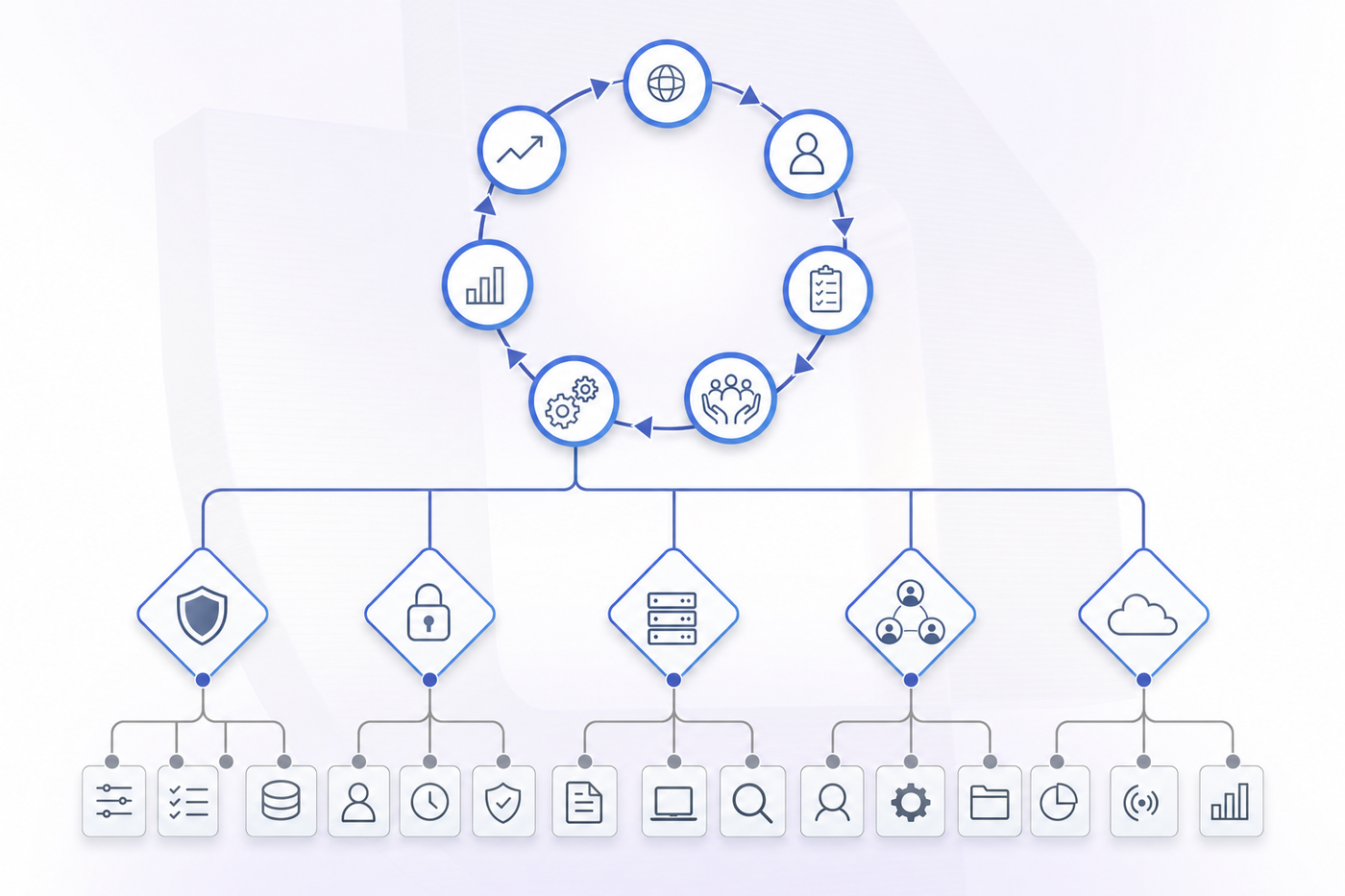
ISO/IEC 42001:2023 follows the same high-level structure (HLS) used by ISO 9001 and ISO 27001, which means organizations already certified under those standards will find the clause architecture familiar. There are ten clauses total, with the substantive requirements starting at Clause 4.
The standard has three core components worth understanding before getting into specifics:
- the main normative clauses (4 through 10),
- Annex A which contains 38 controls across 9 control categories, and
- Annex B which provides guidance on implementing those controls for AI-specific risks.
The main clauses
Clauses 4 through 10 cover the full lifecycle of an AI management system:
- Clause 4 (Context) requires the organization to define the scope of its AI activities, identify internal and external stakeholders, and document the intended purposes of its AI systems.
- Clause 5 (Leadership) places accountability at the executive level, requiring top management to own the AI policy and assign clear roles.
- Clause 6 (Planning) covers risk and opportunity assessment, including how the organization sets objectives for responsible AI.
- Clause 7 (Support) covers resources, competence, awareness, and documentation.
- Clause 8 (Operation) is where the day-to-day management of AI systems lives, including impact assessments and controls over the AI system lifecycle.
- Clause 9 (Performance Evaluation) covers monitoring, measurement, internal audit, and management review.
- Clause 10 (Improvement) covers nonconformities and continual improvement obligations.
Annex A controls
The 38 controls in Annex A are grouped into categories including policies for AI, human oversight, data management, AI system impact assessment, and supplier relationships. Organizations are not required to implement every control; they select applicable controls based on a Statement of Applicability, similar to ISO 27001's approach.
Understanding ISO 42001 Annex A controls
Annex A's 39 controls span nine control areas, ranging from internal AI policy governance to third-party supplier oversight. The AI system life cycle category carries the heaviest load with roughly 11 controls covering design, development, testing, and retirement. Internal organization adds five controls focused on accountability structures and role assignments, while resources for AI systems covers six controls governing compute, data pipelines, and staffing. At the lighter end, AI system use and third-party/supplier AI each contain two controls, but those controls carry real weight in procurement and deployment decisions.
Organizations are not required to implement all 39 controls. Instead, they produce a Statement of Applicability that documents which controls are in scope, which are excluded, and the rationale for each decision. An organization that only deploys third-party AI models instead of developing its own, for example, might exclude several AI system life cycle controls while keeping all third-party supplier controls. Auditors review the Statement of Applicability during Stage 1 to confirm the scoping logic is defensible before the on-site assessment begins. The breakdown looks like this:
| Control Area | Focus |
|---|---|
| Policies related to AI | Creating organization-wide AI governance policies |
| Internal organization | Defining roles, responsibilities, and accountability |
| Resources for AI systems | Managing compute, data, and human resource requirements |
| Assessing AI system impacts | Conducting risk and impact assessments for deployed AI |
| AI system life cycle | Governing design, development, testing, and retirement of AI systems |
| Documented information | Maintaining records and audit trails for AI decisions |
| Relationship with interested parties | Managing stakeholder expectations and communication |
| AI system use | Controlling how AI outputs are applied in practice |
| Third-party and supplier AI | Overseeing AI risk introduced through vendors and partners |
ISO 42001 certification process and timeline
Industry estimates put the typical path to ISO 42001 certification at 6 to 12 months, with the range depending on how much governance infrastructure already exists.
- Gap assessment and preparation: mapping current practices against Annex A controls and producing a Statement of Applicability that documents which controls apply and why.
- Stage 1 audit: a documentation review by an accredited certification body to confirm the AIMS design meets the standard's requirements before any on-site assessment begins.
- Stage 2 audit: the full conformity assessment, where auditors verify that controls are operating as documented in actual practice, not simply on paper.
- Certification decision: the certificate is valid for three years, with annual surveillance audits required to keep it active.
Surveillance audits are narrower in scope than the Stage 2 assessment, but they still require current evidence that the management system is functioning as intended. Missing a surveillance window risks suspension of the certification entirely.
ISO 42001 certification cost and investment
Certification costs range from under $10,000 for small organizations with existing ISO infrastructure to well over $100,000 for large enterprises, depending on management system maturity and which certification body you choose. That said, there are predictable cost categories every organization should plan for.
The main buckets to account for:
- Gap assessment and readiness work, which can run from a few thousand dollars for a small organization to six figures for a large enterprise with complex AI systems across multiple business units.
- Training and internal preparation, including foundation and lead auditor courses, which typically range from $1,000 to $5,000 per person depending on delivery format and provider.
- External audit fees charged by the certification body, which generally scale with the number of audit days required. Expect anywhere from $5,000 to $30,000+ for the initial certification audit.
- Ongoing surveillance audits, required annually, which are typically a fraction of the initial certification cost but still a real budget line.
Recertification audits occur every three years and are usually scoped more narrowly than the initial audit, since a baseline of conformance has already been verified.
One factor that meaningfully affects total cost is whether your organization already holds ISO 27001 or ISO 9001 certification. Because ISO 42001 shares the Annex SL high-level structure common to those standards, organizations with existing management systems can integrate AI governance requirements instead of building from scratch, reducing both preparation time and audit scope. Research shows that ISO 27001-certified organizations can achieve ISO 42001 compliance up to 40% faster than those starting from scratch, making existing management system infrastructure a material cost and time advantage.
ISO 42001 lead auditor certification
Lead auditor certification is the credential that qualifies individuals to plan, conduct, and lead ISO 42001 third-party audits on behalf of a certification body, or to manage an organization's internal audit program at the level of rigor certification bodies expect. Here is what each component of that path actually looks like.
Exam structure
Most lead auditor programs follow a format modeled on the ISO 17021 auditing standard. The exam covers four domains:
- Standard interpretation: applying ISO/IEC 42001:2023 clause requirements and Annex A controls to real audit scenarios
- Audit planning and execution: sampling methods, audit trails, nonconformity classification, and evidence collection
- AI-specific risk concepts: algorithmic bias, data governance, transparency requirements, and monitoring obligations
- Audit reporting: writing findings, grading major vs. minor nonconformities, and closing out corrective action plans
Exams are typically closed-book, multiple-choice plus short-answer, and run two to three hours. Passing scores generally sit around 70%. Most providers also require a practical audit exercise, either a case study write-up or a supervised audit day, before issuing the certificate.
Training course options
There are three main delivery formats, each with meaningful tradeoffs:
- In-person instructor-led (4 to 5 days): providers like BSI, PECB, and DNV run public schedules in major cities. Cost ranges from $2,500 to $5,000 per participant. Best for candidates who want live case study discussion and immediate feedback from an experienced auditor.
- Online self-paced: PECB, Advisera, and several ANAB-accredited bodies offer asynchronous courses with recorded lectures and online exams. Prices typically fall between $800 and $2,000. Quality varies more than in-person options. You should check whether the provider is recognized by the certification body you plan to audit for.
- Blended (online modules plus live virtual exam day): a middle ground that accounts for roughly 30 to 40% of new enrollments as of 2025 to 2026. Typically priced between $1,200 and $3,000.
Providers advertising free lead auditor training with a certificate are almost always offering foundation-level content or awareness modules, not the full lead auditor curriculum. But, confirm the course maps to ISO 17021 auditing competencies before enrolling.
Salary benchmarks
ISO 42001 lead auditors remain scarce relative to demand, which is pushing compensation above comparable ISO 27001 auditor benchmarks. Current market data as of mid-2026:
- Internal/in-house lead auditor: $95,000 to $140,000 in North America; £70,000 to £100,000 in the UK. Roles at larger enterprises with complex AI portfolios sit toward the upper end.
- Third-party/certification body auditor: $100,000 to $160,000 base, often plus per-diem travel coverage. Day rates for contract auditors run $1,200 to $2,000 per audit day.
- Consultants leading gap assessments and certification prep: $150 to $300 per hour independently; $200 to $400+ per hour through larger advisory firms.
Compensation is higher for auditors who hold both ISO 42001 and ISO 27001 lead auditor credentials, since many organizations want to integrate their AIMS with an existing ISMS instead of stand it up separately.
Job availability
The hiring picture breaks into two distinct markets. Certification bodies (BSI, Bureau Veritas, TÜV SÜD, SGS, and several national accreditation-body-approved labs) are actively recruiting to fill scheduling backlogs created by certification demand outpacing auditor supply. Wait times for Stage 2 audits at some bodies stretched to 6+ months in 2025, and new auditor onboarding is still catching up.
On the enterprise side, financial services and healthcare organizations building internal AI governance programs are adding ISO 42001-credentialed roles to their compliance and risk teams. Job postings in those sectors began appearing in meaningful volume in late 2024 and have continued growing through 2026. Candidates who pair lead auditor credentials with hands-on AI/ML engineering background have a materially shorter time-to-hire than those coming purely from traditional management systems auditing.
How ISO 42001 aligns with the EU AI Act
ISO 42001 and the EU AI Act share enough structural DNA that teams familiar with one will recognize the bones of the other. Both treat AI governance as a system-level responsibility instead of a checklist. But they operate differently, and the gap matters for compliance planning.
The EU AI Act is binding law with enforcement teeth: fines, market access restrictions, and mandatory conformity assessments for high-risk systems. ISO 42001 is a voluntary management system standard. Certification signals intent and process maturity, but it carries no legal obligation on its own.
Where they come together:
- Risk classification logic is central to both. ISO 42001 requires organizations to assess AI risk as part of their management system context. The EU AI Act imposes tiered obligations based on risk level. Building your risk taxonomy under ISO 42001 creates a reusable foundation for EU AI Act categorization work.
- Documentation and traceability requirements overlap substantially. Both call for records of system purpose, design decisions, data practices, and monitoring outcomes.
- Human oversight expectations align. ISO 42001 Annex A controls include accountability and human review mechanisms that map directly to EU AI Act requirements for human oversight in high-risk deployments.
The practical implication: ISO 42001 certification does not satisfy EU AI Act obligations, but a well-implemented AIMS gives compliance teams a big head start. The risk assessments, internal audit trails, and governance structures built for certification feed directly into the technical documentation and conformity assessment evidence the EU AI Act demands.
ISO 42001 adoption challenges and current state
Despite being published in December 2023, ISO 42001 certification remains rare. Three friction points account for most of the gap:
- Auditor scarcity: qualified lead auditors who understand both AI systems and management system governance are still limited in number, creating scheduling delays and cost pressure across certification bodies. The pipeline of trained assessors is growing, but slowly.
- Governance speed mismatch: ISO management systems assume stable, documented processes. AI development moves fast. Keeping AIMS documentation current as models change, architectures shift, and use cases expand is a real ongoing commitment, not a one-time project.
- Resource intensity: gap assessment, training, and audit fees stack up quickly, especially for organizations without existing ISO infrastructure to build from.
The reasons adoption remains limited trace back to these structural mismatches instead of any unwillingness to pursue certification. Organizations that treat the process as a documentation exercise tend to underestimate what maintaining the management system actually demands after the certificate is issued.
Benefits of ISO 42001 implementation
The business case for ISO 42001 goes beyond avoiding regulatory scrutiny.
In enterprise procurement, ISO 42001 certification is increasingly appearing as a vendor requirement, particularly in financial services and healthcare. Buyers want documented evidence that AI oversight is systematic. A certificate gives procurement teams a verifiable signal without requiring them to audit your internal processes themselves.
Internally, a well-run AIMS generates audit-ready documentation as a byproduct of ongoing operations instead of a pre-review scramble. Organizations already holding ISO 27001 can fold AI-specific controls into existing management review and internal audit cycles, keeping governance workstreams consolidated instead of running in parallel. And the reusable risk assessments built for certification feed directly into other compliance obligations, cutting the manual mapping work that otherwise consumes 40 or more hours per compliance cycle.
AI evaluation and governance with Openlayer
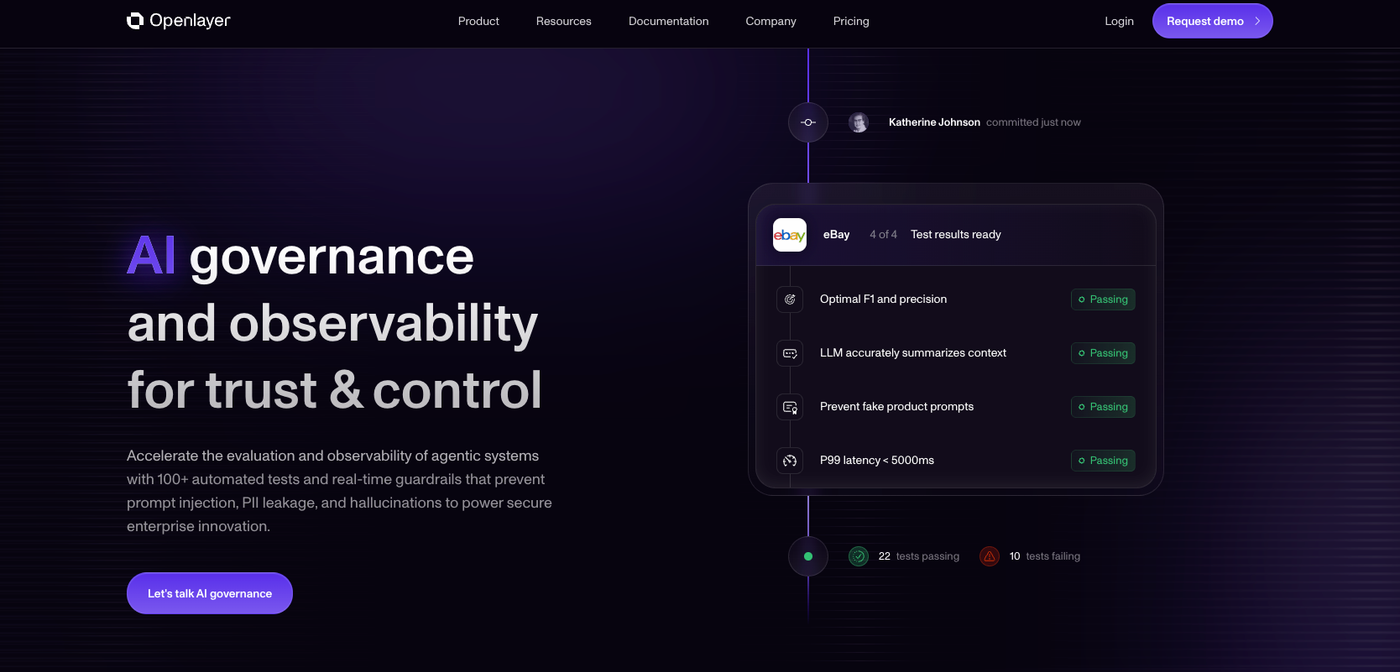
ISO 42001 sets the framework. But meeting it in practice means having continuous visibility into how your AI systems actually behave, not simply documentation that says they should behave well.
Built for exactly that gap, Openlayer is a unified evaluation, observability, and governance platform that connects ISO 42001 requirements to runtime enforcement so teams can prevent non-compliant outputs before they reach users, validate AI system behavior against documented policies automatically in CI/CD, and generate audit-ready evidence without manual documentation cycles.
Where ISO 42001 asks you to manage risk, Openlayer gives you the mechanisms to do it. Where the standard asks for ongoing monitoring, Openlayer tracks output quality, drift, and failure modes in production. Where auditors ask for documentation, Openlayer produces automated compliance mapping tied to real system behavior.
The standard defines the what. Openlayer handles the how.
Final thoughts on implementing ISO 42001
Getting certified under ISO 42001 is one milestone; maintaining the management system without creating governance theater is another. The organizations that succeed treat the standard as an operating framework, not a compliance checkbox, and they build tooling that makes audit-ready evidence a byproduct of normal work. If you need infrastructure that connects certification requirements to how your AI systems actually behave, get in touch.
FAQ
Can I download the ISO 42001:2023 PDF for free?
No, the official ISO/IEC 42001:2023 standard must be purchased through ISO or authorized national standards bodies, it's not legally available as a free download. Some organizations publish implementation guides and summaries publicly, but the normative standard text itself is copyrighted material that requires purchase.
ISO 42001 vs ISO 27001 for AI governance?
ISO 27001 covers information security management broadly, while ISO 42001 is purpose-built for AI management systems with AI-specific controls covering risk assessment for algorithmic harms, data governance, transparency requirements, and ongoing monitoring of AI behavior. Organizations with existing ISO 27001 certification can integrate ISO 42001's Annex A controls into their management system instead of building from scratch.
How much does ISO 42001 certification cost?
Total certification investment typically ranges from $10,000 to $100,000+ depending on organization size and existing governance maturity. Budget for gap assessment and readiness work ($3,000 to $100,000+), training costs ($1,000 to $5,000 per person for foundation or lead auditor courses), initial audit fees ($5,000 to $30,000+), and annual surveillance audits required to maintain the three-year certificate.
Does ISO 42001 certification satisfy EU AI Act requirements?
No. ISO 42001 is a voluntary management system standard while the EU AI Act is binding law with enforcement penalties. But a well-implemented ISO 42001 AIMS gives compliance teams a big head start: the risk assessments, documentation, and governance structures built for certification feed directly into the technical documentation and conformity assessment evidence the EU AI Act demands for high-risk systems.
What's the typical timeline to achieve ISO 42001 certification?
Most organizations reach certification in 6 to 12 months across four stages: gap assessment and Statement of Applicability development, Stage 1 documentation review audit, Stage 2 full conformity assessment, and certification decision. Organizations with existing ISO 27001 or ISO 9001 certification often move faster because ISO 42001 shares the same high-level management system structure.