EU AI Act risk management system requirements: April 2026 guide
The EU AI Act risk management system described in Article 9 isn't a document you write once and file away. It's a control system that has to function continuously, meaning your risk assessments get updated when your model retrains, when deployment context drifts, or when post-market monitoring surfaces failure modes you didn't predict. Most compliance programs fall apart because there's no infrastructure connecting policy to proof. You can identify risks and document mitigation measures all day, but if you can't show a notified body that your testing validated those controls and that production data backs it up, your conformity assessment won't hold.
TLDR:
- High-risk AI systems require continuous risk management by August 2026, not one-time audits.
- Article 9 mandates testing across intended use and foreseeable misuse before market release.
- Post-market monitoring must feed production data back into risk assessments as systems evolve.
- Conformity assessment failures cost up to €30M or 6% of global revenue under EU enforcement.
- Openlayer automates Article 9 compliance with 100+ tests, real-time guardrails, and audit trails.
What Article 9 requires for high-risk AI systems
Article 9 sets a clear expectation: if you deploy a high-risk AI system, you must build, implement, document, and maintain a lifecycle risk management system of that system. Not as a one-time audit. Not as a pre-launch checklist. As an ongoing, living process. The regulation defines this as a continuous iterative process, run in parallel with development and deployment. It must identify and analyze known and reasonably foreseeable risks, estimate and assess those risks under both intended and foreseeable misuse conditions, and adopt appropriate mitigation measures.
Article 9 does not describe a compliance document. It describes a control system that must function continuously, produce evidence, and respond to new risks as they surface.
How to determine if your AI system is high-risk under the EU AI Act
The EU AI Act splits high-risk classification into two distinct pathways. Getting this wrong has real consequences: misclassifying a system as lower risk means skipping Article 9 obligations entirely.
Annex I: safety components in regulated products
The first pathway applies to AI systems embedded in products already governed by EU safety legislation. If your AI functions as a safety component in a product covered by Annex I sectors, such as machinery, medical devices, aviation systems, or automotive equipment, it qualifies as high-risk. The product must also require third-party conformity assessment under that existing sectoral law.
Annex III: standalone high-risk use cases
The second pathway catches AI systems operating in sensitive domains outside regulated products. The Act lists eight categories:
- Biometrics, including remote identification
- Critical infrastructure management
- Education and vocational training
- Employment and worker management
- Access to critical private and public services, including credit scoring
- Law enforcement
- Migration, asylum, and border control
- Administration of justice and democratic processes
Not every system touching these domains automatically qualifies. The Act includes provisions for general-purpose use and low-impact applications within some categories, so classification requires an honest read of both the use case and the decision context.
The continuous iterative process requirement
Most compliance efforts are point-in-time. Article 9 is not. The regulation frames risk management as an iterative process running in parallel with the AI system's entire lifecycle, from initial design through decommissioning. Risk assessments must be revisited when system behavior changes, when new training data is introduced, when deployment context changes, or when post-market feedback reveals unexpected failure modes. A risk management system frozen at launch does not satisfy Article 9. Three requirements follow from this:
- Risks identified during design must be tracked and reassessed as the system evolves over time.
- Mitigation measures must be updated when new risks surface or existing controls prove insufficient.
- Evidence of each review cycle must be documented and retained for regulatory inspection.
The iterative framing also means the process cannot live in a spreadsheet updated once a year. Organizations need infrastructure that captures live system behavior, flags deviations, and connects those signals back to documented risk controls. The gap between policy and proof is where most compliance programs break down, and Article 9 closes that gap by requiring both.
Risk identification and analysis across the AI lifecycle
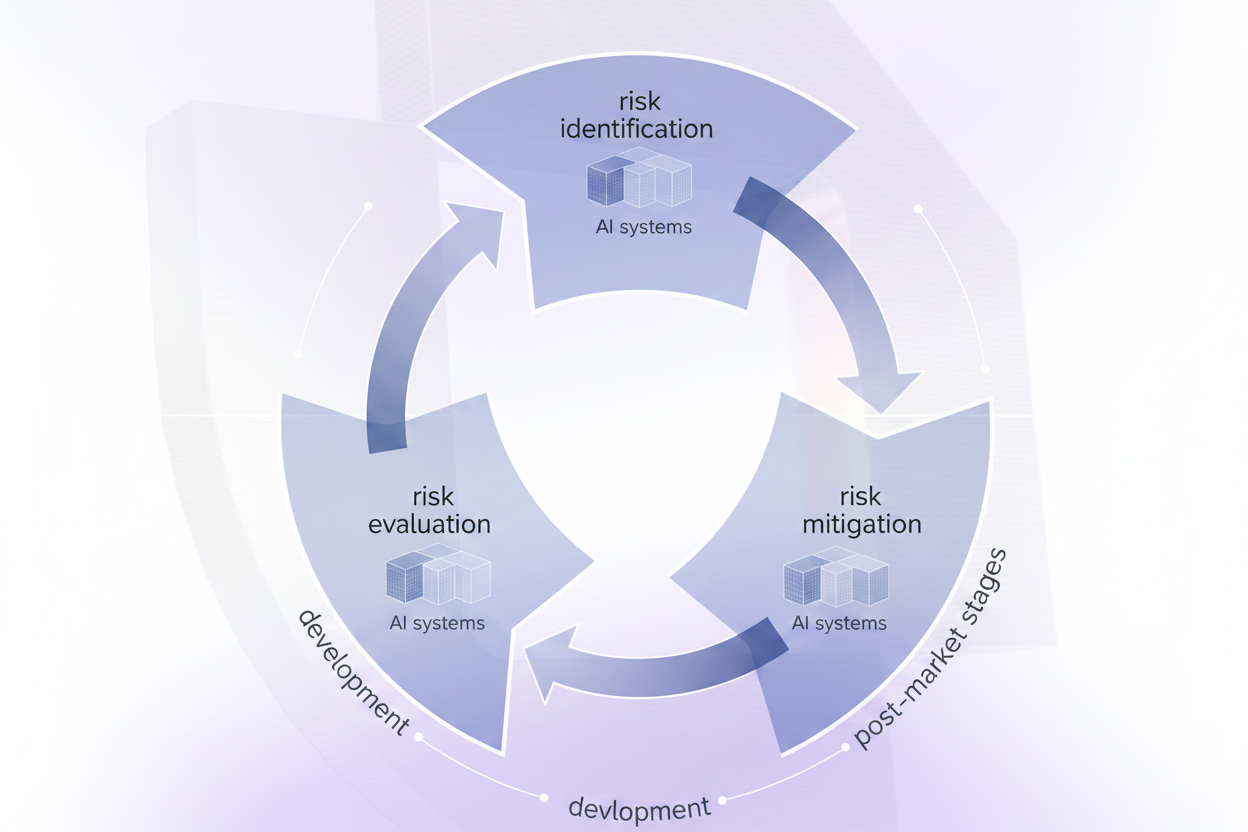
Article 9 requires providers to identify risks across three dimensions: known risks confirmed through prior evidence, reasonably foreseeable risks that could surface under normal use, and risks arising from misuse scenarios the provider could have anticipated even if unintended. What makes this hard for AI systems is that production data is often thin at launch. Traditional software risk assessment draws on years of incident records and failure mode libraries. AI systems built on newer architectures may have no equivalent baseline, so providers must reason forward from model behavior, training data characteristics, and deployment context.
What providers must assess
The regulation requires evaluation across both intended use and reasonably foreseeable misuse:
- What happens when the system performs as designed but the user acts outside expected parameters?
- What failure modes surface under edge cases the training distribution did not cover?
- What downstream harm could result if outputs are incorrect, biased, or manipulated?
- Where does the system touch health, safety, or fundamental rights, even indirectly? What guardrails are needed to prevent harmful outputs?
The misuse problem
Foreseeable misuse includes prompt manipulation, adversarial inputs, and deployment in contexts the provider did not intend but could have predicted. Article 9 holds providers accountable for these scenarios even when the end user causes the harm, meaning risk identification must extend beyond the system itself to how it will realistically be used.
Testing procedures and validation requirements
Article 9, paragraphs 5 through 7, move from risk identification to proof. Identifying a risk is not enough. You must test the system to confirm that mitigation measures actually work and that performance remains consistent with the intended purpose. Testing must also occur throughout development, before release and after. Before a high-risk AI system is placed on the market, providers must run evaluations against predefined metrics and probabilistic thresholds set in advance, not reverse-engineered from results. Three testing requirements stand out:
- Tests must validate that risk mitigation measures reduce identified risks to acceptable levels.
- Performance must be tested across the full intended population, including subgroups that may experience differential outcomes.
- Test results must be documented and retained as evidence of compliance, not discarded after deployment.
Where internal testing cannot replicate real-world conditions, the Act allows for real-world testing under Article 60, particularly for systems interacting with diverse user populations or complex environments.
The validation framing here matters. Article 9 does not ask whether the system works. It asks whether you can prove it works safely, consistently, and within defined performance bounds, before it reaches users.
Data governance and bias mitigation under Article 10
Article 10 sits directly beneath Article 9 for a reason. Data quality failures are risk events. If training data is unrepresentative or systematically biased, the risk management system is already compromised before a single inference runs. Providers must verify that datasets are relevant, sufficiently representative, and free of errors to the extent technically possible. Bias detection cannot be a post-launch observation. It must be built into the validation pipeline before the system reaches users.
Documentation and technical records
Article 11 and Annex IV define what technical documentation must capture for high-risk AI systems: a general description of the system, design specifications, training methodology, risk management measures, testing results, and post-market monitoring plans. Documentation serves two functions at once. Internally, it gives teams a reference point for what risks were identified and whether controls held. Externally, it is the primary evidence package notified bodies review during AI compliance certification and conformity assessments. Three documentation failures consistently surface in practice:
- Records that describe intended risk controls but contain no evidence those controls were tested
- Audit trails broken across tools, with no single source connecting risk identification to mitigation to validation
- Version mismatches where documentation reflects an earlier system state than what is actually deployed
The regulation requires documentation to stay current across the full system lifecycle.
Post-market monitoring and risk evaluation
Article 9's iterative loop does not close at deployment. Article 72 extends the obligation into production, requiring providers to actively collect and review data from systems already in the market. Post-market monitoring must be systematic. Providers need a documented plan for gathering performance data, user feedback, and incident reports from deployed systems, then feeding those signals back into the risk management process. When production data reveals new failure modes or unexpected outcomes, risk assessments must be updated and mitigation measures revised. Four events typically trigger mandatory reassessment:
- Material changes to the system's architecture, training data, or intended use
- Serious incidents reported by deployers or affected persons
- Patterns of near-miss outcomes that suggest new failure modes
- Regulatory guidance or sector-specific incidents that reframe foreseeable risk
The feedback loop between Article 72 and Article 9 is what separates compliance as a process from compliance as a document. Production behavior is evidence. If that evidence contradicts your risk assessment, the regulation expects you to act on it, not file it.
Conformity assessment and CE marking pathways
Before a high-risk AI system can enter the EU market, providers must complete a conformity assessment confirming that Article 9 and all other applicable requirements are met. The pathway depends on the system type and associated risk profile.
Annex VI: internal control
Most high-risk AI systems not covered by existing sectoral legislation follow the internal control procedure. Providers conduct and document the conformity assessment themselves, verify that their risk management system meets Article 9 requirements, and issue an EU declaration of conformity. No external body is involved, but the documentation burden is real and the declaration carries legal weight.
Annex VII: quality management system assessment
Systems falling under certain Annex III categories, particularly biometrics and law enforcement applications, require a notified body to assess the provider's quality management system. The notified body reviews whether risk management processes, testing procedures, and documentation practices are structurally sound, beyond whether a specific system passed its evaluations.
CE marking follows successful conformity assessment. The mark signals that the system meets EU requirements and can be placed on the market or put into service. It does not expire automatically, but the conformity declaration must be updated when material changes occur, connecting directly back to Article 9's iterative requirement.
Your risk management system is the primary artifact a notified body will review if external assessment is required.
August 2026 compliance timeline and enforcement
August 2, 2026 is the primary compliance deadline. Most EU AI Act provisions become applicable on that date, with one exception: Article 6(1), which governs certain Annex I product-embedded systems, takes effect on August 2, 2027. The phased rollout has already been moving. Prohibited AI practices became enforceable in February 2025. GPAI model obligations and governance rules applied from August 2025. High-risk system providers not yet compliant with Article 9 are behind schedule.
What must be in place by August 2026
Regardless if timelines continue to shift, you should have the following in place by August 2026 to make sure that you are compliant in the event that enforcement happens immediately:
- A documented risk management system covering identification, evaluation, and mitigation
- Testing results tied to predefined performance thresholds
- Complete technical documentation per Annex IV
- A post-market monitoring plan ready to activate at deployment
- Conformity assessment completed and CE marking issued where required
Enforcement structure
National market surveillance authorities handle enforcement in each member state, requiring AI compliance tools to meet regulatory requirements. Penalties for high-risk violations reach €30 million or 6% of global annual turnover, whichever is higher. Authorities can require corrective action, restrict market access, or mandate withdrawal of non-compliant systems. If you are building now, the risk management system needs to be in place before launch, not assembled in response to an audit. Modern AI governance platforms can help automate this process.
The table below provides a high-level overview of each compliance phase, the effective date, required deliverables, and what happens with enforcement.
| Compliance Phase | Effective Date | Required Deliverables | Enforcement Consequence |
|---|---|---|---|
| Prohibited AI Practices | February 2, 2025 | Immediate cessation of prohibited systems including social scoring, emotion recognition in workplace and education, real-time biometric identification in public spaces without authorization | Up to €35 million or 7% of global annual turnover for prohibited practice violations |
| GPAI Model Obligations | August 2, 2025 | Technical documentation, transparency measures, copyright compliance, systemic risk assessments for high-impact models | Up to €15 million or 3% of global annual turnover for GPAI violations |
| High-Risk System Compliance | August 2, 2026 | Complete Article 9 risk management system, testing validation against predefined thresholds, technical documentation per Annex IV, conformity assessment, CE marking, post-market monitoring plan | Up to €30 million or 6% of global annual turnover for high-risk system violations |
| Annex I Safety Components | August 2, 2027 | Risk management integration with existing sectoral legislation, third-party conformity assessment where required, updated safety documentation | Combined penalties under both EU AI Act and applicable sectoral regulations |
| Ongoing Post-Market Obligations | Continuous from deployment | Active monitoring of deployed systems, incident reporting within required timeframes, risk assessment updates when production data reveals failures, documentation maintenance across system lifecycle | Market withdrawal orders, restriction of access, mandatory corrective action, financial penalties for non-compliance with monitoring obligations |
How Openlayer automates EU AI Act risk management compliance
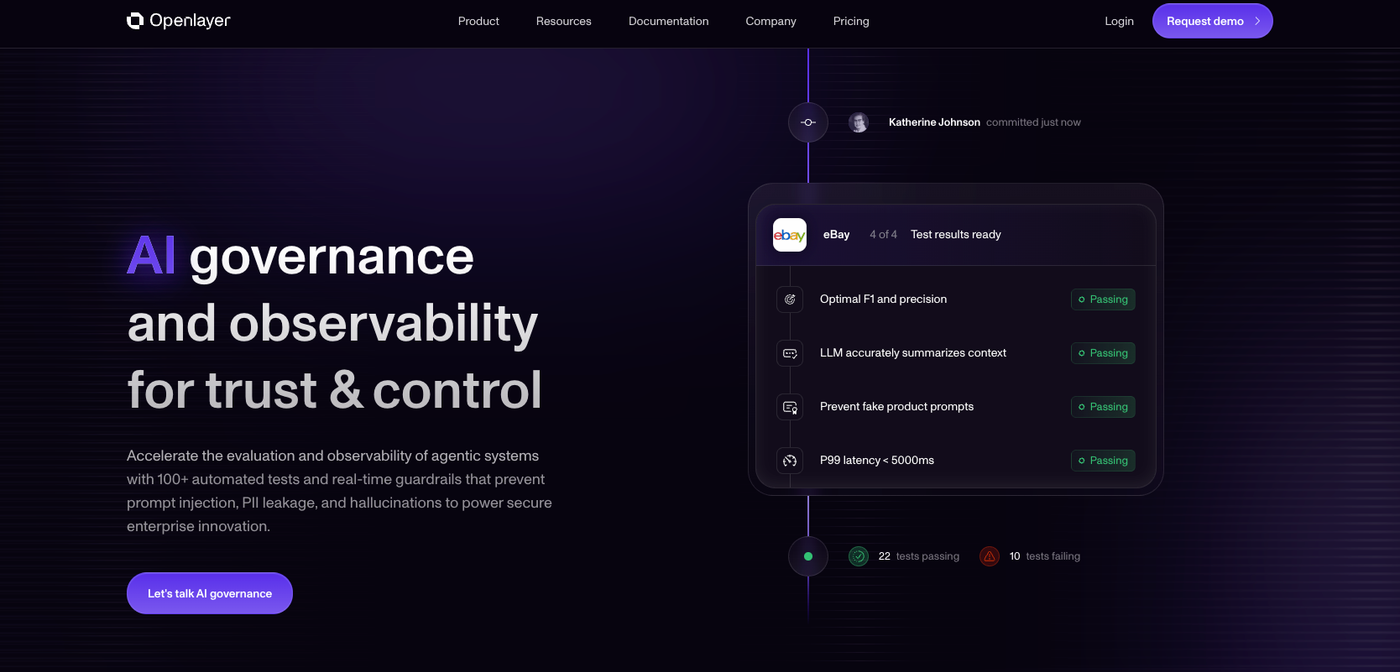
Article 9 demands a system, not a document. Openlayer gives you that system.
The 100+ automated tests cover hallucinations, bias, toxicity, prompt injection, and PII leakage across your AI lifecycle. Every test run produces audit-ready evidence mapped directly to EU AI Act requirements, with no manual configuration required. When production behavior drifts, continuous monitoring feeds new signals back into your risk assessment cycle, keeping the iterative process Article 9 requires actually running. Real-time guardrails block prompt injection and PII exposure before they reach downstream systems. Compliance dashboards and exportable audit trails give notified bodies and internal reviewers a single source of truth connecting risk identification to mitigation to validation.
If your current approach is fragmented across spreadsheets, siloed tools, and manual reviews, you are building the wrong thing. Openlayer replaces that with lifecycle-spanning risk management infrastructure that holds up under scrutiny.
Final thoughts on meeting Article 9 requirements
Article 9 does not ask if you identified risks. It asks if you can prove you tested mitigations, tracked results across deployment, and updated controls when production data revealed gaps. Your EU AI Act risk management system needs to be running before launch, not assembled in response to an audit request. The iterative process requirement means evidence collection starts in development and continues through every system update. If you want to replace manual compliance work with automated testing and continuous validation, get in touch.
FAQ
What is the deadline for EU AI Act compliance for high-risk systems?
August 2, 2026 is the primary compliance deadline for most high-risk AI systems under the EU AI Act. If your system is already in production or launching before that date, your risk management system needs to be in place before deployment, not assembled retroactively in response to an audit.
Can I use internal testing procedures instead of a notified body for EU AI Act compliance?
Yes, for most high-risk AI systems. The internal control procedure under Annex VI allows providers to conduct and document conformity assessments themselves without external involvement. However, certain biometric and law enforcement applications require a notified body to assess your quality management system before you can issue an EU declaration of conformity.
How do I know if my AI system qualifies as high-risk under the EU AI Act?
Your system is high-risk through two pathways: if it functions as a safety component in products covered by Annex I (machinery, medical devices, aviation, automotive), or if it operates in one of eight Annex III categories including biometrics, critical infrastructure, employment, credit scoring, law enforcement, migration control, or justice administration. Classification depends on both the use case and decision context; not every system touching these domains automatically qualifies.
EU AI Act risk management system vs one-time audit?
Article 9 requires a continuous, iterative process running parallel to your AI system's entire lifecycle, not a point-in-time assessment. Risk evaluations must be revisited when system behavior changes, new training data is introduced, deployment context drifts, or post-market feedback reveals unexpected failures. The regulation expects live infrastructure that captures system behavior, flags deviations, and connects those signals back to documented risk controls.
What documentation must be ready before placing a high-risk AI system on the market?
Annex IV requires a complete technical package: general system description, design specifications, training methodology, risk management measures, testing results tied to predefined thresholds, and post-market monitoring plans. This documentation must stay current across the full system lifecycle and serve as the primary evidence package for conformity assessments: broken audit trails or version mismatches between documentation and deployed systems will fail regulatory review.