Top VerifyWise Alternatives & Competitors (October 2026)

There's a real difference between a tool that tracks your compliance intent and one that enforces it at runtime. VerifyWise covers the former well, and for teams early in building a formal program, that's a reasonable starting point. But once you're operating under EU AI Act high-risk obligations or fielding questions from auditors about production behavior, that boundary matters more than most people expect going in.
TLDR:
- VerifyWise covers documentation and evidence intake but has no connection to live model pipelines, drift detection, or runtime enforcement.
- Most VerifyWise alternatives split into two camps: detect-and-inform tools (Arize AI, Fiddler AI) and documentation-layer tools (Credo AI, IBM watsonx.governance), with no output blocking in either group.
- The EU AI Act's high-risk system obligations require continuous post-market monitoring, which documentation-only tools leave entirely unaddressed.
- Openlayer is the only tool in this comparison that blocks outputs at the API boundary and generates audit evidence automatically at inference time, with automated mapping to EU AI Act, NIST AI RMF, ISO 42001, AIUC-1, and OSFI E-23.
What is VerifyWise and how does it work?
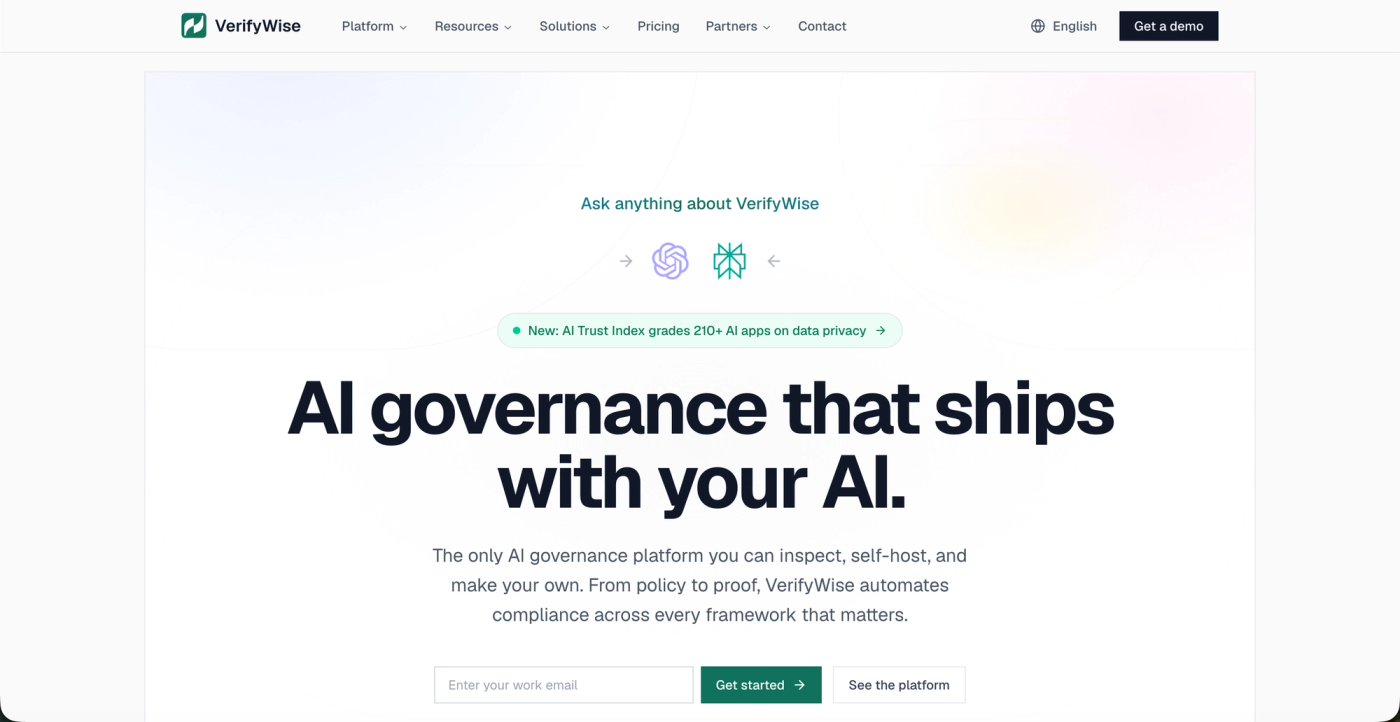
VerifyWise is an open-source AI governance tool designed to help organizations structure compliance documentation around frameworks like the EU AI Act and NIST AI RMF. It works as a structured intake and documentation layer: teams register AI systems, collect required evidence, and track compliance status through a self-hosted interface.
The tool targets smaller teams or organizations early in building a formal compliance program who need a lightweight, free starting point, distinct from enterprise-grade AI governance software platforms built for active enforcement. Its self-hosted architecture gives teams control over their data, and the open-source model means no licensing costs.
Where VerifyWise stops is worth noting before assessing alternatives. It covers the documentation side of governance: intake forms, evidence collection, and compliance status tracking. It does not connect to model pipelines, monitor production behavior, or enforce policies against live outputs. For teams whose governance requirements extend into runtime, that boundary matters.
Why consider VerifyWise alternatives?
VerifyWise earns its place for teams at a specific stage: building out a compliance program from scratch, working within a tight budget, and primarily needing structure around documentation and evidence collection. If your immediate goal is organizing EU AI Act article mappings or creating intake workflows for newly registered AI systems, it provides a workable foundation.
But most organizations hit the ceiling quickly. VerifyWise has no connection to live model pipelines, which means it cannot monitor production behavior, detect drift, or generate compliance evidence from what models actually do. Compliance artifacts are assembled manually. If a model's behavior changes post-deployment, nothing in VerifyWise surfaces it.
For teams operating in regulated environments, that gap is structural, not cosmetic. The EU AI Act post-market monitoring requirements for high-risk systems require ongoing continuous risk assessment, not a one-time documentation exercise. A tool that stops at intake and evidence filing leaves the production side of those obligations entirely unaddressed.
Finally, there are also no pre-built automated tests for hallucination, bias, PII leakage, or prompt injection. No runtime guardrails block unsafe outputs before they reach users. No CI/CD evaluation gates prevent a non-compliant model version from being promoted. These are not edge cases for enterprise deployments; they are the core of what regulators and auditors increasingly expect to see in production.
The practical result: VerifyWise works as a starting point for documentation-heavy compliance workflows, but organizations that need an active control layer, continuous monitoring, or runtime enforcement consistently find they need a more complete solution.
Openlayer: Best VerifyWise alternatives in September 2026
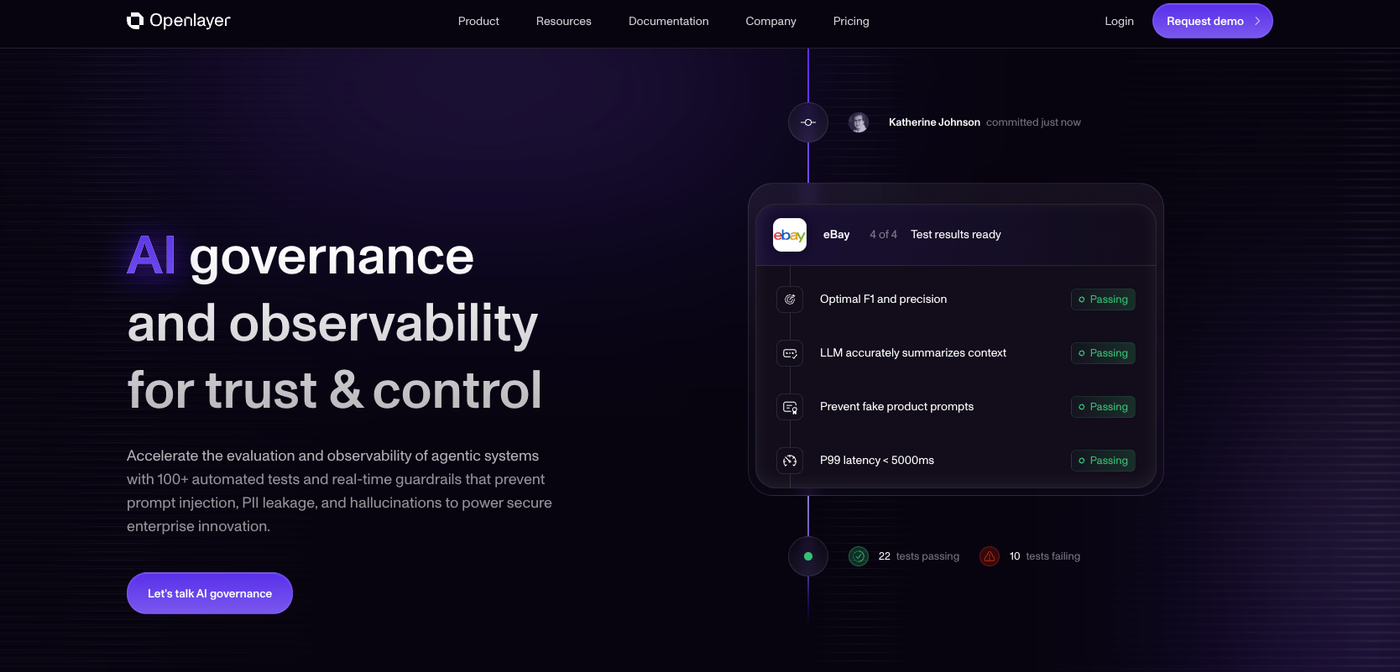
Openlayer is a unified AI evaluation, observability, and governance platform covering traditional ML, LLMs, RAG systems, and multi-agent deployments under a single control layer. Where VerifyWise stops at documentation intake, Openlayer enforces policy at the API boundary, generating audit evidence as a byproduct of enforcement instead of as a separate assembly exercise.
Key features
- Over 175 pre-built automated tests: covers hallucinations, bias, toxicity, PII leakage, and prompt injection, integrated into CI/CD gates that block non-compliant deployments before they reach production
- Real-time guardrails with five enforcement actions: allow, warn, block, redact, and escalate, each event generating immutable audit evidence at inference time
- Automated regulatory framework mapping: continuous mapping to EU AI Act, NIST RMF, ISO 42001, AIUC-1, and OSFI E-23, with on-demand compliance snapshot exports
- Agentic AI governance: tool call authorization, session-level evaluation, and audit trails for multi-agent deployments
- Separate governance workflows: technical and non-technical users operate on the same platform without routing compliance tasks through engineering
Limitations
- Scope fit: built for teams that need active runtime enforcement; organizations whose only requirement is intake documentation may find the platform broader than their current stage
- Setup investment: CI/CD gate configuration and guardrail threshold calibration require upfront engineering time to match your specific risk tolerance and regulatory floor
- Not a self-hosted open-source tool: unlike VerifyWise, Openlayer is a managed platform; teams with hard data-residency or air-gap requirements should confirm deployment options during evaluation
Bottom line
Best for enterprises in regulated industries facing EU AI Act high-risk system deadlines, particularly organizations with mixed ML and GenAI deployments that need active control beyond organized paperwork. Most suitable for teams where the compliance question is not "have we documented our intent" but "can we prove our models are behaving safely under live traffic."
Credo AI
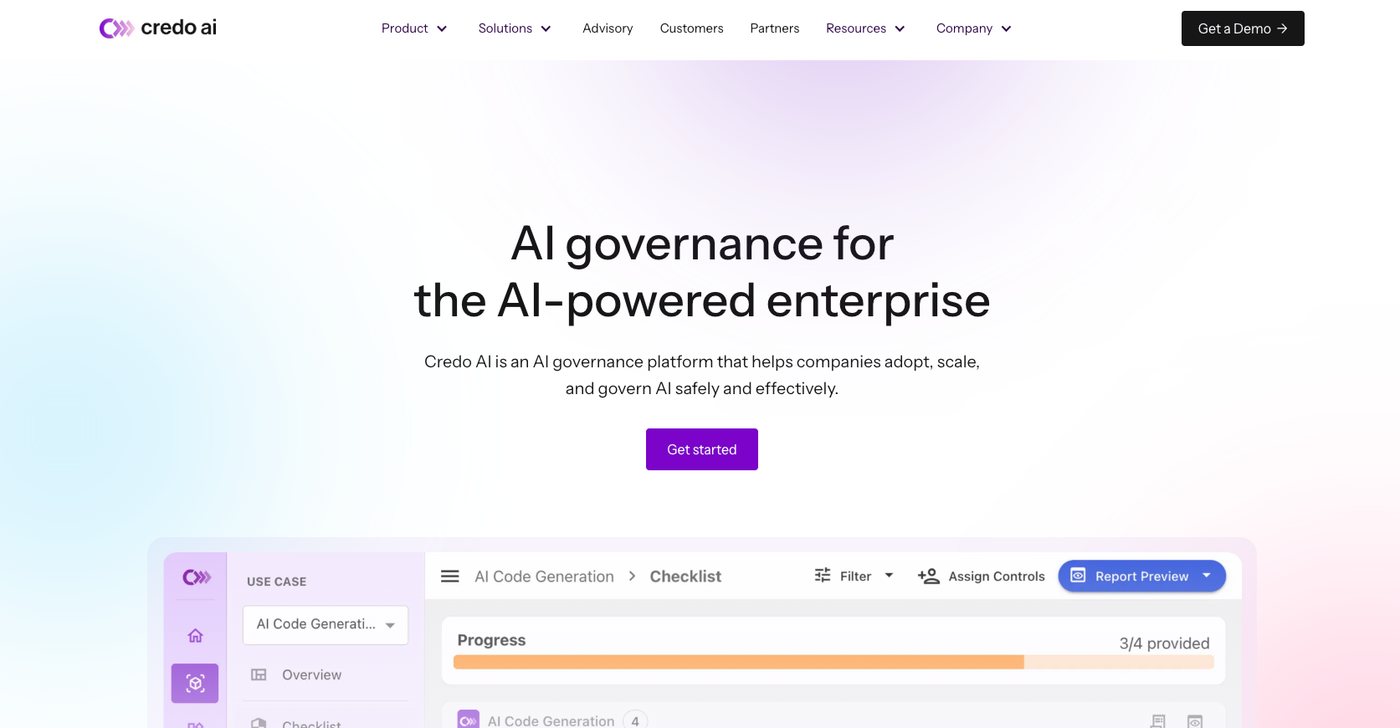
Credo AI structures responsible AI programs through a policy-layer architecture: teams register AI systems, assign Policy Packs aligned to regulatory requirements like the EU AI Act and NIST AI RMF, and collect evidence through guided intake workflows. The result is an organized documentation posture, not an active production control layer. Teams building a formal compliance program from scratch, particularly compliance and legal functions without deep ML engineering capacity, find genuine value here. The boundary to understand before going further is that Credo AI operates at the policy level only.
Key Features
- Policy Packs for regulatory mapping: pre-built templates translate EU AI Act and NIST AI RMF obligations into evidence-collection checklists, giving compliance teams a structured intake workflow without needing to author requirements from scratch
- AI Registry: central inventory for registering AI systems, tracking their risk tier, documentation status, and assigned ownership across the governance lifecycle
- Audit artifact generation: guides teams through assembling compliance documentation, including risk assessments and policy evidence records, in a format reviewable by legal or external auditors
- Role-based workflows: separates compliance and legal team tasks from technical review tasks, allowing non-engineering stakeholders to own documentation workflows without routing every step through ML teams
- Third-party integration hooks: connects to external evaluation tools to pull in test results as supporting evidence, though the enforcement logic stays outside the platform
Limitations
- No runtime enforcement: Credo AI does not block, redact, or escalate outputs at the API boundary; policy documentation and active output control are handled by separate systems
- No production monitoring: the platform has no connection to live model pipelines, so behavioral changes after deployment, including drift or output degradation, go undetected without an external monitoring layer
- No pre-built automated test library: there are no built-in behavioral tests for hallucination, bias, PII leakage, or prompt injection; test results must be generated externally and imported
- No CI/CD deployment gates: Credo AI cannot block a non-compliant model version from being promoted to production; deployment controls require a separate pipeline integration
- Audit evidence is manually assembled: compliance artifacts are collected through intake forms instead of being generated automatically at inference time, meaning evidence of what models actually did in production is not part of the record unless a connected tool captures it
Bottom Line
Best for compliance and legal teams building structured documentation programs around EU AI Act and NIST AI RMF obligations. Most suitable for organizations in early compliance program stages where the immediate need is policy documentation and audit preparation, not runtime enforcement. Teams that need governance to extend into production, blocking outputs before they reach users and generating per-request audit evidence automatically, will need to pair Credo AI with a separate enforcement layer or move to a platform that covers both.
IBM watsonx.governance
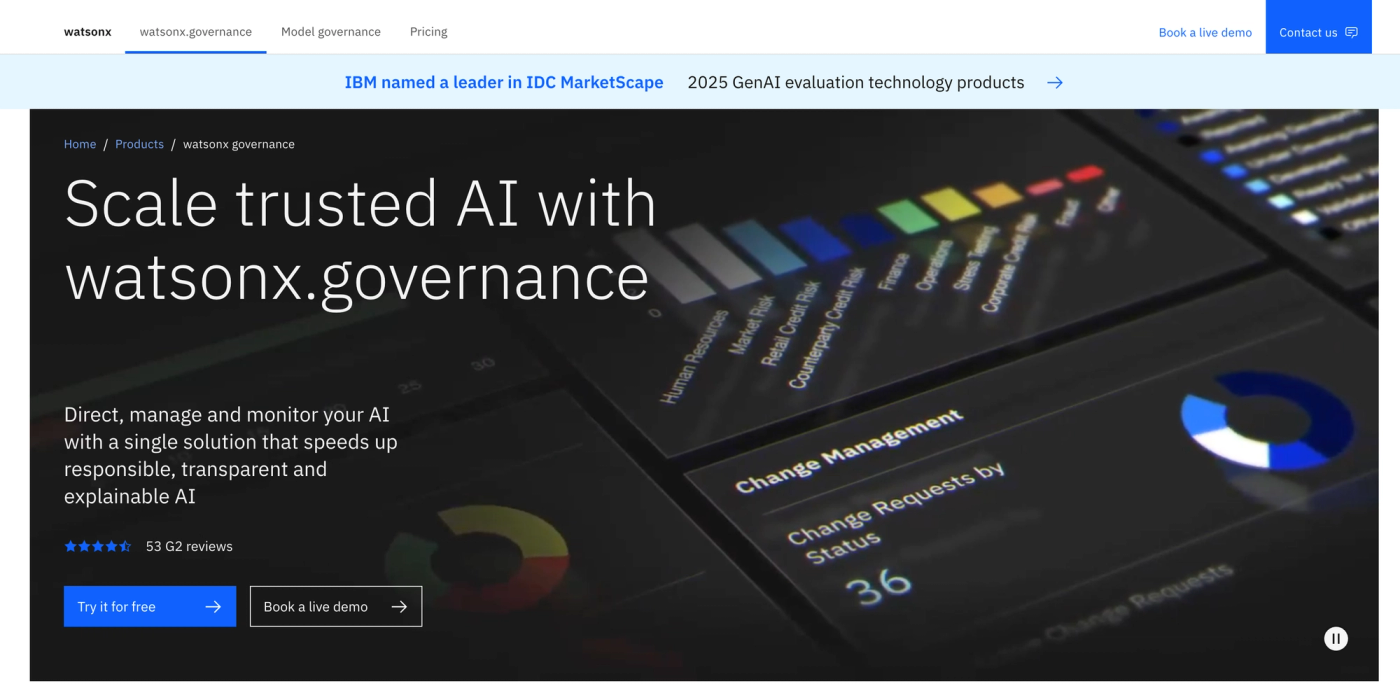
IBM watsonx.governance takes the broadest scope of any governance tool in this comparison: it covers both AI governance and, within the IBM ecosystem, data governance. Teams get fairness monitoring, bias detection, model lineage tracking, and framework mapping for the EU AI Act and NIST AI RMF. For enterprises already standardized on IBM infrastructure, that integrated coverage is genuine value. The boundary to hold in mind before going further is that the platform's monitoring and enforcement couple tightly to IBM's own model-serving stack. Multi-cloud deployments, third-party LLMs, and non-IBM pipelines sit outside the coverage perimeter unless additional manual stitching is in place.
Key Features
- Fairness monitoring and bias detection: tracks demographic parity, disparate impact, and model drift within the IBM stack, giving teams structured visibility into model behavior across protected groups without building custom evaluation pipelines
- Model lineage tracking: connects deployed models to their upstream training data and versioning history within the IBM suite, supporting traceability requirements for regulated deployments
- Regulatory framework mapping: pre-built mappings to EU AI Act and NIST AI RMF obligations, surfaced through policy dashboards and governance workflows designed for compliance and risk teams
- IBM ecosystem integration: native connectivity across IBM's data and AI suite, including watsonx.ai model-serving and Watson Studio, reducing integration overhead for teams already operating inside that stack
- Role-based governance workflows: separates compliance team tasks from technical review tasks so non-engineering stakeholders can engage with governance status without routing every step through ML teams
Limitations
- Ecosystem lock-in: monitoring, enforcement, and lineage tracking are built around IBM's model-serving stack; third-party LLM deployments, multi-cloud pipelines, and non-IBM agents require separate tooling and manual evidence stitching
- No real-time output blocking: IBM watsonx.governance detects vulnerabilities and surfaces risk signals but does not block prompt injections, PII leakage, or unsafe outputs at the API boundary in real time; the platform sits on the detection side of the enforcement range, not the blocking side
- Manual, services-heavy setup: regulatory framework mapping requires substantial manual configuration and IBM professional-services engagement to put into practice; continuous, automated compliance evidence is not a byproduct of normal operation
- No CI/CD deployment gates: IBM watsonx.governance does not block a non-compliant model version from being promoted; deployment controls and pre-deployment evaluation require separate pipeline integration outside the platform
- No pre-built adversarial test library: behavioral testing for hallucination, prompt injection, jailbreak resistance, and toxicity requires external tooling or custom scorer development; the platform's testing focus stays on bias and fairness checks instead of the full safety and security surface
Bottom Line
Best for enterprises already standardized on IBM infrastructure that need integrated fairness monitoring, model lineage, and governance documentation within the IBM stack. Most suitable for organizations where AI deployments are mostly IBM-native and the immediate governance priority is policy documentation and bias monitoring instead of runtime enforcement. Teams running multi-cloud or third-party LLM deployments, or those who need active output blocking and automated compliance evidence generated at inference time, will find the ecosystem constraint a structural limit instead of a configuration gap and will need to supplement IBM watsonx.governance with a separate enforcement layer or move to a platform that covers both.
Arize AI

Arize AI is an observability platform built for AI and ML engineering teams doing active production debugging. It traces prompts, agents, and tool calls end-to-end using OpenTelemetry, surfaces drift and quality signals in real time, and supports online evals that score outputs as they arrive. For engineering teams who need to understand why a model is misbehaving under live traffic, Arize provides genuine depth. The boundary to hold in mind before going further is that Arize covers neither AI governance nor data governance in the compliance sense. It is a diagnostic platform: it detects and reports. It does not block.
Key Features
- End-to-end LLM and agent tracing: built on OpenTelemetry, Arize traces prompts, agent steps, and tool calls through full execution paths, giving engineering teams a detailed view of model behavior in production without custom instrumentation
- Online evals for real-time quality scoring: LLM-as-a-judge templates and custom code metrics score prompt outcomes and agent decision traces as inferences arrive, surfacing quality regressions before they accumulate into larger issues
- Embedding drift and production monitoring: real-time dashboards track model quality, embedding drift, and performance degradation, with alerting that notifies engineering teams when behavior moves outside defined bounds
- Human feedback loops: supports annotation workflows and human feedback collection for LLM outputs, letting teams build labeled evaluation datasets from production traffic
Limitations
- Detect-and-inform, not enforce: Arize surfaces issues for engineering teams to investigate; it does not block unsafe outputs, redact PII leakage, or stop prompt injections before they exit the API boundary. Logging an anomaly is observation, not enforcement, and for regulated deployments, that distinction is the entire compliance gap
- No automated regulatory framework mapping: Arize does not map model behavior to EU AI Act, NIST AI RMF, ISO 42001, or any other compliance framework. Organizations are responsible for translating observability data into compliance evidence manually, with no structured audit trail generated at inference time
- No pre-built safety and governance test library: evaluation setup is developer-driven; teams must define correctness, toxicity, bias, and PII criteria themselves for each use case. There is no turnkey test library covering the safety and security surface that regulators and auditors expect to see
- No CI/CD deployment gates: Arize does not block a non-compliant model version from being promoted to production. Deployment controls and pre-deployment evaluation require a separate pipeline integration outside the platform
- No built-in governance workflows: there are no policy management features, approval flows, or model risk categorization. Governance accountability, meaning who approved this model, at what threshold, under which framework, must be handled by the organization entirely outside the tool
Bottom Line
Best for AI and ML engineering teams doing active production debugging, trace analysis, and quality monitoring. Most suitable for organizations where the primary need is visibility into model behavior under live traffic, and where compliance documentation, runtime enforcement, and audit evidence generation are handled by a separate system. Teams operating under EU AI Act high-risk system obligations or fielding questions from auditors about production behavior will find that Arize's detect-and-inform architecture leaves the enforcement gap open. It tells you what happened, but stops short of preventing it.
Fiddler AI
Fiddler AI is an ML observability and model performance management platform built around explainability-first monitoring. Its core value is the depth it offers on model behavior analysis: SHAP and LIME attribution, custom metrics, and structured fairness and drift tracking give engineering and data science teams genuine visibility into why a model is producing the outputs it does. For teams debugging model degradation or investigating a fairness regression, that explainability depth is real and worth acknowledging. The boundary to hold in mind before going further is that Fiddler AI sits on the diagnostic side of the enforcement range. It detects and reports. It does not block.
Key Features
- Explainability via SHAP and LIME: attribution methods that surface which features drove a model's prediction, giving data science teams structured insight into decision-making patterns without requiring custom interpretation code
- Fairness and drift monitoring: tracks demographic parity, disparate impact, and distribution drift for deployed models, with dashboards that surface regressions across protected groups as they accumulate under live traffic
- Custom metrics: teams can define and deploy custom evaluation metrics tailored to their use case, giving flexibility beyond the platform's built-in monitoring dimensions
- Production model performance tracking: continuous monitoring of model quality signals with alerting that notifies engineering teams when behavior moves outside defined thresholds
Limitations
- Detect-and-inform, not enforce: Fiddler AI surfaces fairness and drift signals for diagnostic review but does not block outputs based on behavioral thresholds or enforce policy at the API boundary. Logging a demographic parity regression is observation; blocking an output that crosses a parity threshold before it reaches a user is enforcement. Fiddler stops at the former
- No automated compliance framework mapping: there is no built-in mapping to EU AI Act, NIST AI RMF, or ISO 42001 obligations. Translating monitoring data into compliance evidence requires manual effort, and no structured audit trail is generated at inference time
- No pre-built safety and security test library: behavioral testing for hallucination, prompt injection, jailbreak resistance, PII leakage, and toxicity requires custom scorer setup, estimated at 10 to 20 or more engineer hours per deployment. There is no turnkey test library covering the safety and security surface regulators and auditors expect to see
- No CI/CD deployment gates: Fiddler AI cannot block a non-compliant model version from being promoted to production. Deployment controls require a separate pipeline integration outside the platform
- Limited agentic and multi-agent support: evaluation and governance coverage for agentic deployments, tool call authorization, and multi-step workflow monitoring are not first-class capabilities; teams running LLM agents or multi-agent systems need separate tooling for those use cases
Bottom Line
Best for ML engineering and data science teams doing active fairness and drift debugging, particularly where explainability depth via SHAP and LIME attribution is the primary diagnostic requirement. Most suitable for organizations where the immediate need is model performance visibility and fairness monitoring, and where compliance documentation, runtime enforcement, and audit evidence generation are handled by a separate system. Teams operating under EU AI Act high-risk system obligations or needing active output blocking, automated framework mapping, and CI/CD deployment gates will find Fiddler's detect-and-inform architecture leaves the enforcement gap open.
MLflow
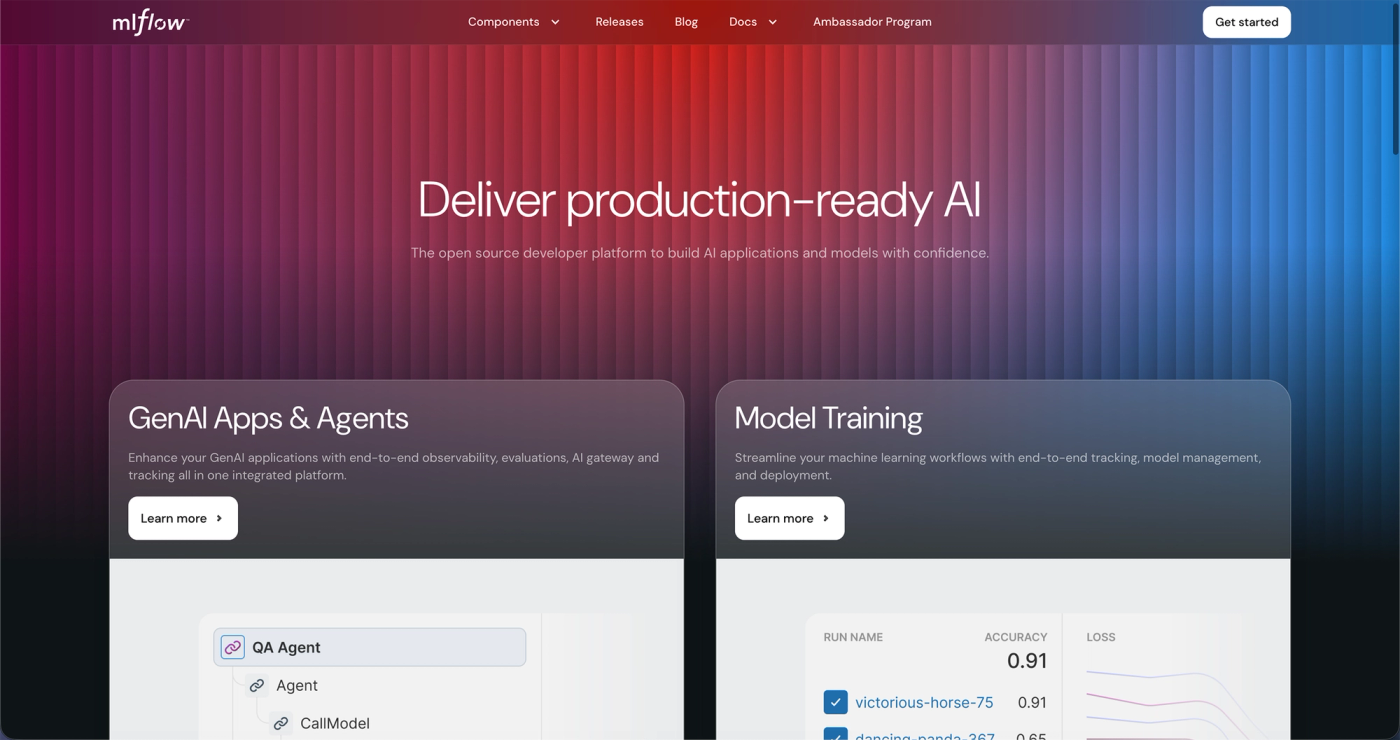
MLflow is an experiment tracking and model registry platform built for ML engineering teams managing training runs, artifact lineage, and model versions. Within that scope it does its job well: parameter logging, artifact storage, and Unity Catalog-backed model lineage are mature capabilities that many ML teams have standardized on. The boundary to hold in mind before going further is that MLflow covers neither AI governance nor data governance in the compliance sense. It is a tracking and registry system. It does not monitor production behavior, run behavioral evaluations, or enforce policies against live outputs.
Key features
- Experiment tracking: logs training runs with parameters, metrics, and artifact references, giving ML teams a structured record of how a model was built and what training inputs produced it
- Model registry and lineage: tracks model versions, stage transitions (staging to production), and, via Unity Catalog integration, upstream data lineage, giving teams traceability from a deployed artifact back to its training source
- Framework-agnostic logging: works across scikit-learn, PyTorch, TensorFlow, XGBoost, and other ML frameworks without requiring framework-specific instrumentation
- Artifact storage: stores models, datasets, and evaluation outputs as versioned artifacts tied to specific runs, supporting reproducibility for traditional ML workflows
Limitations
- No GenAI or agentic evaluation: MLflow has no LLM-as-a-judge capability, no semantic scoring, and no support for RAG or agent evaluation. Teams running LLM applications, retrieval pipelines, or multi-agent systems need a separate evaluation layer entirely. MLflow's metric logging was designed for scalar training metrics, not behavioral quality assessment at inference time
- No production LLM drift detection or monitoring: MLflow logs metrics but does not run continuous anomaly detection against live outputs, track distribution changes, or issue policy-linked alerts when model behavior degrades under production traffic
- No real-time security or runtime enforcement: there is no prompt injection defense, no PII leakage detection, and no output-blocking capability at the API boundary. MLflow cannot intercept or block what a model produces before it reaches end users or downstream systems
- No pre-built behavioral test library: MLflow provides no automated tests for hallucination, bias, toxicity, or adversarial robustness. Behavioral evaluation requires a separate tooling layer; nothing in MLflow prevents a non-compliant model version from being promoted
- No regulatory framework mapping: MLflow provides no built-in mapping to the EU AI Act, NIST AI RMF, ISO 42001, or any other compliance framework. Translating experiment logs or model lineage records into audit evidence requires entirely manual effort outside the platform
- No CI/CD deployment gates: MLflow does not block a model version from being promoted to production when it fails a behavioral or compliance threshold. Deployment controls require a separate pipeline integration
Bottom line
Best for ML engineering teams that need experiment tracking, artifact lineage, and model versioning for traditional ML workflows. Most suitable for organizations early in their MLOps journey whose primary requirements are training reproducibility and model registry management, and whose AI deployments do not yet require behavioral evaluation, production monitoring, or regulatory compliance coverage. Teams running GenAI, RAG, or agentic systems, or those subject to EU AI Act, NIST AI RMF, or similar obligations, will find that MLflow's scope stops well before the governance, enforcement, and compliance surface those deployments require.
Deepchecks
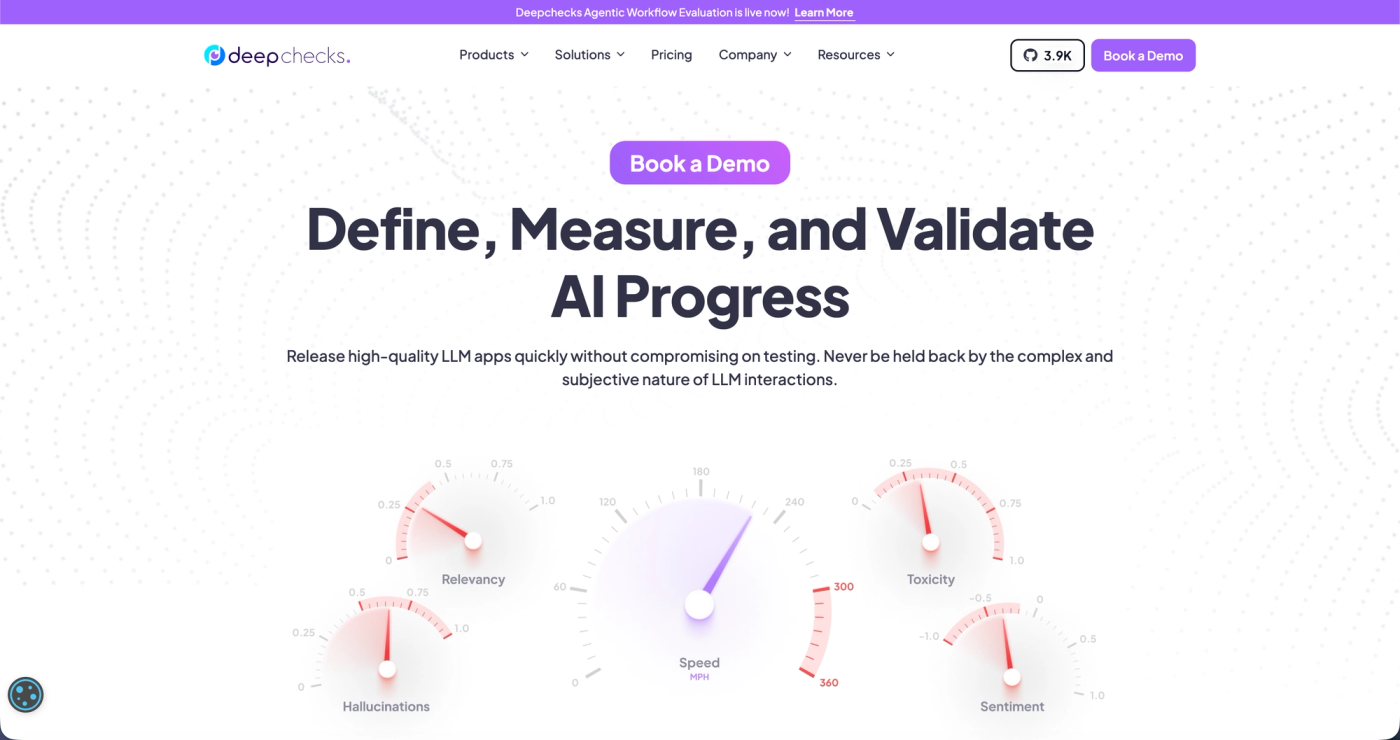
Deepchecks is a pre-deployment validation and ML monitoring platform built around data-centric quality checks. Its core value is the structure it provides for testing models and datasets before they reach production: schema validation, data integrity checks, train/test distribution comparisons, and a library of pre-built checks for traditional ML. For data science teams running structured validation workflows on tabular or classical ML pipelines, that coverage is genuine and worth acknowledging. The boundary to hold in mind before going further is that Deepchecks sits on the validation side of the testing range. It checks data and models before deployment. It does not monitor production behavior, enforce policies at the API boundary, or connect evaluation results to regulatory obligations.
Key features
- Pre-built ML and LLM test suites: a library of checks covering data integrity, schema validation, distribution drift between training and test sets, class imbalance, and label correctness, giving data science teams a structured pre-deployment validation workflow without building test logic from scratch
- Train/test distribution comparison: statistical checks that compare input distributions across training and evaluation splits, surfacing feature drift or data leakage before a model is promoted to production
- LLM evaluation checks: basic behavioral checks for LLM outputs including coherence and relevance scoring, extending the platform's pre-deployment testing coverage to text generation use cases beyond classical ML
- CI integration support: test suites can be run as part of CI pipelines, surfacing data and model quality issues before a build is promoted, though this stops at surfacing, not at blocking
Limitations
- No real-time runtime enforcement: Deepchecks does not operate at the API boundary; it does not block, redact, or escalate outputs before they reach end users or downstream systems. Pre-deployment validation and runtime enforcement are structurally different controls, and Deepchecks covers only the former
- No production monitoring or drift alerting: the platform has no continuous monitoring of live model outputs, no anomaly detection against production traffic, and no alerting when model behavior degrades after deployment. What a model does in production is outside Deepchecks' coverage entirely
- No prompt injection or security testing: there are no defenses against prompt attacks, PII leakage, jailbreak attempts, or data exfiltration at inference time. Teams running LLM applications or agentic deployments in regulated environments need a separate security layer for these risks
- No regulatory framework mapping: Deepchecks provides no built-in mapping to the EU AI Act, NIST AI RMF, ISO 42001, or any other compliance framework. Pre-deployment test results are not translated into audit-ready compliance evidence, and no structured audit trail is generated
- Limited agentic and RAG coverage: the platform's testing scope is built around tabular and classical ML workflows; evaluation for RAG pipelines, tool-calling agents, and multi-step workflows is not first-class. Teams running LLM agents or retrieval-augmented systems need separate tooling for those use cases
Bottom line
Best for data science teams running structured pre-deployment validation on classical ML models, particularly where data quality and train/test distribution checks are the primary requirement before a model is promoted. Most suitable for organizations in early MLOps stages where the immediate need is pre-deployment validation and offline testing, and where production monitoring, runtime enforcement, and compliance evidence generation are handled by a separate system or are not yet requirements. Teams operating under EU AI Act high-risk system obligations, deploying LLM applications or agentic systems in production, or needing active output blocking and automated compliance evidence will find that Deepchecks' pre-deployment scope leaves the production governance surface entirely unaddressed.
Feature comparison: VerifyWise vs top alternatives
The table below maps each capability across the seven tools covered in this post. A few dimensions are worth calling out before you scan it.
| Capability | VerifyWise | Openlayer | Credo AI | Arize AI | Fiddler AI | MLflow | Deepchecks |
|---|---|---|---|---|---|---|---|
| Regulatory Framework Mapping | Manual, documentation-only | EU AI Act, NIST AI RMF, ISO 42001, AIUC-1, OSFI E-23 | EU AI Act, NIST AI RMF via Policy Packs | None | None | None | None |
| Real-Time Runtime Enforcement / Output Blocking | No | Yes: block, redact, escalate at API boundary | No | No | No | No | No |
| Pre-Built Automated Test Library | No | Over 175 pre-built tests (hallucination, bias, PII, prompt injection) | No | Limited online evals | No | No | Basic data validation |
| Continuous Production Monitoring and Drift Detection | No | Yes | No | Yes | Yes (diagnostic only) | No | No |
| CI/CD Deployment Gates | No | Yes: PR-blocking on threshold failure | No | No | No | No | No |
| Agentic AI Governance Support | No | Yes: tool call authorization, session-level eval, audit trails | No | Partial tracing | No | No | No |
| Audit-Ready Evidence Generation | Manual assembly | Automated at inference time | Partial (manual coordination) | No | No | No | No |
Regulatory framework mapping and runtime enforcement are the two areas where the field splits most sharply. VerifyWise handles compliance documentation manually, with no automated mapping to frameworks like the EU AI Act or NIST AI RMF and no mechanism to block or redact outputs at the API boundary. Openlayer covers both: automated framework mapping across EU AI Act, NIST AI RMF, ISO 42001, AIUC-1, and OSFI E-23, plus active blocking and escalation at inference time. Credo AI maps to EU AI Act and NIST AI RMF through Policy Packs but stops at the policy layer. No runtime enforcement. Arize AI and Fiddler AI offer production monitoring, but their output is diagnostic. They detect and report; they do not block, in contrast to high-risk AI drift detection approaches that tie monitoring to compliance obligations. MLflow and Deepchecks cover neither governance documentation nor runtime enforcement in any meaningful sense.
The CI/CD gate row is also worth noting. Openlayer is the only tool here that blocks pull requests on threshold failure, closing the window between evaluation and deployment where unreviewed model behavior typically slips through, and its AI risk scoring capabilities let teams quantify and rank which systems need the most scrutiny.
Why Openlayer is the best VerifyWise alternative
VerifyWise fills a genuine role for organizations that need a low-cost, documentation-first starting point. But a tool that organizes compliance paperwork cannot also enforce the policies that paperwork describes. For enterprises where auditors will ask for evidence of what models did in production, not what policies say they should do, that gap is the entire problem.
Openlayer closes it. Continuous compliance evidence is generated automatically at inference time as a byproduct of enforcement, not assembled after the fact. Continuous production monitoring maps to EU AI Act, NIST AI RMF, and ISO 42001 obligations. And when a model violates a policy threshold, the output is blocked at the API boundary before it reaches a user or downstream system. For teams where the compliance question is not "have we documented our intent" but "can we prove our models are behaving safely under live traffic," that is the difference between observation and control.
Final thoughts on VerifyWise alternatives
VerifyWise fills a real role for teams building a compliance program from scratch, and it's worth using if documentation structure is your immediate bottleneck. The ceiling shows up quickly once production monitoring, runtime enforcement, and audit-ready evidence from live inference become requirements. Those aren't optional extras in regulated environments. Connect with the Openlayer team to see how the enforcement layer fits alongside what you already have.
FAQ
Why do organizations move away from VerifyWise as their AI governance programs mature?
VerifyWise works as a documentation starting point, but it has no connection to live model pipelines, meaning compliance artifacts are assembled manually and nothing surfaces when model behavior changes post-deployment. Organizations in regulated industries hit this ceiling quickly once auditors start asking for evidence of what models did in production, beyond what policies say they should do.
What capabilities should you focus on when comparing VerifyWise alternatives for EU AI Act high-risk system obligations?
Look for three things: automated regulatory framework mapping (so EU AI Act, NIST AI RMF, and ISO 42001 obligations are tracked continuously, not assembled before an audit), runtime enforcement that blocks or redacts unsafe outputs before they reach users, and CI/CD deployment gates that prevent non-compliant model versions from being promoted. A tool that covers only documentation leaves the production side of post-market monitoring obligations entirely unaddressed.
How does Openlayer generate audit evidence differently than VerifyWise or Credo AI?
Openlayer generates per-request audit records at inference time as a byproduct of enforcement: the metric score, threshold breached, policy rule triggered, and timestamp are captured automatically when a guardrail fires. VerifyWise requires manual evidence assembly with no pipeline connection, and Credo AI coordinates policy workflows without touching the model pipeline, leaving production behavior outside the audit record entirely.
When does switching from VerifyWise to a more complete platform make sense?
The switch becomes necessary when your governance requirements extend beyond intake and documentation: continuous production monitoring, drift detection, and runtime controls that block unsafe outputs before they reach users. If your organization faces EU AI Act high-risk system deadlines that passed in August 2026 or operates in financial services, healthcare, or public sector contexts where auditors expect behavioral evidence from live traffic, VerifyWise's documentation-only scope is a structural gap, not a configuration issue.
Can Arize AI or Fiddler AI replace VerifyWise for compliance workflows?
No. They solve a different problem. Arize AI and Fiddler AI are observability and monitoring platforms that detect and report production issues for engineering teams; neither provides automated regulatory framework mapping, approval workflows, or audit-ready evidence generation. Moving from VerifyWise to either tool trades documentation coverage for diagnostic coverage without closing the enforcement gap that both tools share with VerifyWise.