Agent testing in February 2026: your complete guide to validating AI systems
Your agent generates coherent responses but sometimes calls the wrong API or forgets what the user requested two turns ago. Standard evaluation metrics miss these execution failures because they only measure isolated outputs. Testing AI agents means validating decision sequences, tool accuracy, and state management across full workflows. This guide breaks down the test types, security checks, and monitoring strategies that catch real-world agent failures.
TLDR:
- Agent testing validates multi-step workflows, tool selection, and context retention across interactions, not simply single prompt-response pairs.
- 65% of organizations now run AI agent pilots, nearly double last quarter's adoption rate.
- LLM-as-judge evaluations grade reasoning quality and safety when deterministic checks fail on non-deterministic agent outputs.
- Continuous testing in CI/CD and production monitoring catch regressions before users experience failures.
- Openlayer provides 100+ behavioral tests, real-time guardrails, and production monitoring for agents across development and deployment.
The rise of agentic AI in 2026: adoption statistics and market changes
Organizations have accelerated agent adoption in 2026. 65% now run pilot AI agent programs, nearly double the 37% from the previous quarter. This shift moves from experimental chatbots to agents that book appointments, process refunds, and route support tickets autonomously.
The jump exposes a gap in testing infrastructure. Teams that validated prompt quality with single-shot evaluations now face agents that execute multi-turn workflows, call APIs, and make decisions without human oversight. Production deployments at this scale demand validation methods that capture tool invocation accuracy, context retention, and error recovery across full execution paths.
Financial services, insurance, and telecom lead adoption, deploying agents that handle sensitive data and irreversible transactions where validation cannot rely on sampling outputs after deployment.
What is agent testing and why traditional evaluation falls short

Standard metrics miss the behaviors that define agents. An agent might generate coherent text but invoke the wrong API, retrieve irrelevant data, or lose context mid-workflow. These failures only surface when assessing full execution sequences. That's because traditional evaluation assumes fixed inputs produce fixed outputs. Agents, though, branch, retry, and adapt based on intermediate results. Testing requires validating tool selection, parameter passing, error handling, and logical consistency from start to finish. Hence the need for agent testing which validates AI systems that reason through multi-step workflows, invoke external tools, and preserve context across interactions. Traditional LLM evaluation measures single input-output pairs. Agent testing tracks decision sequences, tool selection accuracy, and state management throughout execution paths.
Core components that make agent testing different from LLM evaluation
Agents combine four components absent in standalone LLMs:
- Tool integration. This connects agents to databases, APIs, and external actions. Testing must verify parameter extraction, endpoint selection, and response parsing. Agents can generate coherent text while sending malformed JSON to a payment API.
- Stateful memory. These systems maintain context across conversations. Agents fail when forgetting user preferences mid-session, conflating separate interactions, or retrieving outdated information. Tests must check state consistency and reference accuracy beyond isolated prompt-response pairs.
- Planning modules. These break goals into subtasks. Agents fail by skipping steps, repeating actions, or pursuing contradictory objectives. Testing requires validating decomposition logic, termination conditions, and error recovery.
- Autonomous execution loops. These execute without human confirmation. Failures cascade: retrieval errors feed bad reasoning, triggering wrong tools that return invalid data. Agent observability traces decision paths to pinpoint execution breakdowns. Agent testing traces decision paths to pinpoint execution breakdowns.
Each of those components creates failure modes that single-turn evaluation misses.
Important test types for validating agentic systems
Agent validation requires layered testing. Start with isolated component checks before looking at complete execution flows. The following are the types of tests that you should use in your agent testing:
- Unit tests verify individual elements: prompt templates, parsing logic, and decision functions. Confirm retrieval queries return correct document types, classifiers assign proper categories, and parsers extract structured data accurately.
- Integration tests check tool execution. Validate that agents pass correct API parameters, handle errors, and parse responses. Test authentication, timeouts, and rate limits.
- Trajectory evaluations look at multi-step reasoning. Confirm agents decompose tasks logically, maintain goal consistency, and terminate appropriately.
- End-to-end tests simulate real workflows. Execute actual user requests with realistic API responses and measure success rates, latency, and failure patterns.
It's important to remember that real-world agents handle conversations that span multiple exchanges. For example, a customer asks about order status, clarifies shipping address, then requests a refund. Each turn adds context the agent must retain and reference. But, single-turn tests miss these failures. An agent might answer initial questions correctly but lose track of which order the customer means after three clarifications. Testing multi-turn interactions reveals where agents drop context, misinterpret pronoun references, or repeat already-answered questions.
To tackle this challenge, you should build test cases that simulate full customer journeys: initial request, follow-up clarification, objection handling, and resolution. Review leading platforms for testing these multi-step workflows. Track whether agents maintain goals across interruptions, correctly reference earlier exchanges, and avoid contradicting previous statements.
Security and safety testing for autonomous agents
Agents with tool access create attack surfaces absent in read-only LLMs. Prompt injection that forces unauthorized API calls, data extraction, or record modification creates compliance and liability risks that post-deployment sampling cannot catch. When testing your agents for conversational continuity, you should also test for prompt manipulation that bypasses instructions, ignores constraints, or tricks agents into revealing system prompts. Validate that agents reject requests to access data outside user scope, invoke admin-only functions, or leak credentials in responses. Data exfiltration tests confirm agents block attempts to extract PII, proprietary information, or confidential records through innocent-looking queries. Real-time guardrails should intercept and halt requests before reaching downstream systems.
The evaluation paradox: using LLMs to judge LLM agents
Agent outputs resist traditional assertions. You cannot write "assert response == expected" when reasoning paths vary and multiple answers satisfy requirements. Non-deterministic behavior forces teams to judge semantic correctness, planning validity, and safety through qualitative assessment.
LLM-as-judge solves this. Another model assesses reasoning quality, goal alignment, and policy compliance when deterministic checks fail. The evaluator grades whether an agent properly decomposed a task, selected appropriate tools, or maintained safety constraints across execution. GenAI testing handles this through qualitative assessment.
The recursion creates risk, though. Evaluator bias, blind spots, and inconsistency propagate when one LLM grades another. Control this through evaluator diversity, human calibration datasets, and periodic spot-checks that validate judge accuracy against expert review.
Building evaluation datasets for agent workflows
When you start testing your agents, you'll need to build evaluation data sets that an LLM-as-a-judge can use to assess the agent's output. As you create this dataset, keep in. mind that agent test datasets need scenario definitions, expected tool sequences, and success criteria. Production logs offer grounded examples: pull anonymized conversations where agents completed tasks, failed mid-execution, or invoked incorrect tools. For the test cases based on these datasets, annotate each with the correct trajectory: which tools should fire, what parameters should pass, when the agent should terminate. Include edge cases like ambiguous requests, missing data, or conflicting instructions.
Finally, coverage maps help tests span every capability and failure mode. If your agent handles refunds, cancellations, and exchanges, build datasets exercising each path plus error branches: invalid order IDs, expired return windows, or out-of-stock replacements.
Common pitfalls in agent testing and how to avoid them
Of course, there are always challenges in testing. For example, teams waste resources on tests that don't predict real-world success. Accuracy scores rise while agents fail critical workflows. That's why you should track task completion rates, correct tool selection, and goal achievement instead of isolated response quality.
The bigger problem, though, is that limited coverage creates blind spots. Testing happy paths misses edge cases where agents break. And if you are thinking to use humans for testing, just keep in mind that human evaluation costs $10-50 per task, takes days, and scales poorly to production traffic. To be efficient, you'll need to automate regression suites that validate every capability and failure mode continuously.
And that leads us to the biggest pitfall of all: treating evaluation as a one-time setup. When you do this, it lets drift accumulate. Agents degrade as APIs change, data shifts, or prompt updates introduce bugs. To make sure the best possible agent outcome across a range of coverage, you'll need to run tests continually in CI pipelines and monitor production telemetry to catch regressions before users do.
A note on continuous testing and monitoring agents in production
It probably goes without saying that continual testing is critical for agents in production. While pre-deployment validation catches design flaws, production monitoring reveals how agents behave under real user patterns, API latency, and data variability. Continuous testing runs evaluation suites on live traffic samples, detecting regressions that only surface at scale.
So how should you approach continuous testing? First, track tool invocation patterns over time. A shift from 80% correct API selections to 65% signals drift before user complaints arrive. Second, monitor task completion rates, average turns per session, and error recovery success to catch degradation early. Finally, implement automated regression suites in CI/CD pipelines to test every commit against known scenarios before merging. Canary deployments route 5% of traffic to updated agents while comparing metrics against stable versions. Roll back when success rates drop or safety violations increase.
Building a governance and observability strategy with Openlayer
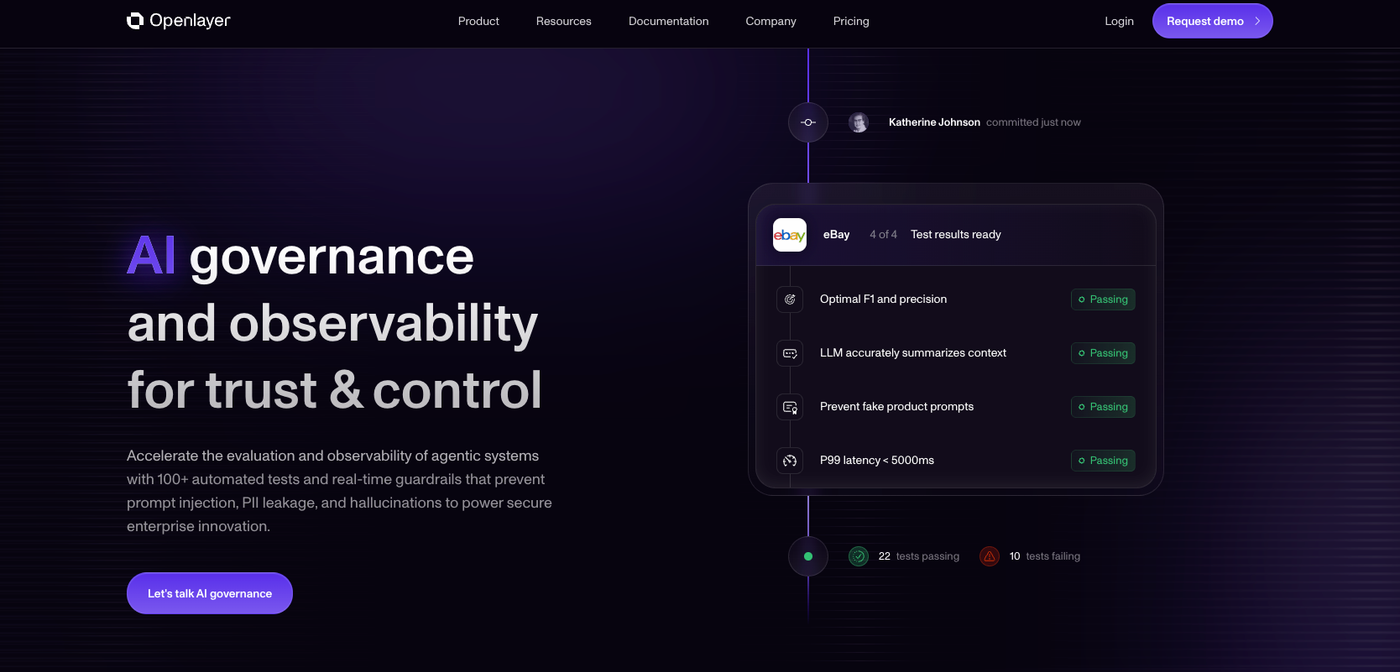
Openlayer unifies agent testing across development and production. Run over 100 behavioral tests that validate tool selection, context retention, and reasoning chains before deployment. Tests verify chain-of-thought logic and catch hallucinations, bias, and toxicity across multi-turn interactions. Real-time guardrails block prompt injections and PII leakage before reaching APIs or databases. Production monitoring tracks tool invocation accuracy, task completion rates, and drift across live traffic.
CI integration runs regression suites on every commit. Version control tracks prompt changes, test results, and performance metrics, creating audit trails for compliance reviews.
Final thoughts on agent evaluation strategies
The shift from single-turn LLM responses to multi-step agent workflows creates new testing requirements. Your AI testing agent infrastructure must validate tool integration, memory systems, and planning logic that traditional metrics miss. Production monitoring catches regressions that only surface under real user patterns and API variability. Build evaluation datasets from production logs, automate regression testing in CI pipelines, and track tool selection accuracy as agents scale.
FAQ
How do I test agents that use different tools on each run?
Build test cases that define expected tool categories and success criteria instead of exact sequences. Validate that agents select appropriate tool types for the task, pass correct parameter formats, and handle responses properly, even when execution paths vary between runs.
What's the difference between agent testing and traditional LLM evaluation?
Traditional LLM evaluation measures single input-output pairs for text quality. Agent testing validates multi-step execution sequences: tool selection accuracy, context retention across turns, error recovery logic, and state management throughout complete workflows.
When should I run agent tests in my CI/CD pipeline versus production monitoring?
Run regression suites in CI/CD to catch design flaws and safety violations before deployment. Production monitoring detects drift, API changes, and failure patterns that only surface under real user traffic and data variability at scale.
Can I use LLM-as-judge to assess agent reasoning without human review?
Yes, but control evaluator bias through diverse judge models, human-calibrated datasets, and periodic spot-checks. LLM-as-judge handles non-deterministic outputs where multiple valid answers exist, but judge accuracy must be validated against expert review to prevent blind spots from propagating.
How do I prevent prompt injection attacks in agents with API access?
Test for manipulation attempts that bypass instructions or trick agents into unauthorized actions. Deploy real-time guardrails that intercept and block suspicious requests before they reach downstream systems, and validate that agents reject attempts to access data outside user scope or invoke admin-only functions.