Agent evaluation: Complete guide to testing AI agents in March 2026
Most agent failures happen silently, buried in reasoning steps no one monitors until something breaks in production. LLM agent evaluation goes beyond input-output pairs to validate the full decision chain because agents operate probabilistically, maintain state, and execute real actions with real consequences. Your agent might return a correct answer while selecting the wrong tool, hallucinating function arguments, or leaking sensitive data through side effects. This guide covers the metrics, methodologies, and tooling to catch these failures before they become incidents that cost you users, money, or compliance standing.
TLDR:
- Agent evaluation validates reasoning chains and tool usage beyond simple outputs.
- Tool calling fails 3-15% of the time in production, causing silent errors and compliance risks.
- Test both end-to-end outcomes and component-level logic to catch flawed reasoning.
- Track task completion, tool accuracy, hallucinations, and cost per success as core metrics.
- Openlayer runs 100+ automated tests with real-time guardrails blocking prompt injections and PII leaks.
What is agent evaluation
Agent evaluation validates AI systems executing autonomous decisions. Unlike standard LLM assessments focused on text generation, this practice analyzes reasoning, tool usage, and multi-step workflows. Since agents behave non-deterministically, teams must measure the full reasoning chain instead of only the final output. This involves verifying the agent selected appropriate tools and accessed correct data sources through testing LLM agents. Proper evaluation confirms the model interprets instructions and executes operations reliably without security failures or hallucinations.
Why agent evaluation matters in production
Production environments expose brittle behaviors that prompt engineering cannot fix. Reports indicate 95% of companies implementing AI pilots miss their goals, often due to inadequate testing. Execution reliability remains the primary risk. Tool calling fails between 3% to 15% of the time, frequently causing silent errors. Without a solid agent reliability testing framework, these failures-ranging from incorrect database arguments to PII leaks-turn into critical incidents and liability.
Key differences between agent evaluation and traditional AI testing
Traditional AI testing validates static inputs against outputs. Agent evaluation differs by measuring iterative reasoning loops. You must perform agent execution path evaluation to analyze intermediate steps and tool selections instead of relying on the final response alone.
Unlike deterministic software, agents operate probabilistically and maintain state. An effective LLM agent evaluation framework verifies that external side effects-such as database updates or API calls-execute correctly. This prevents agents from hallucinating parameters or executing unauthorized actions.
Core evaluation approaches: end-to-end vs component-level
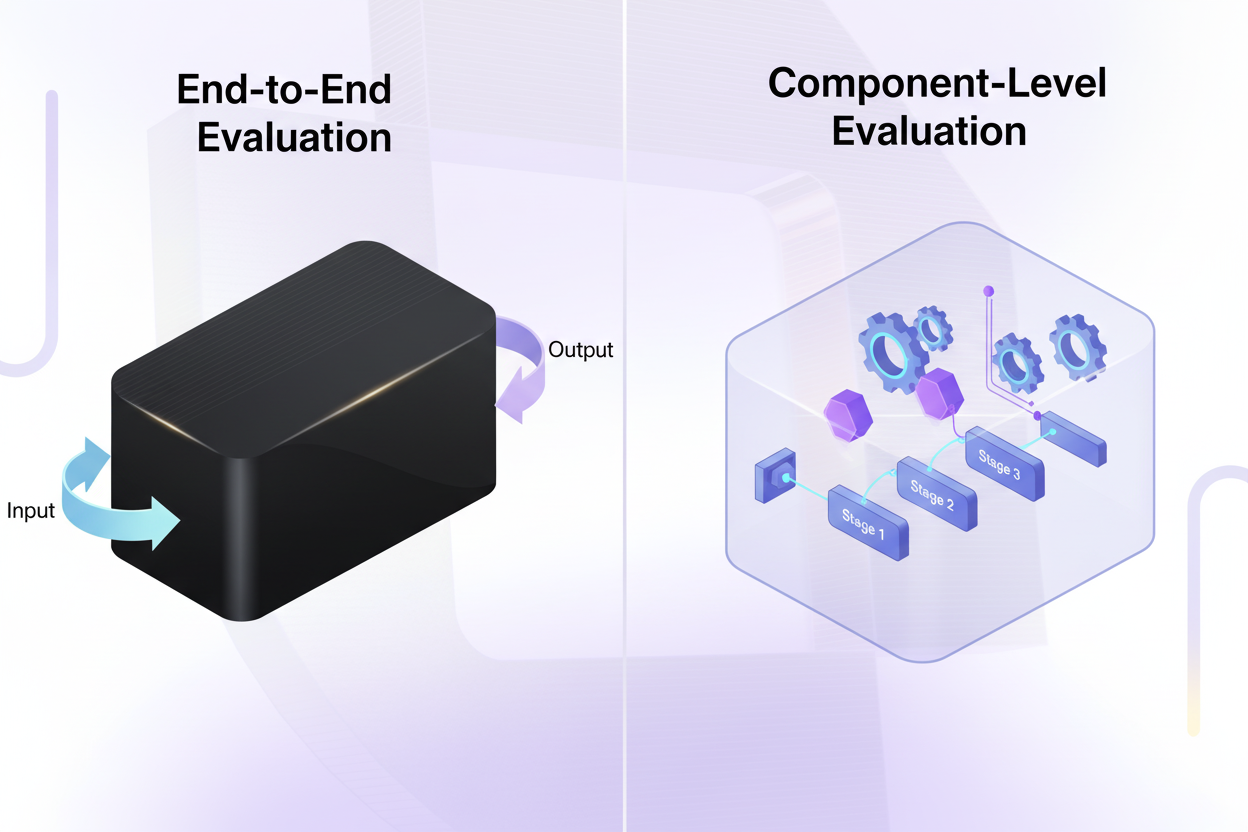
Validating agents requires assessing both final outcomes and the logic behind them. Most production systems require both approaches running at different cadences because each tackles distinct failure modes that the other misses.
End-to-end evaluation
This approach treats the system as a black box, measuring success strictly on inputs and responses. While mirroring user experience, it often masks reasoning errors where correct answers result from flawed logic. End-to-end tests catch emergent failures that only surface when components interact, such as context propagation errors or multi-turn conversation drift. The tradeoff: these tests provide limited diagnostic value when failures occur, making root cause analysis time-intensive.
Component-level evaluation
To diagnose specific failures, you must isolate retrieval and tool selection using AI agent observability. Agent execution path evaluation inspects the intermediate reasoning chain, verifying that the model selected the right tools with valid arguments. Component tests pinpoint exact failure locations and accelerate debugging. The risk: over-optimizing isolated components can degrade system performance when those components interact poorly or make assumptions about context that do not hold in practice.
Combining approaches in production
Agent testing is a layered approach. You need both end-to-end and component level to truly understand and measure how your agent is performing in production. Here are a number of recommendations related to how you should apply each type of evaluation:
- Run end-to-end tests on every deployment and component-level tests on every code change.
- Component tests validate individual reasoning steps during development, catching regressions before integration.
- End-to-end tests confirm that optimized components still compose correctly under production conditions.
- Use component-level evaluation to create performance baselines for retrieval accuracy, tool selection precision, and reasoning quality.
- Use end-to-end evaluation to measure task completion rate, user satisfaction, and cost efficiency. When end-to-end tests fail, component traces isolate whether the failure originated in retrieval, reasoning, or execution.
Core metrics for agent evaluation
Effective LLM agent evaluation metrics extend beyond text generation to assess decision logic. Quantify these performance, safety, and cost indicators to validate production readiness.
| Category | Metric | Definition |
|---|---|---|
| Performance | Task Completion Rate | Percentage of user intents resolved autonomously. |
| Reasoning | Tool Selection Accuracy | Frequency of valid tool choices and arguments. |
| Safety | Hallucination Detection | Identification of ungrounded outputs or parameters. |
| Cost Control | Cost per Success | Total compute costs divided by successful outcomes. |
Common agent failure modes and how to detect them
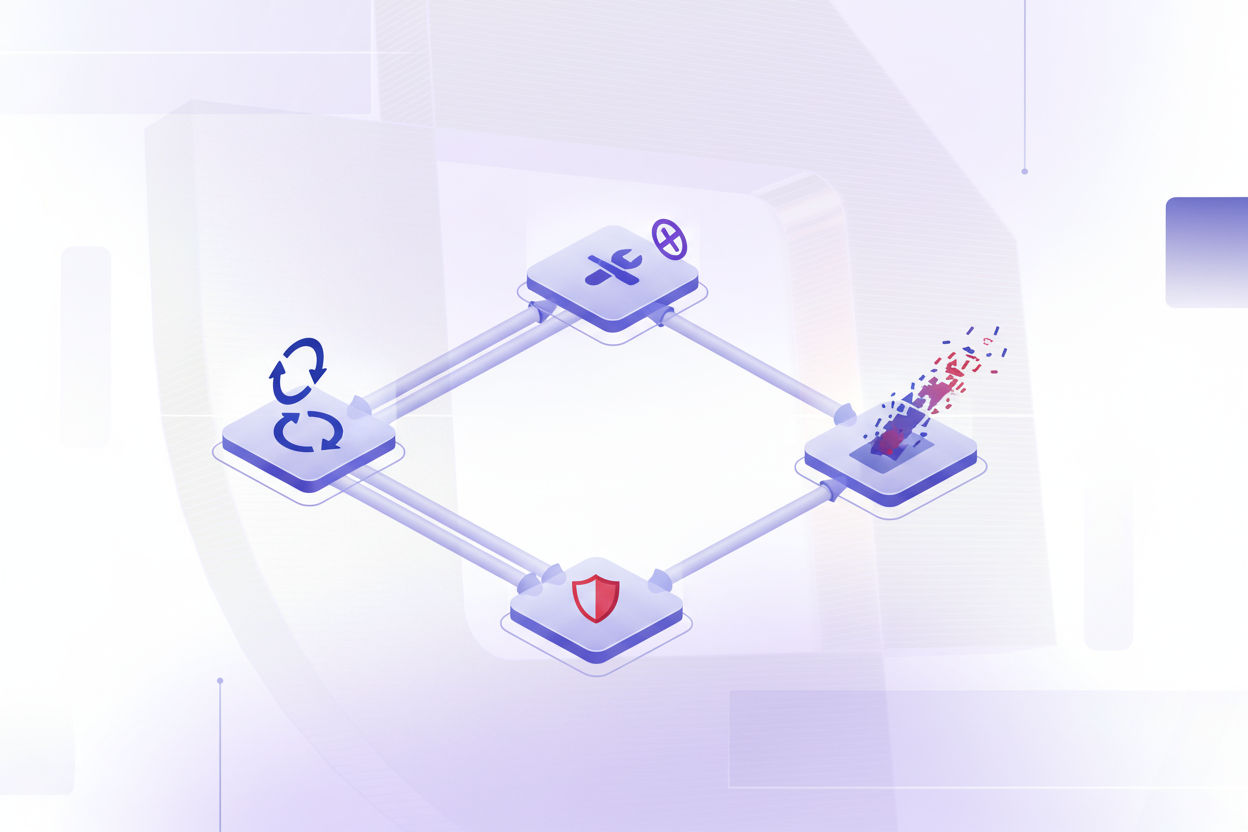
Agents fail differently than static LLMs. Unreliable performance affects 41% of deployments, necessitating precise detection mechanisms.
- Infinite loops: Enforce iteration limits and monitor for recursive tool calls. The challenge: distinguishing genuine retry logic from pathological loops requires tracking success patterns, since agents may legitimately revisit tools when initial attempts fail or context shifts.
- Tool selection errors: Validate generated arguments against function schemas before execution. Schema validation catches malformed calls but misses semantic errors where the agent chooses the right tool with valid arguments in the wrong context, requiring end-to-end trace analysis to detect.
- Prompt injections: Deploy security classifiers to flag adversarial patterns. Detection remains difficult because attacks increasingly resemble legitimate edge cases and frustrated user queries, forcing classifiers to balance security against false positives that degrade user experience.
- Context overflow: Track token usage to verify retention of initial instructions. Performance degrades gradually instead of catastrophically as context fills, manifesting as subtle instruction drift or priority inversion that appears correct locally but violates session-level constraints.
- Cost spikes: Set hard session ceilings to stop runaway agents from draining budgets. The tradeoff: hard limits prevent runaway spend but risk terminating legitimately complex tasks mid-execution, requiring dynamic thresholds that adapt to task complexity and historical patterns.
Evaluation methodologies: from automated tests to human review
Deterministic graders validate structural integrity. Scriptable assertions verify compliance with JSON schemas and API arguments, running in CI/CD to catch regressions immediately.
For complex reasoning, LLM-as-a-judge scales AI agent evaluation. You should deploy stronger models to grade agent reasoning paths for logic and context. There's a tradeoff, though, to keep in mind: judge models inherit their own biases and struggle with domain-specific correctness where they lack expertise. They frequently over-penalize stylistic differences like tone or verbosity while missing subtle logical errors or factual hallucinations that require specialized knowledge to detect.
Human review, on the other hand, extends beyond calibration to catch systematic blind spots judges cannot see, such as context-dependent appropriateness, domain violations that appear structurally valid, and failure modes where incorrect reasoning produces superficially correct outputs.
Production A/B testing confirms that offline agent evaluation results translate to real-world performance. Deploy variants in controlled traffic splits to verify improvements measured in staging environments actually improve task completion and user satisfaction.
Building effective test datasets for agents
Evaluation reliability relies on dataset quality. An effective agent evaluation framework requires test cases mirroring production complexity. Avoid testing only ideal scenarios and curate diverse inputs:
- Happy paths: Standard user intents.
- Edge cases: Ambiguous queries or unavailable tools.
- Adversarial inputs: Prompt injections bypassing guardrails.
- System failures: Simulated API timeouts.
Dataset composition depends on deployment context. Customer support agents require heavier adversarial coverage because users actively probe boundaries and attempt manipulation. Internal workflow agents need deeper edge case representation since ambiguous inputs from employees cause silent failures that compound over time. Weight your dataset by failure cost instead of frequency. A rare catastrophic failure like exposing PII deserves more test cases than a common minor latency spike, even if the latency issue occurs 100 times more often in production logs.
Use anonymized production logs to capture variance. Telemetry offers the strongest baseline for agent step-by-step evaluation, while synthetic data fills coverage gaps.
Testing multi-agent systems and orchestration
Multi-agent architectures introduce dependency risks where failures cascade. Effective multi agent evaluation validates the orchestration layer, maintaining consistent state during handoffs between specialized agents. You must verify that routers correctly delegate intents and that agents do not enter infinite conversational loops. A reliable agent evaluation framework must trace the full agent execution path, stitching together inputs, decisions, and resolutions. Without end-to-end lineage, identifying the root cause of orchestration failures remains impossible.
There is an architectural tradeoff, though: specialized agents reduce individual complexity and improve maintainability, but increase orchestration risk and failure surface area. Routers add latency to every request but improve modularity and allow independent agent updates without system-wide regression testing. Some teams assess the orchestrator separately as its own agent, measuring tool selection accuracy across routing decisions and tracking whether delegation failures stem from ambiguous input classification or incomplete agent capability metadata. This approach isolates orchestration logic from execution logic, but requires maintaining separate test suites and can miss emergent failures that only surface when routing interacts with downstream agent context requirements.
Security and safety evaluation for agents
Agents execute code and query databases, introducing attack vectors static models lack. A chatbot might hallucinate a SQL query in its response; an agent executes it against your production database. An AI agent evaluation strategy must continuously monitor for prompt injections and jailbreaks. Unlike chatbots, agents risk exposing PII through tool use. PII detection must account for context: "John Smith" in a query template differs from "John Smith" in retrieved customer data. LLM agent evaluation protocols must validate real-time PII blocking before data exits the environment. Deploy agent evaluation tools for automated red teaming to simulate adversarial inputs. Track agent evaluation metrics regarding blocked attempts versus bypasses to confirm guardrail resilience.
Agent evaluation tools and frameworks
Standard infrastructure fails to capture the recursive logic of autonomous systems. Teams require dedicated agent evaluation tools to trace execution paths effectively. No single tool covers the full evaluation stack. Most teams combine a tracing layer (LangSmith, Langfuse) with a testing framework (Braintrust, MLflow) and production monitoring (Arize). Tool choice depends on whether you favor developer experience, compliance auditability, or production observability.
- Braintrust runs regression tests against golden datasets to integrate testing into development.
- LangSmith offers LangChain agent evaluation tracing to visualize tool calls and retrieval steps.
- Langfuse operates as an open source agent evaluation framework for latency and quality observability.
- MLflow handles prompt versioning and output comparison across configurations.
- Arize detects drift against production baselines for continuous monitoring.
Continuous evaluation in production environments
Just remember that staging environments fail to capture edge cases found in live traffic. That's why your AI Agent testing needs to be continuous in order to detect drift and behavioral anomalies immediately. Testing can't be a one-off. You must track agent evaluation metrics like tool failure rates and latency against baselines to maintain reliability. Trigger automated alerts based on statistical deviations, not static thresholds. Real-time agent execution path evaluation isolates specific degrading steps, such as retrieval failures. These production insights drive feedback loops that harden the system with every interaction.
Agent evaluation with Openlayer
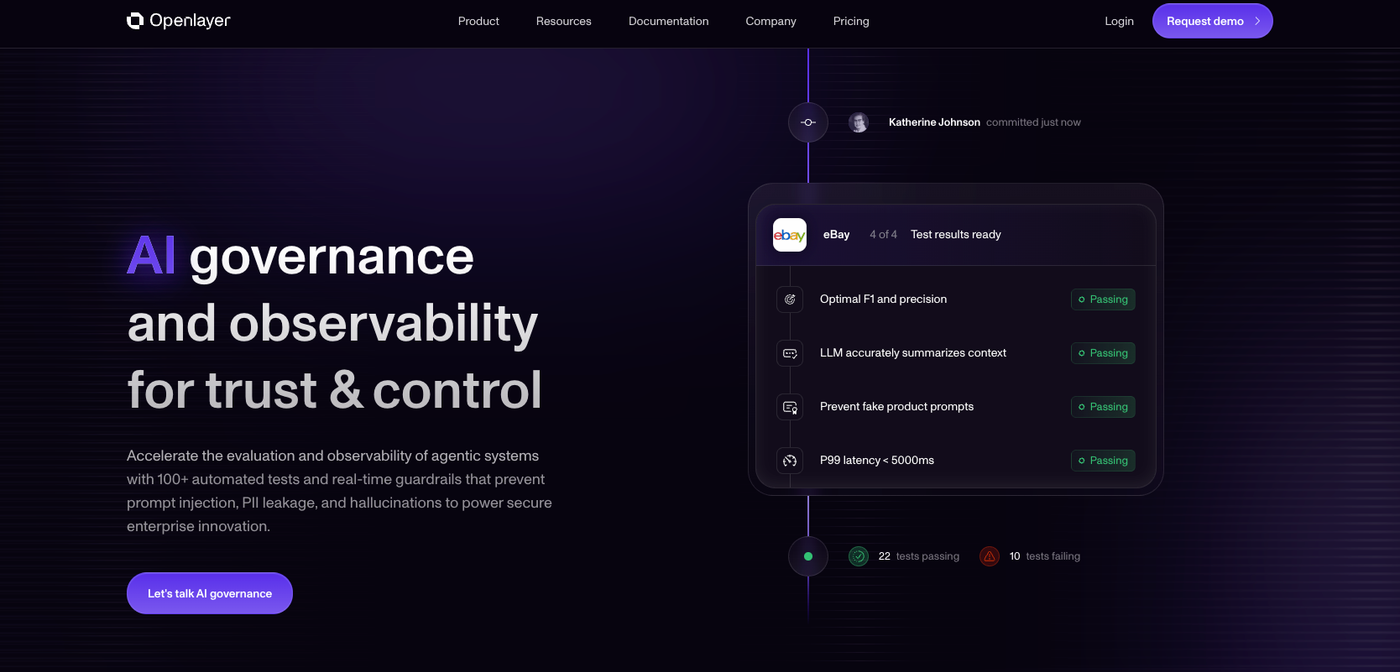
Openlayer provides a unified agent evaluation framework merging observability with governance. Execute over 100 automated tests across development and production to detect hallucinations, bias, and PII risks. Native integrations with LangChain, LlamaIndex, OpenAI Agents SDK, and Pydantic AI embed AI agent evaluation directly into current stacks. Openlayer enforces real-time guardrails to block prompt injections and data leakage while mapping results to EU AI Act and NIST standards, proving your agent evaluation strategy meets enterprise compliance.
Final thoughts on LLM agent evaluation
Production LLM agent evaluation demands more than accuracy metrics. You need to trace tool calls, validate parameters, and block adversarial inputs before they cause damage. Agents fail differently than static models, so your testing must adapt to recursive logic and state management. Start with golden datasets, but refine your approach with real usage patterns.
FAQ
How do you assess multi-step agent reasoning beyond the final output?
Implement agent execution path evaluation by logging each intermediate step, including tool selection, arguments passed, and data retrieved. This captures whether the agent chose the correct sequence even if the final answer appears correct by chance.
What metrics should you track in production to catch agent failures early?
Monitor tool selection accuracy, task completion rate, hallucination frequency, cost per successful session, and iteration count. Set automated alerts when deviations exceed statistical baselines instead of relying on static thresholds.
When should you choose component-level evaluation over end-to-end testing?
Use component-level evaluation when you need to diagnose specific failure points, such as retrieval accuracy or tool argument validation. End-to-end testing confirms user experience but masks reasoning errors where correct answers result from flawed logic.
How do you build test datasets that reflect real production complexity?
Start with anonymized production logs to capture actual variance, then augment with adversarial inputs, edge cases like ambiguous queries, and system failure simulations such as API timeouts. Avoid testing only happy path scenarios.
What security risks do agents introduce that standard LLMs don't?
Agents execute code and query databases, creating vectors for prompt injections that trigger unauthorized actions, PII leakage through tool parameters, and data exfiltration via API calls. Real-time guardrails must block these threats before execution instead of detecting them afterward.