VerifyWise vs Openlayer: AI Compliance Gap (October 2026)

There's a question worth asking about any AI governance platform: does it enforce your policy, or does it record that your policy was broken? For teams operating under high-risk EU AI Act obligations, those aren't the same thing. This comparison walks through exactly where Openlayer and VerifyWise land on that question.
TLDR:
- VerifyWise operates in the documentation and logging layer: it records policy evidence but has no published evidence of blocking unsafe outputs at the API boundary.
- Logging that a PII leak occurred is observation; blocking it before it exits the system is a control, and that architectural gap is what separates the two tools.
- EU AI Act Articles 61 and 72 require continuous production evidence post-deployment, which a compliance dashboard built from intake forms cannot satisfy.
- VerifyWise fits teams at early governance maturity needing fast-start framework coverage without a vendor contract; regulated enterprises under high-risk obligations need more.
- Openlayer covers pre-deployment evaluation, continuous drift detection, and runtime blocking guardrails, generating audit records as a byproduct of enforcement across all three.
What Is VerifyWise?
VerifyWise is an open-source AI governance software platform built to help organizations track compliance with frameworks like the EU AI Act and NIST AI RMF. Its core positioning is around structured documentation: teams use it to register AI systems, collect compliance evidence, and map controls to regulatory requirements through a centralized interface.
The target audience skews toward compliance officers and risk teams who need a lightweight, self-hostable tool to organize governance workflows without a large vendor contract. Organizations with strong engineering capacity can deploy it on their own infrastructure and extend it to fit internal processes.
VerifyWise sits firmly in the documentation and intake layer of AI governance. It organizes policy evidence and tracks compliance status, but there is no published evidence it connects to model pipelines, monitors production behavior, or enforces controls at the API boundary. That distinction is where the comparison with Openlayer gets meaningful.
What Is Openlayer?
Openlayer covers the full AI lifecycle in one place: pre-deployment testing, production monitoring, and active runtime enforcement, with compliance mapping running across all three. It handles traditional ML models, LLM applications, RAG systems, and multi-agent deployments.
Two distinct user types work from the same underlying system. Engineers and data scientists run evaluations, debug traces, and configure CI/CD deployment gates. Compliance officers and risk managers get governance dashboards, audit evidence exports, and framework mapping without needing developer help.
The core architectural difference from documentation-layer tools is enforcement. Real-time guardrails block unsafe outputs at the API boundary before they reach end users or downstream systems. Detecting a PII leak after it has exited the system is a log entry; blocking it before it exits is a control. That distinction is where the policy-vs-enforcement gap becomes concrete. Built-in framework mapping for the EU AI Act, NIST AI RMF, and ISO 42001 generates audit evidence as a byproduct of normal operation, not as a separate documentation exercise assembled after the fact.
AI System Inventory and Compliance Framework Coverage
VerifyWise covers over 30 regulatory frameworks, including regional data protection laws beyond the major AI-specific standards. Its shadow AI codebase scanning capability is a genuine differentiator for teams trying to surface unregistered models before an audit does. For organizations whose primary governance need is structured documentation and intake, that breadth matters.
Openlayer covers five built-in frameworks: EU AI Act, NIST AI RMF, ISO 42001, AIUC-1, and the Openlayer Governance Framework. The meaningful distinction is not the count but what those mappings do. Each guardrail event produces an Article 12-compliant record (metric score, threshold breached, and timestamp) without a separate documentation step. That record populates the post-market monitoring log required under Annex IV automatically, with no documentation exercise assembled after the fact.
On intake, Openlayer's configurable form builder lets compliance teams register AI systems, collect structured metadata, and route submissions through configurable approval workflows without developer mediation. Non-technical governance users can operate the full intake flow independently. VerifyWise's intake is functional, but it targets users with engineering capacity to self-host and extend. That gap shows up most clearly when a compliance officer needs to register a new system or pull an audit snapshot mid-cycle without filing a ticket to engineering.
Runtime Enforcement vs. Policy Logging
The enforcement range runs from documentation through logging, alerting, and finally blocking. VerifyWise operates in the documentation and logging band: its LLM Gateway records prompts and controls model access, but there is no published evidence it actively blocks unsafe outputs before they exit the API boundary. That positions it as a detect-and-inform tool for runtime behavior, not a control.
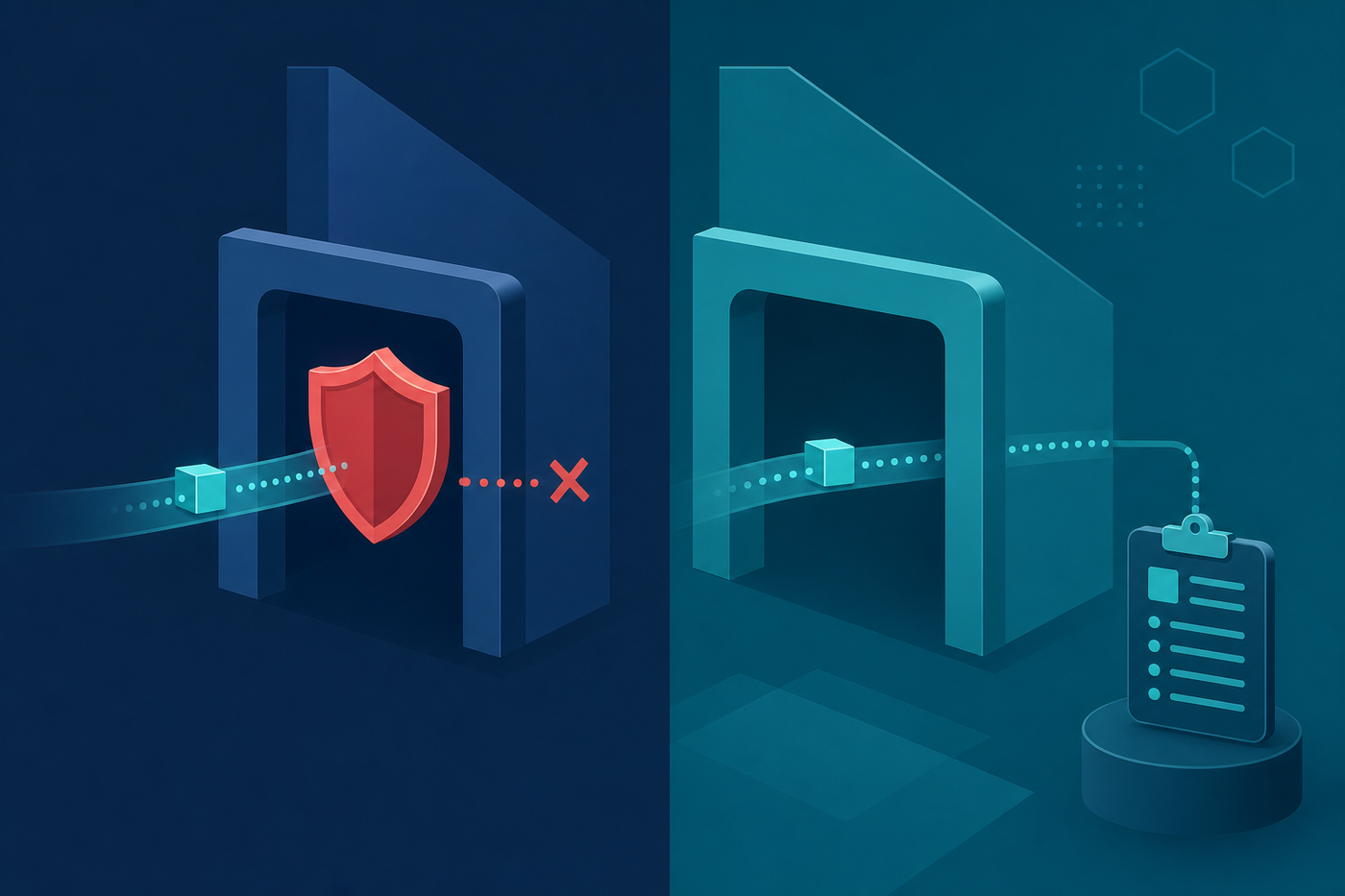
Openlayer sits at the blocking end. Five configurable enforcement actions operate at the API boundary before outputs reach end users or downstream systems: allow with logging, warn, block, redact, and escalate. Each action fires before the response exits, not after. When a guardrail triggers, an audit record is generated at that moment carrying the metric score, the threshold breached, and the policy rule invoked.
The gap between those two positions is architectural, not a feature roadmap difference. A log entry tells you a PII leak occurred. A block stops it from occurring. For regulated enterprises facing EU AI Act Article 9 risk management obligations, the former is evidence of a control gap; the latter is the control itself. The Article 9 risk management requirements mandate continuous iterative risk identification and mitigation across the full system lifecycle, not a one-time documentation exercise. VerifyWise is not alone in this band: Credo AI and IBM watsonx.governance also operate primarily in the documentation and policy-tracking layer, with no published API interceptor that blocks outputs before they exit the inference boundary.
Agentic Governance and CI/CD Deployment Gates
For agentic deployments, the timing of intervention is everything. An agent that calls an unauthorized tool (one of the key AI agent failure modes) has already executed that call before any post-hoc log captures it. The control that matters fires before the tool invocation, not after.
VerifyWise introduced an Agent Control module in v2.4 (June 2026), but published detail on its runtime capabilities remains thin (as of June 2026). What's documented covers governance tracking for agent deployments, not blocking at the moment of action.
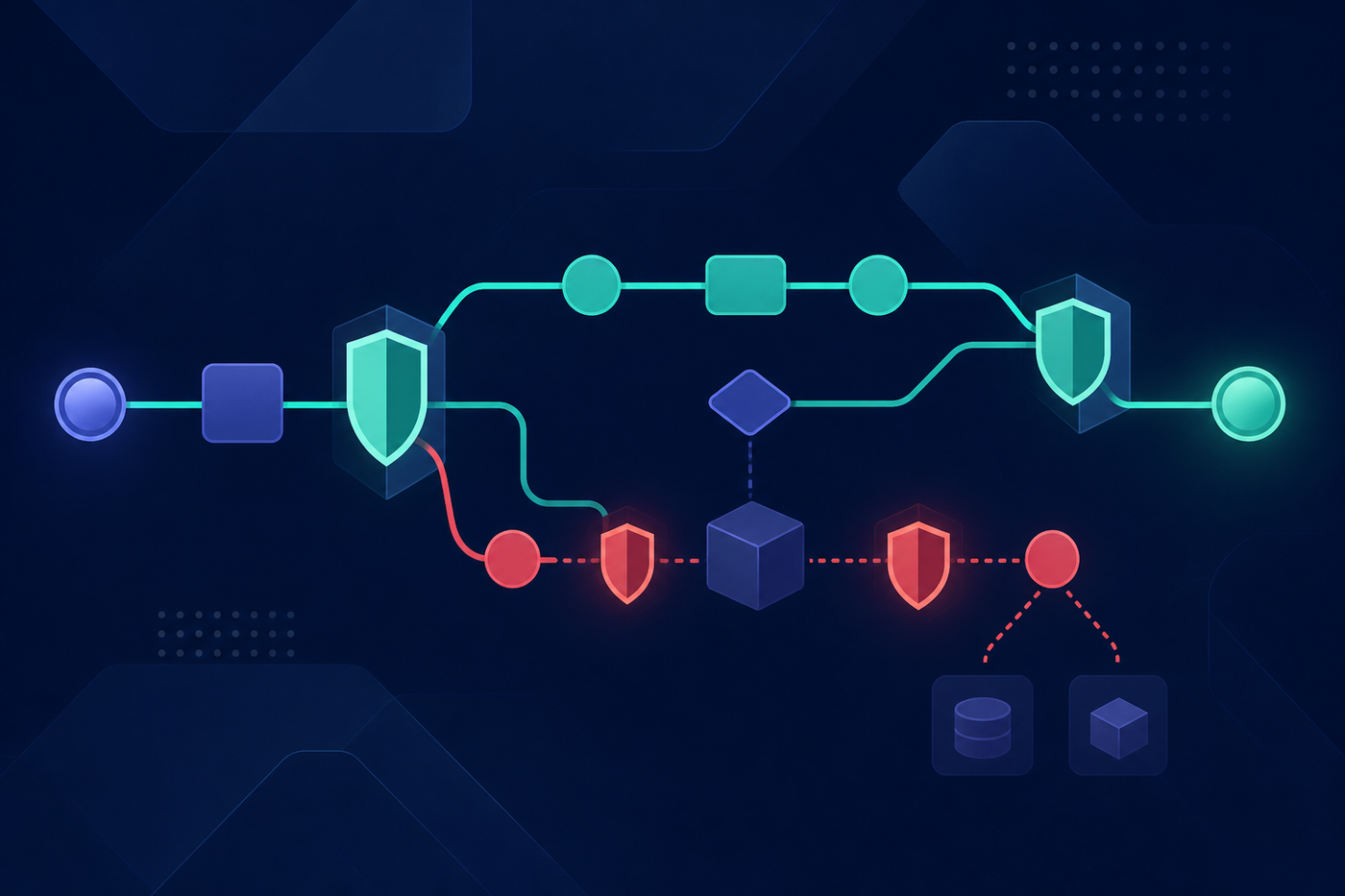
Openlayer's agentic controls are shipping and specific. Tool call authorization with explicit allow lists blocks unauthorized invocations before they execute. Execution is suspended when intent-to-tool alignment confidence drops below 0.75, or when the requested tool sits outside the agent's registered allowlist. Each block event generates an audit trail entry carrying the agent ID, requested tool, alignment score, and task context, satisfying EU AI Act Article 9 risk management documentation requirements automatically. Session-level evaluation runs across 13 metrics covering coherence, goal achievement, guideline adherence, and task progression across full multi-turn interactions, not isolated steps.
On CI/CD gates, VerifyWise has approval workflows, but there is no published evidence of hard PR-blocking integration. Openlayer's CI/CD evaluation gates block merges when evaluation thresholds fail: groundedness falling below 85% or a demographic parity gap exceeding 5 percentage points. That blocking step prevents non-compliant models from reaching production, instead of flagging them for manual review after promotion. Logging the failure is observation; blocking the merge is enforcement. For more on that distinction, see runtime AI controls and compliance docs.
Production Observability and Drift Detection
VerifyWise's monitoring posture appears to stop at compliance dashboards and audit logs. There is no published evidence of statistical drift detection, latency tracking, or anomaly detection on live traffic. For teams whose governance need is purely documentation, that may be sufficient. For teams subject to EU AI Act Articles 61 and 72, it is not: post-market monitoring obligations require continuous production evidence, not pre-deployment snapshots periodically refreshed.
Openlayer monitors continuously. Here is what that covers:
- High-risk AI drift detection surfaces input distribution changes and accuracy degradation against learned baselines, so degradation is caught as it accumulates instead of surfacing only at the next audit cycle.
- Tail latency is tracked at p50, p95, and p99 with automated alerts tied to policy thresholds.
- Runaway token-cost loops are caught before they become budget events.
- Anomaly detection includes root-cause analysis that identifies the primary categorical drivers, rather than flagging that something changed.
For compliance teams, AI-generated trace summaries make multi-step agent and RAG traces readable without line-by-line span review. A compliance officer auditing a complex agent workflow gets a structured summary of tool calls, handoffs, errors, and outcomes at the top of the trace view. That is not a quality-of-life feature; it is the mechanism that lets non-technical governance stakeholders produce audit evidence without routing every trace question through engineering.
Article 72 post-market monitoring requires providers to actively and systematically collect, document, and analyse performance data throughout the system's lifetime. A compliance dashboard built from intake forms and pre-deployment test results cannot satisfy that obligation; only continuous compliance evidence from production can. Production monitoring that generates continuous, timestamped evidence does.
| Capability | Openlayer | VerifyWise |
|---|---|---|
| Compliance framework coverage | EU AI Act, NIST AI RMF, ISO 42001, AIUC-1, Openlayer Governance Framework (5 built-in) | 30+ frameworks including regional data protection laws |
| AI system intake & registration | Configurable form builder with approval workflows; no developer mediation required | Functional intake; requires engineering capacity to self-host and extend |
| Runtime enforcement | Blocks unsafe outputs at the API boundary before they exit (allow, warn, block, redact, escalate) | LLM Gateway records prompts and controls access; no published evidence of pre-exit blocking |
| Agentic governance | Tool call authorization with allow lists; suspends execution below 0.75 alignment confidence; per-block audit trail entries | Agent Control module (v2.4, June 2026); covers governance tracking, not blocking at moment of action |
| CI/CD deployment gates | Hard PR-blocking gates; e.g. blocks merge if groundedness < 85% or demographic parity gap > 5 pp | Approval workflows present; no published evidence of hard PR-blocking integration |
| Production drift detection | Continuous statistical drift detection, p50/p95/p99 latency tracking, anomaly detection with root-cause analysis | No published evidence of statistical drift detection or anomaly detection on live traffic |
| Audit evidence generation | Auto-generated as a byproduct of enforcement (per-request metric score, threshold, timestamp) | Manual documentation and intake forms; assembled separately from enforcement |
| Shadow AI discovery | Not featured | Codebase scanning to surface unregistered models before an audit |
| Deployment model | Vendor-hosted SaaS | Open-source; self-hostable on own infrastructure |
| Best fit | Regulated enterprises under EU AI Act high-risk obligations needing enforcement + continuous evidence | Early governance maturity; teams needing fast-start framework coverage without a vendor contract |
Why Openlayer Is the Better Choice
VerifyWise earns its place for specific use cases: teams at early governance maturity who need fast-start framework coverage without a large vendor contract, security teams managing vendor AI risk portfolios, and organizations whose primary requirement is source-auditable open-source code they can extend on their own infrastructure. For those buyers, it is a legitimate starting point.
It is worth placing this comparison in the broader governance market. The two most direct enterprise governance-layer alternatives to Openlayer are Credo AI and IBM watsonx.governance. Credo AI is strongest at policy documentation and stakeholder alignment workflows, with a risk-scoring layer that maps controls to frameworks, but its architecture is policy-workflow based with no published SDK or API interceptor for blocking outputs at inference time. Like VerifyWise, it does not sit at the API boundary to stop outputs before they exit. IBM watsonx.governance offers deeper integration with IBM's model-serving infrastructure and covers explainability and fairness monitoring within that ecosystem, but its runtime enforcement capabilities are tied to the IBM stack; teams operating multi-vendor or cloud-agnostic LLM deployments will encounter coverage gaps at the enforcement layer. Both tools operate primarily in the documentation and policy-tracking band. VerifyWise occupies similar territory at lower cost and with an open-source deployment model.
For regulated enterprises operating under EU AI Act high-risk obligations, the picture is different. Documentation and intake workflows satisfy audit requirements only when paired with continuous production evidence and active controls that fire before an unsafe output exits the system, a gap closed by running EU AI Act, NIST RMF, ISO 42001. Openlayer covers all three simultaneously: pre-deployment evaluation, continuous production observability with drift detection, and real-time blocking guardrails at the API boundary. Compliance mapping runs automatically across that stack, generating audit evidence as a byproduct of enforcement instead of requiring a separate documentation exercise. That is the difference between knowing your policy and being able to prove your system followed it.
Final Thoughts on Openlayer vs VerifyWise
Choosing between these two tools comes down to what governance work you actually need to do. VerifyWise handles documentation and intake well, and it's a reasonable fit for teams whose primary requirement is structured evidence collection without a large vendor contract. Openlayer covers that same ground and extends it into production, where the EU AI Act's real obligations live: continuous monitoring, drift detection, and guardrails that block before they log. Talk to us if you want to see how that full stack maps to your specific regulatory requirements.
FAQ
Should your team choose Openlayer or VerifyWise if you're subject to EU AI Act high-risk system obligations?
If your organization faces EU AI Act high-risk system obligations (including Articles 9, 14, and 15), VerifyWise covers the documentation and intake layer but does not generate continuous production evidence or block unsafe outputs before they exit the API boundary. Openlayer satisfies all three layers simultaneously: pre-deployment evaluation, continuous production monitoring with drift detection, and real-time blocking guardrails that produce audit records automatically as a byproduct of enforcement, with no separate documentation exercise required.
What is the core architectural difference between how Openlayer and VerifyWise handle runtime enforcement?
VerifyWise operates in the documentation and logging band: its LLM Gateway records prompts and controls model access, but there is no published evidence it actively blocks unsafe outputs before they exit the API boundary. Openlayer sits at the blocking end of the enforcement range, with five configurable actions (allow with logging, warn, block, redact, and escalate) that fire at the API boundary before outputs reach end users or downstream systems, with each triggered event generating a per-request audit record carrying the metric score, threshold breached, and policy rule invoked.
Who is VerifyWise best suited for, and when does Openlayer become the right choice?
VerifyWise is a legitimate starting point for teams at early governance maturity who need fast-start framework coverage without a large vendor contract, security teams managing vendor AI risk portfolios, and organizations whose primary requirement is source-auditable open-source code they can self-host and extend. Openlayer becomes the right choice when your organization needs to satisfy EU AI Act Articles 61 and 72 post-market monitoring obligations, enforce policies against live agent tool calls before they execute, or produce continuous audit evidence without routing every compliance question through engineering.
Can non-technical compliance officers use Openlayer independently, without developer support?
Yes. Openlayer's governance intake interface, configurable form builder, approval workflows, AI-generated trace summaries, and role-based dashboards are designed so compliance officers and risk managers can register AI systems, pull audit snapshots mid-cycle, and review complex agent traces without filing tickets to engineering. VerifyWise's intake is functional but targets users with engineering capacity to self-host and extend, which creates friction when a compliance officer needs to act quickly outside a planned deployment cycle.
How does Openlayer's agentic governance differ from VerifyWise's Agent Control module?
Openlayer's agentic controls are shipping with specific enforcement mechanics: tool call authorization with explicit allow lists suspends execution when intent-to-tool alignment confidence drops below 0.75 or when the requested tool sits outside the agent's registered allowlist, generating an audit trail entry per block event that satisfies EU AI Act Article 9 risk management documentation requirements automatically. VerifyWise introduced an Agent Control module in v2.4 (June 2026), but published detail on its runtime capabilities covers governance tracking for agent deployments, not blocking at the moment of action, and for agentic systems, a tool call that has already executed cannot be undone by the log that captures it afterward.