Best AI governance software platforms in May 2026
When regulators ask how you know your AI system isn't biased, hallucinating, or vulnerable to prompt attacks, most governance tools will hand you a spreadsheet and a policy PDF. The better ones run automated tests against real outputs and give you traceable proof. We looked at six platforms that claim to handle enterprise AI governance, focusing on whether they actually test model behavior or just document what you promise it will do.
TLDR:
- AI governance tools manage how AI systems behave across their lifecycle with risk tracking and audit trails.
- Most platforms document compliance but lack runtime enforcement and automated behavioral testing.
- Gartner found that organizations using AI governance frameworks now outperform peers on trust metrics.
- Openlayer runs continuous evaluations for hallucinations, bias, and prompt injections before and after deployment.
- Credo AI and IBM WatsonX handle policy documentation; OneTrust focuses on privacy integration.
What is AI governance software?
AI governance software refers to tools that help organizations manage, audit, and control how AI systems behave across their lifecycle. That includes tracking model decisions, documenting risk assessments, running bias and fairness checks, and producing audit trails that satisfy regulators.
The category has grown sharply as AI adoption has accelerated. Gartner found that organizations applying governance frameworks to AI now outperform peers on trust metrics by a wide margin. The core use cases span risk management, regulatory compliance, model documentation, and ongoing monitoring of AI outputs in production.
How we assessed AI governance software
We focused on tools built for enterprise AI governance, not general GRC tools or developer-only point solutions. Each option was assessed against publicly available capability information across six dimensions:
- Runtime policy enforcement: does the tool act in real time, or only document after the fact?
- Compliance framework coverage: which regulations are natively supported, and which require manual configuration?
- Testing and evaluation capabilities: can teams run automated behavioral checks before and after deployment?
- Production monitoring: is there continuous visibility into live AI system behavior?
- Integration flexibility: how well does the tool fit existing ML infrastructure and data pipelines?
- Deployment options: on-premises, private cloud, or SaaS-only?
Best overall AI governance software: Openlayer
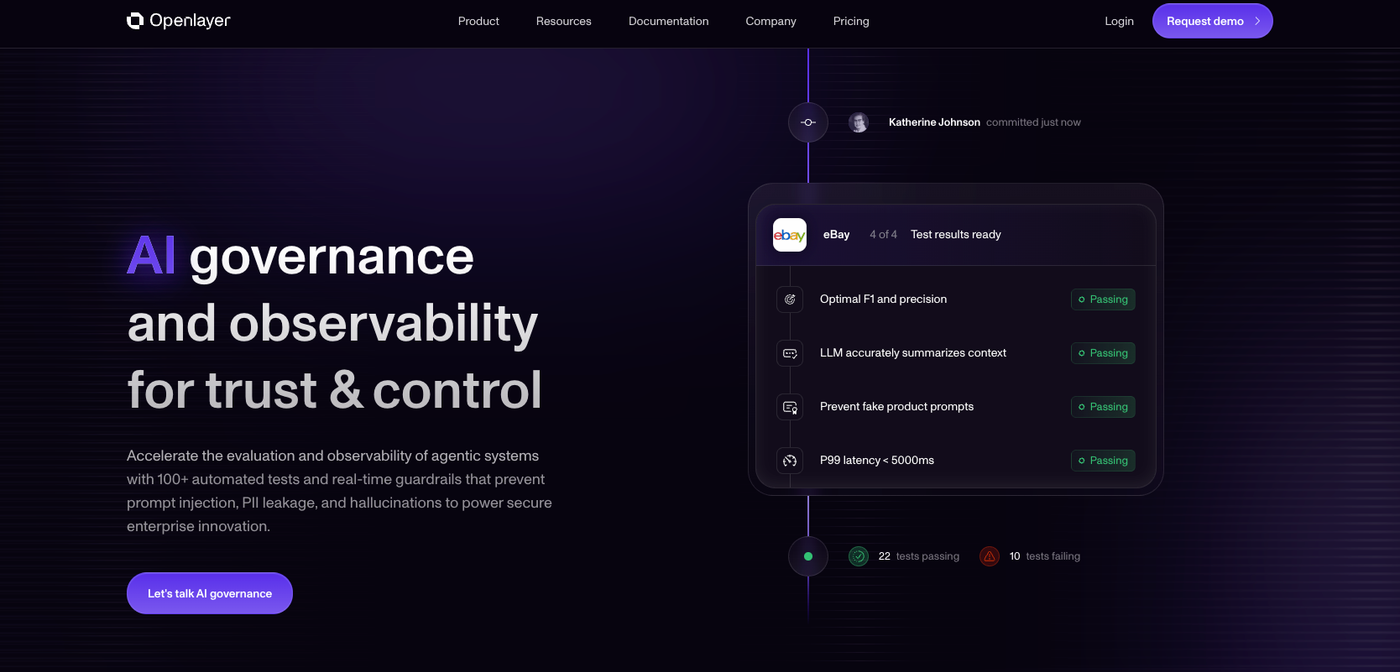
Openlayer is an AI governance and observability platform built for enterprises that need proof their models are behaving safely, not simply documentation that says they should. It connects directly to AI pipelines and runs continuous evaluations across quality, safety, and security for both traditional ML and GenAI systems. The platform covers everything from pre-deployment testing to real-time guardrails to production monitoring, with full traceability across agents, RAG systems, and multi-step workflows.
Key features
- Automated testing runs 100+ behavioral checks covering hallucinations, bias, toxicity, and prompt injection attacks before and after deployment.
- Real-time security guardrails block prompt manipulation and PII leakage before they reach downstream systems.
- CI/CD integration means every new model version or code commit triggers a full evaluation run automatically.
- Compliance mapping automatically aligns projects to frameworks including EU AI Act, NIST AI RMF, and ISO 42001 without manual configuration.
- Every test result is logged with full context, making audit-ready evidence a byproduct of regular operations.
Limitations
- Teams expecting a purely documentation-focused governance tool may find the technical depth more than their current workflows require.
- The platform is built for organizations with AI systems already in production or near deployment, so it is less suited for early-stage exploration.
- On-premises deployment requires more setup investment than SaaS-only alternatives.
- Some compliance and legal teams may face a learning curve if they are unfamiliar with ML pipeline concepts.
- Smaller organizations with limited AI infrastructure may not fully use the breadth of testing and monitoring capabilities.
Bottom line
Openlayer is best used by enterprises that need governance tied to actual model behavior instead of policy paperwork. It is a strong fit for regulated industries in financial services, healthcare, and telecom where continuous evaluation, real-time risk prevention, and regulator-ready evidence are non-negotiable. Engineering teams handling model deployment and compliance officers responsible for regulatory reporting both benefits directly, as the platform gives both audiences a shared, traceable source of truth.
Credo AI
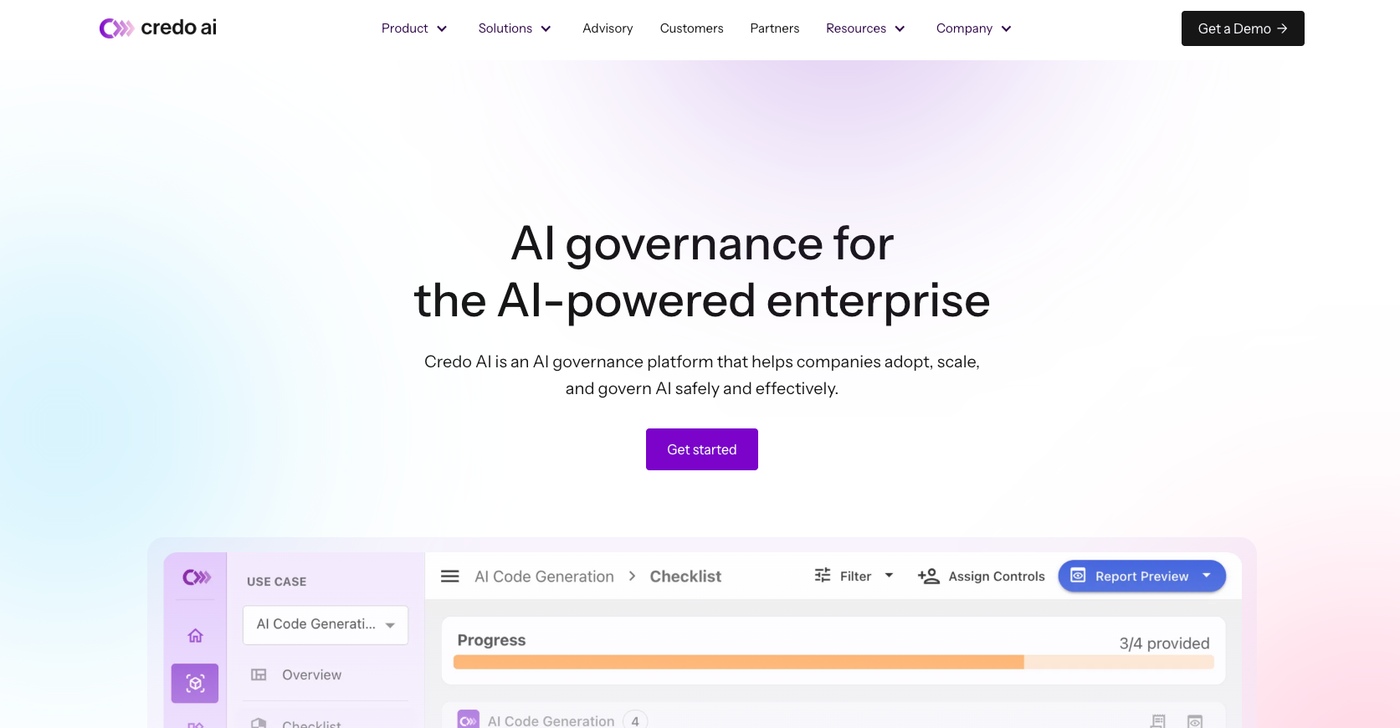
Credo AI is one of the more recognized names in AI governance, particularly among enterprises facing regulatory pressure. The company has built a reputation for policy-driven governance workflows that map AI systems to compliance frameworks like the EU AI Act and NIST AI RMF. The tool focuses on documenting risk assessments, generating audit trails, and producing governance reports for stakeholders.
Key features
- Policy-driven workflows map AI systems to major compliance frameworks including the EU AI Act and NIST AI RMF.
- Risk assessment documentation gives stakeholders structured evidence of AI accountability across the model lifecycle.
- Model inventory tracking assigns ownership and accountability across AI systems at the enterprise level.
- Audit trail generation produces governance reports suited for board-level and regulatory audiences.
- Agentic AI governance capabilities extend oversight to more complex, multi-step AI workflows.
Limitations
- The platform focuses primarily on documentation and policy workflows instead of runtime enforcement or automated behavioral testing.
- Live production monitoring is limited compared to platforms built around continuous evaluation pipelines.
- Teams that need automated test suites integrated into CI/CD workflows will find the coverage narrow.
- The tool is better suited for compliance and legal teams than for engineering-led governance workflows.
- On-premises deployment is not supported, which may restrict adoption in regulated environments with strict data residency requirements.
Bottom line
Credo AI is best used by organizations that need structured documentation and policy workflows to satisfy regulators or internal governance bodies. Compliance officers, risk managers, and legal teams benefit most from its framework mapping and audit trail capabilities, particularly in enterprises where governance is primarily a reporting and documentation exercise over a technical validation workflow.
IBM WatsonX Governance
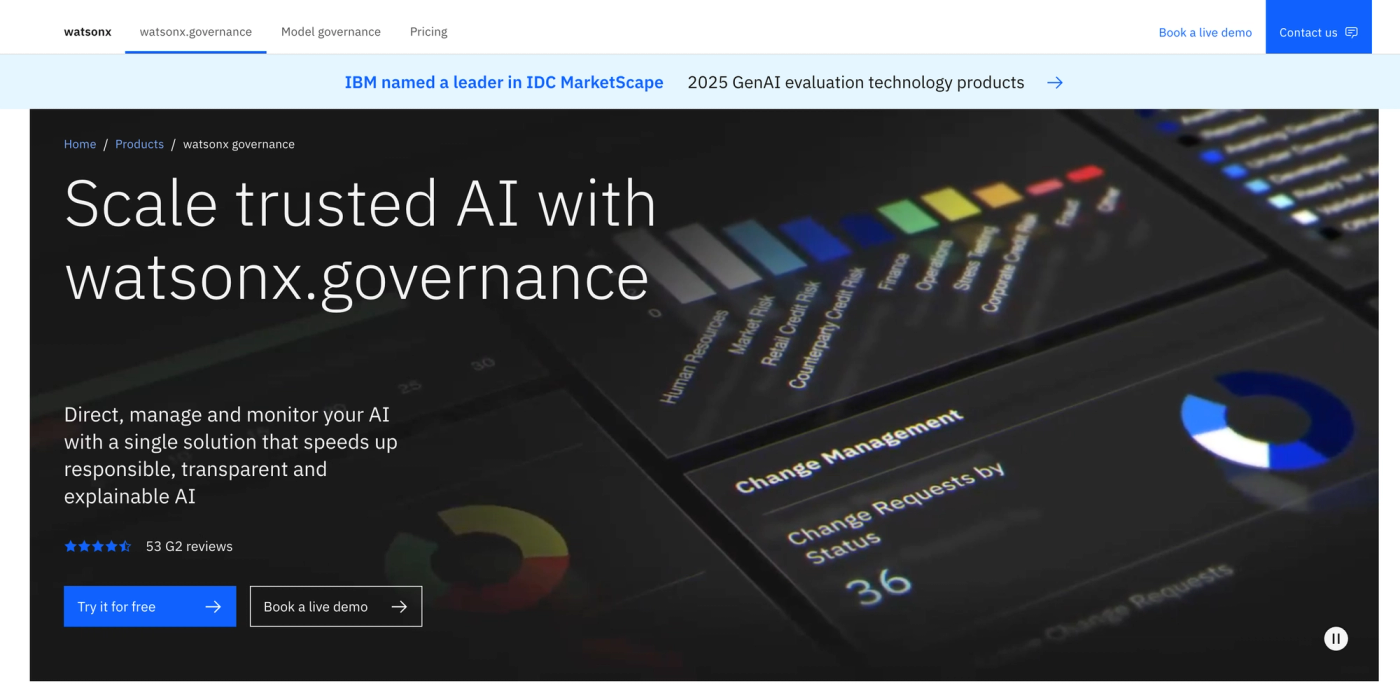
IBM WatsonX Governance is one of the more mature entries in the AI governance space, built for large enterprises that need audit trails, model risk management, and regulatory documentation at scale. The tool covers model lifecycle tracking, bias detection, and explainability reporting across both IBM-built and third-party models. It integrates with IBM's broader data and AI stack, making it a natural fit for organizations already running IBM infrastructure.
Key features
- Model lifecycle tracking provides end-to-end visibility across both IBM-built and third-party models from development through production.
- Bias detection and explainability reporting give compliance teams structured evidence of model fairness and transparency.
- Integration with IBM's broader data and AI stack reduces onboarding friction for organizations already running IBM infrastructure.
- Audit trail generation produces regulatory documentation suited for board-level and regulator audiences in financial services and healthcare.
- Gartner has recognized WatsonX Governance in its market coverage of AI governance tools, reflecting its enterprise adoption across regulated industries.
Limitations
- Deep integration with IBM's ecosystem can create friction for organizations running non-IBM infrastructure or multi-cloud environments.
- Teams that need automated behavioral test suites integrated into CI/CD workflows will find the coverage limited.
- Real-time guardrails and runtime enforcement are not core capabilities of the platform.
- The tool is better suited for documentation and audit workflows than for engineering-led continuous evaluation pipelines.
- Licensing and implementation costs can be substantial for organizations outside the IBM ecosystem.
Bottom line
IBM WatsonX Governance is best used by large enterprises already invested in IBM infrastructure that need mature model risk management, audit trails, and regulatory documentation at scale. Compliance officers, risk managers, and governance teams in financial services and healthcare benefit most, particularly where IBM's broader data and AI stack is already in place and deep integration with existing tooling is a priority.
OneTrust
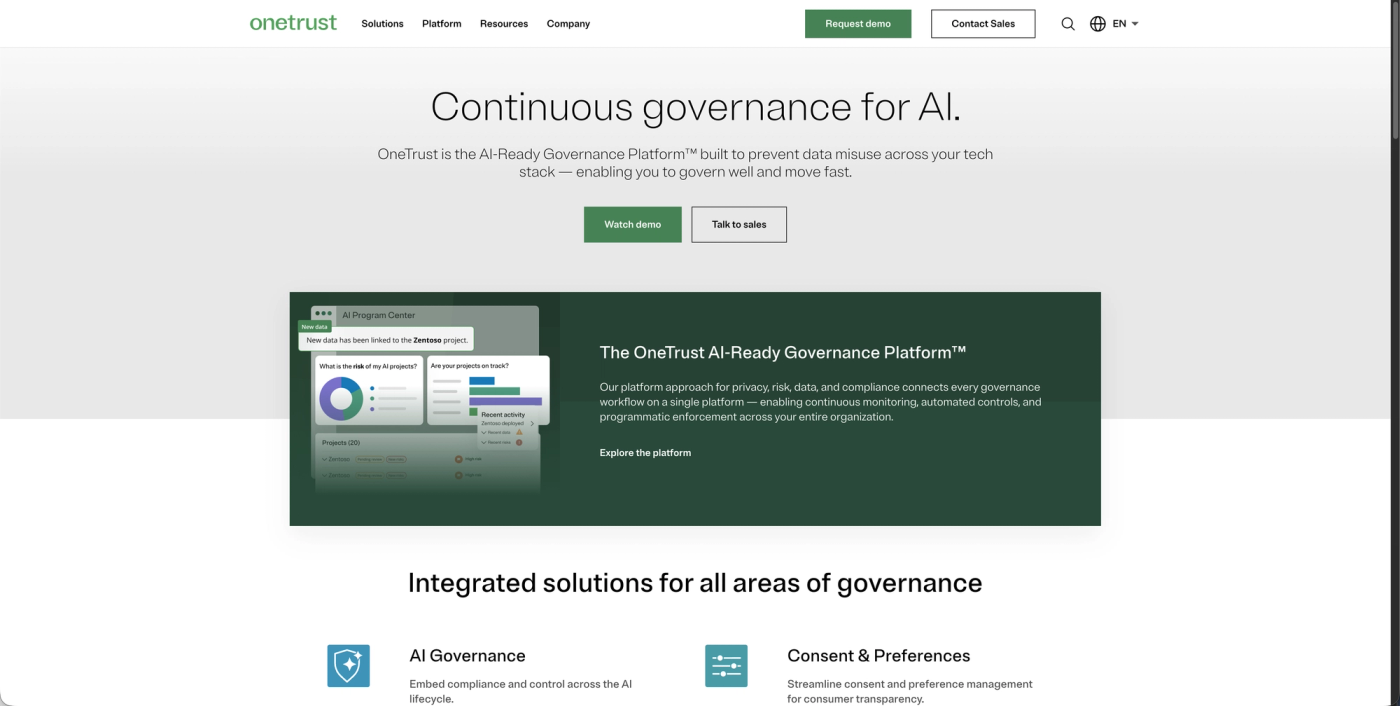
OneTrust sits at the intersection of privacy, data governance, and AI risk management. Its AI governance module lets teams inventory AI systems, assess risk, and document compliance workflows across regulatory frameworks like the EU AI Act and NIST AI RMF. The tool is built for compliance and legal teams instead of ML engineers, making it a natural fit for organizations where governance is primarily a documentation and audit exercise.
Key features
- AI system inventory and risk assessment workflows give compliance teams a structured starting point for regulatory documentation.
- Framework mapping covers major regulations including the EU AI Act and NIST AI RMF without requiring manual configuration.
- Integration with broader data privacy workflows is a genuine strength for enterprises already running OneTrust for GDPR or CCPA compliance.
- Audit trail generation produces governance reports suited for legal, risk, and regulatory audiences.
- A no-code interface makes the tool accessible to non-technical compliance and legal teams without ML engineering support.
Limitations
- The platform offers limited technical depth for teams that need model-level testing or production monitoring.
- Runtime enforcement and real-time guardrails are not core capabilities of the platform.
- Teams that need automated behavioral test suites integrated into CI/CD workflows will find the coverage narrow.
- The tool is better suited for compliance and legal teams than for engineering-led governance workflows.
- On-premises deployment is not supported, which may restrict adoption in regulated environments with strict data residency requirements.
Bottom line
OneTrust is best used by organizations that already rely on it for data privacy compliance and want to extend that coverage to AI risk management. Compliance officers, legal teams, and privacy professionals benefit most, particularly in enterprises where AI governance is treated as an extension of existing GDPR or CCPA programs instead of a standalone technical discipline.
Collibra
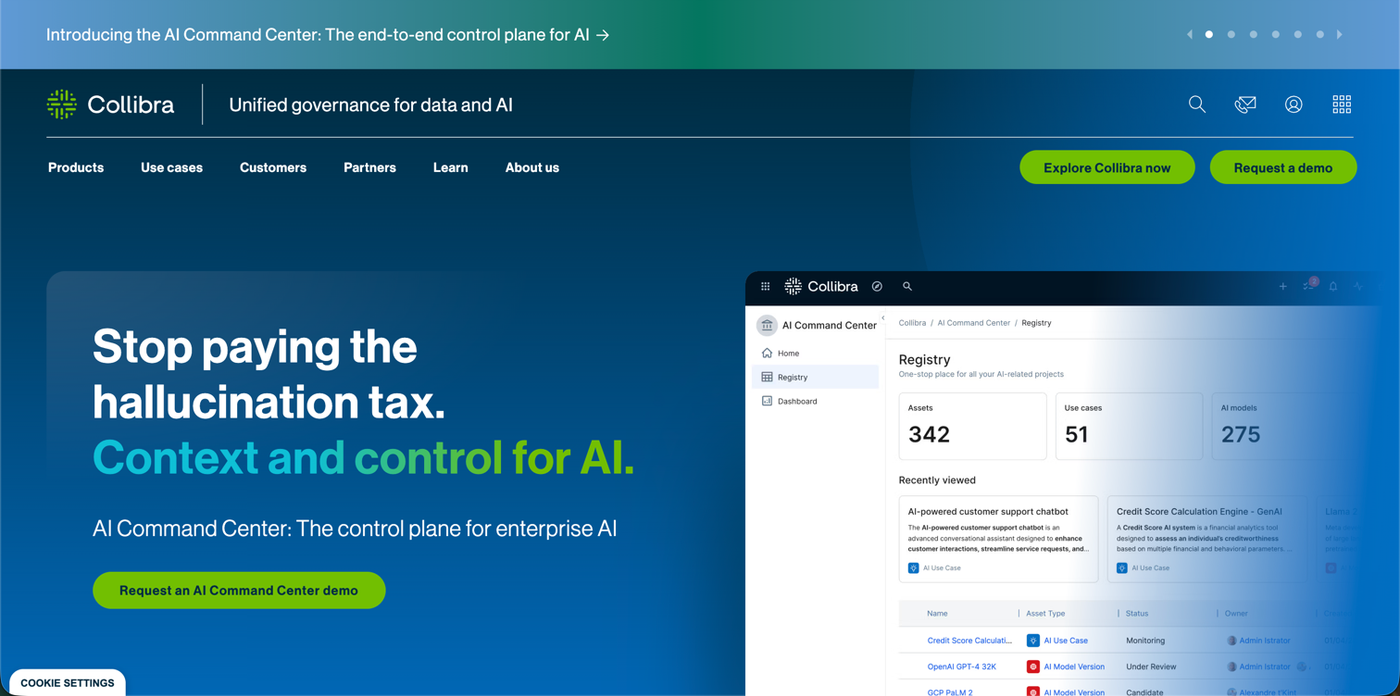
Collibra built its reputation on data governance and has since extended that foundation to AI. 2025 Gartner Magic Quadrant Leader, reflecting its standing among enterprises with complex data architectures.
Key features
- The AI Command Center provides centralized control over agentic AI systems within existing data governance workflows.
- Unified data cataloging and lineage tracking give teams end-to-end visibility across AI assets and their underlying data sources.
- Policy automation enforces governance rules across data and AI systems without requiring manual configuration at each step.
- 100+ native integrations across data environments reduce onboarding friction for enterprises with complex data architectures.
- Gartner Leader recognition in Data and Analytics Governance reflects broad enterprise adoption and market maturity.
Limitations
- The platform has no CI/CD integrated testing, meaning automated behavioral validation before deployment is not a supported workflow.
- Real-time guardrails and runtime enforcement are not core capabilities of the platform.
- Compliance validation depends on human review instead of automated evidence generation.
- The tool is a stronger fit for data governance use cases than for engineering-led AI evaluation pipelines.
- Teams managing LLM-specific risks such as hallucinations, prompt injections, and toxicity will find coverage limited.
Bottom line
Collibra is best used by enterprises already running it for data governance that want to extend oversight to AI assets within familiar workflows. Data governance leads, compliance officers, and analytics teams benefit most, particularly in organizations where AI governance is treated as an extension of existing data management programs instead of a standalone technical discipline.
complete AI
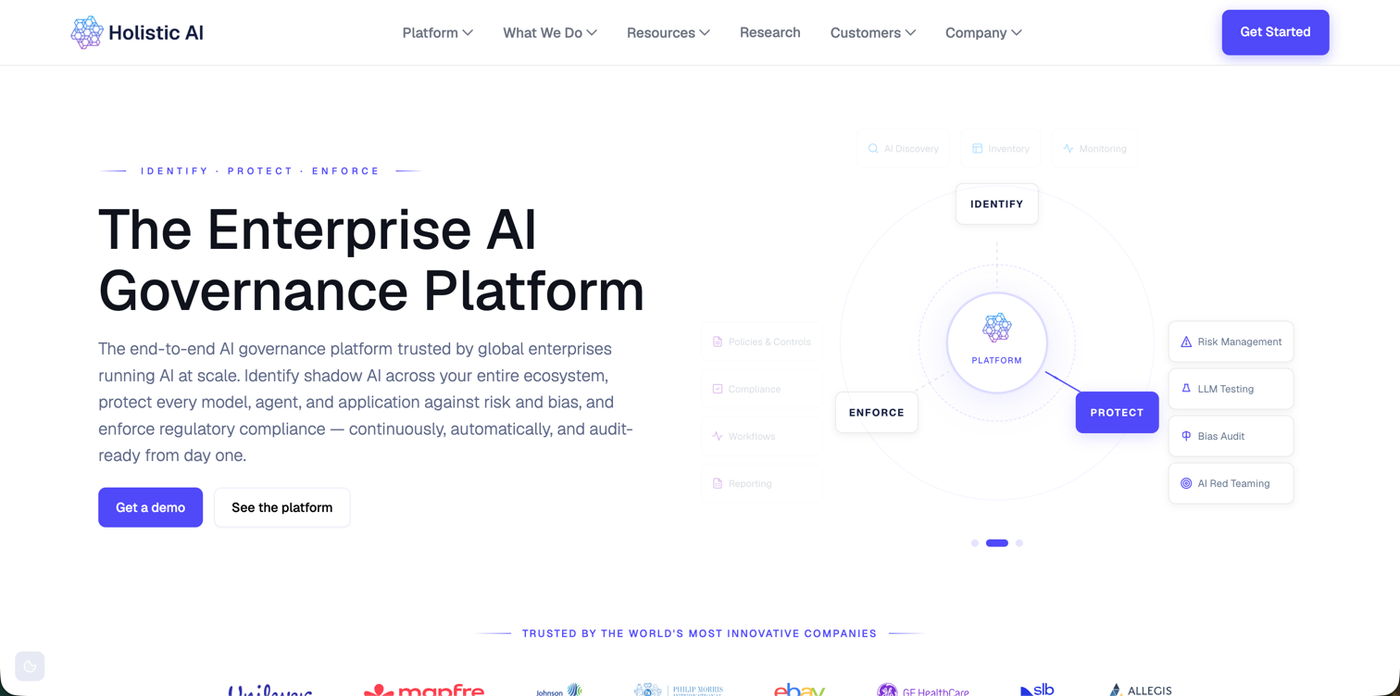
complete AI is a UK-based AI governance and risk management vendor focused on helping enterprises audit, assess, and monitor AI systems across the full deployment lifecycle. The company positions itself in the compliance and risk segment, with particular traction among regulated industries in Europe where EU AI Act readiness has become a board-level concern. The tool covers model risk assessment, bias auditing, and regulatory mapping, and it integrates with existing ML workflows to produce audit-ready documentation for regulators and internal stakeholders.
Key features
- Prebuilt assessment frameworks aligned to the EU AI Act, NIST AI RMF, and ISO 42001 shorten the time from deployment to documented compliance.
- Audit trail generation gives risk officers a paper trail that survives regulatory scrutiny.
- Bias testing and explainability tools support high-stakes use cases in financial services and healthcare.
- Risk assessment workflows provide structured evidence of AI accountability across the model lifecycle.
- Framework mapping covers major regulations without requiring a lot of manual configuration.
Limitations
- The platform focuses primarily on documentation and compliance workflows instead of runtime enforcement or automated behavioral testing.
- Continuous production monitoring is limited compared to platforms built around evaluation pipelines.
- Teams that need automated test suites integrated into CI/CD workflows will find the coverage thin.
- The tool is better suited for compliance and legal teams than for engineering-led governance workflows.
- On-premises deployment options are limited, which may restrict adoption in regulated environments with strict data residency requirements.
Bottom line
complete AI is best used by organizations that need structured evidence of AI accountability to satisfy regulators, particularly in European markets where EU AI Act compliance has become a priority. Risk officers, compliance teams, and legal leads benefit most, particularly in financial services and healthcare where bias auditing and explainability documentation are central to regulatory submissions.
Feature comparison table of AI governance software
Governance tools differ sharply once you move past documentation. Here is how the six solutions in this guide compare across the capabilities that matter most for enterprise AI deployments.
| Capability | Openlayer | Credo AI | IBM WatsonX | OneTrust | Collibra | complete AI |
|---|---|---|---|---|---|---|
| 100+ automated behavioral tests | Yes | No | No | No | No | No |
| Real-time security guardrails | Yes | No | No | No | No | No |
| CI/CD integrated testing | Yes | No | Yes | No | No | No |
| Production monitoring with traces | Yes | No | Yes | No | No | No |
| Automated compliance mapping | Yes | Yes | Yes | Yes | Yes | Yes |
| On-premises deployment | Yes | No | Yes | No | No | No |
| Policy-based risk assessment | Yes | Yes | Yes | Yes | Yes | Yes |
| Runtime enforcement | Yes | No | No | No | No | No |
| Multi-cloud support | Yes | No | Yes | No | Yes | No |
| Agentic AI governance | Yes | Yes | Yes | Yes | Yes | Yes |
The pattern is consistent: most tools handle policy documentation and compliance mapping, but only Openlayer covers the full stack from pre-deployment testing to real-time guardrails to production traces.
Why Openlayer is the best AI governance software
Openlayer treats governance as an outcome of rigorous testing, not a documentation exercise. Where many tools ask you to fill out forms and attach policies, Openlayer runs continuous evaluations against your AI models and agents before and after deployment, so compliance is a byproduct of quality.
The core workflow is built around testing pipelines that check for hallucinations, bias, toxicity, prompt injections, and latency regressions. Every test run produces auditable evidence. Compliance teams get traceable records. Engineering teams get actionable signals.
- Batch and real-time monitoring covers both LLM-based systems and traditional ML models.
- CI/CD integration means governance happens where the work already happens, not as a separate process.
- Every test result is logged with full context, making audit readiness a byproduct of regular operations.
Final thoughts on enterprise AI governance software
Choosing AI governance software comes down to whether you need proof or just paperwork. Your compliance and engineering teams both benefit when governance comes from continuous testing instead of quarterly audits, because real-time validation catches risks before they reach production. Most tools in this space focus on documentation and risk assessments, but the ones that matter test your models against actual behavioral standards. Governance works when it prevents failures, not when it reports on them afterward.
FAQ
How do I choose the right AI governance software for my organization?
Start by identifying whether your primary need is documentation for regulators or technical validation of model behavior. If you need automated testing, production monitoring, and real-time guardrails, favor tools that integrate with your ML infrastructure and offer CI/CD capabilities. If your focus is audit trails and policy documentation for legal teams, look for tools with strong compliance framework mapping and reporting features.
Which AI governance tool works best for teams already running IBM infrastructure?
IBM WatsonX Governance integrates directly with IBM's data and AI stack, making it a natural fit if your organization already runs IBM infrastructure. The tool covers model lifecycle tracking, bias detection, and explainability reporting across both IBM-built and third-party models without requiring a lot of integration work.
Can AI governance software enforce policies in real time or only document after the fact?
Most AI governance tools focus on documentation and post-deployment auditing. Only a subset offer runtime enforcement through real-time guardrails that block prompt injections, PII leakage, and other security violations before they reach production systems. Check whether the tool runs continuous evaluations against live model outputs or simply generates reports after issues occur.
What's the difference between governance tools built for compliance teams versus engineering teams?
Governance tools built for compliance teams focus on risk assessments, audit trails, and regulatory documentation workflows: they serve legal and risk officers who need evidence for regulators. Tools built for engineering teams offer automated testing, production monitoring, and CI/CD integration so governance happens as part of the development workflow. Some tools bridge both audiences, but most optimize for one over the other.
When should I consider on-premises deployment for AI governance software?
Consider on-premises deployment if your organization operates in regulated industries with strict data residency requirements, handles sensitive data that cannot leave your infrastructure, or maintains air-gapped environments. Financial services, healthcare, and government sectors often require private cloud or on-premises options to meet compliance mandates like GDPR, HIPAA, or SOC 2.l with