10 best LLM observability tools to know in February 2026
You're deploying AI at scale, and someone just asked if your models comply with the EU AI Act. You check your monitoring dashboard, but all you see are latency graphs and error rates. That won't help when regulators ask for proof that you're testing for bias, blocking prompt injections, or tracking hallucinations in production. The best LLM observability tools go beyond traditional metrics. They run automated safety tests, enforce guardrails in real time, and map your system to regulatory frameworks so you can show evidence of compliance without manual documentation. We ranked 15 platforms across evaluation, security, governance, and production monitoring to help you choose.
TLDR:
- LLM observability tracks real-time model behavior, measures quality, and flags risks like hallucinations or PII leaks.
- 100+ automated tests with real-time guardrails prevent prompt injections and data breaches before they occur.
- Development and production share test libraries, closing feedback loops that fragment traditional toolchains.
- Openlayer unifies evaluation, security, and compliance with automated mapping to EU AI Act, NIST RMF, and ISO 42001.
What are LLM observability tools?
LLM observability tools track how AI systems behave in real time. They capture traces from model inputs and outputs, measure response quality, monitor costs per query, and flag anomalies like sudden accuracy drops or drift in production data. While traditional software monitoring focuses on uptime and error rates, aI observability goes deeper. It asks whether a model's answers are correct, safe, and compliant. It checks for hallucinations, bias, or leaked sensitive data.
These tools span the full AI lifecycle. During development, they run automated test suites on new prompts or model versions. In production, they log live inferences and detect regressions before customers notice.
How we ranked LLM observability tools
We ranked each tool across five criteria for production LLM deployments:
- First, evaluation depth: coverage of hallucinations, bias, toxicity, and security risks through automated tests.
- Second, observability: tracing workflows, drift detection, and monitoring at scale.
- Third, governance: mapping to regulatory frameworks, runtime policy enforcement, and automated audit evidence collection.
- Fourth, security: blocking prompt injections and PII leakage in real time versus post-incident logging.
- Fifth, integration: how tools fit into CI/CD pipelines, support multiple LLM providers, and deploy in on-prem or hybrid environments.
Best overall LLM observability tool: Openlayer
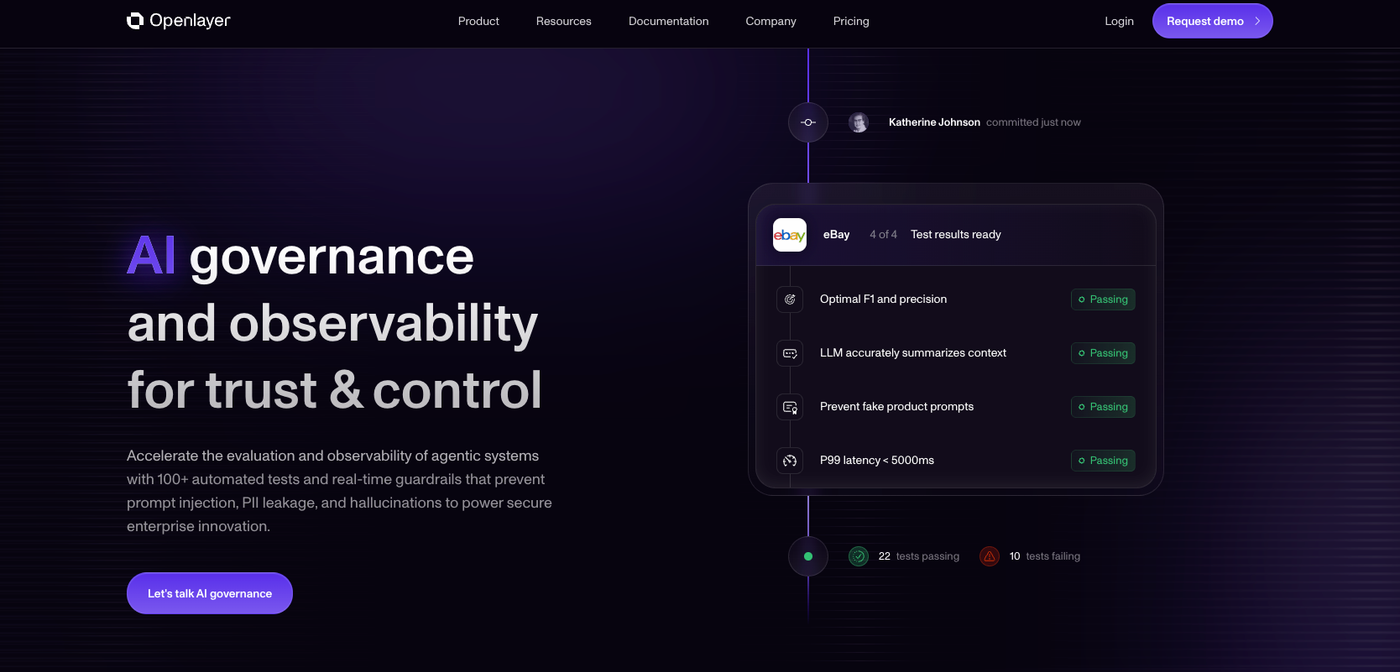
Openlayer was built to give enterprise teams unified control over AI systems from development through production. The system runs 100+ automated tests and real-time guardrails that prevent prompt injections, PII leakage, bias, toxicity, and hallucinations across agentic workflows. Core strengths include behavioral tests across multiple modalities with CI/CD integration, guardrails that block prompt injection and data exfiltration before they reach downstream systems, and continuous monitoring that tracks outputs, latency, and anomalies with automated alerts.
Key features
Behavioral tests across multiple modalities including text, vision, tabular, audio, and agent workflows with CI/CD integration. Real-time guardrails block prompt injections and PII leakage before reaching downstream systems. Continuous monitoring tracks outputs, latency, and anomalies with automated alerts for immediate response. Automated compliance mapping to EU AI Act, NIST RMF, and ISO 42001 with evidence collection. Unified platform covers agents, RAG, LLMs, and traditional ML with shared test libraries across development and production.
Limitations
None identified for enterprise deployments requiring complete governance and security controls. Teams seeking lightweight developer-only tools may find the governance features more than needed. Organizations without regulatory requirements may not fully use compliance automation capabilities. Smaller teams with limited AI deployments might benefit from more targeted single-purpose solutions. Requires initial setup investment to configure policies and integrate with existing infrastructure.
Bottom line
Best for enterprise teams deploying production AI systems at scale who need unified evaluation, security, and compliance capabilities. Most suitable for regulated industries requiring automated governance, real-time threat prevention, and audit-ready documentation across their entire AI portfolio.
Braintrust
Braintrust offers an evaluation framework built around datasets, tasks, and custom scorers. Teams define test criteria for their AI use cases and integrate gates into CI/CD pipelines to catch regressions before deployment. The tool includes production logging and trace analysis with full-text search capabilities, plus automated issue detection that converts production problems into evaluation test cases.
Key features
Flexible scoring framework allows teams to define custom evaluation metrics tailored to specific use cases. CI/CD pipeline integration blocks deployments when models fail quality thresholds. Production logging with full-text search provides for detailed trace analysis and debugging. Automated issue detection converts production failures into reusable test cases. Version comparison helps teams understand performance differences between model iterations.
Limitations
Lacks prebuilt test library requiring manual implementation of most safety and quality metrics. No real-time guardrails to block prompt injections or PII leakage before they reach downstream systems. Missing automated compliance mapping to regulatory frameworks like EU AI Act or NIST RMF. Limited governance constructs for enterprise oversight and audit preparation. Requires a lot of engineering investment to build complete test coverage.
Bottom line
Good for teams building custom evaluation workflows who need flexible scoring frameworks and can invest engineering time in test definition. Best suited for engineering-led organizations with mature CI/CD practices that focus on development-time testing over runtime security controls.
LangSmith
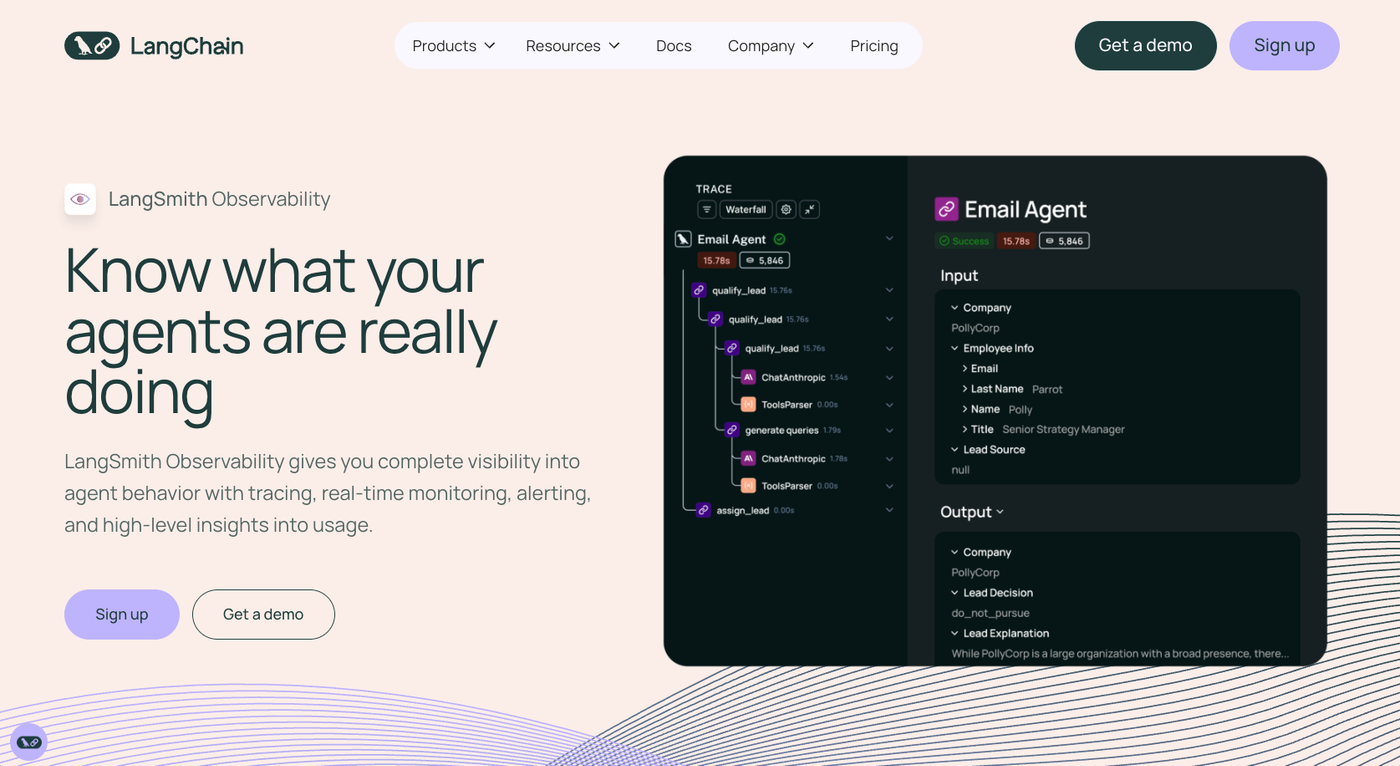
LangSmith is a developer tool for tracing and assessing AI prompts with detailed logging for debugging. Built for LangChain workflows, it provides prompt-level evaluation, version control, and trace inspection to help engineers understand application behavior. The platform focuses on developer experience with granular visibility into model calls and conversation flows.
Key features
Detailed trace logging captures prompts, model calls, tool usage, and agent steps across LangChain applications. Cost tracking and latency monitoring provide visibility into inference expenses and performance bottlenecks. Prompt versioning with evaluation supports iterative development and A/B testing workflows. Session-level analysis tracks conversation patterns and user interactions across multi-turn dialogues. Developer-focused debugging interfaces allow for engineers to inspect individual model calls and chain execution.
Limitations
No prebuilt safety or security test library requiring custom implementation of adversarial checks. Lacks real-time guardrails for blocking prompt injections or preventing PII leakage in production. Missing automated compliance mapping to regulatory frameworks or governance dashboards. Limited production monitoring capabilities beyond basic logging and trace inspection. Primarily designed for LangChain ecosystems with less flexibility for framework-agnostic deployments.
Bottom line
Good for development teams building on LangChain who need detailed debugging and trace inspection for prompt engineering workflows. Best suited for engineering-focused organizations focusing on developer experience and iterative prompt development over enterprise governance or security controls.
Langfuse
Langfuse is an open source observability tool offering tracing of AI calls with dataset-based testing and evaluation. The solution provides detailed production visibility with self-hosting support and framework-agnostic integrations. The tool includes end-to-end tracing of inputs, outputs, and API interactions with LLM-as-judge metrics and human annotations supporting evaluation workflows.
Key features
End-to-end tracing captures inputs, outputs, and API interactions across AI application workflows. LLM-as-judge metrics and human annotation capabilities support flexible evaluation approaches. Centralized prompt versioning with playground environment provides for rapid iteration and testing. Self-hosting options provide data residency control for compliance and security requirements. Framework-agnostic integrations work across multiple AI development stacks and providers.
Limitations
Missing prebuilt test suites for adversarial, safety, or robustness validation requiring custom builds. No native governance constructs for enterprise oversight or policy enforcement workflows. Lacks real-time guardrails to prevent prompt injections or PII leakage in production. Limited automated regulatory framework mapping for compliance documentation and audit preparation. Requires engineering effort to implement complete safety and quality testing coverage.
Bottom line
Best for teams focusing on open source transparency who can build custom evaluation logic and need trace-level debugging capabilities. Most suitable for engineering-led organizations comfortable with self-hosted infrastructure that value data control over prebuilt enterprise governance features.
MLflow
MLflow is an open source experiment tracking and model registry solution that has expanded to include AI evaluation capabilities. Originally focused on traditional ML lifecycle management, it now supports evaluation workflows, registry functionality, and observability across ML and AI workloads. The platform provides experiment tracking with runs, parameters, metrics, and artifact management alongside model registry and lineage tracking.
Key features
Experiment tracking captures runs, parameters, metrics, and artifacts across traditional ML and AI projects. Model registry with lineage tracking often integrates with Unity Catalog for governance workflows. AI evaluation capabilities include RAG metrics and LLM-as-judge workflows for quality assessment. Multi-domain flexibility supports traditional ML, deep learning, and AI systems requiring observability. Open source deployment provides for self-hosting with broad community support and extensibility.
Limitations
No prebuilt test library for safety, security, or adversarial robustness requiring manual implementation. Missing real-time guardrails to block prompt injections or PII leakage in production environments. Limited automated compliance mapping to regulatory frameworks like EU AI Act or NIST RMF. Lacks native governance dashboards for enterprise oversight and policy enforcement workflows. Primarily focused on experiment tracking instead of complete production monitoring and security.
Bottom line
Best suited for engineering-led organizations with existing MLflow infrastructure who need experiment tracking and registry capabilities without strong regulatory or security requirements. Most appropriate for teams focusing on reproducibility and version control over real-time security controls or automated compliance workflows.
Deepchecks
Deepchecks handles pre-deployment evaluation and basic ML monitoring through structured test suites for models and data quality. The tool covers validation needs for offline testing with some production monitoring features. Pre-deployment test suites check AI and traditional ML validation with data quality checks and distribution validation spanning training and production.
Key features
Pre-deployment test suites validate AI and traditional ML models before release. Data quality checks detect distribution shifts and schema violations across training and production. AI evaluation uses structured offline testing for quality and performance assessment. Basic ML monitoring tracks model performance metrics over time. Offline validation workflows support teams requiring structured pre-deployment checks.
Limitations
Missing real-time prompt attack prevention and data exfiltration blocking capabilities. No production-grade continuous monitoring with system-level visibility across deployments. Limited alignment to compliance frameworks or governance dashboards for non-technical stakeholders. Lacks real-time guardrails to prevent security threats before they reach downstream systems. Primarily focused on offline validation instead of runtime security controls.
Bottom line
Works for teams requiring structured pre-deployment validation with modest regulatory pressure where offline testing serves as the primary risk control. Best suited for organizations focusing on development-time quality checks over real-time production security and enterprise governance workflows.
Galileo
Galileo provides real-time monitoring with built-in guardrails and custom evaluation metrics, particularly suited for RAG and agentic workflows. The tool runs evaluations against production outputs as they happen, letting teams define application-specific quality measures. Real-time guardrails block prompt injections and data exfiltration before reaching downstream systems with specialized RAG evaluation capabilities.
Key features
Real-time guardrails prevent prompt injections and PII leakage before they impact downstream systems. RAG-specific evaluation includes retrieval quality, context relevance, and groundedness metrics. Custom metric definitions allow for teams to build application-specific quality assessments. Production monitoring assesses outputs as they happen with immediate anomaly detection. Flexible evaluation framework supports diverse GenAI use cases beyond standard benchmarks.
Limitations
No prebuilt test library requiring custom implementation of most safety and quality metrics. Missing automated compliance mapping to regulatory frameworks like EU AI Act or NIST RMF. Limited governance dashboards for enterprise oversight and policy enforcement workflows. Lacks unified evaluation and monitoring across traditional ML and GenAI systems. Requires engineering effort to define and maintain complete custom evaluation logic.
Bottom line
Suited for RAG-focused teams needing real-time safety checks with custom metrics who can invest in building evaluation logic. Best for organizations deploying retrieval-augmented systems that focus on runtime security controls over prebuilt enterprise governance features.
Arize

Arize provides enterprise-grade ML observability extending to AI applications with specialized evaluators and production-scale monitoring. The solution offers drift detection, performance tracking, and evaluation capabilities designed for teams requiring operational observability at scale. Real-time performance monitoring with drift detection for production ML models supports specialized evaluators for hallucinations, question answering, and relevance assessment.
Key features
Real-time performance monitoring with drift detection for production ML models. Specialized evaluators for hallucinations, question answering, and relevance assessment. LLM guardrails enhance model safety with multimodal handling capabilities. RAG evaluation features focus on retrieval quality and response assessment. Enterprise-scale infrastructure supports high-volume production deployments across mixed workloads.
Limitations
No prebuilt complete test library requiring custom implementation of many safety metrics. Missing automated compliance mapping to regulatory frameworks like EU AI Act or NIST RMF. Limited real-time guardrails compared to solutions offering prevention-first security approaches. Lacks unified governance dashboards for cross-team policy enforcement and audit workflows. Primarily focused on observability instead of complete development-time evaluation and testing.
Bottom line
Good for enterprise teams with existing observability requirements who need proven production-scale monitoring and drift detection for mixed ML and AI workloads. Best suited for organizations focusing on operational visibility and performance tracking over complete development-time testing or automated compliance workflows.
Credo AI
Credo AI is a governance and compliance solution focused on responsible AI risk management and policy orchestration. The tool provides AI registry, automated risk assessments, and policy packs translating regulations into structured workflows with evidence collection capabilities. Credo AI delivers policy-driven compliance and documentation workflows for organizations focusing on audit preparation.
Key features
AI registry catalogs models and systems with ownership tracking and risk classification. Automated risk assessments assess projects against regulatory frameworks and internal policies. Policy packs translate regulations like EU AI Act and NIST RMF into actionable workflows. Evidence collection automates documentation for compliance reporting and audits. Governance dashboards provide executive visibility into AI risk portfolio and compliance status.
Limitations
Does not provide technical guardrails for real-time threat prevention or runtime enforcement. Missing continuous monitoring for production anomalies requiring integration with external tools. No native testing capabilities for model quality, safety, or adversarial robustness validation. Lacks development-time evaluation features for catching issues before deployment. Primarily focused on documentation and policy workflows instead of operational risk controls.
Bottom line
Best for compliance and legal teams managing AI governance documentation who need policy orchestration and audit preparation. Most suitable for organizations with mature AI programs requiring regulatory alignment and enterprise risk management frameworks without technical validation needs.
IBM Watsonx
IBM Watsonx.governance provides policy-driven oversight within the IBM ecosystem. The solution offers fairness and explainability dashboards with agent workflow management for IBM-standardized environments. Governance dashboards track model lineage and compliance requirements while integrating with broader Watsonx capabilities for data and AI lifecycle management.
Key features
Governance dashboards for fairness and explainability within Watsonx ecosystem. Policy-driven oversight with framework mapping requiring setup and services. Agent workflow controls limited to Watsonx environment. Model lineage tracking integrates with IBM data and AI suite components. IBM integration provides tight coupling with broader IBM infrastructure and tooling.
Limitations
Limited to IBM ecosystem requiring standardization on Watsonx infrastructure and services. No prebuilt test library for complete safety and security validation requiring custom implementation. Missing real-time guardrails to block prompt injections or PII leakage in production. Requires a lot of IBM services engagement for setup and framework customization. Lacks framework-agnostic deployment flexibility for multi-cloud or hybrid environments.
Bottom line
Good for enterprises standardized on IBM infrastructure who need governance dashboards integrated with existing Watsonx deployments. Best suited for organizations with IBM-centric technology stacks requiring vendor-aligned governance tools over independent or multi-platform observability solutions.
Feature comparison table of LLM observability tools
Below is a side-by-side comparison of how these tools stack up across core capabilities like prebuilt testing libraries, real-time guardrails, and compliance automation.
| Feature | Openlayer | Braintrust | LangSmith | Langfuse | MLflow | Deepchecks | Galileo | Arize | Credo AI | IBM Watsonx |
|---|---|---|---|---|---|---|---|---|---|---|
| Prebuilt test library | 100+ tests | No | No | No | No | Limited | Yes | Yes | No | No |
| Real-time guardrails | Yes | No | No | No | No | No | Yes | No | No | No |
| Continuous monitoring | Yes | Yes | Yes | Yes | Limited | Limited | Yes | Yes | No | Limited |
| Automated compliance mapping | Yes | No | No | No | No | No | No | No | Yes | Manual |
| Prompt injection prevention | Yes | No | No | No | No | No | Yes | No | No | Detection only |
| PII leakage blocking | Yes | No | No | No | No | No | Yes | No | No | No |
| Governance dashboards | Yes | Limited | No | No | No | No | Limited | Limited | Yes | Yes |
| On-premises deployment | Yes | No | No | Yes | Yes | No | No | No | Yes | Yes |
Why Openlayer is the best LLM observability tool
Openlayer unifies evaluation, observability, security, and compliance in one governance layer. While competitors focus on tracing or documentation, we provide 100+ automated tests, real-time guardrails that block prompt injections and PII leakage, and automated compliance mapping across EU AI Act, NIST RMF, and ISO 42001. Development and production share the same test library, closing feedback loops that fragment toolchains. Security runs alongside reliability. Governance becomes operational, not clerical. This lets enterprises accelerate AI deployment with full auditability for regulators and stakeholders.
Final thoughts on selecting LLM observability tools
Your LLM observability tool should match your deployment requirements and regulatory obligations. Developer teams building experimental workflows need different capabilities than enterprises deploying customer-facing AI systems at scale. Look for solutions that close the gap between development testing and production monitoring, especially if you face compliance requirements like EU AI Act or need real-time security controls. If unified evaluation, security, and governance matter for your use case, contact our team to discuss your requirements.
FAQ
How do I choose the best LLM observability tool for my organization?
Start by mapping your requirements across evaluation depth (prebuilt tests vs. custom), production monitoring needs (tracing, drift detection, real-time alerts), and regulatory pressure (EU AI Act, NIST RMF compliance). Teams in regulated industries need governance dashboards and automated compliance mapping, while development-focused teams may focus on trace debugging and prompt versioning.
Which LLM observability tools offer real-time security guardrails?
Only Openlayer and Galileo provide real-time blocking of prompt injections and PII leakage before they reach downstream systems. Most competitors log security events after they occur, requiring manual review and incident response instead of preventing threats at runtime.
What's the difference between open source and enterprise LLM observability platforms?
Open source tools like Langfuse and MLflow offer trace-level debugging and self-hosting for data residency but require engineering effort to build safety tests, governance workflows, and compliance mapping. Enterprise platforms provide prebuilt test libraries, automated regulatory alignment, and production-grade monitoring with vendor support for regulated environments.
Can I integrate LLM observability tools into my existing CI/CD pipeline?
Most tools support CI/CD integration through APIs, SDKs, or CLI commands that trigger evaluations on code commits. Openlayer and Braintrust run automated test suites as pipeline gates, blocking deployments when models fail quality or security thresholds. Check whether your tool supports your deployment environment: on-premises, cloud, or hybrid.
Which tools are best for teams building RAG systems?
Galileo specializes in RAG evaluation with retrieval quality metrics, while Openlayer provides RAG-specific tests including needle-in-a-haystack retrieval, context utilization, context relevancy, and groundedness checks. Arize offers relevance assessment for production RAG workflows, and Langfuse provides for trace-level debugging of retrieval steps.