LLM Evaluation in Regulated Sectors (July 2026)


Standard AI evaluation was not designed for industries where a bad output triggers enforcement actions. In financial services, healthcare, and the public sector, accuracy is one requirement among several. You're documenting ongoing conformance, tracking demographic fairness across protected groups, and generating audit trails regulators expect to see on demand. Most evaluation frameworks miss this entirely. They measure model performance at deployment and go quiet, leaving you with no drift monitoring, no fairness records, and no evidentiary artifacts when an audit or incident surfaces six months later. This guide breaks down the evaluation requirements regulated industries actually face and the infrastructure teams need to meet them from development through production.
TLDR:
- Standard AI evaluation treats compliance as a pre-deployment checkbox, missing three critical gaps: benchmark accuracy that doesn't predict regulated failures, unmonitored post-deployment drift, and absent audit trails.
- Financial services requires demographic parity gap testing below 5%, groundedness scores above 85%, and explainability records for adverse actions under ECOA and Fair Housing Act.
- Healthcare evaluation must test PHI boundary enforcement, minimum necessary compliance, and demographic fairness across patient subgroups where a 92% overall accuracy masks 78% performance in specific populations.
- Public sector AI faces EU AI Act prohibited practices including social scoring and biometric identification, with transparency obligations requiring functional human override capacity, not nominal review steps.
- Openlayer runs pre-deployment gates that block release when thresholds fail, monitors live outputs with guardrails that prevent unsafe responses from reaching users, and generates audit trails organized by model version for conformity assessments.
Why Standard AI Evaluation Falls Short in Regulated Industries
Regulated industries operate under a fundamentally different risk calculus than most AI deployments. A hallucinated product recommendation is a bad user experience. A hallucinated drug interaction, a miscalculated credit risk score, or an incorrectly denied benefits claim can cause direct harm, trigger regulatory action, and generate liability that persists long after the model is retrained.
Standard AI evaluation frameworks were not designed with this gap in mind. Most treat evaluation as a pre-deployment checkpoint: run a benchmark, review accuracy metrics, ship. That approach misses three structural problems that show up in regulated contexts in particular.
Here are the failure modes worth understanding before selecting any evaluation approach:
- Benchmark accuracy does not predict compliance-relevant failure. A model can score well on general reasoning benchmarks while systematically failing on the narrow, high-stakes tasks regulators care about, such as adverse event classification in clinical notes or fair lending determinations across demographic segments. The evaluation surface needs to match the actual risk surface.
- Post-deployment drift goes undetected without continuous monitoring. Regulated industries require evidence of ongoing conformance, not a one-time sign-off. A model's behavior at deployment and its behavior six months later can diverge substantially as input distributions shift, yet most evaluation setups produce no ongoing record that auditors can inspect.
- Audit trails are missing by design. Standard eval tooling is built to help teams improve models, not to generate the evidentiary record regulators expect: timestamped test results, documented failure modes, version-linked performance data, and sign-off records tied to specific deployment events. Without those artifacts, compliance claims rest on intention instead of evidence.
The practical consequence is that teams building for financial services, healthcare, or the public sector need evaluation infrastructure that treats compliance documentation as a first-class output, not an afterthought assembled before an audit.
Financial Services AI Evaluation Requirements
Financial services sits at the intersection of two colliding pressures: rapid LLM adoption and some of the most demanding regulatory oversight of any industry. Getting evaluation wrong here carries consequences that extend well beyond model performance: enforcement actions, reputational damage, and direct consumer harm.
Three regulatory frameworks set the floor for what LLM evaluation must cover in this sector.
Key Regulatory Frameworks
Fair lending laws (ECOA, Fair Housing Act): Any LLM involved in credit decisions, underwriting, or loan pricing must be tested for disparate impact across protected classes. Demographic parity gaps exceeding 5% warrant formal review before deployment. Evaluation must include adverse action explainability: if a model contributes to a denial, the reasoning must be traceable to specific input factors, not a black-box score.
Model Risk Management (SR 11-7): The OCC and Federal Reserve expect model inventories, independent validation, and ongoing performance monitoring. For LLMs, that translates to pre-deployment evaluation against defined benchmarks, documented limitations, and post-deployment drift tracking with defined thresholds for escalation.
SEC AI disclosure guidance: Models that influence investment recommendations or client communications face disclosure obligations. Evaluation records must show what the model was tested on, what failure modes were identified, and what mitigations were applied before the model touched client-facing outputs.
What Financial Services Evaluation Must Cover
- Bias and fairness testing across protected demographic groups at every model update and throughout the lifecycle after initial deployment
- Groundedness scoring for any output that informs a financial decision, flagging responses when groundedness falls below 85% before they reach an advisor or client
- Explainability records that satisfy adverse action notice requirements under ECOA
- Drift monitoring with escalation thresholds tied to model risk tiers, so a consumer lending model triggers faster review than an internal summarization tool
Healthcare AI Evaluation and HIPAA Alignment
Healthcare sits at the intersection of two competing pressures: the obligation to deploy AI that genuinely improves patient outcomes, and the obligation to protect the sensitive data those systems depend on. HIPAA does not mention LLMs by name, but its Privacy and Security Rules create concrete evaluation requirements for any model that touches protected health information (PHI).
The core question for healthcare AI teams is not whether a model is accurate in the abstract. It is whether the model behaves safely and consistently across the specific patient populations, clinical contexts, and data types it will encounter in production.
What HIPAA Alignment Requires from LLM Evaluation
There are three evaluation dimensions that map directly to HIPAA obligations.
- PHI boundary enforcement: Any LLM deployed in a healthcare context must be tested for its tendency to reproduce, infer, or inappropriately surface PHI. Evaluation should include adversarial prompts designed to elicit patient identifiers, test cases covering indirect re-identification risk, and output inspection for unintended PHI leakage across session boundaries.
- Minimum necessary standard compliance: HIPAA's minimum necessary rule requires that disclosures of PHI be limited to what is needed for the stated purpose. LLM evaluation should measure whether model outputs consistently scope responses to the clinical question at hand without volunteering adjacent patient data that was not requested.
- Audit trail completeness: The HIPAA Security Rule requires covered entities to maintain access logs and activity records. For LLM deployments, evaluation infrastructure must generate inference-level records that document what input was received, what output was produced, and what model version was active at the time.
Demographic Fairness Across Patient Populations
Clinical AI has a documented history of performing unevenly across demographic groups. Evaluation for healthcare must go beyond aggregate accuracy metrics and measure performance separately across race, ethnicity, age, sex, language, and insurance status where the training data supports it. A model that achieves 92% accuracy overall but performs at 78% for a specific demographic subgroup is not safe for clinical use, regardless of its headline number. Fairness evaluation should be a deployment gate, not a post-hoc analysis.
Human oversight requirements add another layer. Any LLM operating in a clinical decision support capacity should be tested for how well its outputs support clinician judgment instead of substituting for it. That means testing for appropriate confidence calibration, clear uncertainty signaling, and the absence of outputs that present probabilistic suggestions as definitive diagnoses.
Public Sector AI Transparency and Prohibited Practice Avoidance
Public sector AI deployments sit at the intersection of democratic accountability and execution risk in ways that financial services and healthcare do not. When a government system makes or informs decisions about benefits eligibility, immigration status, criminal risk scoring, or resource allocation, the affected individuals typically have no alternative recourse and often no visibility into how the decision was made.
The EU AI Act's prohibited practices list is where this accountability gap gets codified into hard law. Several prohibitions apply directly to government use cases.
Prohibited Practices with Direct Public Sector Exposure
Three categories carry the highest compliance exposure for public sector AI deployments:
- Social scoring by public authorities: any AI system that scores or classifies individuals based on social behavior or personal characteristics to produce scores that then govern access to public services, benefits, or rights. A welfare fraud detection model that assigns risk scores determining case review priority falls squarely in this category if those scores feed directly into adverse determinations without meaningful human review.
- Real-time remote biometric identification in publicly accessible spaces: law enforcement use of live facial recognition in crowds, transit systems, or public events. The EU AI Act permits narrow exceptions (imminent terrorist threat, locating missing children), but the default is prohibition, and each exception requires prior judicial or independent administrative authorization.
- Subliminal manipulation and exploitation of vulnerabilities: AI systems that use techniques operating below conscious awareness, or that target individuals based on age, disability, or socioeconomic circumstances, to distort behavior in ways that cause or are likely to cause harm.
Transparency Obligations for Public Sector High-Risk Systems
Beyond prohibited practices, public sector deployments of high-risk AI must meet transparency and human oversight requirements that go well beyond what most government agencies have built into their current procurement and deployment processes. The EU AI Act Article 6 classification rules define which systems are always considered high-risk unless they pose no material risk to health, safety, or fundamental rights.
The distinction between nominal and actual human oversight is where most public sector evaluations break down in practice. A benefits adjudication system might have a "human in the loop" step where a case worker reviews the AI's recommendation, but if the case worker sees 200 cases per day with two minutes allocated per review, the oversight is not functional. Evaluation must test whether the human reviewer has the information, time, and authority to meaningfully override.
For public sector teams building evaluation programs, measure override rates and their distribution across demographic groups, track whether human reviewers have access to model confidence scores and feature-level explanations, and document the review process in sufficient detail that an auditor can confirm the oversight was real instead of nominal.
Evaluation Metrics for High-Risk AI Systems
Regulated industries require evaluation frameworks that go well beyond standard LLM benchmarks. A model that scores well on general capability tests can still produce outputs that trigger regulatory violations, expose patient data, or generate discriminatory credit decisions. The metrics that matter here fall into four primary categories.

Factual Accuracy and Groundedness
In financial services and healthcare, hallucination carries real liability. Groundedness measures whether a model's output is anchored in retrieved or provided source material. A practical deployment threshold: flag responses when groundedness scores fall below 85%, and block outputs where the model introduces claims with no traceable source. For clinical decision support, that bar should be higher.
Fairness and Demographic Parity
High-risk systems under the EU AI Act, the Equal Credit Opportunity Act, and HHS bias guidance must show that outputs do not systematically disadvantage protected groups. The metric to track is demographic parity gap across gender, race, age, and disability status. A gap exceeding 5% across any protected attribute should trigger a mandatory review before deployment proceeds.
Toxicity and Safety
Public sector chatbots and patient-facing health tools carry reputational and regulatory exposure for harmful outputs. Toxicity scoring should run on every response in production. Flag responses when toxicity probability exceeds 0.15; in children's services or mental health contexts, tighten that threshold to 0.05.
Calibration and Confidence
A model that is frequently wrong but highly confident is more dangerous in a regulated context than one that surfaces its own uncertainty. Calibration metrics measure the alignment between stated confidence and actual accuracy. Poor calibration in a medical diagnosis assistant or fraud scoring model is a deployment risk with regulatory consequences beyond performance degradation.
| Metric Category | What It Measures | Regulated Industry Risk If Ignored |
|---|---|---|
| Groundedness | Output anchored to source material | Hallucinated advice, audit failure |
| Demographic parity gap | Output consistency across protected groups | Discriminatory lending, fair housing violations |
| Toxicity score | Harmful or unsafe content probability | Patient harm, public trust loss |
| Calibration | Confidence vs. actual accuracy alignment | Overconfident clinical or fraud decisions |
Testing AI Systems for Demographic Bias in Lending and Employment
Demographic bias testing sits at the intersection of technical rigor and legal exposure. In lending, a model that systematically assigns lower scores to applicants from protected demographic groups violates the Equal Credit Opportunity Act and Fair Housing Act regardless of whether the bias was intentional. In employment screening, similar patterns trigger Title VII liability. The technical mechanism is often indirect: the model never sees race or gender explicitly, but proxy features like zip code, name etymology, or employment gap duration carry demographic signal.
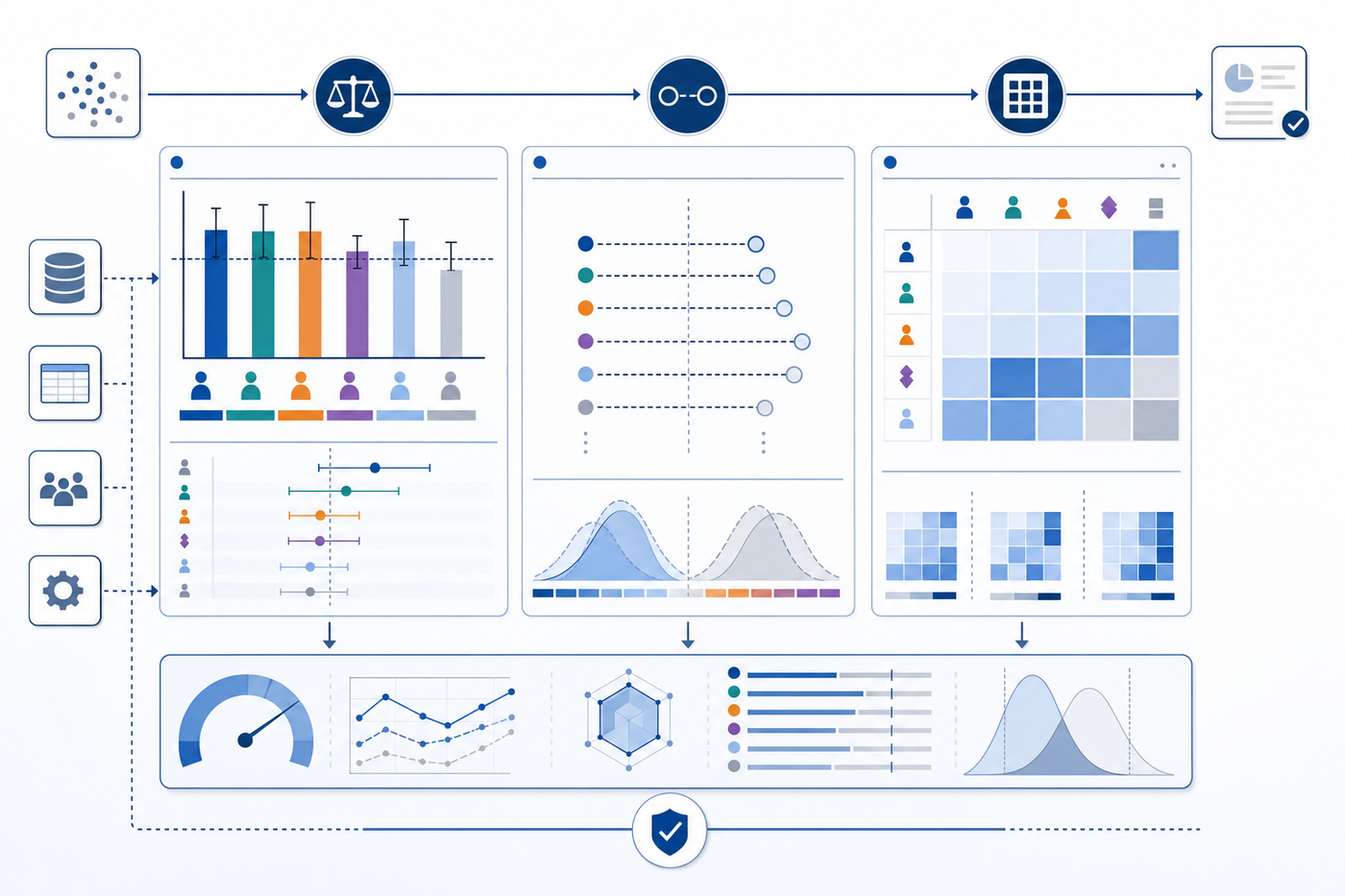
There are three testing approaches teams should run in parallel.
Disparate Impact Analysis
Measure approval or selection rates across protected groups and compute the adverse impact ratio. The four-fifths rule from EEOC guidance sets a common threshold: a selection rate for any group below 80% of the highest group's rate signals potential disparate impact. For a lending model, that means computing approval rates segmented by race, gender, and national origin proxies, then flagging any ratio below 0.8 for investigation.
Counterfactual Fairness Testing
Generate matched application pairs that are identical except for a single demographic signal, then compare model outputs. If swapping an applicant's inferred gender changes the credit decision or employment score, the model is using that signal. This test catches proxy discrimination that disparate impact ratios can miss when group membership is inferred indirectly.
Intersectional Subgroup Evaluation
Single-axis fairness metrics can mask compounding bias. A model may show acceptable approval rates for women and acceptable rates for applicants from majority-minority zip codes separately, while producing discriminatory outcomes for women in those exact zip codes. Evaluation grids should cover intersectional combinations across protected classes instead of treating each in isolation.
Hard CI/CD Gates for Regulated AI Deployments
Regulated deployments cannot rely on manual review cycles to catch model failures before they reach users. When an LLM produces a hallucinated loan denial reason, a contraindicated medication suggestion, or a benefits eligibility error, the harm is already done. CI/CD gates move the enforcement boundary upstream, blocking deployment before a flawed model ever serves a request.
There are three gate categories worth building into any regulated pipeline.
Pre-Deployment Quality Thresholds
Set minimum pass rates on domain-specific test suites before a model can advance to staging or production. For financial services, that means factual accuracy benchmarks on product disclosures and regulatory Q&A. For healthcare, it means clinical safety tests covering contraindication scenarios and dosage edge cases. A model that scores below the threshold fails the gate and returns to the evaluation queue, no exceptions.
Fairness and Demographic Parity Checks
Before any model touches a credit decision, benefits determination, or public-sector eligibility workflow, automated fairness checks must confirm that demographic parity gaps fall within approved limits. If the gap between approval rates across protected groups exceeds the threshold set by the ethics committee, the gate blocks promotion and routes the failure record to the governance log for review.
Regression Guards on Production Baselines
Every new model version runs against the behavioral baseline of the version it would replace. If accuracy drops more than an approved margin on held-out evaluation sets, or if a previously passing safety test now fails, the gate prevents the swap. This keeps production behavior stable across the release cycle and creates a traceable record of what changed and why each promotion was approved or rejected.
Mapping Evaluation Results to Regulatory Frameworks
Evaluation results only create compliance value when they map to the specific artifacts regulators expect to see. A strong ROUGE score or a passing groundedness check is useful signal, but it becomes audit-ready evidence only when it is recorded against a named regulatory obligation, assigned to an owner, and stored in a retrievable format.
The mapping work breaks down across three frameworks most relevant to regulated industries.
EU AI Act (High-Risk Systems)
For high-risk system providers facing the August 2026 deadline, evaluation outputs need to populate four specific record types:
- Technical documentation (Annex IV): performance metrics from pre-deployment evaluation runs, accuracy and robustness results across demographic subgroups, known failure modes surfaced during adversarial testing, and the risk management procedures triggered by those findings.
- Conformity assessment record (Article 43): pass/fail results from behavioral tests mapped to Annex I requirements, with version hashes identifying the exact model artifact tested.
- Post-market monitoring log: production metric snapshots at defined intervals, drift alerts and their resolution status, and any serious incident reports filed within the 15-day statutory window.
- Human oversight record: logs confirming override capability was available and exercised where required, with timestamps traceable to specific inference sessions.
NIST AI RMF
The RMF's four functions (Govern, Map, Measure, Manage) each pull from evaluation in distinct ways. The NIST AI RMF structures Measure function outputs to feed directly into Map function risk registers: a demographic parity gap measured at 6.2% becomes a documented risk with a severity rating and a named owner. Manage function records then capture what remediation was applied, when, and whether the metric moved back within the approved threshold. Govern function documentation holds the policy that set the threshold in the first place, so auditors can trace from policy to measurement to action in a single chain.
HIPAA and Financial Services Regulators
HIPAA does not prescribe LLM-specific evaluation criteria, but the Security Rule's risk analysis requirement covers AI systems that handle protected health information. Evaluation records here serve as evidence that the organization identified the risks a model introduces, assessed their likelihood and impact, and implemented safeguards proportionate to that assessment. For financial services firms under SR 11-7, model risk management documentation must show that a model's limitations are understood and that performance is monitored against those limitations in production. Evaluation results, bias audit outputs, and drift alert histories are the artifacts that satisfy both requirements when retained with sufficient traceability.
Conformity Assessment Requirements Under EU AI Act Article 43
Article 43 sets the conformity assessment bar for high-risk AI systems before they reach deployment. For financial services, healthcare, and public sector teams, this is where documentation stops being a paper exercise and becomes a gatekeeping requirement.
There are two routes through Article 43, and which one applies depends on your system's risk profile.
The first is internal control assessment, which most regulated-industry teams will use for systems not covered by sector-specific third-party certification requirements. You conduct the assessment yourself, but the evidentiary standard is unambiguous. Auditors expect to see a complete technical documentation package covering system architecture, intended purpose, training data provenance and governance practices, performance metrics across accuracy and robustness dimensions, known failure modes, and a functioning post-market monitoring plan. A declaration of conformity signed by an authorized representative closes the record.
The second route applies when a harmonized standard or sector regulation requires third-party involvement. In those cases, a notified body reviews your documentation and test results before issuing certification. Healthcare AI touching medical device classification thresholds is the most common trigger for this path in regulated industries.
What the Evidentiary Record Must Contain
The artifact-level requirements break down by lifecycle stage:
- Pre-deployment: technical documentation per Annex IV, including system architecture diagrams, training data description and sources, data governance practices, accuracy and robustness metrics, and foreseeable misuse scenarios.
- Deployment-time: a conformity assessment record with evidence of internal control procedures followed, test results showing conformity with Annex I requirements, and a signed declaration of conformity.
- Post-deployment: a post-market monitoring log capturing ongoing performance data, incident reports filed with national authorities within 15 days of serious incidents, and periodic summary reports for continuous learning systems.
The gap most teams hit is not understanding the requirements. It is producing evaluation outputs during development in formats that cannot be retrieved as audit artifacts later. Pass/fail records, metric scores, and flagged failure modes generated during testing need to be traceable to a named model version and a specific deployment event, or they carry no evidentiary weight when an auditor asks for them.
Frequently Asked Questions: AI Evaluation for Regulated Industries
What evaluation metrics matter most in regulated industries?
The answer depends on the risk profile of the deployment. In financial services, fairness metrics (demographic parity, equalized odds) and groundedness scores take priority because model outputs directly affect credit, insurance, and lending decisions. In healthcare, calibration and factual accuracy matter most since a confidently wrong output can lead to patient harm. In the public sector, explainability and audit trail completeness often rank above raw accuracy because decisions must be defensible to citizens and oversight bodies.
How often should regulated LLM deployments be re-tested?
Continuous monitoring is the baseline expectation, with formal re-evaluation triggered by specific events: a model update, a detected drift beyond defined thresholds, a regulatory change affecting the deployment scope, or a flagged incident. Static quarterly reviews alone will not satisfy regulators who expect evidence of ongoing performance surveillance. For high-risk systems under the EU AI Act, post-market monitoring logs must capture ongoing performance data and report serious incidents to national authorities within 15 days.
Does passing an internal evaluation mean a model is compliant?
No. Internal evaluation results are inputs to a compliance argument, not the argument itself. Regulators expect documentation of evaluation methodology, test coverage, ground truth sourcing, and the personnel who signed off on results. A model that passes every internal test but lacks traceable evaluation records may still fail a conformity assessment. The evaluation output, including pass/fail records, metric scores, and flagged failure modes, becomes the evidentiary record an auditor reviews.
What is the biggest gap teams miss when building regulated AI?
Shadow deployment. Teams invest heavily in pre-deployment evaluation and then lose visibility once a model is running. Drift goes undetected, behavioral baselines erode, and by the time an audit or incident surfaces the problem, months of unmonitored operation represent unmet regulatory obligations with no documentation to show for it.
Governance Platforms vs. Runtime Enforcement in Regulated AI
Before looking at how evaluation, monitoring, and governance connect in production, it's worth understanding where current governance platforms focus and where they stop.
Credo AI covers AI governance with a policy-and-documentation orientation: risk assessment frameworks, policy templates, stakeholder alignment workflows, and audit trail generation for compliance artifacts. The platform organizes governance obligations across frameworks like the EU AI Act, NIST AI RMF, and ISO 42001, and maps controls to those obligations. What Credo AI does not do is monitor live model outputs in production or enforce behavioral thresholds at runtime. A model that drifts beyond approved fairness thresholds after deployment will not trigger automated remediation or output blocking through Credo AI; those actions require separate tooling.
IBM watsonx.governance tackles both AI governance and data governance within the IBM ecosystem, with model inventory, factsheet generation, lifecycle tracking, and policy enforcement integrated across watsonx.ai and watsonx.data. It provides policy-level controls and documentation for audit readiness. The architectural constraint is that watsonx.governance operates as a governance layer over IBM's stack: teams running models outside watsonx (via OpenAI, Anthropic, or self-hosted LLMs) face integration overhead, and runtime enforcement of output-level policies depends on whether those external systems expose the hooks watsonx needs to act.
Both platforms organize compliance obligations and generate audit artifacts. Neither provides real-time guardrails that block unsafe outputs before they leave the API boundary, nor continuous drift monitoring with automated threshold enforcement across arbitrary model providers. That runtime gap is where Openlayer enters.
How Openlayer Unifies Evaluation, Observability, and Governance for Regulated Industries
Regulated industries don't just need a tool that runs evals before deployment and goes quiet. They need continuous visibility into model behavior, documented evidence that compliance obligations are met, and enforcement that acts on violations instead of merely logging them. That's the gap most evaluation tools leave open.
Openlayer covers the full lifecycle: pre-deployment testing, production monitoring, and governance documentation, all connected in a single audit trail.
Pre-Deployment: Testing Before Anything Ships
Before a model reaches production, Openlayer runs structured evaluation across more than 100 pre-built tests covering accuracy, groundedness, toxicity, fairness, and custom behavioral criteria. Teams can define pass/fail thresholds specific to their risk tier and block deployment automatically if scores fall below them. For a credit underwriting model, that might mean blocking release if demographic parity gap exceeds 5%. For a clinical documentation assistant, it might mean requiring groundedness above 90% before any output reaches a clinician.
These gates integrate directly into CI/CD pipelines, so evaluation isn't a manual checkpoint that gets skipped under deadline pressure.
Production: Monitoring That Enforces, Not Merely Observes
Once deployed, Openlayer monitors live model outputs in real time. When a behavioral threshold is breached, guardrails block the unsafe output before it leaves the API boundary. This is a meaningful architectural distinction from tools that detect violations after the fact and surface them in a dashboard for human review.
For regulated industries, the difference matters: a flagged output that still reached a patient, a loan applicant, or a benefits claimant is already a compliance event. Blocking at the boundary prevents that exposure entirely.
Governance: Audit Trails That Hold Up Under Review
Every evaluation run, threshold decision, monitoring alert, and guardrail trigger is recorded in a structured audit trail. Pass/fail records, metric scores, and flagged failure modes become the evidentiary record auditors review during conformity assessments under frameworks like the EU AI Act, SR 11-7, or HIPAA security rule requirements.
Teams assessing multiple regulatory obligations don't need to reconstruct compliance evidence from scattered logs. The documentation is generated continuously as part of normal operations, organized by model version and deployment event, and exportable in formats regulators and internal audit functions can work with directly.
Final Thoughts on Meeting August 2026 With Evidence Instead of Intentions
The EU AI Act high-risk deadline is close, and most teams still lack the artifact-level documentation auditors will ask for: conformity assessment records, post-market monitoring logs, human oversight evidence, and technical documentation mapped to Annex IV requirements. Evaluation results only create compliance value when they are recorded against named regulatory obligations and stored in retrievable formats. If your evaluation setup produces strong accuracy scores but no audit trail an assessor can inspect, you are solving the wrong problem. Openlayer generates compliance artifacts as output, not as a scramble before review.
FAQ
Can I build LLM evaluation for regulated industries without running tests in production?
No. Pre-deployment evaluation alone leaves you exposed. Regulated industries face mandatory post-market monitoring obligations under frameworks like the EU AI Act Article 61 and SR 11-7, which require ongoing evidence of conformance as input distributions shift and model behavior drifts. A model that passed all benchmarks at deployment can degrade substantially six months later, and without continuous production monitoring, you have no audit trail showing you detected and responded to that drift.
LLM evaluation tools vs governance platforms for financial services: what's the actual difference?
Evaluation tools test model quality and surface failures after they occur. Governance platforms organize compliance paperwork and policy workflows. Neither blocks unsafe outputs at runtime or maps test results to regulatory requirements automatically. The gap is enforcement: most tools stop at detection, leaving teams to manually route incidents through separate remediation processes. Real-time guardrails that prevent violations before they escape the API boundary close that window.
How often do regulated AI systems need demographic fairness re-evaluation?
At every model update throughout the deployment lifecycle. Fair lending laws under ECOA and the EU AI Act's high-risk system requirements make demographic parity testing a recurring obligation tied to the deployment lifecycle. When a credit scoring model is retrained, re-prompted, or migrated to a new provider, fairness evaluation must run again before the updated version touches production traffic. Static annual reviews will not satisfy regulators who expect continuous conformance evidence.
What makes an AI evaluation framework audit-ready for EU AI Act conformity assessment?
Three artifacts in traceable form: technical documentation covering system architecture, training data provenance, and known failure modes; timestamped test results with pass/fail records mapped to Annex I requirements and linked to the deployed model version; and a post-market monitoring log capturing ongoing performance data with incident reports filed within statutory windows. Evaluation results that exist only in dashboards or Slack threads carry no evidentiary weight when an auditor requests Article 43 conformity records.