Best AI compliance tools for regulatory requirements (December 2025)
Your AI systems need to meet regulatory requirements like the EU AI Act, NIST RMF, and ISO 42001, and proving compliance manually doesn't scale. AI governance compliance platforms automate the testing, monitoring, and audit trails that regulators expect across your entire AI lifecycle. The trick is finding one that covers traditional ML, LLMs, and agents without requiring you to rebuild your stack around a single vendor.
TLDR:
- AI compliance tools automate testing, monitoring, and evidence collection to meet EU AI Act, NIST, and ISO standards.
- Organizations face penalties up to €35M or 7% of revenue for non-compliance under the EU AI Act.
- Real-time guardrails block prompt injections and PII leaks before they reach production systems.
- Openlayer provides 100+ automated tests, continuous monitoring, and framework mapping in one control plane.
What is AI compliance for AI systems?
AI compliance tools help organizations validate that AI systems meet regulatory requirements and industry standards. These solutions provide automated testing, continuous monitoring, governance frameworks, and evidence collection to show compliance with frameworks like the EU AI Act, NIST RMF, ISO 42001, and OWASP.
Organizations face penalties reaching €35 million or 7% of global annual turnover for prohibited AI practices under EU AI Act compliance requirements. In the US alone, 38 states have enacted approximately 100 AI regulations, creating a complex compliance lay of the land that manual processes struggle to make work at scale. This is exacerbated by the simple fact that nearly half of companies fail to monitor production AI systems for accuracy, drift, or misuse.
AI compliance tools automate the documentation, risk assessment, and ongoing validation that regulators expect, replacing manual surveys and legal reviews with audit-ready workflows.
How we ranked AI compliance tools
We looked at AI compliance tools based on what enterprises need to prove regulatory alignment and maintain control over production AI systems. Our critical evaluation criteria included:
- Automated testing across bias, fairness, hallucinations, toxicity, PII leakage, and prompt injection vulnerabilities
- Real-time guardrails that block security threats before they reach downstream systems
- Continuous monitoring with drift detection and anomaly alerts
- Mapping to EU AI Act, NIST RMF, ISO 42001, and OWASP standards
- Audit-ready evidence generation for compliance documentation
- Support across traditional ML, LLMs, agents, and multimodal workflows
Best overall AI compliance tool: Openlayer
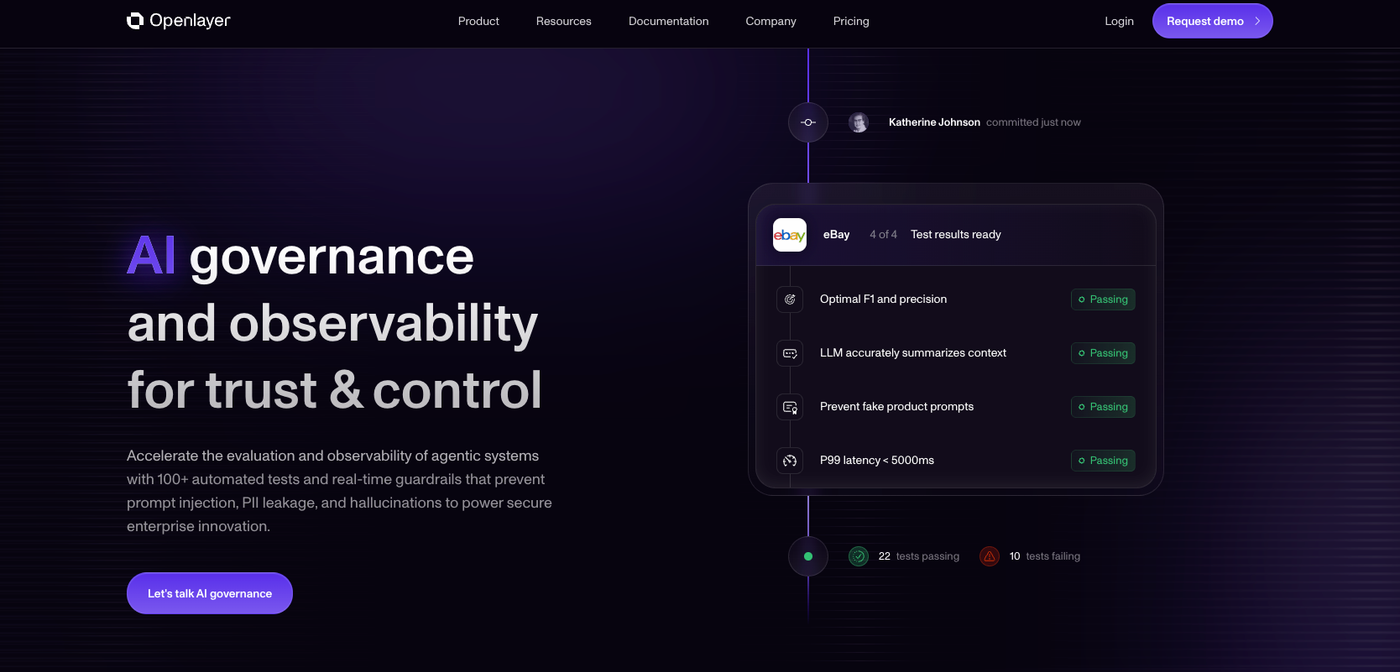
Openlayer provides AI governance, observability, and compliance across the AI lifecycle. The system automatically maps AI projects to global frameworks including the EU AI Act, NIST RMF, ISO 42001, TRAIGA, OWASP, and LGPD while running continuous risk assessments and evidence capture.
Key features
Openlayer includes a number of key features companies need for AI governance, observability, and compliance:
- 100+ automated tests covering hallucinations, bias, toxicity, PII leakage, prompt injection, drift, and robustness across text, vision, tabular, audio, and agent workflows, integrated into CI/CD pipelines
- Real-time security guardrails that prevent prompt injections, data exfiltration, and PII/IP leakage before they reach downstream systems
- Continuous monitoring of predictions, drift, regressions, correctness, latency, and anomalies at scale with automated alerts tied to policy thresholds and risk scoring, plus data quality monitoring across pipelines
- Automated compliance workflows that replace manual surveys and legal reviews with audit-ready documentation, model inventory, ownership tracking, and usage evidence
- Unified oversight across ML models, LLMs, agents, and data pipelines covering both internally built and externally acquired AI systems
- Enterprise deployment options including on-premises, private cloud, and hybrid environments with SOC 2 compliance and full data sovereignty
Openlayer targets enterprise organizations in regulated industries like financial services, insurance, healthcare, telcos, and utilities that need to prove continuous compliance while deploying AI at scale across multiple teams and geographies. By combining automated testing, real-time security, continuous monitoring, and automated compliance mapping in a single control plane, regulatory compliance becomes an inherent outcome of trusted AI operations.
Credo AI
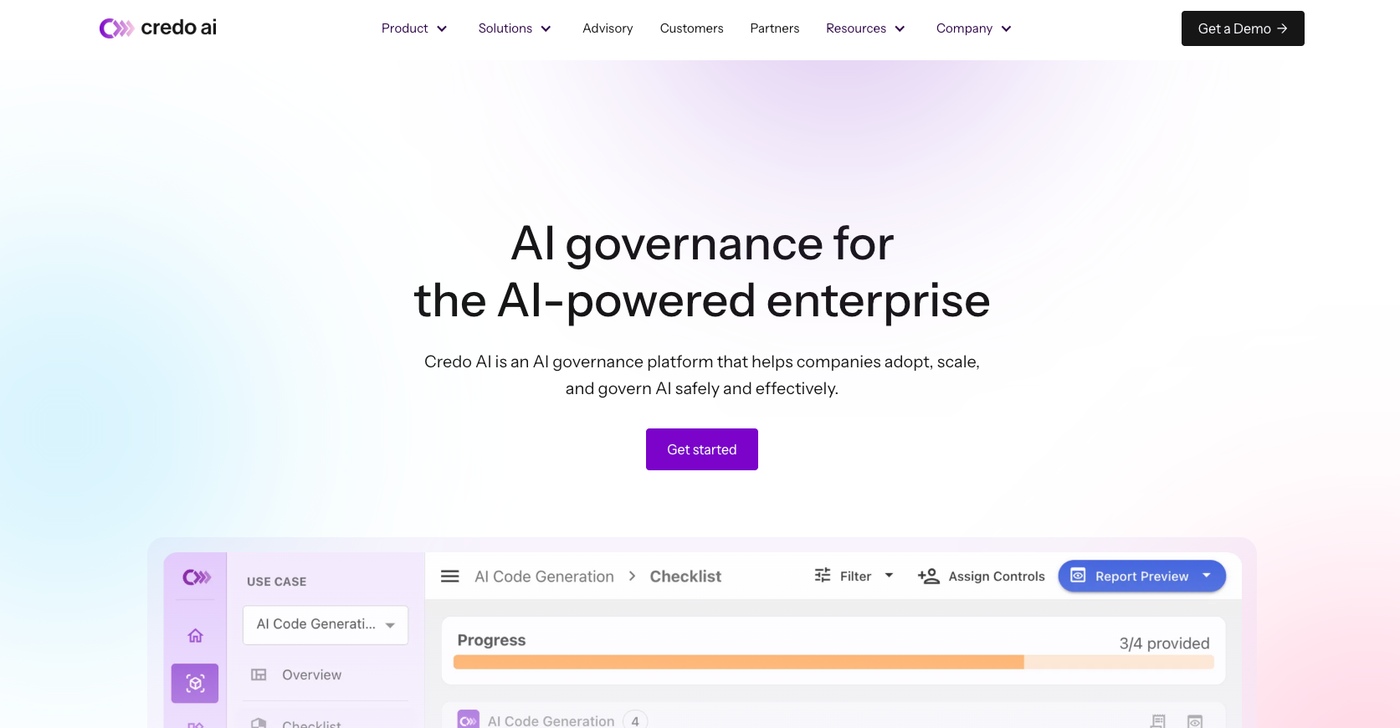
Credo AI focuses on governance-driven compliance and policy oversight. The solution highlights regulatory mapping and documentation workflows.
Key features
Credo.ai includes a number of key features companies need for AI governance, observability, and compliance:
- AI Registry for central inventory of AI systems and use cases with automated risk assessments
- Policy Packs that translate regulations (EU AI Act, NIST RMF, ISO 42001, NYC Local Law 144) into structured governance workflows
- Open-source Credo AI Lens framework for standardized assessment of performance, fairness, transparency, and robustness
- Automated generation of audit artifacts including model cards, bias reports, fairness reports, and compliance summaries
Limitations
The system does not provide real-time runtime guardrails or enforcement mechanisms. It lacks a large pre-built test library for automated behavioral testing, requiring users to define most evaluation logic themselves. Finally, there is no native model observability for fine-grained drift detection, latency monitoring, or per-request metrics.
The bottom line
Credo AI excels at compliance documentation and policy workflows but lacks the technical depth for runtime protection. It works well for organizations that want policy-based governance and compliance documentation workflows with strong legal and risk management oversight.
IBM Watsonx.governance
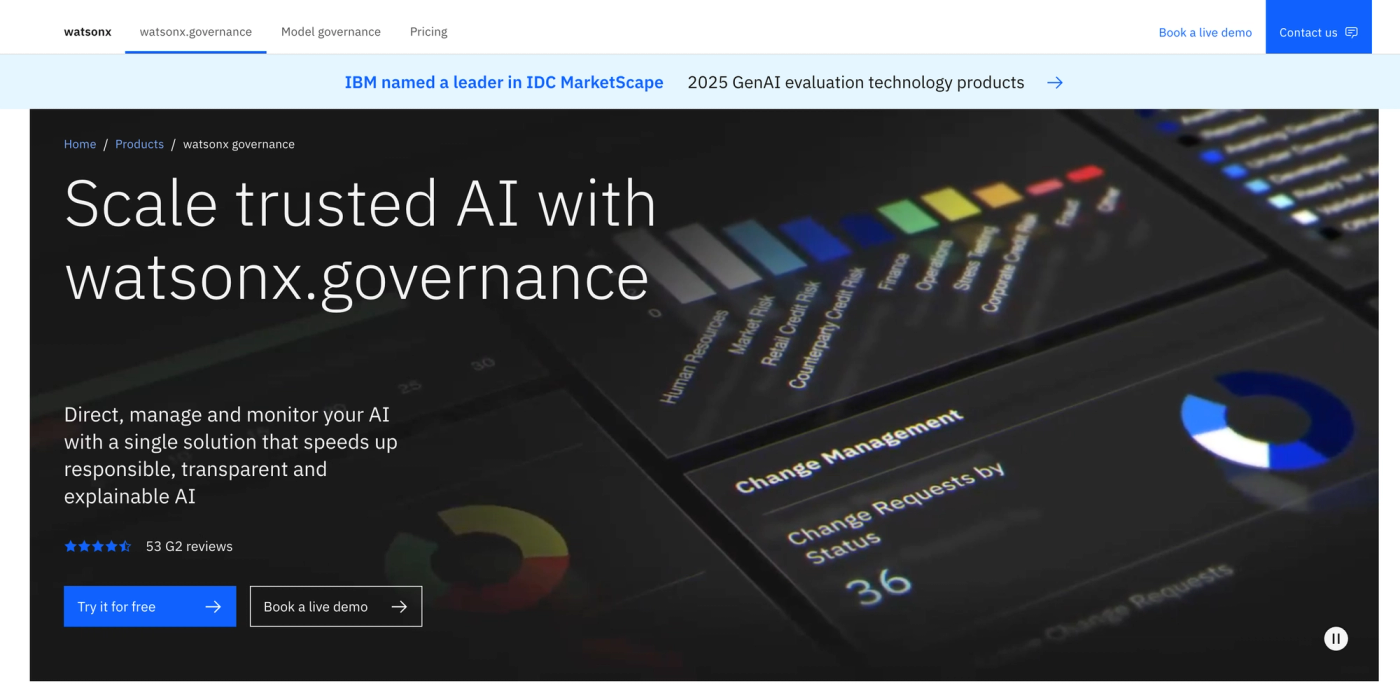
IBM Watsonx.governance offers governance capabilities for organizations operating within the IBM AI and data ecosystem. The system provides policy controls, fairness checks, and explainability features for enterprises standardized on IBM infrastructure.
Key features
IBM Watsonx.governance includes a number of key features companies need for AI governance, observability, and compliance:
- Framework mapping to EU AI Act, NIST, and ISO standards, with IBM-delivered services handling implementation
- Watsonx.orchestrate adds workflow-level controls and agent governance within the IBM stack
- Native integration with IBM's data and AI suite for organizations running IBM infrastructure
Limitations
The system operates only within the IBM ecosystem, with limited visibility into non-IBM systems. It detects vulnerabilities in bias and explainability but cannot block threats like prompt injection or data exfiltration in real time. Testing coverage focuses on bias and explainability, missing extensive multimodal and adversarial scenarios. Framework mappings require manual, service-heavy setup, and runtime monitoring provides limited granularity for agent-level metrics.
The bottom line
IBM Watsonx.governance works for IBM-centric environments but lacks unified oversight for multi-cloud or hybrid deployments. Organizations running AI across multiple stacks need vendor-agnostic governance with real-time security controls and automated compliance mapping.
LangSmith
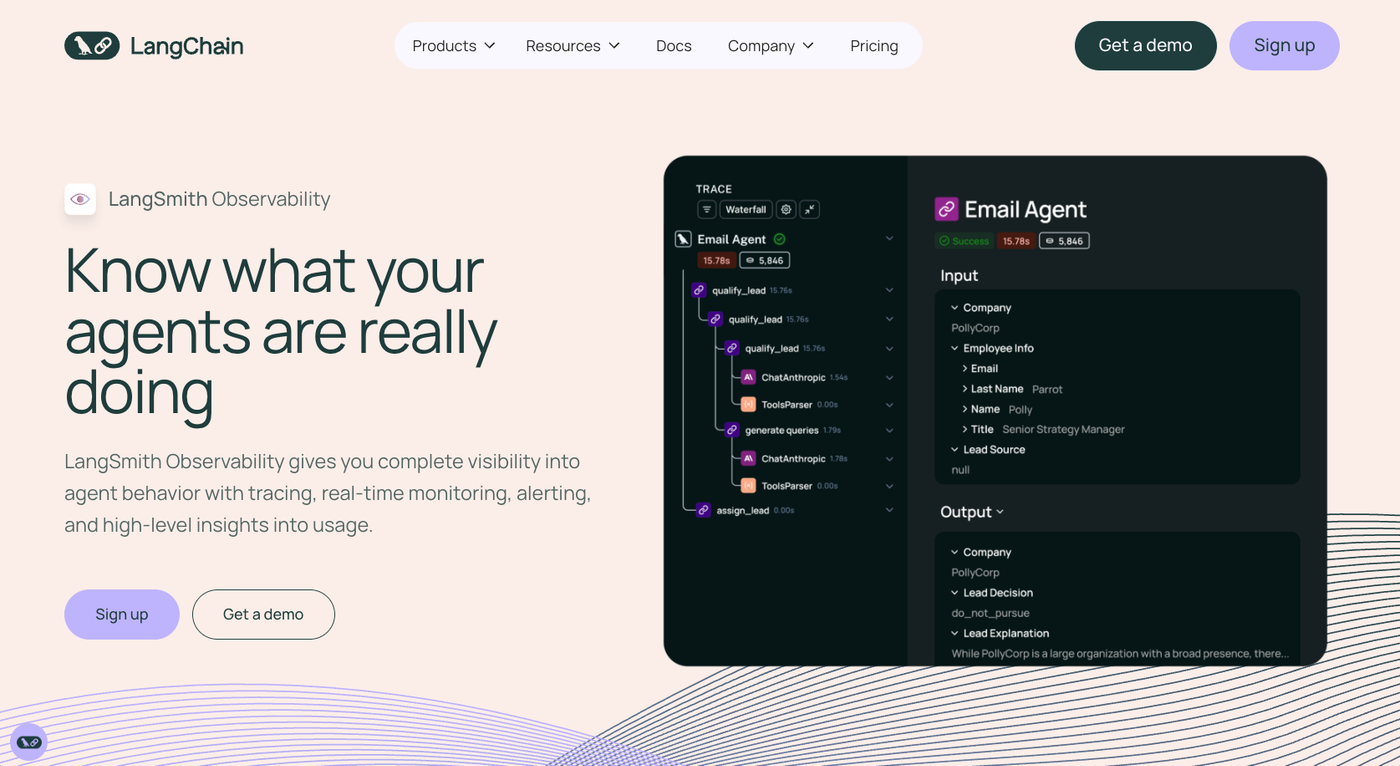
LangSmith is a tracing and evaluation tool built for LangChain-based LLM applications. It provides debugging visibility and prompt-level testing for development teams working within the LangChain framework.
Key features
LangSmith includes a number of key features companies need for AI governance, observability, and compliance:
- Detailed traces and logs for LLM prompts, chains, and agent steps
- Datasets and experiments features for offline regression testing and A/B comparisons of prompt variations
- Cost tracking and latency monitoring with version comparisons
- Developer-centric evaluation where users define eval datasets, metrics, and scorers
Limitations
The system is tightly coupled to LangChain and does not support multi-framework or ML model estates. There is no concept of regulation, policy enforcement, or automated framework alignment for compliance. LangSmith offers no real-time guardrails or security protections. It lacks statistical anomaly detection, compliance alerting, or risk scoring for business and regulatory users.
The bottom line
LangSmith is a debugging tool for LangChain developers, not a governance solution. It works for development teams building LLM applications exclusively on LangChain that need detailed trace inspection and prompt-level debugging.
Langfuse
Langfuse is an open-source observability tool built for LLM applications. The system provides detailed trace visibility and cost tracking for development teams.
Key features
Langfuse includes a number of key features companies need for AI governance, observability, and compliance:
- Traces for every LLM and agent call with high-throughput logging via OpenTelemetry integration
- Flexible evals and scoring where users define their own metrics and evaluation logic
- Datasets and experiments for offline benchmarking of LLM apps
- Cost tracking, latency monitoring, and version comparisons for production LLM workflows
Limitations
The system has no pre-built test library; users must manually implement safety and quality metrics. It does not detect drift or monitor fairness. Observability is diagnostic only, surfacing issues but not blocking or mitigating them. There are no out-of-the-box regulatory mappings; compliance work must be implemented by users.
The bottom line
Langfuse provides rich traces but no governance infrastructure. Organizations deploying AI in regulated environments need automated tests, real-time blocking, and built-in compliance frameworks. It is good for teams wanting self-hosted, open-source observability with detailed trace visibility and cost tracking.
Braintrust
Braintrust provides evaluation and observability through custom testing frameworks. The system integrates with CI/CD pipelines for regression detection and quality gates during development.
Key features
Braintrust includes a number of key features companies need for AI governance, observability, and compliance:
- Datasets, tasks, and scorers that let teams define custom evaluation tests and metrics for specific use cases
- CI/CD-integrated evaluation gates that prevent quality regressions before deployment
- Brainstore logging for trace analysis at scale with dashboards and threshold-based alerts
- Human and LLM-based feedback loops with Loop agent that surfaces production issues and converts them into evaluations
Limitations
The system provides no pre-built test library; teams must manually implement safety and quality checks. It does not block unsafe behavior in real time, relying on human intervention after alerts fire. Governance capabilities are absent; organizations must define their own policy structures and accountability frameworks. There are no pre-defined compliance mappings; teams must build scorers for bias, fairness, and regulatory requirements themselves.
The bottom line
Braintrust works for teams that need flexible custom evaluation frameworks with strong CI/CD integration for quality gates.
Deepchecks
Deepchecks handles pre-deployment testing for ML models and LLMs through structured validation suites before release.
Key features
Deepchecks includes a number of key features companies need for AI governance, observability, and compliance:
- Pre-deployment test suites that validate model quality and safety offline before going live
- Data quality checks for traditional ML models during development
- Offline LLM evaluations covering basic quality and safety dimensions
Limitations
The tool stops at the deployment boundary. It can't detect prompt injection attacks, lacks real-time production alerting, and provides no continuous anomaly detection across live AI systems. There's no alignment to regulatory frameworks like NIST, EU AI Act, or ISO 42001. Without compliance workflows or evidence capture, teams in regulated industries need separate solutions for production monitoring and audit requirements.
The bottom line
Deepchecks works for teams that need structured pre-deployment testing with limited production requirements.
Feature Comparison Table of AI Compliance Tools
| Feature | Openlayer | Credo AI | IBM Watsonx | LangSmith | Langfuse | Braintrust | Deepchecks |
|---|---|---|---|---|---|---|---|
| Automated test library | 100+ pre-built tests | User-defined via Lens framework | Limited bias/explainability checks | User-defined scorers | User-defined metrics | User-defined scorers | Pre-deployment suites |
| Real-time security guardrails | Blocks threats before downstream systems | None | Detects only | None | None | None | None |
| Continuous monitoring | Anomaly detection and drift | Limited | IBM-only telemetry | Logging and cost tracking | Trace logging | Trace analysis with alerts | Pre-deployment only |
| Framework mapping | Automated EU AI Act, NIST, ISO 42001, OWASP | Manual via Policy Packs | Manual with IBM services | None | None | None | None |
| Audit evidence generation | Automated | Automated model cards | Manual | Manual | Manual | Manual | Manual |
| Coverage | ML + LLMs + agents + multimodal | ML + LLMs | IBM ecosystem only | LangChain LLMs | LLMs | LLMs + custom | ML + LLMs offline |
Why Openlayer is the best AI compliance tool
Organizations choose Openlayer because it embeds compliance into runtime operations instead of treating it as a documentation task. Where other tools focus on workflow automation or passive logging, Openlayer integrates automated testing, real-time guardrails, continuous monitoring, and framework mapping into a single control plane.
When auditors request evidence of bias testing, PII protection, or drift detection, Openlayer generates audit-ready reports automatically across every model version and production inference. Teams in financial services, healthcare, insurance, and telecom use this to deploy AI at scale while meeting requirements from the EU AI Act to NIST RMF.
Final thoughts on selecting compliance tools for AI
Compliance becomes manageable when you automate the testing, monitoring, and evidence collection that auditors require. AI governance compliance tools handle the continuous validation work that manual processes can't scale to meet. Your choice should depend on whether you need runtime protection and automated framework mapping or just documentation workflows.
FAQ
What is the difference between AI compliance tools and AI observability tools?
AI compliance tools automate regulatory alignment through framework mapping, risk assessments, and audit evidence generation, while observability tools focus on logging and trace analysis. Compliance tools like Openlayer combine both by embedding automated testing, real-time guardrails, and continuous monitoring with built-in regulatory mappings to EU AI Act, NIST RMF, and ISO 42001.
How do real-time guardrails prevent compliance violations before they happen?
Real-time guardrails analyze each AI request as it happens and block threats like prompt injections, PII leakage, and data exfiltration before they reach downstream systems. This proactive blocking prevents compliance violations at runtime instead of detecting them after the fact through logs or periodic audits.
Can AI compliance tools work across both traditional ML models and LLM applications?
Most tools specialize in either ML monitoring or LLM evaluation, requiring separate solutions for each. Openlayer covers traditional ML, LLMs, agents, and multimodal systems in one platform, running the same test library and compliance frameworks across your entire AI estate regardless of model type or deployment environment.
When should I automate compliance mapping instead of doing it manually?
Automate compliance mapping when you're managing multiple AI systems across teams, deploying in regulated industries, or facing audits that require continuous evidence collection. Manual mapping through spreadsheets and surveys breaks down at scale. Automated tools, on the other hand, map every model version to regulatory requirements and generate audit-ready documentation without manual intervention.
Why do some compliance tools lack production monitoring capabilities?
Many compliance tools focus on pre-deployment testing and policy documentation but stop at the deployment boundary. Production AI systems require continuous drift detection, anomaly monitoring, and real-time alerting to catch regressions and compliance violations after release, capabilities that pre-deployment tools don't provide.