What is AI governance? A complete guide for May 2026
Most AI governance frameworks get built backward. Organizations start with compliance documents, add some manual review checkpoints, and hope that counts as governance. Then a model drifts in production, or an audit surfaces a gap in your documentation, and you realize governance without continuous monitoring is just theater. Real governance runs in production, not in quarterly reviews.
TLDR:
- AI governance defines who owns AI decisions, how models are evaluated, and how organizations prove compliance to regulators.
- 79% of organizations plan AI adoption within two years, yet fewer than one in three have governance structures in place.
- Without governance, AI failures become liability events; regulators impose fines up to €30M or 6% of global revenue under the EU AI Act.
- Core governance components include AI system inventory, risk assessment, technical controls, and continuous monitoring with audit trails.
- Openlayer provides 100+ automated tests, real-time guardrails, and automatic compliance mapping to EU AI Act, NIST RMF, and ISO 42001.
What is AI governance?
AI governance is the set of policies, processes, and accountability structures an organization puts in place to manage how AI systems are built, deployed, and monitored. It covers who owns decisions about AI, how models are evaluated for fairness and accuracy, what controls exist to catch failures, and how the organization demonstrates compliance to regulators and stakeholders.
Think of it as the operating model for AI responsibility. Without it, AI deployments happen without clear ownership, and risk accumulates silently.
Why organizations need AI governance now
The vast majority of organizations plan to adopt AI in the next two years, yet fewer than one in three have the governance structures to support it. That gap is where risk lives. Regulators are moving fast. The EU AI Act, passed in 2024, imposes tiered compliance obligations based on risk level. Organizations that deploy high-risk AI without proper controls face fines up to €30 million or 6% of global revenue.
Without governance, AI failures become liability events.
The risks organizations face without clear AI governance
Without governance, model drift, bias, and failures go undetected until a customer complaint or regulatory inquiry forces a response. And the consequences are concrete:
- Regulatory fines under frameworks like the EU AI Act or GDPR for non-compliant deployments
- Discriminatory outputs that expose organizations to litigation
- Reputational damage when AI failures become public
- Audit failures due to missing documentation or traceability across the AI lifecycle
Core components of an AI governance framework

Every AI governance framework shares the same core components. The question is whether yours has them integrated or scattered across disconnected tools.
- AI system inventory: a registry of every AI system in use, with risk tier, owner, and deployment status
- Risk assessment: systematic scoring based on harm potential, data sensitivity, and regulatory exposure
- Policy and standards: documented requirements that define what "compliant" means for your organization
- Accountability structures: clear ownership over who approves, reviews, and escalates AI decisions
- Technical controls: runtime guardrails for bias, PII, and prompt injection
- Monitoring and audit: continuous behavioral tracking with exportable evidence for regulators
AI governance frameworks: NIST AI RMF, ISO 42001, and EU AI Act
Three frameworks define most of what organizations mean when they talk about structured AI governance.
The NIST AI Risk Management Framework organizes AI risk into four functions: Govern, Map, Measure, and Manage. It is voluntary but widely adopted across US federal agencies and enterprises.
The EU AI Act is binding law. It classifies AI systems by risk tier and assigns compliance obligations accordingly, with the strictest requirements reserved for high-risk applications in sectors like healthcare and critical infrastructure. Below is a high-level overview of the governing frameworks, the scope, core functions, compliance nature, and what the framework is best used for.
| Framework | Type | Geographic Scope | Core Functions | Compliance Nature | Best Used For |
|---|---|---|---|---|---|
| NIST AI RMF | Risk management framework | US federal agencies and enterprises, internationally adopted | Four functions: Govern (accountability structures), Map (context and risk), Measure (metrics and testing), Manage (risk response and monitoring) | Voluntary guidance widely adopted across federal and commercial sectors | Building active risk management processes and systematic governance workflows |
| ISO 42001 | International management system standard | Global, first international AI-specific standard | Management system requirements: leadership accountability, risk assessment, lifecycle controls, continuous improvement, documentation requirements | Certifiable standard with third-party audit requirements | Organizations seeking formal certification and structured auditability across AI operations |
| EU AI Act | Binding legal regulation | European Union member states, applies to organizations deploying AI in EU markets | Risk-based classification system: unacceptable risk (prohibited), high-risk (strict requirements), limited risk (transparency obligations), minimal risk (no requirements) | Legally enforceable with fines up to €30M or 6% of global revenue for violations | Legal compliance for organizations deploying AI systems in regulated sectors within EU jurisdiction |
Keep in mind that no single framework covers everything. NIST provides practical guidance, ISO 42001 provides auditability, and the EU AI Act provides legal enforceability. Organizations operating at scale typically align to all three, using each to fill gaps the others leave open.
How maintaining an AI inventory supports responsible governance
Governance starts with visibility. Before you can classify risk, assign ownership, or map a system to a compliance framework, you need a complete picture of what AI is actually running in your organization. That means more than internally built models. Vendor tools, embedded AI features in SaaS applications, and shadow deployments all carry risk. Without a centralized inventory, each of those systems is an ungoverned blind spot.
A well-maintained AI inventory lets you assign risk tiers, trigger intake workflows, track lifecycle stages, and map each system to applicable frameworks. Every downstream governance activity, from audit evidence to recertification, depends on that foundation being accurate.
The role of testing and evaluation in AI governance
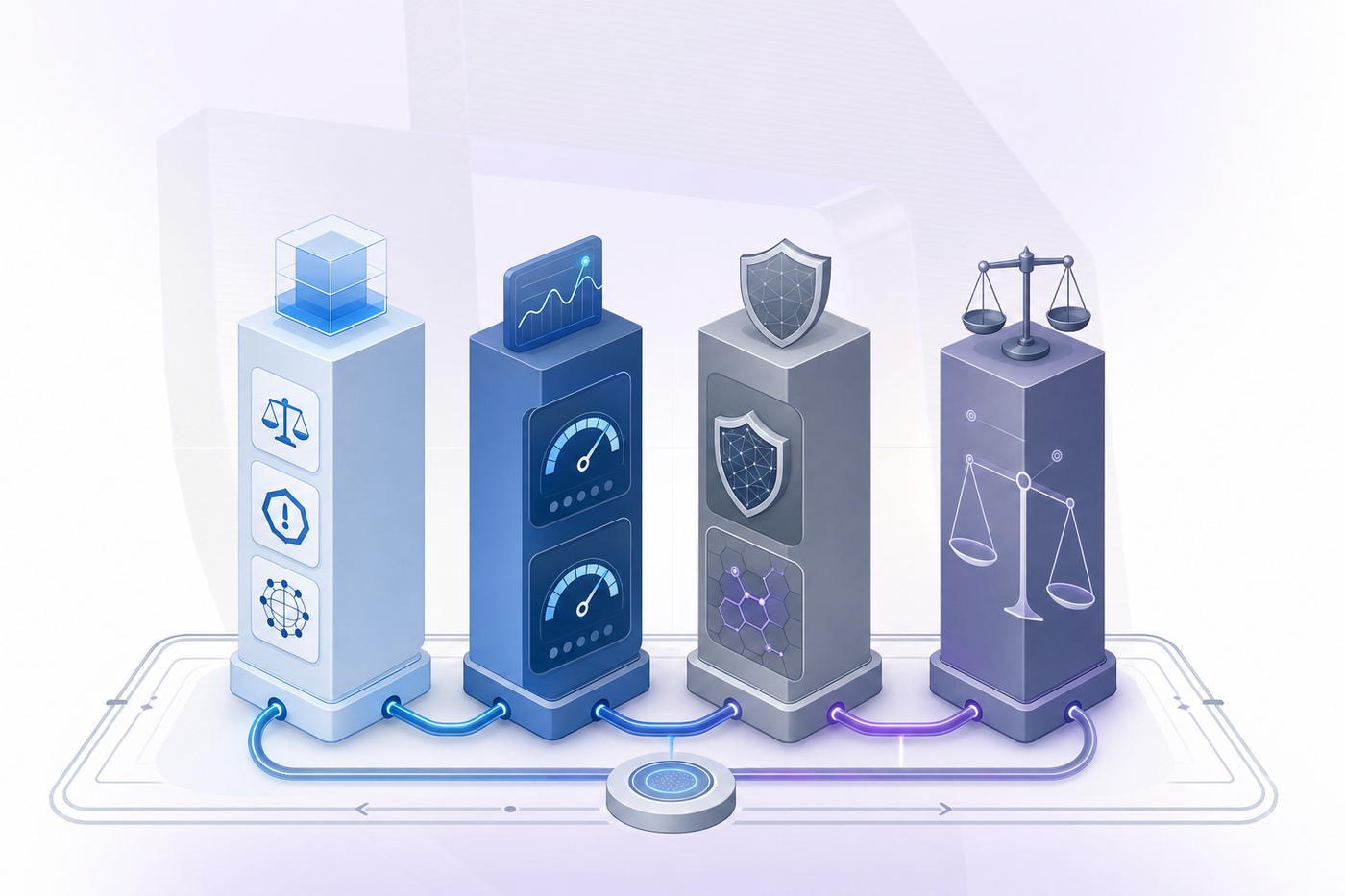
Testing and evaluation sit at the operational core of any serious AI governance program. Policies and frameworks set the rules, but testing is how you verify the rules are actually working.
Every AI model in production requires continuous testing across four dimensions: quality (bias, toxicity, groundedness, hallucinations), performance (latency, throughput), security (prompt injection resistance), and fairness. Without this, governance becomes a documentation exercise with no connection to real system behavior.
AI governance for agentic systems
Agentic AI systems act autonomously, chain decisions together, and operate across extended workflows without human checkpoints. This creates governance gaps that traditional policy frameworks were never designed to handle. Static rules break down when an agent can replan mid-task. Accountability becomes unclear when no single decision point exists. Traceability gets harder as actions compound across tools and APIs.
Governing agentic systems requires monitoring at the action level, not just the output level. Log and audit every action an agent takes. That means capturing which tools were called, in what order, with what inputs, and what downstream effects each call produced. A single agent session can span dozens of decisions across retrieval steps, API calls, and code execution — and any one of those steps can introduce bias, expose PII, or trigger an unauthorized action.
Three governance controls are especially relevant for agentic deployments:
- Tool call authorization: agents should operate against an explicit allow list of permitted tools and functions. Any attempt to invoke an unauthorized tool should be detected, blocked, and flagged for review.
- Session-level evaluation: assessing individual outputs misses failures that only emerge across multi-turn interactions. Quality, safety, and compliance metrics need to aggregate across the full session, not just each isolated step.
- Replay and audit trails: governance teams need to reconstruct what an agent did and why. Logs should capture enough context to replay a session and identify exactly where a failure occurred in the decision chain.
Without these controls, agentic systems operate as black boxes. Compliance evidence becomes impossible to generate, and incident response requires reconstructing behavior from incomplete logs after the fact.
Implementing AI governance: practical steps
Turning governance principles into action requires a sequence of deliberate steps. Most organizations that stall do so because they treat governance as a policy exercise over an active practice.
- Audit your AI inventory: catalog every model in production, including who owns it, what data it touches, and what decisions it influences.
- Assign clear accountability: designate owners for each system so responsibility never diffuses across too many roles.
- Define risk tiers: not every model carries equal risk, so calibrate oversight accordingly.
- Build review checkpoints into your ML lifecycle, from data ingestion through deployment.
- Monitor continuously in production, not just at launch.
Common AI governance challenges and how to overcome them
Most governance programs don't fail from a lack of intent. They fail from execution gaps. Here's where organizations get stuck and what actually fixes it.
- Fragmented tools: consolidate testing, monitoring, and compliance into one layer so evidence doesn't live across disconnected spreadsheets.
- Limited expertise on governance teams: automated controls that enforce technical requirements without requiring engineers to manually configure each check.
- Competing regulations across jurisdictions: map systems to multiple compliance frameworks simultaneously from a single framework layer.
- Engineering resistance: embed governance into CI/CD pipelines so it runs alongside code, not as a separate approval gate.
- Integration difficulty: use SDKs and APIs that drop into existing toolchains without rebuilding pipelines.
- Rapidly evolving AI capabilities: shift from periodic audits to continuous production monitoring so governance keeps pace with deployment velocity.
The growing AI governance market
Spending on AI governance is projected to reach $492 million in 2026 and surpass $1 billion by 2030, according to Gartner.
That growth is driven by regulatory expansion: according to Gartner, by 2030, AI regulation will quadruple, covering 75% of the world's economies. Organizations that build governance infrastructure now gain the foundation that slower competitors will scramble to replicate when regulators arrive. Governance moves from compliance burden to competitive asset. Early movers accumulate audit-ready evidence continuously, so when a regulator asks for proof, the answer is ready. That speed of response is a compliance advantage that also shortens deal cycles with enterprise customers who require documented AI controls before signing. The organizations still treating governance as a periodic checklist will face that gap when it matters most.
How Openlayer accelerates AI governance and compliance
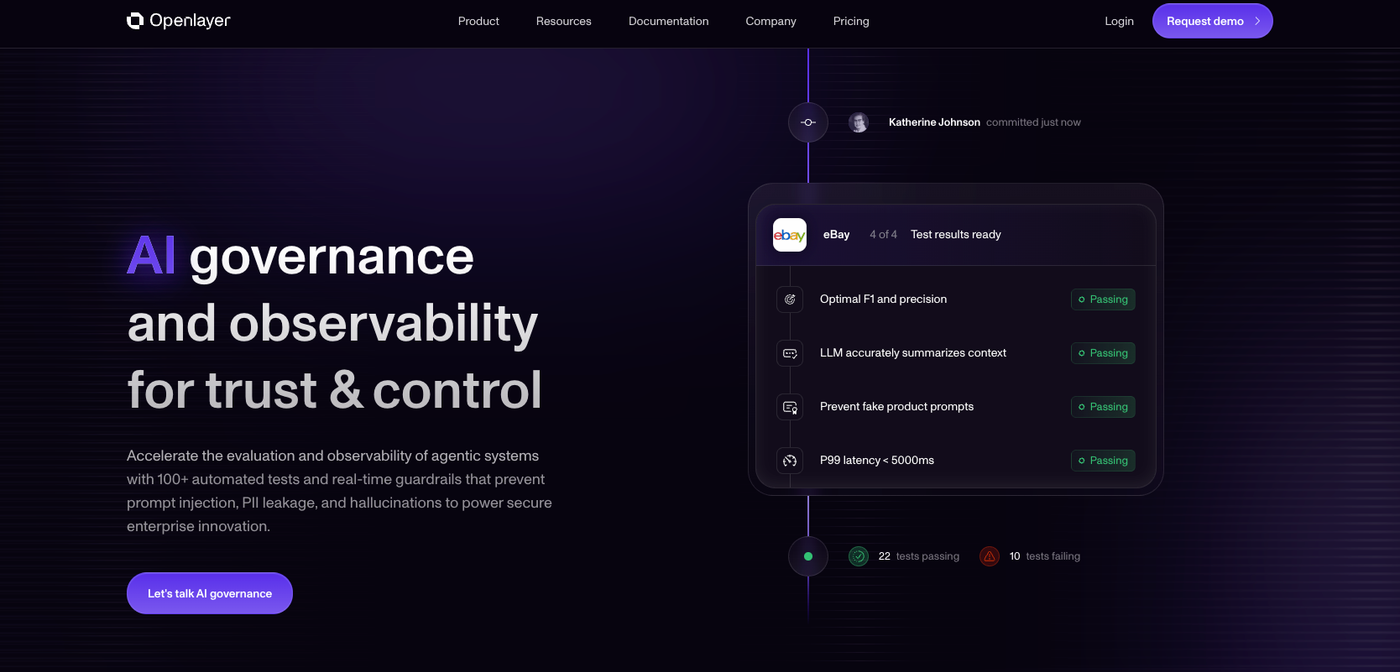
Openlayer is governance infrastructure that runs continuously in production, not a policy documentation layer.
The platform integrates into existing CI/CD pipelines through SDKs and APIs, so governance runs alongside deployment instead of as a separate approval gate. This integration means compliance evidence accumulates continuously in production, not through periodic manual audits.
Every test result generates audit-ready evidence. Every governance rule reflects live system behavior, not point-in-time snapshots. For organizations scaling AI deployment across regulated industries, that's the difference between governance that works and governance that only looks good on paper.
Final thoughts on responsible AI governance
The gap between deploying AI and governing it responsibly closes faster than most teams expect. AI governance certification and compliance mapping matter because they turn abstract policy into concrete operational evidence when auditors arrive. Your governance program either generates proof automatically or you scramble to reconstruct it after the fact. Get in touch if you want to see what governance infrastructure looks like when it's built into your deployment workflow from day one.
FAQ
How long does it take to implement an AI governance framework?
Most organizations can set up baseline governance infrastructure in 4-6 weeks, covering AI inventory, risk classification, and basic monitoring. Full maturity across all compliance domains takes 3-6 months depending on regulatory scope and the number of AI systems in production.
What's the difference between NIST AI RMF, ISO 42001, and the EU AI Act?
NIST AI RMF provides operational risk management guidance through four functions (Govern, Map, Measure, Manage) and is voluntary. ISO 42001 offers a certifiable management system standard with third-party audit requirements. The EU AI Act is binding law with tiered compliance obligations and fines up to €30 million for violations.
How do I start building an AI inventory?
Start by cataloging every model in production, including internal builds, vendor APIs, and embedded AI features in SaaS tools. For each system, document the owner, data sources, decision scope, and regulatory exposure. Shadow deployments account for the largest blind spot in most initial inventories.
Can governance tools integrate with existing CI/CD pipelines?
Yes. Modern governance platforms integrate through SDKs and APIs that run alongside deployment workflows rather than as separate approval gates. Tests execute automatically at each pipeline stage, generating compliance evidence without manual intervention.
What's the difference between model drift and data drift?
Data drift occurs when input distributions change over time, causing prediction quality to degrade. Model drift refers to changes in the relationship between inputs and outputs, where previously accurate models lose predictive power even when data distributions stay stable.