Governing Shadow AI in Your Organization (July 2026)

When was the last time you audited every AI tool your employees are actually using? Not the ones in your approved vendor list or your model registry. The ones they adopted on their own because the sanctioned options were too slow or too limited. Shadow AI enters through three main channels: data science teams spinning up unregistered models, product teams connecting third-party APIs without risk review, and business units deploying SaaS tools that process regulated data before compliance knows they exist. Research from 2024 found that 55% of employees using AI at work are doing so without employer approval. The EU AI Act's obligations are enforceable now, and every shadow AI deployment is a gap in your audit trail. AI usage monitoring and employee AI monitoring surface what policy documents miss: the models running outside any governance perimeter, processing data with no baseline and no oversight. Unauthorized AI usage doesn't wait for your approval process to catch up.
TLDR:
- 55% of employees use AI tools at work without approval, creating models that run for months with no audit trail before anyone in compliance knows they exist.
- Shadow AI enters through three channels: data science teams spinning up unregistered fine-tuned models, product teams connecting third-party LLM APIs without risk review, and business units deploying generative tools that process regulated data.
- Detection methods that work combine network traffic analysis for API calls to known providers, expense monitoring for unapproved AI vendor charges, and behavioral signals like bulk data exports to unregistered notebooks.
- Governance frameworks that reduce shadow AI use tiered approval routing low-risk tools through self-certification while high-risk systems get full review, maintaining a vetted catalog of approved alternatives.
- Openlayer blocks unregistered models from serving production traffic, monitors live inference against behavioral baselines, and generates the audit records regulators expect under the EU AI Act and NIST AI RMF.
What Shadow AI Is and Why It Matters Now
Shadow AI refers to AI tools, models, and integrations that employees adopt and run without formal approval, oversight, or awareness from IT, legal, or compliance functions. A developer connects a third-party LLM API to process customer data. A marketing team uses a generative writing tool that ingests proprietary briefs. A data science team fine-tunes a model internally and never registers it anywhere. None of these appear in any inventory, and none have been reviewed for risk.
The scale of this is no longer theoretical. Research from 2024 found that 55% of employees using AI at work are doing so without employer approval.
This matters now because the regulatory window for informal AI use has closed. The EU AI Act's GPAI obligations became enforceable in August 2025. NIST AI RMF adoption is accelerating across regulated industries. ISO 42001 is becoming a baseline expectation in enterprise procurement. Each of these frameworks requires documented evidence of what AI systems are running, what data they touch, and how their outputs are governed. Shadow AI produces none of that evidence by definition.
The gap between deployment and discovery is where exposure compounds. A model running without a behavioral baseline, no monitoring, and no audit trail may have been producing outputs for months before anyone in compliance knows it exists. By then, the obligation window has already passed.
How Shadow AI Enters Your Organization
Shadow AI doesn't arrive through a single breach or a rogue actor. It accumulates quietly, tool by tool, across teams that are moving fast and working around slow approval processes. There are three specific channels through which it typically enters:
| Deployment Channel | Who Deploys It | What Gets Deployed | Why It Bypasses Governance |
|---|---|---|---|
| Unregistered fine-tuned models | Data science teams | Custom models trained or adapted internally that never enter a model registry | Models bypass evaluation gates and accumulate outside any governance perimeter |
| Third-party LLM API integrations | Product teams | Direct API integrations added at the feature level | Time pressure drives teams to skip formal assessment of data handling, output risk, and vendor compliance posture |
| Off-the-shelf generative tools | Business units | SaaS productivity tools or copilots that ingest regulated data | Team-level adoption happens before legal or compliance functions are aware the tools are in use |
- Data science teams spinning up unregistered fine-tuned models: custom models trained or adapted internally that never enter a model registry, bypass evaluation gates, and accumulate outside any governance perimeter.
- Product teams connecting third-party LLM APIs without risk review: direct API integrations added at the feature level, often under time pressure, with no formal assessment of data handling, output risk, or vendor compliance posture.
- Business units deploying off-the-shelf generative tools that process regulated data without compliance sign-off: SaaS productivity tools or copilots adopted at the team level that ingest PII, financial records, or other regulated data before legal or compliance functions are aware they're in use.
By the time an audit or incident surfaces one of these deployments, the model may have been running for months with no behavioral baseline on record. That time gap is not merely an oversight. It is the specific window where regulatory obligations go unmet: no documentation, no monitoring, no evidence of conformity. The longer the gap, the deeper the compounding exposure.
The Real Costs of Unauthorized AI Usage
The costs of shadow AI rarely appear on a single line item. They accumulate across legal exposure, security incidents, and compliance failures that are difficult to trace back to their source once they've compounded.

There are three primary cost categories worth accounting for:
- Regulatory and legal liability: when employees submit proprietary data or customer PII to unvetted external LLM APIs, that data may be used for model training or stored in jurisdictions that conflict with GDPR, HIPAA, or SOC 2 obligations. The organization bears the liability even if the employee acted without authorization.
- Security and data exposure: shadow AI tools sit outside the security review process, meaning no one has assessed their data retention policies, encryption standards, or breach notification procedures. A single integration can become an unmonitored exfiltration vector, which is why organizations need AI compliance tools to detect and prevent such exposures.
- Audit and compliance gaps: governance frameworks like the EU AI Act require documented evidence of what AI systems are in use, how they were assessed, and what oversight controls exist. Models running outside the registry produce none of that evidence, leaving organizations unable to show conformity when regulators ask.
The Compounding Effect of Time
The longer a shadow AI deployment runs undetected, the deeper the exposure. A model processing customer data for six months with no behavioral baseline on record means six months of regulatory obligations unmet, six months of outputs with no audit trail, and six months of drift with no monitoring to catch it.
That time gap is not recoverable after the fact. Documentation cannot be reconstructed retroactively to satisfy an auditor, and incident records cannot be created for events that were never logged.
Data Leakage Pathways You Cannot See
When employees route work through unauthorized AI tools, the data they submit does not stay local. Prompts sent to third-party LLM APIs frequently include customer records, internal financial projections, proprietary source code, and PII that employees never consciously identified as sensitive.
There are three leakage pathways that governance teams consistently miss.
- Prompt ingestion by external model providers: When a tool has no data processing agreement in place, every prompt submitted becomes potential training data or retained inference log. Employees using consumer-grade AI products often have no visibility into the retention policy they accepted on behalf of the organization.
- API key sprawl and credential exposure: Product teams that wire up LLM APIs without a central registry frequently hard-code credentials into repositories or share them across environments. Once a key is out of a controlled context, the traffic it authenticates is invisible to monitoring infrastructure.
- Cross-tenant data handling in shared inference environments: Off-the-shelf generative tools built on shared infrastructure offer no guarantee of prompt isolation. Regulated data submitted through a business-unit SaaS tool may be processed alongside other tenants' data with no audit trail available to either party.
Each pathway compounds the exposure silently. By the time a data handling incident surfaces through an audit or a vendor's breach disclosure, the organization typically has no log of what was submitted, no record of what retention policy applied, and no baseline to assess the scope of the exposure.
Shadow AI Detection Methods That Actually Work
Passive approaches to shadow AI detection consistently miss the most consequential cases. Network traffic analysis alone catches obvious API calls to known providers, but misses self-hosted models running on internal infrastructure. Policy attestations tell you what employees say they're using, not what they're actually running. The detection methods worth building are the ones that surface real usage signals instead of assumed behavior.
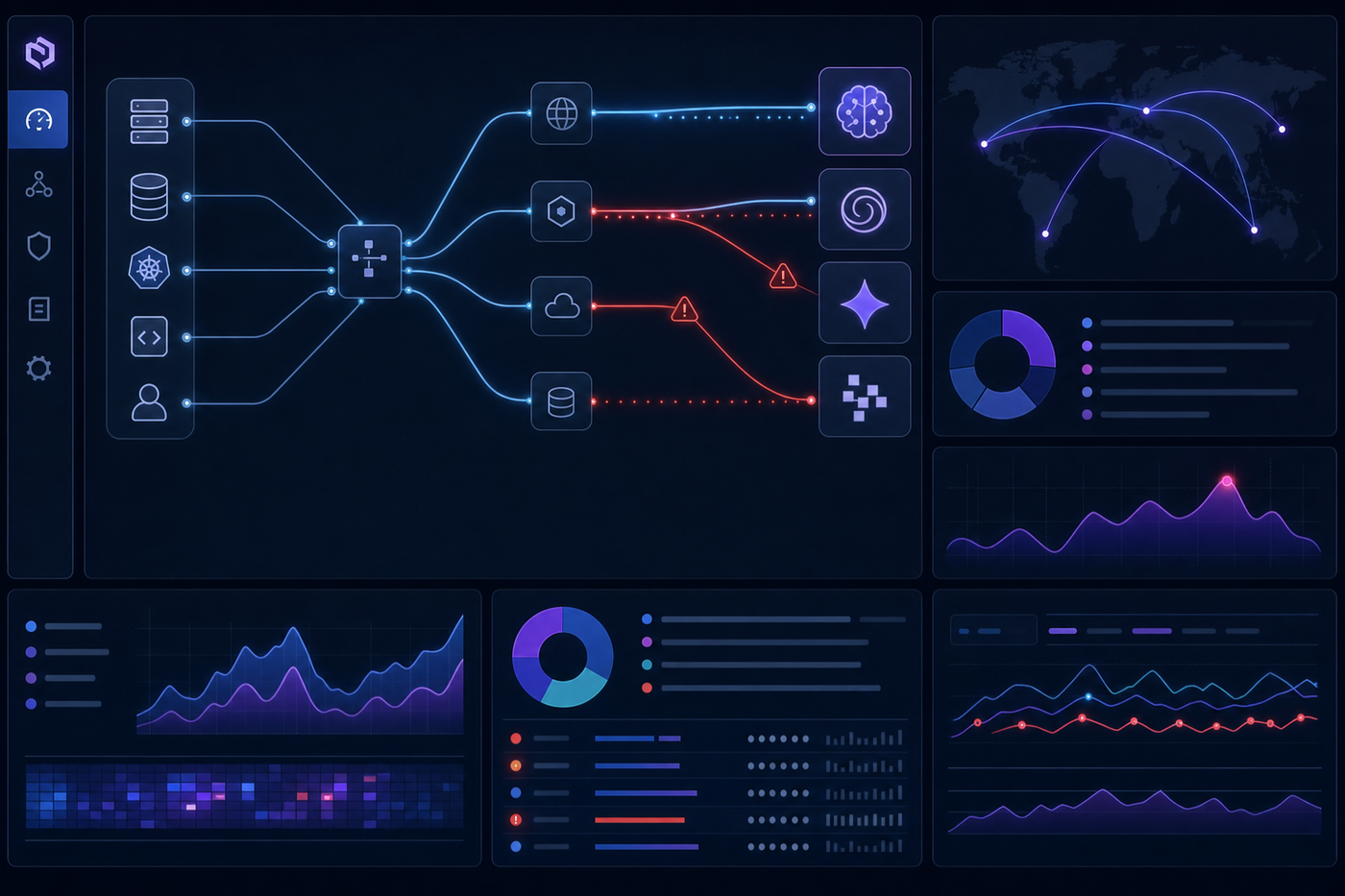
There are three categories of detection signals worth instrumenting.
Network and API Traffic Analysis
Start with DNS query logs and egress traffic patterns. Calls to endpoints like api.openai.com, api.anthropic.com, or generativelanguage.googleapis.com from workstations outside approved tooling indicate direct API access that bypasses procurement. Flag any API key usage that doesn't trace to a registered integration. Browser-based tools often appear as standard HTTPS traffic, so augment with DLP rules that catch structured AI request and response payloads crossing your perimeter.
Expense and Procurement Signals
Shadow IT research shows that unsanctioned spend reliably precedes formal discovery. Monitor corporate card transactions for AI vendor billing descriptors, SaaS subscription charges, and consumption-based API billing that doesn't route through approved procurement. A recurring $20 charge from an AI provider on an engineer's corporate card is a registration event, not merely a finance anomaly.
Behavioral and Access Pattern Signals
Model registries and data access logs surface what network monitoring misses. Look for bulk data exports to unregistered notebooks, unusual access to training datasets outside normal working hours, or compute cluster jobs with no associated project ticket. Internal developer tooling like GitHub Copilot Business generates audit logs; gaps between licensed seat counts and actual usage often indicate personal-account workarounds running on company data.
None of these signals work in isolation. Effective detection pairs automated instrumentation with a lightweight intake process so employees have a sanctioned path to register tools they're already using, which converts shadow usage into governed usage without forcing it further underground.
Building an AI Governance Framework Without Blocking Progress
Good governance and fast-moving AI adoption feel like opposing forces, but the tension is mostly structural. Organizations that treat every AI tool as a compliance blocker end up with shadow AI anyway: employees route around friction instead of through it.
There are a few AI governance principles worth building around here.
Tiered approval, not uniform review
Not every AI tool carries the same risk. A grammar-checking tool and a model making credit decisions warrant very different review processes. A tiered intake system routes low-risk tools through a lightweight self-certification checklist while directing high-risk systems through full security, legal, and compliance review. This keeps the approval queue from becoming a bottleneck that employees learn to ignore.
Sanctioned alternatives reduce the pull toward shadow usage
When employees reach for unauthorized tools, it's often because no approved equivalent exists or the approved options are too limited for practical work. Maintaining a curated catalog of vetted AI tools, updated regularly as new tools are assessed, gives teams a legitimate path that doesn't require workarounds.
Monitoring as a feedback loop, not surveillance
AI usage monitoring works best when its outputs inform policy updates instead of generating violation reports. If the same unapproved tool keeps appearing in network logs, that's a signal the approved catalog has a gap, not a disciplinary matter. Treating monitoring data as product feedback for the governance program itself keeps the framework responsive to how people actually work.
Policy visibility matters as much as policy content
Governance frameworks fail quietly when employees don't know they exist. Publishing clear, plain-language AI use policies, running short onboarding sessions when new tools are approved, and giving teams a simple intake form for requesting tool reviews all reduce the friction that makes shadow AI the path of least resistance.
Employee Training That Changes Behavior
Most AI training programs teach employees what AI is. The ones that actually reduce shadow AI risk teach employees what happens when they use the wrong tool for the wrong data.
There are two behaviors worth targeting here. First, employees need to recognize when a task involves regulated or sensitive data before they reach for an AI tool. Second, they need to know which approved tools are cleared for which data types, so the compliant path is faster than the workaround.
Building Training That Sticks
Generic awareness sessions rarely change habits at the moment of decision. Training that does tends to share a few characteristics:
- Scenario-based instead of policy-based, walking through real workflows where shadow AI use is tempting, such as summarizing a customer call, drafting a contract clause, or analyzing financial data, and showing exactly where the compliance line sits.
- Role-specific instead of org-wide, because the risk surface for a sales rep pasting deal notes into a public chatbot differs from that of a data scientist spinning up an unregistered fine-tuned model.
- Reinforced at the point of friction, meaning short reminders surfaced when employees request access to a new tool or try to move regulated data into an unapproved workflow.
Closing the Feedback Loop
Training without feedback data is a guess. When your AI usage monitoring captures which tools employees are actually reaching for, that data can feed directly back into training content. If procurement analytics show a spike in unapproved image generation tools in the marketing org, that is a signal to update scenario content for that team, not to send another org-wide policy email. The audit trail generated by monitoring becomes the evidence base for refining where training is working and where the gap between policy and behavior persists.
Technical Controls for AI Usage Monitoring
Governing shadow AI requires more than policy statements. Without technical controls in place, usage policies are unenforceable and audit trails remain empty. There are four control layers worth building out.
Network and Endpoint Visibility
Network monitoring tools can detect traffic to known AI service endpoints, flagging unauthorized API calls to providers like OpenAI, Anthropic, or Cohere before data leaves the organization. Browser extensions and endpoint agents can log which AI tools employees access, giving security teams a behavioral baseline to work from.
API Gateway Enforcement
Routing all approved AI API traffic through a centralized gateway lets teams enforce rate limits, inspect request payloads for regulated data patterns (PII, financial records, protected health information), and block calls that fall outside policy. Requests that include flagged data categories can be rejected before they reach an external model.
Model Registry Integration
Any model deployed internally should register against a central inventory before serving production traffic. Registry checks can block unregistered model artifacts from receiving inference requests, closing the gap where fine-tuned models accumulate outside any governance perimeter.
Behavioral Monitoring and Alerting
Once a model is running, output monitoring tracks whether its behavior stays within approved parameters. Alert thresholds tied to specific metrics, such as blocking deployment if a toxicity score exceeds 0.15 or flagging responses when a groundedness score falls below 85%, turn policy thresholds into enforceable runtime gates instead of documentation that sits in a shared drive.
Governing AI Agents Across Your Organization
Three controls close this gap directly. Tool call authorization sets explicit allowlists for which tools an agent can invoke, blocking unauthorized calls before execution instead of logging them afterward. Session-level monitoring tracks goal drift across multi-step reasoning chains, flagging when an agent's behavior diverges from its declared objective. Rollback capability preserves a record of every state change so that when an agent takes an unauthorized action, the affected systems can be restored.
Shadow AI complicates all three. An unregistered agent has no approved tool allowlist on record, no behavioral baseline to drift from, and no deployment event tied to a version hash.
Compliance Mapping for Shadow AI Risk
Three regulatory frameworks create direct exposure when shadow AI goes undetected: the EU AI Act, the NIST AI RMF, and ISO 42001.
Here is how each one maps to the shadow AI problem directly.
EU AI Act
Unregistered models processing HR decisions, credit assessments, or biometric data likely meet the high-risk classification threshold under Annex III. Once classified, the obligations are concrete:
- Technical documentation (Annex IV): system architecture, training data provenance, known limitations, and performance metrics across demographic groups must exist before deployment.
- Conformity assessment (Article 43): evidence of internal control procedures and test results confirming Annex I conformity, signed by an authorized representative.
- Post-market monitoring log: ongoing performance data post-deployment, with serious incident reports filed within 15 days.
Shadow AI produces none of these artifacts. When an audit surfaces an unregistered model running in production, the organization cannot retroactively reconstruct a behavioral baseline that never existed. Fines for high-risk non-compliance under Article 99 reach €15 million or 3% of global annual turnover.
NIST AI RMF
The RMF's GOVERN function requires organizations to maintain an inventory of AI systems in active use. Without one, the MEASURE and MANAGE functions have no inputs. Shadow AI breaks the chain at the first step.
ISO 42001
ISO 42001 requires documented AI management with defined scope. Undisclosed models fall outside that scope by definition, creating a gap between the certified system boundary and actual organizational exposure.
How Openlayer Brings Shadow AI Under Control
Most shadow AI governance frameworks stop at documentation: log what models exist, assign an owner, file the record. That posture misses the actual problem. By the time a shadow model surfaces in an audit, it has typically been running for months with no behavioral baseline, no output monitoring, and no evidence trail an auditor can use.
Openlayer operates at the enforcement layer, not at the policy layer alone. Here's what that looks like in practice across the shadow AI lifecycle.
Detection Before the Damage Accumulates
The first gap shadow AI creates is invisibility. Models running outside a registry produce no audit artifacts, no drift signals, and no incident history. Openlayer's model registry closes that gap by requiring every model, whether it entered through a formal ML pipeline or a product team's direct API integration, to be registered before outputs reach production. Unregistered models attempting to serve predictions are flagged automatically.
Behavioral Baselines and Continuous Output Monitoring
Registration alone doesn't govern a model. Openlayer attaches behavioral baselines at registration time: groundedness thresholds, toxicity ceilings, demographic parity limits, and output quality floors. Once a model is running, Openlayer monitors live inference against those baselines continuously. When outputs drift outside approved bounds, for example a groundedness score falling below 85% or a demographic parity gap exceeding 5%, the system triggers alerts and can block outputs before they leave the API boundary.
This is the distinction that matters for regulated environments. Logging that a model drifted is observation. Blocking the output before it reaches an end user is enforcement.
Automated Compliance Evidence Generation
Every inference Openlayer monitors produces a structured audit record: input features, output values, model version hash, threshold pass/fail status, and timestamp. Those records accumulate into the evidentiary trail regulators expect under frameworks like the EU AI Act and NIST AI RMF. Teams aren't assembling compliance documentation manually after the fact; Openlayer generates it continuously as a byproduct of normal monitoring operations.
For organizations subject to the EU AI Act's high-risk system obligations, that record directly supplies the post-market monitoring log Article 9 requires, without a separate documentation sprint ahead of each audit.
Final Thoughts on Enforcing AI Governance at Runtime
Shadow AI creates regulatory exposure because the time between deployment and discovery is when obligations go unmet, which means your governance framework needs enforcement tools that act before an auditor asks questions. The gap closes when monitoring infrastructure blocks policy violations in real time instead of logging them for retrospective review. If you are running models that your compliance team does not know exist yet, contact us and we will walk through how to wire detection signals into active guardrails that stop unsafe outputs before they reach production. Every model registration, behavioral baseline, and audit record your regulators expect becomes automatic once enforcement happens at the API boundary instead of in a quarterly review cycle.
FAQ
Shadow AI vs rogue deployment: what's the actual difference?
Shadow AI is any AI tool, model, or integration running without formal approval or governance oversight; it includes well-intentioned deployments that bypass slow approval processes, not merely malicious actors. Rogue deployments are deliberate security violations; shadow AI is usually accidental accumulation across teams moving faster than governance workflows allow.
Can you detect shadow AI through network monitoring alone?
No. Network monitoring catches obvious API calls to known providers like OpenAI or Anthropic, but misses self-hosted models running on internal infrastructure, browser-based tools appearing as standard HTTPS traffic, and fine-tuned models deployed through internal ML pipelines. Effective detection requires network signals combined with expense monitoring, data access logs, and model registry cross-checks.
What's the best way to bring unregistered AI models under governance without blocking teams?
Use tiered intake with risk-based routing: low-risk tools go through lightweight self-certification checklists while high-risk systems require full security and compliance review. Pair this with a curated catalog of pre-approved AI tools so teams have sanctioned alternatives that don't require workarounds, and treat monitoring data as feedback for closing gaps in the approved catalog instead of generating violation reports.
How long does shadow AI typically run before governance teams detect it?
By the time an audit or incident surfaces an unregistered model, it has typically been running for months with no behavioral baseline, no monitoring, and no audit trail. That time gap creates compounding regulatory exposure: six months of EU AI Act obligations unmet, six months of outputs with no evidence trail, and six months of drift with no detection mechanism.
What EU AI Act obligations apply to models detected after they're already in production?
High-risk systems under Annex III require technical documentation (Annex IV) including system architecture, training data provenance, and performance metrics; conformity assessment records (Article 43) documenting internal controls and test results; EU database registration; and post-market monitoring logs. Shadow AI produces none of these artifacts, and retroactive reconstruction is not accepted as conformity evidence under enforcement review.