Responsible AI Framework: Principles and Implementation Guide for June 2026
Everyone building production AI knows they need a responsible AI framework. NIST published the AI Risk Management Framework. Microsoft released Responsible AI Standard v3. Cisco built security and accountability into its Responsible AI Framework. Google, AWS, Accenture, PwC, and others have their own governance models covering fairness, transparency, bias detection, and security in AI systems. The patterns align: document your principles, classify risk, assign accountability, monitor for drift, and maintain audit trails. The hard part isn't choosing a framework or downloading a responsible AI framework PDF. It's making those principles work in practice when models ship weekly, data changes in production, and regulators expect timestamped evidence of active governance, with behavior to match policy statements.
TLDR:
- Responsible AI frameworks translate ethical principles into concrete requirements for bias detection, accountability chains, and pre-deployment documentation.
- NIST AI RMF structures governance across four functions (Govern, Map, Measure, Manage) that run continuously as systems evolve in production.
- The EU AI Act high-risk obligations carry an August 2026 enforcement deadline and require documented risk assessments, ongoing monitoring, and clear accountability.
- Implementation collapses when teams document principles but skip technical controls like embedding fairness checks and bias audits directly into deployment pipelines.
- Openlayer runs 100+ pre-built tests and blocks unsafe outputs at the API boundary, generating audit-ready evidence trails that align with NIST AI RMF, the EU AI Act, and ISO 42001.
What responsible AI frameworks are and why they matter in 2026
Responsible AI frameworks are structured AI governance systems that translate ethical principles into concrete requirements for how AI is built, tested, and deployed. They cover decisions like how bias gets detected, who holds accountability when a model causes harm, and what documentation must exist before deployment.
In 2026, these frameworks are moving from voluntary best practice toward regulatory expectation in key jurisdictions. The EU AI Act's high-risk obligations are now in force, NIST's AI Risk Management Framework has become a default reference for US federal procurement, and organizations without documented governance structures are facing real audit exposure.
There are three core reasons frameworks matter right now:
- Without one, accountability gaps are structural. When an AI system causes harm, the absence of a documented governance chain makes it nearly impossible to trace the decision back to a responsible owner.
- Regulators are asking for evidence, not intentions. A framework that exists only as a slide deck fails audit. What's needed is traceable, timestamped proof that governance controls were active.
- Deployment velocity has outpaced informal oversight. Teams shipping AI features weekly cannot rely on ad hoc review cycles to catch bias, safety failures, or policy violations before they reach users.
Core principles that define responsible AI frameworks
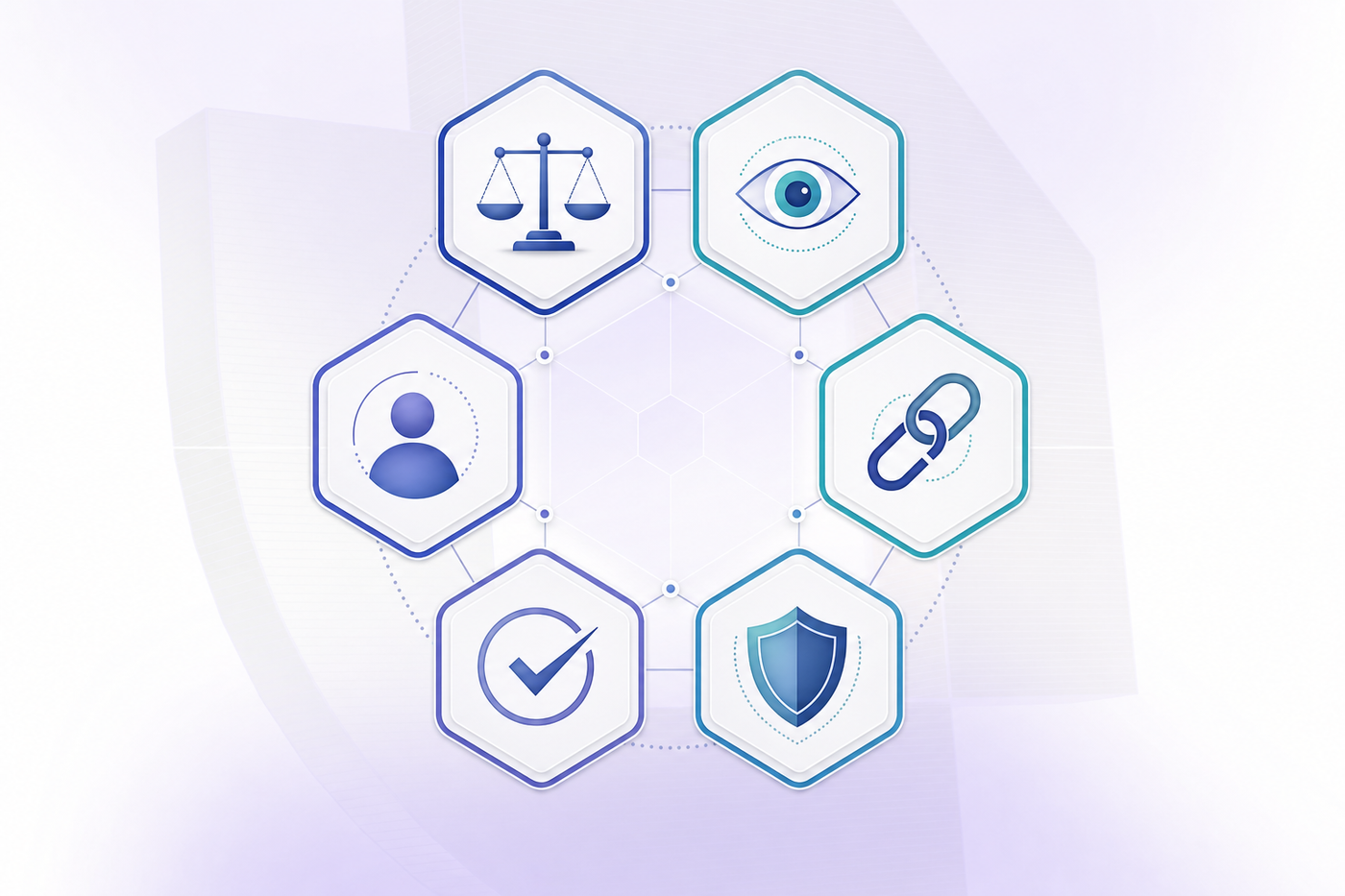
Most responsible AI frameworks share a common set of principles, though how they name and weight those principles varies by organization and regulatory context.
Here are the core principles that appear across major frameworks from NIST, Microsoft, Google, Cisco, and others:
- Fairness and non-discrimination: AI systems should produce equitable outcomes across demographic groups. Microsoft's Responsible AI Standard, for example, requires bias assessments before deployment, while NIST's AI RMF maps bias risk to specific governance controls.
- Transparency and explainability: Stakeholders should be able to understand how an AI system reaches its outputs. This ranges from technical explainability for engineers to plain-language disclosure for end users.
- Accountability: Clear ownership must exist for AI system decisions and their consequences. Frameworks like the NIST AI RMF and the EU AI Act assign accountability roles to providers and deployers separately.
- Privacy and data governance: AI systems must handle personal data lawfully and with appropriate controls, including data minimization and consent management.
- Security and reliability: Systems must perform consistently under adversarial conditions and routine operation alike. Security in AI systems goes beyond perimeter defense to include input validation, output integrity, and model robustness.
- Human oversight: High-stakes decisions should preserve meaningful human review beyond nominal approval steps.
These principles do not exist in isolation. The most effective frameworks treat them as interdependent: a system that is transparent but lacks accountability structures still fails in practice.
| Framework | Type | Core Structure | Primary Distinguishing Feature |
|---|---|---|---|
| NIST AI RMF | Voluntary U.S. standard released January 2023 | Four functions that run continuously: Govern, Map, Measure, Manage | Non-prescriptive flexibility with no specific metrics or enforcement mechanisms, adapted to sector and risk tolerance |
| Microsoft Responsible AI Standard | Internal governance standard with mandatory checkpoints | Six principles translated into concrete requirements: fairness, reliability and safety, privacy and security, inclusiveness, transparency, accountability | Ties each principle to internal governance checkpoints that teams must pass before shipping |
| Cisco Responsible AI Framework | Product-integrated governance framework with public principles | Security and privacy by design across AI components with behavioral guardrails | Treats security and privacy as foundational requirements built into system design from the start |
| EU AI Act | Legally binding regulation with August 2026 enforcement deadline | Risk-tiered approach banning unacceptable systems and imposing strict requirements on high-risk AI | Carries legal enforcement with documented risk assessments, ongoing monitoring, and clear accountability chains required by law |
| ISO 42001 | Certifiable management system standard | Repeatable process for governing AI across lifecycle from risk assessment through deployment and review | Provides management scaffolding similar to ISO 27001 for consistent execution of AI governance |
NIST AI Risk Management Framework: the voluntary U.S. standard
The NIST AI Risk Management Framework (AI RMF), released in January 2023, is the U.S. government's voluntary standard for managing AI risk across the full system lifecycle. Unlike compliance-driven mandates, it gives organizations a structured way to think about trustworthiness before, during, and after deployment.
The framework is built around four core functions:
- Govern: Create the policies, roles, and accountability structures that shape how AI risk decisions get made across the organization.
- Map: Identify and contextualize AI risks relative to the system's intended use, stakeholders, and operating environment.
- Measure: Apply quantitative and qualitative methods to assess identified risks and track them over time.
- Manage: Rank and respond to risks, including deciding when to accept, mitigate, or retire a system.
These functions are not sequential steps. They run in parallel. A model update triggers re-evaluation under Measure, a new deployment context reopens Map, and a production incident may prompt changes to Govern. Teams revisit each function as systems evolve instead of completing them once at launch.
Where the NIST framework fits in practice
The AI RMF is deliberately non-prescriptive, which is both its strength and its limitation. Organizations get flexibility to adapt it to their sector and risk tolerance, but that also means the framework provides no specific metrics, thresholds, or enforcement mechanisms on its own.
For teams building production AI systems, the Govern and Measure functions tend to require the most supporting infrastructure, since documenting accountability structures and tracking output quality at scale goes well beyond what policy documents alone can support.
Microsoft Responsible AI Standard: putting six principles into practice
Microsoft's responsible AI standard translates six core principles into concrete organizational requirements instead of aspirational statements. Those principles are fairness, reliability and safety, privacy and security, inclusiveness, transparency, and accountability.
There are a few things worth knowing about how these work in practice:
- Fairness means AI systems must treat all people equitably, with documented bias testing across demographic groups before deployment.
- Reliability and safety requires systems to perform as intended across diverse conditions, with failure mode analysis built into the development cycle.
- Privacy and security covers data minimization, consent, and protection against adversarial inputs at the system design stage.
- Inclusiveness means products must work across languages, abilities, and contexts beyond majority-use scenarios.
- Transparency requires that users understand what an AI system can and cannot do, including its known limitations.
- Accountability assigns human ownership over AI outcomes, with clear escalation paths when systems cause harm.
Microsoft's standard does not stop at documentation. It ties each principle to internal governance checkpoints that teams must pass before shipping. That structure is what separates a values statement from an enforceable standard, and it is the model most responsible AI framework templates try to reproduce.
Cisco Responsible AI Framework: security and privacy by design
Cisco treats security and privacy as foundational requirements instead of features bolted on after the fact. The Cisco Responsible AI Framework builds these concerns directly into how AI systems are designed, trained, and deployed across its product portfolio.
There are four areas where this shows up concretely:
- Security by design means AI components are held to the same vulnerability management and threat modeling standards as the rest of Cisco's infrastructure, reducing the attack surface that AI introduces instead of managing it separately.
- Privacy protections cover how training data is collected, how user data flows through AI-powered features, and how inferences about individuals are handled and stored.
- Transparency obligations require that users can understand when AI is acting on their behalf, particularly in products like Cisco Webex where AI-powered features include meeting summaries, real-time transcription, and content-sharing assistance.
- AI guardrails set behavioral limits on what Cisco's AI systems can output, with the goal of catching harmful or biased results before they reach end users.
Cisco also publishes its AI principles openly, which means teams assessing the framework can reference the Cisco AI guardrails and underlying rationale directly instead of reconstructing them from product documentation alone. The Cisco Responsible AI Framework PDF and supporting materials are available for organizations that want to use Cisco's approach as a reference point when building their own responsible AI governance structures.
EU AI Act and ISO 42001: the compliance-driven frameworks
Two regulatory frameworks now set the compliance floor for organizations deploying AI at scale: the EU AI Act and ISO 42001.
The EU AI Act takes a risk-tiered approach. Unacceptable-risk systems are banned outright. High-risk systems, covering areas like hiring, credit scoring, and critical infrastructure, carry strict documentation, testing, and human oversight requirements with an August 2026 enforcement deadline. Lower-risk systems face lighter transparency obligations.
ISO 42001 operates differently. Where the EU AI Act is law, ISO 42001 is a certifiable management system standard, closer in structure to ISO 27001 than to a regulation. It gives organizations a repeatable process for governing AI across its lifecycle, from risk assessment through deployment and review.
There are three things both frameworks share:
- Documented risk assessments tied to specific use cases beyond general policy statements
- Evidence of ongoing monitoring instead of one-time pre-deployment sign-off
- Clear accountability chains showing who owns each AI system and its outputs
For teams building responsible AI governance, these two frameworks are not competing choices. The EU AI Act defines what you must do by law; ISO 42001 provides the management scaffolding to do it consistently.
Implementation roadmap: from principles to practice
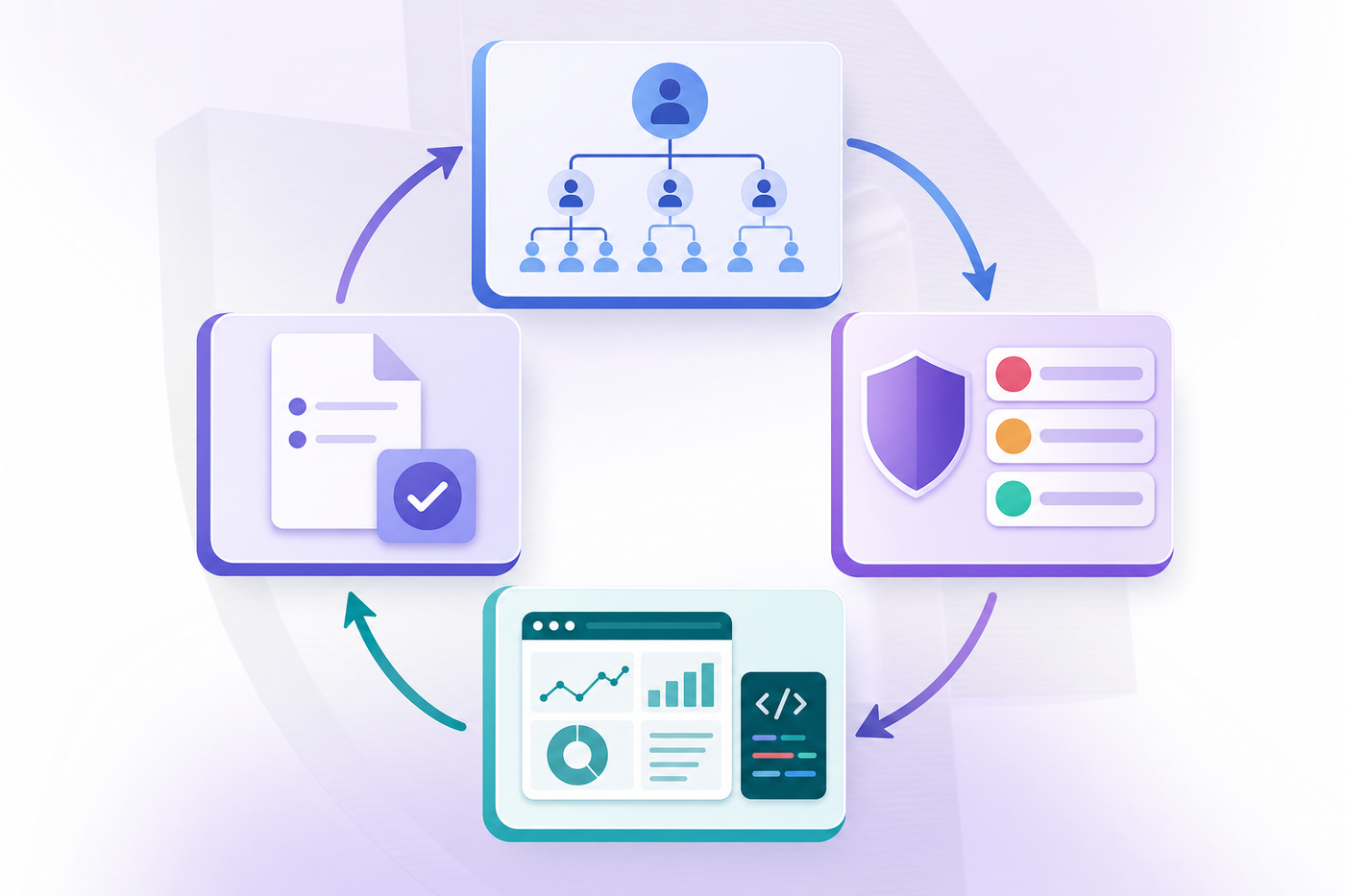
Most responsible AI frameworks collapse at the implementation stage because principles get documented and then ignored. The gap between stated values and actual system behavior is where AI risk lives.
There are four phases that move a framework from policy to practice:
- Governance setup: Appoint an AI ethics board or designated review body with authority to approve, pause, or reject deployments. Without decision-making power tied to a named group, accountability diffuses across teams and disappears.
- Risk classification: Map AI use cases to risk tiers before building begins. High-stakes applications in hiring, lending, or healthcare require stricter pre-deployment review than low-risk internal tools.
- Technical controls: Embed fairness checks, bias audits, and output monitoring directly into your development and deployment pipelines. Principles stated in a PDF do not catch a model drifting in production.
- Audit and reporting: Schedule recurring reviews against your framework's criteria. Document findings, remediation steps, and sign-offs so you have a traceable record when regulators or auditors ask.
The sequencing matters. Teams that skip risk classification and jump straight to controls end up applying heavy-handed review to trivial tools while missing the genuinely high-stakes ones.
Common implementation challenges and how to solve them
Three challenges tend to surface when organizations move from responsible AI principles to actual deployment.
- Vague accountability structures are the first. Without named owners for AI decisions, governance documents sit unused. Assign specific roles, whether a Chief AI Officer, ethics review board, or model risk team, and tie each to documented responsibilities.
- Bias detection gaps are the second. Many teams audit models at launch but skip ongoing monitoring. Bias can surface or worsen as data changes post-deployment, so continuous evaluation is needed, not a one-time check.
- Documentation debt rounds out the third. Teams build models faster than they write records. Audit trails, training data lineage, and model cards should be built into the development workflow from the start, not retrofitted afterward.
How Openlayer supports responsible AI framework implementation
Responsible AI frameworks set the principles. Putting them into practice requires continuous testing, monitoring, and evidence collection across the full model lifecycle. Most governance platforms focus on documentation and policy management. Credo AI provides governance workflows, policy templates, and risk assessment dashboards that help teams document compliance posture. IBM watsonx.governance offers model inventory, bias detection reports, and audit trails for tracking AI assets across the enterprise. Both platforms excel at creating the paper trail regulators expect.
Where they stop at observation and documentation, Openlayer is a unified evaluation, observability, and governance platform built to add active runtime enforcement and automated compliance mapping. Your framework stays active and enforceable instead of sitting in a PDF.
There are a few areas where Openlayer directly maps to responsible AI requirements:
- Pre-deployment evaluation runs 100+ pre-built tests covering fairness, toxicity, factual accuracy, and safety before any model reaches production.
- Runtime guardrails block unsafe or policy-violating outputs at the API boundary, not after the fact.
- Automated compliance mapping generates audit-ready evidence trails that align with frameworks like NIST AI RMF, the EU AI Act, and ISO 42001.
- LLM-as-a-judge scoring provides high human correlation, giving teams a scalable signal for output quality without manual review at every step.
The result is a governance posture that works in production, beyond policy documents alone.
Final thoughts on implementing responsible AI governance
Frameworks set expectations, but production systems need continuous enforcement. The teams that get this right treat fairness checks, output monitoring, and compliance mapping as part of the development pipeline, not as pre-launch theater. If your governance lives in slides instead of CI/CD, let's fix that.
FAQ
Responsible AI framework Microsoft vs NIST vs Cisco: which should I use?
No single framework wins across all contexts: Microsoft's standard is most practical if you're already in the Azure ecosystem, NIST AI RMF offers maximum flexibility for U.S. federal and cross-sector use, and Cisco's framework is strongest on security-by-design for infrastructure-heavy deployments. Most organizations map to multiple frameworks simultaneously, since regulators and customers increasingly expect evidence aligned to NIST, the EU AI Act, and ISO 42001 together.
What is the difference between a responsible AI framework and actual governance?
A framework documents principles and requirements; governance is the continuous execution of those requirements through testing, monitoring, enforcement, and audit-ready evidence capture. Most frameworks collapse because they stay documentation-only. Teams write the policy PDF, then never instrument the controls or trace outputs back to compliance criteria in production.
How does Microsoft handle potential biases in AI systems under its Responsible AI Standard?
Microsoft requires documented bias testing across demographic groups before deployment, with fairness assessments built into internal governance checkpoints that teams must pass before shipping. The standard treats fairness as a gate, not a guideline. Systems that fail bias evaluation cannot proceed to production without remediation and re-review.
Can I implement a responsible AI framework without slowing down model deployment?
Yes, if technical controls are embedded directly into your CI/CD pipeline instead of bolted on as separate review cycles. Pre-deployment evaluation gates, automated compliance mapping, and runtime guardrails that execute in milliseconds let teams ship quickly while maintaining governance. The bottleneck is manual, after-the-fact documentation, not the controls themselves.
What are the most common responsible AI framework implementation failures?
Three patterns dominate: vague accountability structures where no named owner exists for AI decisions, bias audits that happen once at launch but never again in production, and documentation debt where teams build models faster than they write audit trails. All three stem from treating governance as a launch checklist instead of a continuous practice.