NIST AI RMF Implementation Guide (April 2026)
AI adoption across industries has accelerated faster than most risk teams anticipated, and the compliance requirements have followed close behind. Since its January 2023 release, the NIST AI Risk Management Framework has become the de facto standard for AI risk management in the United States. Regulatory bodies now reference it directly, and organizations well outside the US have adopted it as a foundation for internal governance. Yet your leadership wants compliance, your engineers need to ship models, and you're stuck figuring out how to do both. The framework provides the structure, but it doesn't come with a runbook for your specific stack. This guide gives you the implementation roadmap, covering everything from the core framework to the generative AI profile, so you can build controls that satisfy auditors without blocking your team.
TLDR:
- NIST AI RMF provides four core functions (Govern, Map, Measure, Manage) that work cyclically to control AI risks across your organization's lifecycle.
- NIST AI 600-1 targets generative AI risks like hallucinations and IP leakage that standard ML frameworks miss.
- ISO 42001 provides certifiable management structure while NIST defines technical risks; most enterprises adopt both together.
- Manual compliance creates bottlenecks; platforms like Openlayer automate NIST mapping with 100+ tests and real-time guardrails.
Understanding the NIST AI risk management framework
The NIST AI Risk Management Framework (AI RMF) serves as the primary resource for organizations seeking to deploy safe systems. Released in January 2023, the NIST AI RMF 1.0 provides a voluntary, consensus-driven set of guidelines designed to help entities control the complex risks unique to AI. It offers a common language for technical experts and C-suite leaders to discuss trustworthiness, bias, and security without mandating specific technologies.
The framework's development followed a consensus-driven, open, and transparent process. NIST issued Requests for Information, published multiple draft versions for public comment, and conducted workshops with broad stakeholder engagement across industry, academia, and government. This collaborative approach means the framework reflects real-world implementation concerns instead of top-down mandates, giving technical teams and compliance officers a shared foundation they can trust.
NIST reviews the framework regularly, with formal community input on updates expected by 2028. The versioning system uses two numbers: the first marks major revisions, while minor revisions append a decimal increment (e.g., 1.1). A Version Control Table tracks all changes across releases. The Playbook, which translates core functions into specific suggested actions, receives more frequent updates than the core framework document itself, giving practitioners access to current guidance without waiting for a full major revision.
Adopting the NIST Artificial Intelligence Risk Management Framework AI RMF 1.0 is important as adoption scales. With private sector investment in AI topping $100 billion in 2024 in the U.S. alone, the financial and reputational stakes are immense. What is NIST AI RMF aimed at achieving? It supports risk management through a flexible lifecycle approach instead of a rigid checklist. A NIST AI RMF summary makes the goal clear: align technical controls with business values. The NIST AI RMF 2023 release set the standard, allowing enterprises to handle an evolving compliance environment while maintaining the speed required for rapid development.
Official NIST AI RMF resources
NIST provides several supporting resources to help organizations move from policy to practice. Knowing what is available and where to find it saves teams considerable time during initial implementation.
- AI RMF 1.0 PDF. The core framework document, available as a free download from the NIST publications site. This is the primary reference for the four core functions and their subcategories.
- AI Resource Center (AIRC). NIST's central hub for AI-related guidance, standards, and tools. The AIRC hosts the latest framework versions, supplemental documents, and links to related NIST AI research.
- Playbook in multiple formats. The NIST AI RMF Playbook translates the four core functions into over 460 suggested actions. It is available as a PDF, CSV, Excel workbook, and JSON file, making it straightforward to import into existing risk management workflows or GRC platforms.
- Crosswalk documents. NIST publishes official mappings between the AI RMF and other frameworks, including ISO 42001, the EU AI Act, and OECD AI principles. These documents let compliance teams reuse a single evidence set across multiple regulatory requirements.
- Sector and use-case profiles. Domain-specific profiles adapt the general framework for areas such as generative AI (NIST AI 600-1), financial services, and critical infrastructure, allowing teams to apply targeted controls without starting from scratch.
The Playbook accepts community feedback via email at AIframework@nist.gov, with semi-annual updates that integrate practitioner input. Teams can filter and tailor Playbook suggestions by function, category, and organizational context so that only the most relevant actions appear in their implementation view.
The four core functions: govern, map, measure, and manage

The NIST AI RMF framework relies on four interconnected functions:
- Govern. This function createes the culture of risk management. You define policies, roles, and accountability structures. It connects technical teams with leadership so NIST AI RMF controls match organizational principles.
- Map. This function contextualizes risks. You inventory systems, identify usage contexts, and categorize capabilities. It provides the necessary visibility into where models operate and who relies on them.
- Measure. This function quantifies risk through rigorous testing. This involves assessing systems for bias, drift, and performance metrics. Without concrete data, you cannot validate trustworthiness or safety.
- Manage. This function focuses and mitigates identified risks. You allocate resources to handle critical vulnerabilities, deploy guardrails, or decommission unsafe models.
| Function | Key categories | Example subcategories | Primary purpose | |
|---|---|---|---|---|
| Govern | Policies, roles, accountability, risk culture | GV-1.1: Legal and regulatory requirementsGV-1.2: Accountability and responsibilityGV-2.1: Organizational team rolesGV-4.1: Organizational risk tolerance | Build the cultural and structural foundation for AI risk management across the organization | |
| Map | Context, system inventory, risk categorization | MP-1.1: Context is set for framing risksMP-2.1: Categorization of AI systemMP-4.1: Approaches for mapping AI risksMP-5.1: Likelihood of AI risk consequences | Identify where models operate, who relies on them, and what categories of risk apply | |
| Measure | Testing, metrics, bias assessment, performance | MS-1.1: Appropriate methods and metrics identifiedMS-2.1: Trustworthy AI characteristics assessedMS-2.5: AI system test environments definedMS-3.1: Feedback and monitoring processes | Quantify risk through rigorous testing so teams can validate trustworthiness and safety with concrete data | |
| Manage | Risk treatment, resource allocation, monitoring | MG-1.1: Risk treatment options selectedMG-2.1: Resources for AI risk managementMG-3.1: Responses to identified AI risksMG-4.1: Post-deployment monitoring plans | Mitigate identified risks by allocating resources, deploying guardrails, or decommissioning unsafe models |
These components do not function as linear steps but as continuous actions that reinforce one another throughout the system lifecycle. They work cyclically. For example, insights from Measure inform Manage, which updates Govern policies, allowing your NIST RMF AI strategy to adapt to new threats rapidly.
NIST AI 600-1: the generative AI profile explained
NIST released the NIST AI 600-1 profile in July 2024 to handle the unique volatility of Generative AI. While NIST AI 100-1 (the core RMF) creates a high-level structure for general AI governance, this companion document targets the distinct behaviors of foundation models. It applies the four core functions directly to the lifecycle of text-to-image, text-to-video, and LLM systems, acknowledging that generative outputs require different guardrails than traditional predictive classifiers.
Generative systems create risks that standard ML models rarely exhibit. The profile targets "confabulation" and hallucinations, where models generate plausible but factually incorrect information with high confidence. It also notes the lowered barrier to entry for malicious actors using these tools for cyberattacks or non-consensual deepfakes. Risk management here must account for open-ended outputs that standard accuracy metrics often miss.
Intellectual property and information integrity receive heavy focus within the NIST AI 600-1 profile. Organizations must track training data provenance to prevent copyright infringement and accidental leakage of proprietary secrets. For example, a model trained on scraped web data might reproduce copyrighted code snippets verbatim, or a customer service chatbot might inadvertently surface confidential product roadmap details present in its training documents. A retrieval-augmented system could also expose internal pricing data if its document store lacks strict access controls. The profile warns that GenAI systems often obscure the line between public and private data. Organizations must run behavioral testing (including red-teaming exercises, adversarial input testing, and continuous output monitoring) instead of relying solely on pre-deployment validation benchmarks, moving from point-in-time checks to continuous active defense.
Key differences between NIST AI RMF and ISO 42001
Comparing ISO 42001 vs NIST AI RMF often leads to confusion, but they serve distinct, compatible purposes.
The NIST AI RMF 1.0 operates as a voluntary guidance framework focused on identifying and mitigating specific technical risks. It helps teams understand the nuance of bias, explainability, and safety within their specific context. In contrast, ISO 42001 functions as an international standard for an AI Management System (AIMS). While NIST defines the specific risks you must watch for, ISO provides the organizational structure to handle those risks consistently across an enterprise. NIST focuses on technical agility and risk identification. It breaks down granular risk categories and asks teams to map them against business objectives. It does not offer a seal of approval or a formal audit process. Its value lies in the playbook and profiles, like the NIST AI 600-1, that help engineering and data science teams implement specific controls. It answers the "what" and the "why" of risk management, providing the detailed taxonomy needed to assess model behavior effectively.
ISO 42001, on the other hand, focuses on process, documentation, and auditability. It aligns with other ISO standards, such as ISO 27001 for information security, giving global enterprises a structured way to integrate AI governance into existing compliance stacks. ISO requires you to document policies, resources, and continuous improvement cycles. If you need a third-party audit to prove to clients or regulators that you maintain a valid system, you pursue ISO certification. It represents the "how" of practical governance.
| Feature | NIST AI RMF | ISO 42001 |
|---|---|---|
| Core Nature | Voluntary Guidance Framework | Certifiable Management System Standard |
| Primary Focus | Risk identification and technical mitigation | Organizational process and governance structure |
| Certification | Self-attestation only | Third-party audit and certification |
| Integration | Standalone or maps to other risk models | Harmonized with ISO 27001 and ISO 9001 |
Most mature organizations adopt these frameworks together instead of choosing one. You can apply the NIST AI Risk Management Framework AI RMF to identify specific technical risks in your models and create the necessary testing protocols. You then wrap those protocols in the management structure of ISO 42001 to verify execution and accountability. This layered approach creates a defensible strategy that satisfies both technical safety requirements and organizational compliance mandates.
Two industry examples show this pairing in action. A regional bank uses NIST AI RMF to identify risks in its fraud detection model, running bias tests across demographic segments, scheduling monthly performance drift checks, and documenting confidence thresholds for human review escalation. Those technical controls are then wrapped inside ISO 42001's management structure, giving the bank's external auditors a certifiable process to review when regulators require proof of fair lending compliance. A hospital system applies NIST AI RMF to assess risks in its diagnostic imaging AI, validating safety margins, running explainability tests for radiologists, and categorizing edge cases where the model's confidence falls below acceptable thresholds. ISO 42001 then provides the documented management system that HIPAA compliance officers and accreditation bodies can audit directly. In both cases, NIST defines the specific technical controls while ISO provides the governance wrapper that makes those controls auditable and defensible to external reviewers.
Building your NIST AI RMF implementation roadmap
Creating your implementation roadmap follows a few key steps:
- create a clear line of authority
- Conduct a system inventory and gap analysis
- Apply risk-based prioritization
- Create, deploy, and document technical controls.
Step 1: create a clear line of authority
In this first step, you should form a cross-functional risk committee which includes stakeholders from engineering, legal, and compliance to define organizational risk tolerance. This group approves the baseline policies that guide all subsequent NIST AI RMF activities, giving technical teams the mandate to enforce safety checks. A financial services company, for example, might seat their Chief AI Officer, Head of Legal, Data Science Director, and Compliance Manager on this committee to cover each dimension of risk ownership.
Step 2: Conduct a system inventory and gap analysis
You cannot manage invisible risks. Create a complete inventory of every algorithmic system in use, including shadow IT and third-party SaaS integrations. Document the intended purpose, data sources, and deployment environment for each entry. With this inventory complete, conduct a gap analysis against the NIST AI RMF controls to identify where your current practices fall short of the framework's standards. A healthcare provider, for instance, might categorize their patient diagnosis AI as high-risk, their appointment scheduling chatbot as medium-risk, and their internal email sorting system as low-risk.
Step 3: Apply risk-based prioritization
Attempting to bring every model into full compliance simultaneously often leads to paralysis. Classify your inventory into high, medium, and low-risk categories. Focus resources on high-impact systems first, such as those affecting customer decisions, while applying lighter monitoring to low-risk internal tools. This tiered approach allows you to show value and iterate your NIST AI risk management framework rmf adoption processes effectively. In practice, start with the loan approval model affecting 50,000 customers monthly before the internal resume screening tool used by five HR staff.
Step 4: Define, deploy, and document technical controls
With your prioritization list, start defining how you will meet the NIST AI risk requirements for each of the relevant processes. Once defined, you can implement these controls and document how they operate. For a high-risk credit scoring model, this might mean running bias tests across protected attributes, scheduling monthly drift monitoring, and creating human review protocols for edge cases that fall outside the model's confidence threshold.
Key tools and resources: playbook, crosswalks, and profiles
Translating the high-level guidance of the NIST AI RMF 1.0 into engineering reality requires more than the core document. NIST provides several companion resources designed to bridge the gap between abstract principles and concrete workflows. These tools make sure that risk management stays active and concrete, not theoretical.
The NIST AI RMF playbook
The most critical implementation aid is the NIST AI RMF Playbook. This resource translates the four core functions into over 460 specific suggested actions. Whether used online or as a downloadable NIST AI RMF playbook pdf, this tool offers granular guidance for documentation, testing, and team structuring. It helps engineering teams interpret requirements like "assess system impact" by providing checklists and examples of specific evidence needed to prove compliance.
Crosswalks and profiles
Enterprise teams operate in a fragmented regulatory environment. NIST maintains official crosswalks that map RMF sub-categories directly to external standards like the EU AI Act, ISO 42001, and OECD principles. These crosswalks allow compliance officers to use a single set of evidence to satisfy multiple frameworks. In addition, profiles adapt the general NIST AI RMF for specific use cases. By combining these crosswalks with a sector-specific profile or a targeted NIST AI RMF summary, you reduce administrative overhead and change a generic risk model into a specialized defense strategy.
NIST AI RMF training and certification options
As adoption of the NIST AI RMF framework accelerates, the demand for qualified professionals has spiked. The NIST AI RMF 1.0 Architect certification stands as the primary credential for proving expertise. Earning this designation proves a practitioner understands the four core functions and can translate high-level guidelines into specific technical controls. Pursuing NIST AI RMF certification creates value for risk officers and data scientists. Certified architects act as internal champions, guiding teams through NIST AI RMF 1.0 architect certification requirements. This capability allows organizations to internalize risk management instead of relying solely on external consultants.
Automated compliance and continuous monitoring with Openlayer
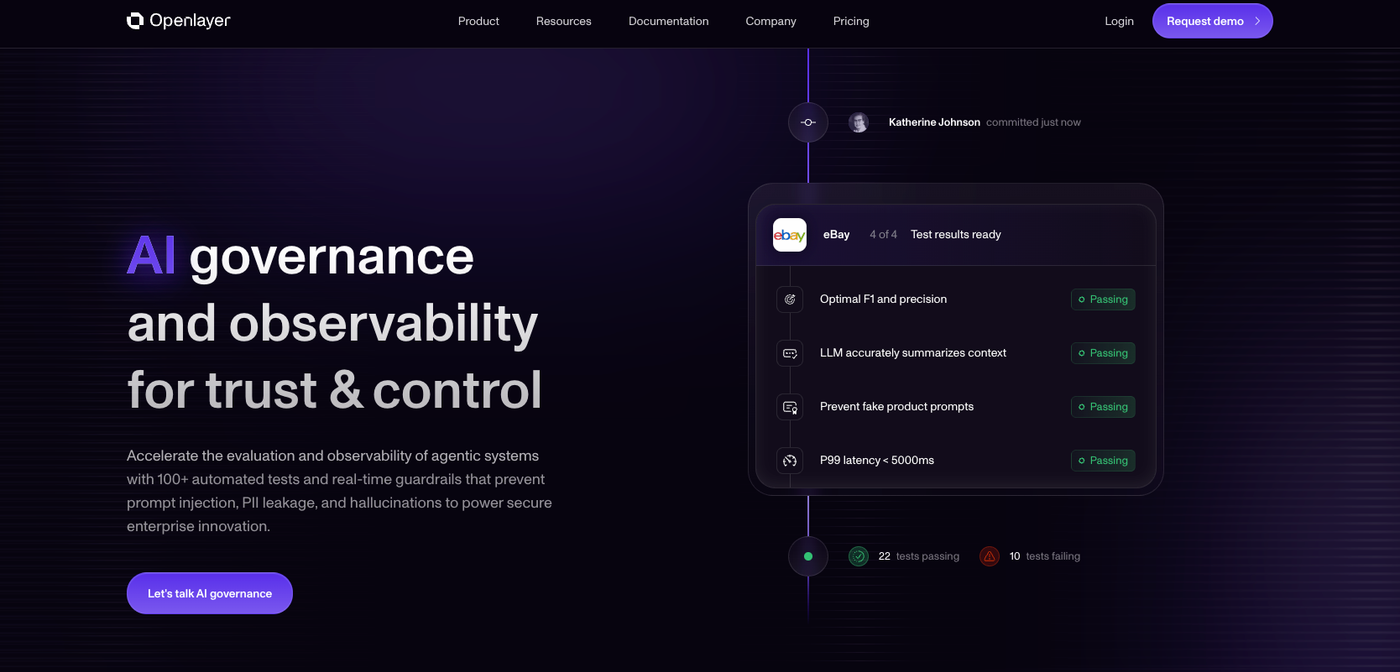
Manual compliance creates bottlenecks. Openlayer automates the NIST AI RMF lifecycle, converting static policy into active runtime protection. The system automatically maps AI projects to the NIST framework (alongside ISO 42001, the EU AI Act, and OWASP) replacing spreadsheet-based tracking with risk assessment. This allows teams to execute compliance workflows without slowing deployment velocity.
For the Measure function, Openlayer deploys over 100 automated tests across text, vision, and tabular data. These evaluations detect hallucinations, bias, and toxicity before models reach production. To handle the Manage function, real-time guardrails intercept specific threats like prompt injections and PII exfiltration, blocking malicious inputs instantly.
The Govern function relies on visibility. Openlayer provides centralized oversight across ML, GenAI, and agentic systems. Teams enforce consistent policies and generate regulator-friendly reporting automatically. This guarantees that every model version includes the necessary audit trails and evidence to prove reliability to stakeholders.
Final thoughts on building a sustainable AI risk strategy
You don't need to master every detail of the NIST AI RMF before you start applying it to your models. Pick one function, implement it for your highest-risk system, and build momentum from there. Openlayer automates the Measure and Manage functions with over 100 tests and real-time guardrails, giving you audit trails and evidence without spreadsheets. The goal is continuous improvement, not perfection on day one.
FAQ
How long does NIST AI RMF implementation typically take?
Most organizations complete initial system inventory and gap analysis within 4-6 weeks, with full implementation of high-priority controls taking 3-6 months depending on system complexity and existing governance maturity.
What is the main difference between NIST AI RMF and ISO 42001?
NIST AI RMF provides voluntary technical guidance for identifying and mitigating specific AI risks, while ISO 42001 offers a certifiable management system standard for organizational AI governance processes that can be audited by third parties.
When should I focus first on NIST AI 600-1 over the core framework?
Apply NIST AI 600-1 when working with generative AI systems like LLMs or text-to-image models, as it targets unique risks such as hallucinations, confabulation, and intellectual property concerns that traditional ML models rarely exhibit.
Can I use NIST AI RMF alongside other compliance frameworks?
Yes, NIST maintains official crosswalks that map RMF categories directly to the EU AI Act, ISO 42001, and OWASP standards, allowing you to satisfy multiple regulatory requirements with a single set of evidence and controls.
How do I measure compliance with NIST AI RMF without manual audits?
Automated testing platforms can execute the Measure function by running continuous evaluations for bias, drift, and toxicity, while real-time guardrails handle the Manage function by blocking threats like prompt injections before they reach production systems.