Needle in a Haystack: AI Testing Guide (Jan 2026)
Everyone talks about expanding context windows, but finding a needle-in-a-haystack gets harder as the haystack grows. Your AI might handle 200K tokens in theory, yet fail to recall information from the middle when it matters. These retrieval failures turn into confident hallucinations in RAG systems, missed clauses in legal analysis, and broken workflows in multi-step agents. We'll cover how needle tests work, why single-fact benchmarks fall short, and what you need to validate across development and production to catch blind spots before your users do.
TLDR:
- Needle-in-a-haystack tests measure if AI systems retrieve specific facts from long contexts.
- Single-fact retrieval misses real failures: multi-needle tasks drop accuracy from 95% to 60%.
- RAG systems turn retrieval failures into hallucinations that break compliance and trust.
- Multimodal models collapse from 97% to 27% accuracy as visual complexity increases.
- Openlayer runs 100+ automated tests in CI/CD to catch retrieval regressions before production.
- Openlayer provides native needle tests plus context utilization, relevancy, and groundedness metrics through LLM-as-a-judge.
What is the needle-in-a-haystack test for AI systems
The needle-in-a-haystack test measures whether an AI system can find and use specific information buried in long context windows. You insert a single fact (the needle) into a large document or conversation history (the haystack), then prompt the model to retrieve or act on that fact. Greg Kamradt introduced this evaluation in 2023 to test how well LLMs handle extended context. As context windows grew from 4K to 100K+ tokens, teams needed proof that models could actually use all that context, not simply claim to support it. The test reveals a gap between theoretical capability and practical retrieval. A model might accept 200K tokens but fail to recall information from position 87,543. For RAG systems, chatbots, and agents processing lengthy documents or conversation threads, that failure breaks the entire application.
How the needle-in-a-haystack benchmark works
The benchmark tests three variables:
- context length (minimum to maximum supported tokens),
- needle position (depth percentage where 0% = start, 100% = end), and
- retrieval accuracy (whether the model extracts the fact correctly).
Greg Kamradt's protocol embeds a specific statement in filler text, varies length and depth, then queries the model across a grid of combinations to map performance throughout the context window. Results display as heatmaps with context length on one axis and depth percentage on the other, providing clear LLM evaluation metrics. Green cells mark successful retrieval, red indicates failures, revealing whether models drop information at specific positions or beyond certain token counts. Rigorous tests randomize placement, vary haystack content, and verify the needle never appeared in training data to prevent pattern memorization.
Why traditional needle-in-a-haystack tests fall short
How do traditional needle-in-a-haystack tests fall short? There are several reasons:
- Single-fact retrieval doesn't reflect production workloads. Most AI systems synthesize multiple pieces of information, resolve conflicts, or apply reasoning across retrieved context.
- Standard tests reward exact string matching. A model scores perfectly if it regurgitates the planted fact, even if it can't understand surrounding content. Research from Chroma shows that context quality degrades as length increases, a phenomenon called "context rot."
- Real applications require semantic retrieval. The needle might be paraphrased, implied, or contradicted by later information. Benchmarks also ignore adversarial scenarios where attackers inject misleading facts, turning the haystack into a minefield instead of passive filler text that AI guardrails should protect against.
Because of these issues, at the moment, human evaluation remains necessary because automated scoring misses reasoning failures that only surface when outputs are used downstream.
Multi-needle retrieval and reasoning challenges
Multi-needle tests ask models to locate and connect several facts across a context window. For example, you embed three to ten distinct pieces of information at varying depths, then pose questions requiring synthesis. Here's a scenario: three needles describe a person's name, location, and role at different positions in a 50,000-token document. The query asks, "Who leads the Tokyo office?" The model retrieves and combines all three facts to answer.
But, when you move to multi-needle scenarios, additional testing challenges present themselves:
- Retrieval accuracy drops as needle count increases. Models achieving 95% accuracy on single-needle tasks fall to 60% when retrieving four needles requiring joint reasoning.
- Support bots encounter this regularly: pricing from one section, policy exceptions from another, account history from a third to resolve a single request, requiring thorough GenAI testing.
Multimodal needle-in-a-haystack evaluation
If you have a multimodal AI system (processing images, video, audio, and text together), needle testing is complicated even further. Vision-language models struggle with spatial ordering and fine-grained visual differences, making LLM evaluation across modalities critical. Thankfully, multimodal benchmarks now embed target images within sequences of distractor visuals, testing whether models retrieve the correct frame or object.
The key issue with needle tests in multimodal AI systems is performance. It collapses as visual complexity increases. GPT-4o achieved 97% accuracy retrieving needles from 10 images, but dropped to 27% when those images contained sub-images, creating an effective context of 160 visuals. Consider some real-world examples:
- Medical imaging apps sift through dozens of scans,
- security tools analyze hours of surveillance footage, and
- e-commerce search ranks thousands of product photos.
If your model can't locate the correct image in position 42 of 200, retrieval fails before reasoning starts.
RAG systems and context retrieval in production
If you've worked with RAG systems, you know that they turn retrieval failures into confident hallucinations. When a chatbot pulls wrong context or a legal analyzer misses a buried clause, compliance and trust suffer. 70% of engineers already run RAG in production or plan deployment within 12 months. These systems answer customer questions, generate reports, and surface insights where accuracy is required, not optional.
Needle tests expose retrieval blind spots before users see them. Production RAG faces noisy metadata, overlapping chunks, contradictory document versions, paraphrased queries, and domain-specific terminology when assessing RAG pipelines. Testing across your actual corpus with real user intent reveals where context windows drop facts or conflate similar passages.
Testing AI agents beyond simple retrieval
Needle testing becomes even more important when you are running agentic workflows, where one agent orchestrates multi-step workflows that chain tool calls, manage state, and handle errors across turns, requiring specialized LLM agent evaluation.
WebArena and SWE-bench measure end-to-end task completion, where agents book flights, debug code, or process returns. A correct retrieval at step one fails if the agent calls the wrong API at step seven. Tool-use errors, authentication mistakes, parameter formatting issues, and rate-limit violations break workflows that retrieval benchmarks never expose. Interaction quality failures like tone violations, brand guideline breaches, or PII leaks surface only during multi-turn execution. Effective AI agent evaluation validates state coherence, retry logic, and graceful termination under goal drift.
Continuous testing and monitoring for AI context retrieval
You know that retrieval accuracy degrades as context patterns shift, training data ages, or prompt templates evolve. That's why, whether you are testing a single text-based AI agent, an AI agent connected to a RAG system, or a multi-modal agent, needle testing shouldn't be a one off. It should be a continuous process to improve the trust-worthiness of your AI agent's output:
- CI/CD integration runs needle tests on every model update, catching regressions in pull requests instead of production.
- Scheduled evaluations track live performance, running multi-needle tests against actual document corpora to detect drift.
- LLM monitoring through production telemetry logs context lengths, needle positions, and user satisfaction signals.
Just keep in mind that if users abandon sessions after queries pulling from 80K+ token contexts, your haystack exceeds practical limits regardless of benchmark scores.
Needle-in-a-haystack testing with Openlayer
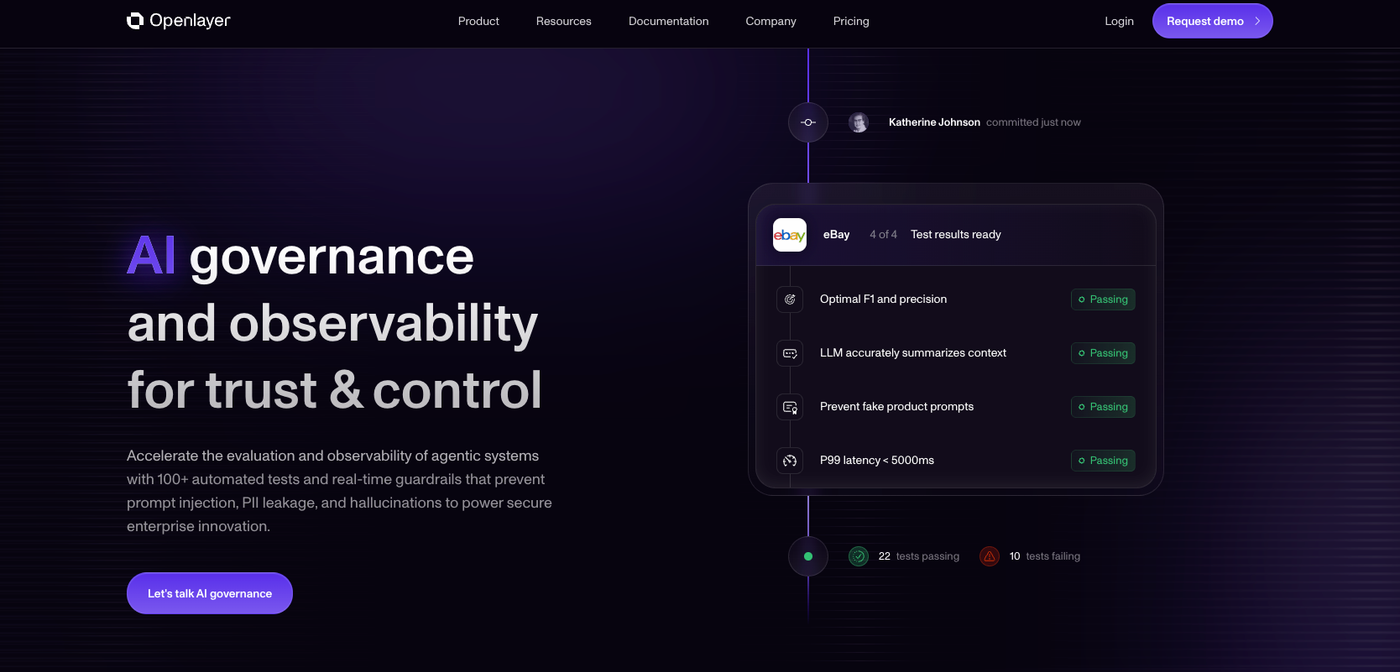
Openlayer implements needle-in-a-haystack tests natively through LLM-as-a-judge evaluation, eliminating the need for external tooling or manual test construction. Our platform validates retrieval accuracy through multiple complementary metrics:
- Traditional needle tests embed specific facts at varying depths and lengths to map retrieval accuracy across the full context window.
- Context relevancy validates that retrieved passages match the user's query, catching cases where retrieval systems return semantically distant content despite keyword matches.
- Context utilization measures how much retrieved content the model actually uses, detecting when models ignore relevant information despite retrieving it correctly.
- Groundedness verifies that factual statements in outputs trace back to retrieved context, preventing hallucinations that mix real and fabricated information.
Our 100+ automated tests detect hallucinations in retrieved context and block prompt injections that manipulate haystack content before processing. CI/CD integration catches retrieval regressions when you update embedding models, chunk strategies, or context window sizes. Real-time guardrails prevent failed retrievals from reaching users by stopping responses when confidence drops or context contains contradictions. Tests run continuously on live data to detect drift as document collections grow or user queries shift, with LLM-as-a-judge providing detailed rationales for each failure to accelerate debugging.
Final thoughts on AI retrieval accuracy
The needle-in-a-haystack test measures whether your AI can find and use buried information across long contexts. Extend beyond single-fact retrieval with multi-needle scenarios, multimodal evaluation, and adversarial content that reflects production complexity. Run tests continuously on your actual document corpus to detect drift as user queries and content patterns shift.
FAQ
How does the needle-in-a-haystack test work for LLMs?
The test embeds a specific fact (the needle) at varying positions within a large document (the haystack), then queries the model to retrieve that fact. Results map as heatmaps showing retrieval accuracy across different context lengths and depth percentages, revealing where models fail to recall information.
What is multi-needle retrieval testing?
Multi-needle tests embed three to ten distinct facts at different positions in a context window, then ask questions requiring synthesis of those facts. Retrieval accuracy typically drops from 95% with single needles to 60% with four needles requiring joint reasoning.
Why do standard needle tests fail to predict production performance?
Single-fact retrieval doesn't reflect real workloads where systems must synthesize multiple pieces of information, resolve conflicts, or apply reasoning. Standard tests also reward exact string matching while ignoring semantic understanding, adversarial scenarios, and context quality degradation at scale.
How can I test retrieval accuracy in RAG systems continuously?
Run needle tests on every model update through CI/CD integration to catch regressions before deployment. Schedule evaluations against actual document corpora to detect drift, and log production telemetry tracking context lengths, retrieval positions, and user satisfaction signals to identify practical limits.
What makes multimodal needle testing different from text-only tests?
Multimodal tests embed target images within sequences of distractor visuals to measure retrieval accuracy across vision-language models. Performance drops a lot as visual complexity increases: GPT-4o achieved 97% accuracy with 10 images but fell to 27% with 160 effective visuals containing sub-images.