How to Monitor and Control Every Enterprise AI System November 2026
If the underlying inventory is incomplete, enterprise AI oversight can fail even when a monitoring layer is in place. Systems running in production with no named owner, no risk tier, and no monitoring threshold aren't a governance problem you can solve with alerts. A unified platform connects inventory, evaluation, production monitoring, runtime enforcement, and audit evidence so teams can track systems, act on policy violations, and verify control outcomes.
TLDR:
- A blank field in a required AI system inventory is an evidence gap, and missing required documentation can itself count as a compliance failure even when a technical control exists
- Score each system across impact scope, failure severity, observability, and regulatory exposure
- RAG pipelines have two distinct failure surfaces (retrieval and generation), and both need separate monitoring
- Tool calling fails regularly in production; post-hoc logging after an unauthorized call executes is evidence of a control gap, not proof of a control
- Openlayer enforces policy at the API boundary before outputs reach end users, generating per-request audit records that map to EU AI Act requirements, NIST AI RMF guidance, and ISO 42001 requirements
What enterprise AI oversight requires
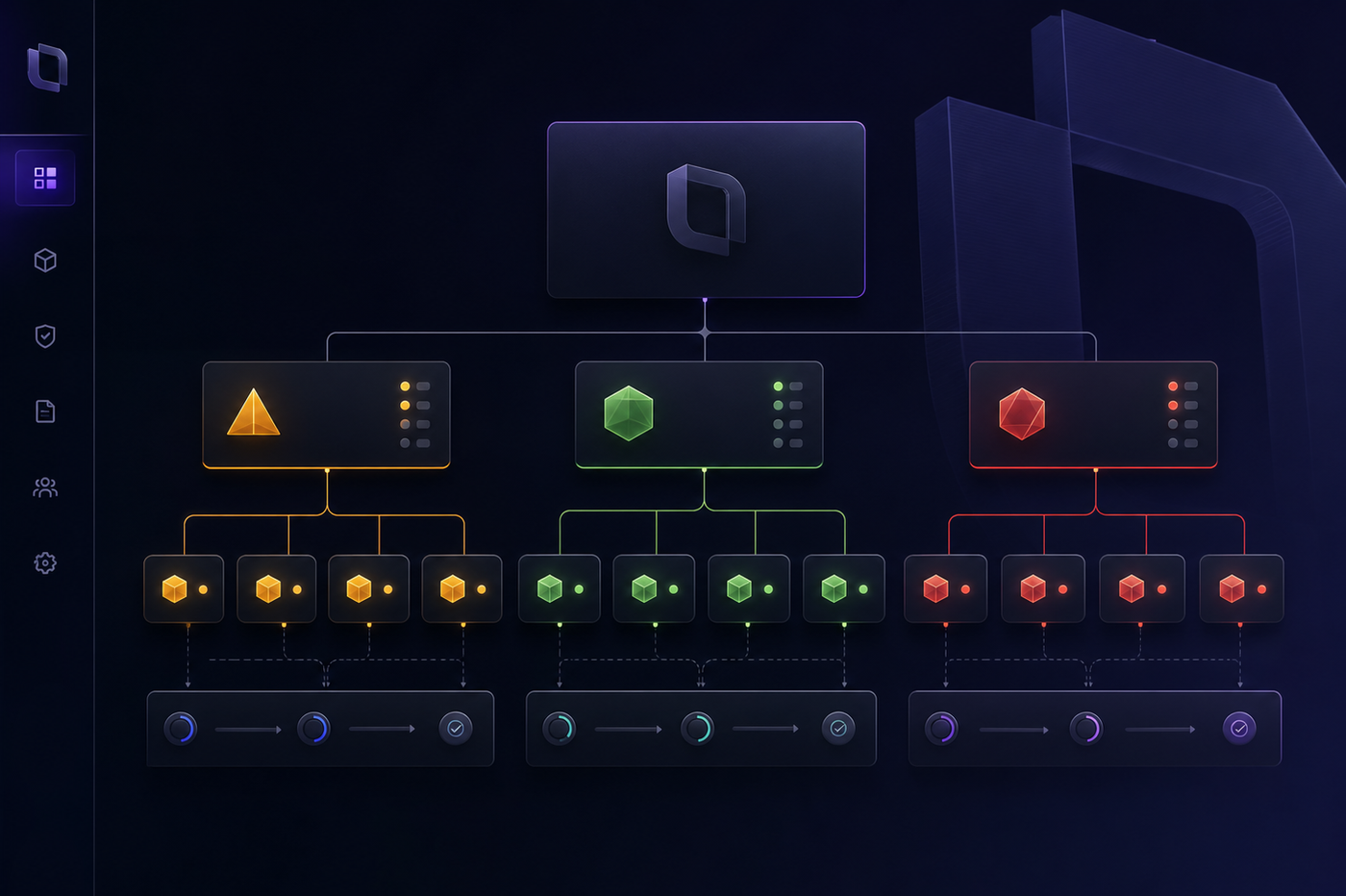
Effective enterprise AI oversight starts with a central inventory linking every system to a named owner, risk tier, lifecycle stage, and monitoring status and thresholds. That record lets teams check coverage and accountability across the portfolio.
An unregistered fine-tuned model leaves a gap in the catalog. Connecting a third-party LLM API without a risk review leaves data handling, output risk, and vendor compliance unassessed. Neither omission proves that access restrictions, security checks, logging, or monitoring are absent.
But working controls do not remove documentation duties. Where EU AI Act high-risk requirements apply, Article 83(1)(g) of the Act treats unavailable technical documentation as formal non-compliance, even if the underlying control works. A blank inventory field alone does not prove that required documentation is unavailable. To prevent documentation gaps, an approved intake policy can require complete records before production. That is a release condition, not a technical prerequisite for monitoring a known system.
Building a centralized AI system inventory
Each inventory entry must carry the system's origin (vendor-built, internal, embedded in a SaaS product, or research), a named owner with contact information, the intended use case, an assigned risk tier, the data sources it touches, its current lifecycle stage, and the specific regulatory categories it falls under.
Every one of those fields carries weight. A system listed without a risk tier cannot be routed to the appropriate review workflow, and a system with no named owner has no accountable party when a threshold breach triggers escalation. An entry missing its data sources leaves a GDPR or HIPAA exposure assessment incomplete, even if reviewers can locate the relevant data flows elsewhere, because that evidence still needs to be linked back to the system's entry. Good practice is to link the supporting record directly in the entry, note a justified reason when a field does not apply, or assign an owner and a deadline to close the gap.
The origin field deserves particular attention. Shadow AI enters through three distinct channels:
- Data science teams spinning up unregistered fine-tuned models that bypass evaluation gates and accumulate outside any governance perimeter.
- Product teams connecting third-party LLM APIs without a risk review, often under time pressure, without a vendor risk management assessment of data handling or the vendor's compliance posture.
- Business units deploying off-the-shelf generative tools that process regulated data before compliance functions are aware they exist.
An inventory that tracks only internally built models misses the second and third categories entirely, and that's where regulatory exposure tends to accumulate undetected.
Governing the full AI system lifecycle
Each lifecycle stage requires a specific gate:
- Intake: structured risk scoring before any development begins; output is a risk tier, a named owner, and the regulatory obligations that apply.
- Development: evaluation against bias, safety, and accuracy thresholds; CI/CD gates block promotion when groundedness falls below the approved floor. A demographic parity gap, the absolute approval-rate difference between, say, women and men applicants in the same cohort, is one illustrative threshold, not a universal rule. The model owner and a fairness or compliance reviewer approve the group definitions, sample adequacy, and cutoff before it governs any gate.
- Validation: a named approver signs off on test results, plus fairness audit findings and the conformity assessment record where applicable to the system, before any traffic reaches the system.
- Production: continuous monitoring with explicit drift thresholds, scheduled recertification windows, and automated alerts routed to the model owner when a threshold is breached.
- Decommissioning: lifecycle state updated, access revoked, audit log archived with a retention schedule tied to the applicable regulatory window.
A configured stage gate produces its evidence artifact directly from enforcement. As an illustrative example, a team sets a groundedness floor at 85%: supported factual claims divided by all assessed claims on a fixed validation set, scored with a versioned rubric, and no-claim outputs recorded separately from passes. The model owner and validation reviewer approve the rubric, dataset, and floor before the gate runs. A build scoring below the floor has its promotion blocked, and the gate records that outcome automatically.
Sign-off requirements scale with risk tier. Low-risk systems may advance on automated gate passage alone where policy allows it. High-risk systems can require N-of-M approval: a configured minimum number of sign-offs (for example, 2 of 3) from a named pool of eligible reviewers. Openlayer supports configurable N-of-M sign-offs at the lifecycle-stage and framework-rule level, routing each transition to functional reviewers such as the model owner, compliance, and legal. But a quorum count is only part of the policy. These additional rules are recommended governance design, not confirmed native workflow settings: require every mandatory-role sign-off regardless of how the quorum is met, treat a rejection from any required reviewer or an unresolved blocker as a hold on the transition, and route disagreement or an overdue review to a named governance lead, never to automatic release. Check which of these rules your workflow configuration enforces natively, and cover the rest in your documented review process.
Risk classification and tiered governance
Risk classification makes governance proportional, not uniform. A customer-facing credit scoring model and an internal summarization tool warrant fundamentally different controls; treating them the same wastes resources on one while creating liability on the other.
Score each system against an approved rubric with lowest-to-highest risk bands for four dimensions: impact scope, failure severity, observability, and regulatory exposure. A higher observability-risk score means poorer visibility into behavior and failures, not stronger monitoring. The composite determines the internal risk classification, and configured rules can trigger stricter requirements when a dimension lands in the rubric's highest-risk band:
- More approval stages before production
- Applicable fairness testing with documented, approved use-case thresholds
- Shorter recertification intervals
- Narrower drift alert bands before escalation fires
A system scoring low across all four dimensions advances through lightweight intake on standard monitoring. Under a recommended rule, not a default, reaching the highest-risk band on any single dimension can override a low composite score and require designated approvals, applicable safety and fairness tests, shorter recertification, and tighter monitoring. The top band for failure severity covers catastrophic harm, and the top band for observability risk covers an inability to detect or reconstruct consequential failures; a composite score alone can obscure either condition.
Legal classification and internal risk scoring serve different purposes. Under the EU AI Act, Annex III financial-services categories include creditworthiness assessment and credit scoring, with an exception for financial-fraud detection only, plus risk assessment and pricing for life and health insurance. The Commission's AI Omnibus timeline update sets application of the Annex III high-risk rules at 2 December 2027 and the Annex I product-related high-risk rules at 2 August 2028. By contrast, the NIST AI Risk Management Framework is voluntary guidance, not a statutory tier system. Record the legal classification basis separately from the internal scoring rationale. A composite score guides approval and monitoring depth; legal compliance requires a separate review of applicable obligations and evidence. Judge an inventory by the completeness and accuracy of its records, not whether it uses a spreadsheet.
Finding shadow AI and unregistered systems
The inventory you build deliberately is only part of the picture. Unregistered systems are already running, and discovery is not a one-time audit.
Finding unregistered systems requires comparing evidence of AI use against the inventory. Gateway/API logs and integration, deployment, and procurement records provide that evidence, supplemented by available CASB, DLP, and proxy signals. But network visibility has limits: CASB tools can identify known AI services, while reading HTTPS request bodies requires TLS decryption. Identity provider (IdP) sign-in and OAuth consent logs show access and permissions for apps used through corporate identity, but they don't reveal prompt contents or personal-account activity.
Together, these sources reduce blind spots without eliminating gaps from uncollected traffic or delayed records. To keep the inventory current, check new integrations and deployment changes as they occur; a recommended cadence is a daily comparison of records. When an unregistered system surfaces, assign an owner and complete a risk review before linking it to continuous AI risk monitoring.
Production monitoring: from drift detection to behavioral anomalies
Inventory records ownership and risk tier. Production monitoring checks behavior after deployment, on any system a team knows to watch.
Production monitoring splits into four distinct layers, each catching failure modes the others miss:
- Statistical drift detection: input distribution shift and concept drift are separate, silent signals. Distribution shift shows up in unlabeled feature data checked against an approved reference. Concept drift is a change in how inputs map to outcomes, confirmed only with trusted labels or outcome evidence, not feature data alone. Drift detection for high-risk AI systems needs thresholds set at deployment, not after a problem surfaces.
- Behavioral anomaly detection: a baseline from the same model, scorer, and comparable traffic can surface regressions above a fixed floor. Configured windows, metric-specific settings, and sufficient data determine when an alert fires at a scheduled check, not a decline's size alone.
- Session-level quality monitoring: for multi-turn and agentic systems, full-session checks can catch failures that turn-level scoring misses, including a conversation that fails end-to-end despite correct individual turn scores.
- Tail-latency and cost runaway detection: p95 and p99 spikes are symptoms, not proof of retrieval failure. Traces locate delays across retrieval, model calls, network time, queues, and retries where those stages are instrumented. Configured budget controls block further covered requests in agent loops. Dashboards report spend. Neither reverses costs already incurred.
| Monitoring Layer | What It Watches | Failure Mode It Catches | Alert / Action |
|---|---|---|---|
| Statistical drift detection | Unlabeled input shift; concept drift confirmed only with trusted labels or outcomes | Live input distribution shifting from an approved reference, such as training data; shift alone does not prove accuracy loss | Shift alert on distribution change; accuracy impact confirmed separately once outcomes arrive |
| Behavioral anomaly detection | Quality metrics checked against an adaptive baseline learned from historical patterns for the same model, scorer, and comparable traffic | Subtle regressions that may stay above a fixed floor | Alerts depend on the configured evaluation window, metric-specific thresholds, and sufficient data to confirm a deviation |
| Session-level quality monitoring | Multi-turn and agentic conversation quality across full sessions | Conversations failing end-to-end despite correct turn-level scores | Session-level metrics surface failures turn-level scoring misses |
| Tail-latency & cost runaway detection | p95 / p99 latency; instrumented stage timings; token costs across agent loops | Latency spikes requiring attribution; runaway token costs | Traces help locate delays in instrumented stages; configured budget controls block further covered requests, not costs already incurred |
High-risk systems warrant continuous monitoring with prompt alerting where the underlying signal supports it. Lower-risk systems may run on daily or weekly scheduled evaluation, with results surfaced in the next governance review cycle. Cadence should follow risk tier and the availability of trusted evidence, since some signals, like outcome-based drift, are only confirmed once labels arrive.
Governing RAG systems and retrieval pipelines
RAG pipelines have two distinct failure surfaces: retrieval and generation. The retrieval layer fails quietly: a query pulls low-relevance chunks, the model generates a coherent response anchored to the wrong context, and no error is thrown.
Governing a RAG system calls for separate evaluation at each layer. Retrieval evaluation scores retrieved chunks against the query for precision and relevance, while coverage asks whether the retrieved set contains all the evidence a correct answer needs. Confirming coverage needs reference evidence or a labeled benchmark; query relevance scoring alone cannot prove the evidence set is complete, since a chunk can match the query well and still omit a fact the answer depends on. Generation evaluation measures faithfulness and groundedness: whether the output is grounded in the chunks it received. A faithfulness test checks support by the supplied context, so it can pass even when retrieval returned irrelevant or incomplete evidence, meaning faithfulness alone cannot prove the answer is correct. Running these checks before generation calls for configured integration with the retrieval path; not every offline evaluation needs to run inline to be useful.
Indirect prompt injection adds a third concern. Adversarial instructions embedded in documents can enter the context window through retrieved chunks, bypassing input-layer defenses. Openlayer's retrieval pipeline defense flags chunks whose injection-pattern classifier score exceeds a 0.85 confidence threshold before they reach the context window, then routes them to a secondary review path instead of hard-blocking them, which keeps legitimate tasks working. Flagging and routing is detection, and it does not by itself hold a request until an authorized reviewer acts. Deployments document the classifier and version in use, what the score measures, which direction signals higher risk, and how any cutoff was calibrated against labeled benign and adversarial chunks for the use case. Treat the following as recommended design, not confirmed native workflow behavior: define a hold policy for flagged chunks, where approval releases them, rejection excludes them, and timeout keeps the chunk withheld with a safe fallback or stopped request. Check which of those steps your configuration enforces natively, and cover the rest in your own pipeline or review process.
A RAG governance program needs three monitoring controls in place at deployment:
- Retrieval-layer relevance scoring with an alert threshold for low-precision retrievals
- Faithfulness monitoring at the generation layer comparing outputs against retrieved context
- Pre-context injection screening on retrieved chunks before they reach the model
Multi-agent system governance in production
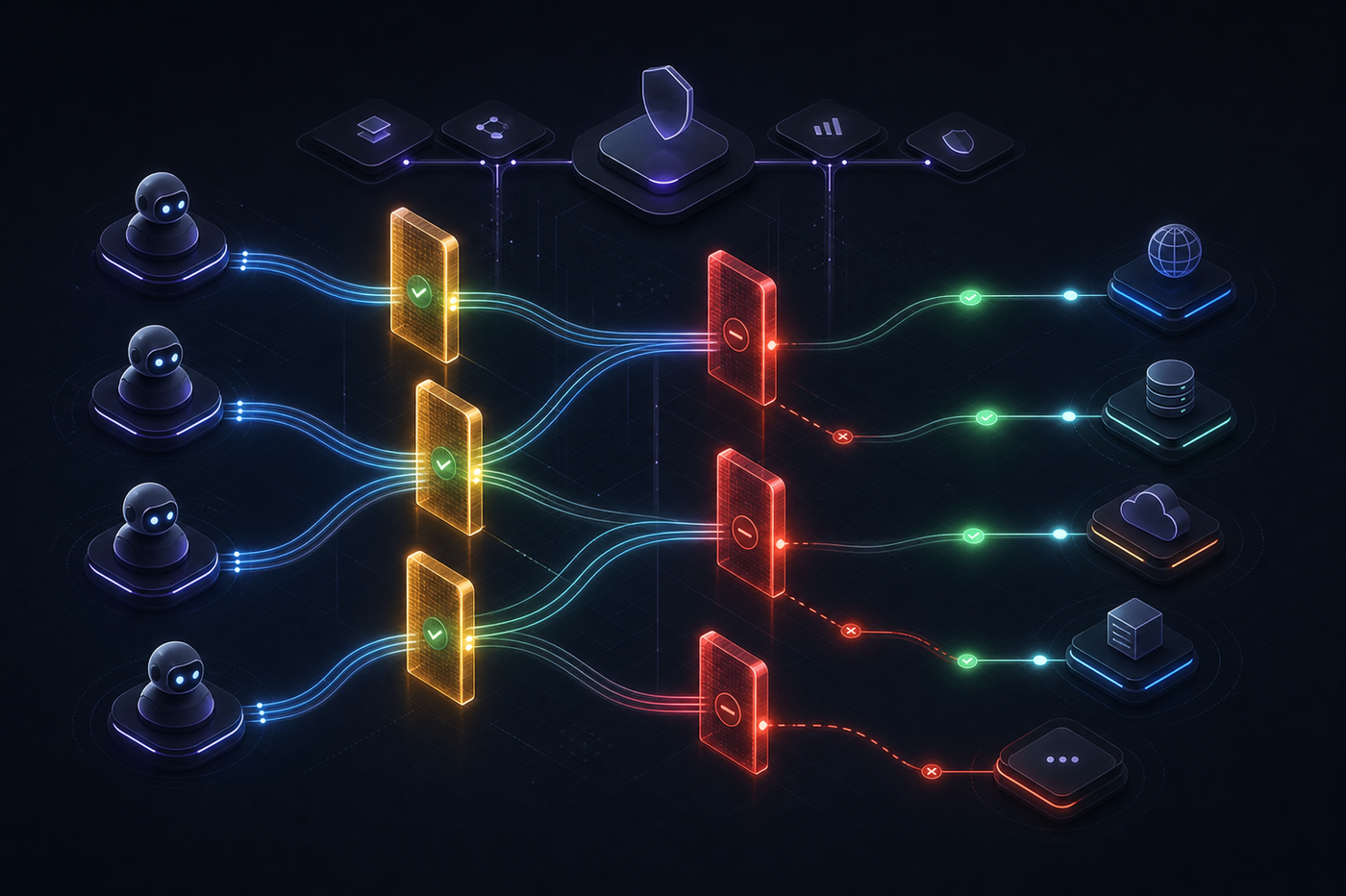
Tool calling fails in production in several distinct ways: a call can be rejected or fail validation before it ever runs, or a call can execute partway and leave the system in an altered state. A call can also complete and carry out a harmful action, and once that happens, the production state has already changed before any post-hoc review can occur.
Agentic governance requires three controls that standard LLM monitoring doesn't provide:
- Tool call authorization with explicit allow lists: suspend execution if the tool is outside the agent's allowlist or its task-intent score falls below the approved cutoff. Document the scorer version and score meaning, and test the cutoff against labeled authorized and unauthorized examples for the use case. Record the agent ID, requested tool, score, and decision. A passing intent score does not replace the application's or tool service's pre-execution checks on arguments, resources, tenant data, and transaction limits.
- Sequence-level monitoring: individual step evaluation misses failure modes that surface only across a full execution path, so track tool calls, intermediate outputs, and state changes as a unit.
- Session replay and audit trails: sufficient context must be captured to reconstruct what an agent did, in what order, and why, including what arguments each tool received and what state it modified.
Logs support investigation and recovery after an unauthorized call has already run; they cannot prevent it. Pre-execution authorization, execution-time permissions, sandboxing, and transaction limits form layered controls applied before the call runs; a single inference-time check does not stand on its own.
Prompt injection and adversarial attack defenses
Prompt injection enters through two distinct routes. Direct injection arrives through user inputs. Indirect injection arrives through retrieved documents, tool outputs, or any external content that enters the context window before generation occurs. Screen every untrusted entry point with detectors validated for that input type.
Three controls cover these routes at different points in the request lifecycle:
- Input classification runs at the ingestion layer before the model sees the request. A dedicated input classifier scores the input; high-confidence injection patterns are blocked before any generation occurs.
- Retrieved chunk screening checks for indirect injection before chunks enter context. Openlayer flags chunks scoring above 0.85 and routes them to a secondary review path. Document the classifier version, score meaning, and cutoff calibrated on labeled benign and malicious examples. A hold-and-release policy is recommended design, not confirmed native behavior: keep flagged chunks withheld pending approval, exclude rejected chunks, and keep timed-out chunks withheld with a safe fallback or stopped request. Confirm which of these steps your workflow enforces natively.
- Output verification checks the final response against the original task specification and holds delivery when it detects an unexplained deviation. A normal-looking final response can still follow a harmful tool action taken mid-session, so pair output verification with pre-execution tool permissions and checks on intermediate steps. Output checks cannot undo an action that already executed.
Map each check to a specific path an attacker could use: untrusted inputs, retrieved documents, tool outputs, tool actions before execution, and outgoing responses. Test each path on its own and record any path left uncovered.
Human-in-the-loop controls for high-stakes decisions
Automated enforcement handles most policy violations without a human in the loop. The question is which decisions it should never handle alone.
Clinical recommendations, legal reviews, investment guidance, and benefits decisions may warrant human approval before delivery, but not every output requires a hold. The EU AI Act's Article 14 human oversight requirements call for measures proportionate to a high-risk system's risks, autonomy, and use context. Define which decisions need approval, who can approve them, and the legal or internal policy basis for each hold.
Two escalation modes apply, with meaningfully different trade-offs:
- Soft escalation: the output passes through, but a policy flag routes it to a reviewer queue for post-delivery review. User experience is uninterrupted; risk mitigation is delayed. Appropriate for borderline outputs where the harm of holding is concrete, and the harm of delivery is marginal.
- Hard escalation: the output is held at the API boundary and routed to a named human reviewer before delivery. Delivery waits for approval, which gives the reviewer a chance to stop an unsafe output before anyone acts on it. Consider this safeguard when an error could cause irreversible harm, weighing the risk of delivery against the risk of delay. Make the hold mandatory where the applicable legal requirement or approved use-case policy calls for pre-delivery review; irreversible consequences alone do not create a universal legal requirement.
Hard escalation is auditable when the record captures the hold trigger (confidence score included when that's what triggered the hold), the routing policy, the named reviewer, and the timestamped decision with a justification. A missing justification leaves an incomplete oversight record and may count as a documentation failure, but it does not on its own prove the review never happened: check approval logs or linked review records before concluding a checkpoint was bypassed.
Confidence thresholds should be set per use case. A clinical recommendation system and a customer service bot face different harm floors; the confidence level that warrants a hold in one context may be appropriate for automated delivery in another.
Audit-ready evidence and regulatory compliance mapping
Structured, verifiable records let reviewers check what a control actually did; policy documents only state what should happen.
Capture per-request audit records at inference time: metric scores, breached thresholds, triggered policies, and timestamps. Exporting those records later does not itself weaken the evidence if timestamps, provenance, and integrity remain intact. A log reconstructed from memory needs corroboration and documented limitations. Evidence weight depends on the auditor and framework, not the export date alone.
An audit-ready evidence package requires four components:
- Per-request inference records with metric scores, triggered thresholds, and enforcement actions, timestamped at the moment of occurrence
- Compliance test results mapped to specific regulatory articles, not general framework categories
- Framework mapping across EU AI Act legal obligations, NIST AI RMF voluntary guidance, and ISO 42001 standard requirements, kept distinct by source, with each mapped item recording test status, evidence completeness, reviewer approval, and any outstanding gap separately; a passing test or a mapped item does not on its own settle an overall compliance assessment, which stays a separate accountable review
- Lifecycle documentation binding evaluation results to the tested system version, with the relevant model, prompt, dataset, and retrieval-configuration identifiers recorded, using hashes where available
An evaluation result with no traceable link to the deployed artifact can still show that testing happened, but it cannot on its own prove the tested version and the deployed version match. Where available, tie the record to an immutable artifact or commit reference, plus the provider's model and version identifiers and the relevant application, prompt, and retrieval configuration versions. Record any provider detail that isn't available as a traceability limit; don't assume a model-weight hash exists for every system. Identifiers narrow the gap but don't guarantee reproducibility on their own.
Enforcement artifacts provide evidence for the applicable Article 43 conformity assessment procedure; they do not replace that procedure or its documentation requirements. A timestamped record of a blocked unauthorized tool call shows that a control acted, but it is only one input to Article 9 risk management, which requires a continuous, iterative process and testing throughout the system's lifecycle. Likewise, records of evaluation cadence and threshold status support Article 72 post-market monitoring. Providers also need a documented monitoring system that collects and analyses relevant performance data throughout the high-risk system's lifetime, with a monitoring plan included in the technical documentation. Those records alone do not fulfill the obligation. Openlayer's runtime enforcement and automated evidence capture connect control actions to a continuous compliance evidence trail. Openlayer packages this evidence into framework snapshots that teams can export on demand for review and regulatory submissions, while the organization remains responsible for completing the applicable assessment, risk-management, and monitoring processes.
Turning oversight into a shared platform service
Decentralized governance programs share a common failure mode: when intake runs separately per team, evaluation thresholds vary by project, and the catalog does not reflect what's actually running in production, coverage gaps become harder to see. A compliance posture can look complete from above while individual systems slip past review underneath.
Making oversight a shared service means three things.
- Risk-based intake: configure automated gates for low-risk systems where policy permits. For high-risk systems, require N approvals from M eligible reviewers, a pattern Openlayer supports through configurable N-of-M sign-offs at the lifecycle-stage and framework-rule level. Mandatory-role sign-offs (model owner, compliance, and legal, with security and privacy added as needed), promotion holds on required-reviewer rejections or unresolved blockers, and escalation of disputes and overdue reviews to a named governance lead are recommended policy design. Define them in your governance process, check which ones your workflow configuration enforces natively, and never default to automatic approval. Keep routing rules in the framework configuration.
- Role-based routing with captured decisions: distributed review only works when every decision carries a named actor, a timestamp, and a recorded rationale. A compliance officer clearing a fairness review and a security lead approving tool call scope are different sign-offs on the same system; both must appear as discrete artifacts in the audit trail, not collapsed into a single approval event.
- Policy-as-code for behavioral rules: topic blocking, output format requirements, and confidence thresholds should live in version-controlled logic that executes at inference time, not in documentation that describes what rules should exist. Policy changes are tied to commits, timestamps, and authors, and can be validated against held-out prompt sets before deployment. When a policy change ships, the audit trail records who authored it, when it was merged, and what it replaced.
How Openlayer puts enterprise AI oversight into practice
Enterprise AI oversight needs complementary controls: documentation sets policy, logs preserve evidence, and alerts prompt action. Documentation and logging alone cannot stop an unsafe output before delivery. Runtime controls block, redact, or route outputs for review; recovery may still be needed after harm occurs. Openlayer unifies AI governance and risk management through active runtime enforcement at the API boundary and automated compliance mapping, built on a foundation of evaluation and observability.
Openlayer's centralized AI system registry tracks vendor-built, internal, embedded, and research models, recording owner, use case, risk level, approval status, lifecycle stage, and model versions, with regulatory obligations and monitoring status as additional fields configurable at setup. Configurable intake scoring routes higher-risk systems through stricter approvals. Required fields and approvals block production only when an organization-approved policy is enforced through a connected deployment or lifecycle gate. Registration alone cannot stop deployments outside that gate. The LLM Gateway captures traffic routed through it and flags any system missing from the inventory. Unregistered models surface in the governance layer without a registration form, and configured guardrails apply to their traffic whether or not a team registered the system first. Coverage is limited to traffic that actually routes through the gateway.
From there, over 175 pre-built tests cover accuracy, safety, and security dimensions. For agentic systems, 13 session-level metrics track quality, coherence, task progression, and cost across full conversation sessions. Built-in governance frameworks map test results to each framework's requirements and guidance, and compliance snapshots export on demand as structured evidence packages for review.
At the enforcement layer, five discrete actions are configurable per policy rule: allow with logging, warn, block, redact, and escalate. Each executes at the API boundary before outputs reach end users, and each configured action records its outcome, applicable metric scores, the triggered policy rule, and a timestamp, recording any breached threshold when it applies.
The scope of regulations can extend beyond expectations. Under Article 2 scope rules, non-EU providers placing AI systems or general-purpose AI models on the EU market, or putting AI systems into service there, must meet applicable requirements. Non-EU providers and deployers also fall within scope when their AI system's output is used in the EU.
Engineers need evaluation depth, drift detection, and CI/CD integration. Production traffic reaches enforcement through the managed LLM Gateway or through native integrations that route requests to the API boundary. Compliance officers need a dedicated AI compliance toolkit for framework mapping and portfolio-wide visibility without requiring a developer to run queries. Openlayer's executive dashboard surfaces compliance status and governance metrics across the entire organization in one view. Shared audit records support both engineering investigations and compliance reviews.
Final thoughts on closing the gap between AI policy and enforcement
Enterprise AI oversight connects a complete inventory, risk-based lifecycle controls, and production monitoring to accountable action. Each guardrail must execute its configured response: allow with logging, warn, block, redact, or escalate, and record the outcome. Blocking rules must stop delivery; other actions serve different risk-management purposes. Talk to the Openlayer team about connecting runtime enforcement to your oversight program.
FAQ
How do I govern AI systems that use retrieval-augmented generation in production?
Monitor retrieval relevance, evidence coverage, and generation faithfulness separately. Faithfulness can pass with irrelevant or incomplete context; coverage checks need reference evidence or labeled benchmarks. Set retrieval alert thresholds and screen chunks for injection before they reach the model. Openlayer flags chunks scoring above 0.85 and routes them to a secondary review path. Document the classifier version, score meaning, and approved cutoff tested against benign and adversarial examples. Treat the following as recommended design, not confirmed native behavior: define a hold policy where approval releases a flagged chunk, rejection excludes it, and timeout keeps it withheld with a safe fallback or stopped request. Screening reduces exposure but cannot catch every injection attempt.
How do I build a multi-agent system governance framework for production deployments?
Combine tool call authorization, sequence-level monitoring, and session replay. Pair tool allowlists with a versioned task-intent scorer whose meaning and approved cutoff are tested against labeled authorized and unauthorized requests. Before execution, check arguments, resources, tenant access, and transaction permissions: a passing intent score does not authorize an action. Track tool calls, intermediate outputs, arguments, and state changes across the full execution path. Audit trails support investigation but cannot undo executed actions; use pre-execution authorization alongside execution-time permissions, sandboxing, and transaction limits.
How do I implement human-in-the-loop controls for AI systems making high-stakes decisions?
Set human-review triggers by use-case risk, harm from delay, and applicable law or internal policy; high-stakes uses do not universally require holds. Hard escalation holds an output at the API boundary for a named reviewer's approval. Soft escalation delivers it and flags it for later review. Record the hold trigger, confidence score when applicable, routing policy, reviewer, timestamped decision, and rationale. A missing rationale leaves an incomplete oversight record, not proof that review was skipped.
Openlayer vs. Credo AI and IBM watsonx.governance for enterprise AI oversight: which covers production enforcement?
Openlayer connects AI governance to runtime blocking, redaction, and automated compliance mapping across supported AI workflows. Continuous testing and monitoring provide evidence of control performance beyond periodic assessments or self-reported status. Credo AI's Agent Governor describes pre-action enforcement but remains a research preview with limited integrations. IBM watsonx.governance documents blocking and PII masking through Python integration. The distinction is production readiness and coverage: compare generally available controls, supported integrations, and runtime records showing what those controls did, not feature announcements alone.
How do I build a complete AI system inventory that satisfies EU AI Act Article 9 and NIST AI RMF accountability requirements?
Record each system's origin, named owner and contact, intended use, risk tier, data sources, lifecycle stage, and applicable regulatory categories. Include vendor-built, internal, embedded SaaS, and research systems. Check for shadow AI across unregistered fine-tuned models, third-party LLM integrations, and business tools processing regulated data. Missing required documentation can itself be a compliance failure, even when technical controls exist. A complete inventory supports enterprise AI oversight; it does not alone prove compliance.