High-Risk AI Model Evaluation Guide (July 2026)
The EU AI Act moved faster than vendors anticipated, and high-risk system providers are now facing binding obligations with evaluation requirements that go deeper than what most teams built during initial deployment. If your system makes decisions about people in employment, credit, or benefits, you need model evaluation for high-risk AI systems that satisfies EU AI Act conformity assessment under Article 43. That means accuracy, fairness, and robustness testing before deployment, plus ongoing post-market monitoring that tracks demographic parity gaps, prediction drift, and incident escalation within the 15-day window Article 72 requires. The August 2, 2026 enforcement deadline for financial services is eight weeks away, and the teams that deferred this work are behind on documentation and accumulating exposure in the tier where regulators have the clearest enforcement mandate.
TLDR:
- High-risk AI systems under the EU AI Act include employment screening, credit scoring, and biometric ID tools that materially shape decisions about individuals.
- Article 10 makes bias testing a legal requirement: flag demographic parity gaps exceeding 5 percentage points before deployment.
- Drift detection is mandatory post-deployment under Articles 61 and 72, with serious incident reports due within 15 days.
- Non-compliance carries fines of €15 million or 3% of global turnover for high-risk systems, with August 2026 enforcement deadlines closing fast.
- Openlayer enforces behavioral thresholds at runtime and generates audit-ready records that map to Annex IV conformity requirements.
What Qualifies as a High-Risk AI System Under the EU AI Act
The EU AI Act sorts AI systems into risk tiers, and the classification decision has direct consequences for what evaluation, documentation, and oversight your system must produce before it can legally deploy.
High-risk systems fall into two main buckets.
The first is systems explicitly listed in Annex III of the Act. These cover eight sectors where AI-driven decisions carry material consequences for individuals:
- Biometric identification and categorisation of natural persons
- Management and operation of critical infrastructure (water, gas, electricity, transport)
- Education and vocational training (access decisions, assessments)
- Employment and worker management (recruitment, promotion, task allocation, performance monitoring)
- Access to critical private and public services, including credit scoring and insurance risk assessment
- Law enforcement (risk assessment, evidence evaluation, predictive policing)
- Migration, asylum, and border control management
- Administration of justice and democratic processes
The second bucket covers AI systems embedded as safety components in products already regulated under existing EU product safety legislation, such as medical devices and machinery.
One classification edge worth knowing: not every system that touches an Annex III domain automatically qualifies as high-risk. The Act includes a filtering provision that exempts systems where the AI output is purely preparatory and a human makes the consequential decision independently. But that exemption is narrow, and regulators interpret it that way. If your system scores, ranks, or recommends in a way that materially shapes a downstream decision about a person, high-risk classification almost certainly applies.
| EU AI Act Article | Evaluation Requirement | Evidence Artifact | Implementation Approach |
|---|---|---|---|
| Article 9 | Continuous risk management system across lifecycle | Risk assessment records, mitigation measures, post-deployment monitoring logs showing ongoing risk evaluation | Automated drift detection with threshold-based alerts; documented escalation protocols; quarterly risk reassessment cycles |
| Article 10 | Training data quality and bias testing across protected groups | Demographic parity test results showing gaps below 5 percentage points; data representativeness audit records; preprocessing documentation | Pre-deployment fairness test suites disaggregated by gender, race, age; intersectional bias detection; CI/CD gates blocking deployment when parity gaps exceed thresholds |
| Article 15 | Accuracy, robustness, and cybersecurity standards | Benchmark results across representative test sets; adversarial test results; penetration test records; documented accuracy thresholds | Accuracy floors enforced at deployment (e.g., 85% groundedness minimum); adversarial robustness testing including prompt injection and data poisoning scenarios; runtime guardrails |
| Articles 61 & 72 | Post-market monitoring and serious incident reporting | Continuous performance tracking logs; drift detection records; incident reports submitted within 15 days of serious incidents | Real-time monitoring of prediction drift, data drift, and fairness drift; automated threshold breach alerts; incident escalation workflows with regulatory notification triggers |
| Article 43 | Conformity assessment before market placement | Complete Annex IV technical documentation; conformity assessment record; EU Declaration of Conformity; EU database registration | Versioned evaluation records linked to model artifact hashes; immutable audit trail from testing through deployment; automated documentation completeness checks in CI/CD pipeline |
Article 9: Continuous Risk Management Throughout the AI System Lifecycle
Article 9 of the EU AI Act requires providers and deployers of high-risk AI systems to run a documented risk management system across the full lifecycle, from initial design through decommissioning. This is not a one-time pre-deployment checklist. It is an ongoing process that must produce evidence at every stage.
The practical obligations break down into four areas:
- Identification and analysis of known and foreseeable risks associated with the intended purpose, including reasonably foreseeable misuse scenarios where outputs could harm individuals or groups.
- Estimation and evaluation of risks that may arise from use in real-world conditions, accounting for the cumulative effect of incremental model or data changes over time.
- Adoption of risk mitigation and control measures, with residual risk documented and accepted by an accountable owner before deployment proceeds.
- Post-deployment monitoring feeding back into risk analysis, so that new failure modes observed in production trigger a reassessment instead of waiting for the next scheduled review cycle.
The lifecycle framing matters because model behavior drifts. A system that passed its pre-deployment evaluation six months ago may be operating outside its original risk envelope today due to data distribution changes, upstream API changes, or population-level behavioral changes in the users it serves. Article 9 treats that drift as a compliance event beyond an engineering concern, which means teams need monitoring infrastructure that generates audit-ready records, beyond live dashboards that alert on degradation.
Article 10: Training Data Quality and Bias Testing Requirements
Article 10 of the EU AI Act sets binding requirements on the data used to train, validate, and test high-risk AI systems. Training datasets must be relevant, representative, and free from errors that could produce discriminatory outcomes. For any system that touches employment decisions, credit scoring, or benefits determination, this is where bias testing becomes a legal obligation beyond an engineering preference.

There are three distinct testing categories teams need to cover:
- Demographic parity testing across protected groups (gender, race, age, nationality): measure the difference in positive outcome rates between groups and flag for review when that gap exceeds 5 percentage points (a common industry baseline, though the Act does not specify a numeric threshold). For example, a loan approval model should produce selection rates within 5 percentage points across racial groups before deployment is approved.
- Intersectional bias detection across combined attributes: a model may appear fair when gender and age are tested separately but produce discriminatory outcomes for women over 50. Single-attribute testing alone will miss these failure modes.
- Data representativeness auditing against the intended deployment population: if a hiring model is trained on historical data from a workforce that is 80% male, the training set itself encodes the imbalance it is supposed to avoid.
Documentation requirements under Article 10 are specific. Teams must produce records of data sources and collection methods, preprocessing decisions and their rationale, known limitations in the training data, and the results of bias tests conducted before deployment. These records supply the technical documentation that Article 43 conformity assessments draw on directly.
Article 15: Accuracy, Robustness, and Cybersecurity Standards
Article 15 sets the technical baseline for high-risk AI systems, covering three interconnected requirements: accuracy, robustness, and cybersecurity. Each carries specific obligations that teams need to translate into testable evaluation criteria.
Accuracy under Article 15 means the system performs at declared levels across its intended use cases, with performance metrics documented in Annex IV technical documentation. Robustness requires the system to handle reasonably foreseeable misuse, edge cases, and input perturbations without producing harmful outputs. Cybersecurity obligations cover resistance to adversarial attacks, including data poisoning and model inversion.
What This Looks Like in Practice
For each requirement, there is a corresponding evaluation artifact auditors expect to see:
- Accuracy: benchmark results across representative test sets, disaggregated by subgroup where the system affects protected classes, with pass/fail thresholds defined before testing begins instead of tuned to results after the fact.
- Robustness: adversarial test suites covering input perturbations, out-of-distribution inputs, and edge cases the system will plausibly encounter in deployment; failure mode documentation for each category.
- Cybersecurity: threat modeling records, penetration test results, and documented controls against known attack vectors such as prompt injection for LLM-based systems or data poisoning for systems retrained on user-generated input.
The practical gap most teams hit is treating these as one-time pre-deployment checks. Article 15 obligations apply continuously, meaning the post-market monitoring plan in Annex IV must include how these metrics are tracked after launch and what threshold breach triggers a re-evaluation event.
Article 61 and Article 72: Post-Market Monitoring and Drift Detection
Post-deployment obligations under the EU AI Act are where many compliance programs fall short. Articles 61 and 72 require providers and deployers of high-risk AI systems to maintain active post-market monitoring: collecting performance data after deployment, tracking incidents, and submitting reports to national authorities within 15 days of serious incidents.
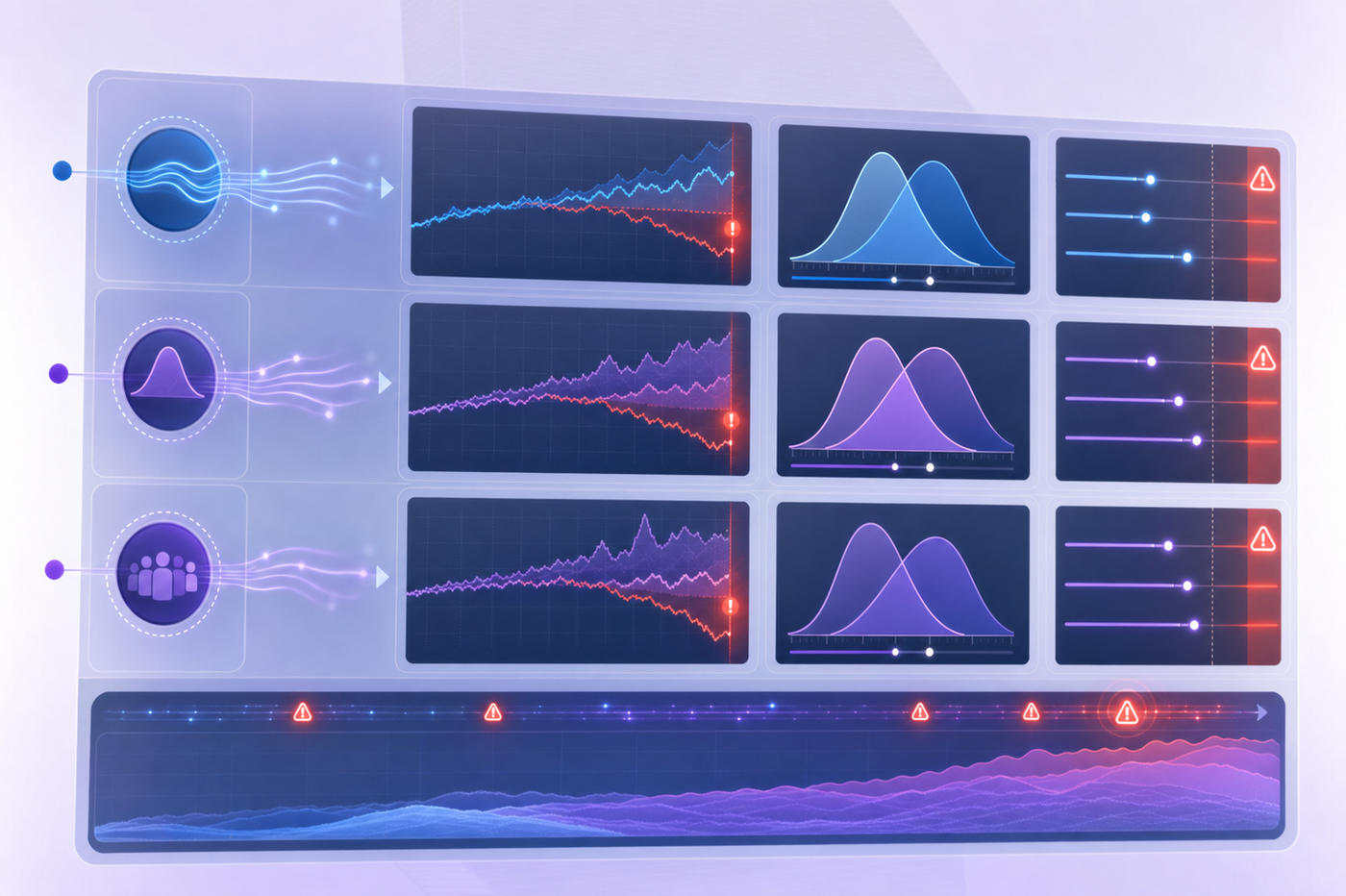
For model evaluation purposes, drift detection is a regulatory requirement, not an engineering best practice. When a credit scoring model's demographic parity gap widens beyond approved thresholds, or a medical imaging classifier's accuracy degrades against the live population it was validated on, those changes must be caught, documented, and escalated through a defined process.
Three monitoring signals matter most here:
- Prediction drift: the model's output distribution moves relative to its pre-deployment baseline, indicating the model may be operating outside its validated scope.
- Data drift: the incoming feature distribution diverges from the training distribution, often the leading indicator of downstream performance degradation before ground truth labels are available.
- Fairness drift: demographic parity gaps, equalized odds violations, or disparate impact ratios move beyond approved thresholds, triggering the review and escalation procedures required under Article 9's ongoing risk management obligations.
Each signal requires a threshold, an owner, and a documented response protocol. A monitoring setup that detects drift but has no defined escalation path does not satisfy Article 72's post-market monitoring requirements.
Article 43: Conformity Assessment Procedures Before Market Placement
Before a high-risk AI system reaches the market, providers must complete a formal conformity assessment under Article 43. This is the procedural gate that separates internal development from lawful deployment, and the documentation your team has built throughout evaluation becomes the evidentiary record that either passes or fails that gate.
There are two routes through Article 43, depending on system type.
For most high-risk systems, providers conduct an internal conformity assessment. The provider reviews their own technical documentation, risk management records, and evaluation results against the requirements in Annex I and Annex III. No third-party auditor is required, but the record must be complete enough to satisfy a national authority inspection on demand.
For high-risk systems in higher-stakes domains, such as biometric identification or safety components in critical infrastructure, Article 43 requires a third-party conformity assessment body to review the documentation before deployment is permitted.
In either case, the artifacts that satisfy Article 43 are specific:
- Technical documentation meeting Annex IV requirements: system architecture, training data description, data governance practices, performance metrics across accuracy and robustness dimensions, known limitations, and foreseeable misuse scenarios
- A completed conformity assessment record showing which internal control procedures were followed and what test results confirmed conformity
- A signed EU Declaration of Conformity, naming the authorized representative and citing the specific Annex III provision that classifies the system as high-risk
- EU database registration, including provider identity, intended purpose, risk classification, and conformity assessment body if a third party was involved
What auditors actually inspect is the chain of traceability from evaluation results to conformity claim. A conformity assessment record that asserts compliance without linking to the underlying evaluation artifacts, metric scores, and pass/fail records is not a complete artifact. It is an open gap.
Mapping Evaluation Tests to EU AI Act Evidence Requirements
Each evaluation test your team runs should produce a traceable artifact that satisfies a specific EU AI Act evidence requirement. The mapping is not automatic, so building it deliberately before deployment saves substantial rework during conformity assessment.
There are four primary evidence categories auditors inspect for high-risk systems, and each one pulls from a different class of evaluation output.
- Technical documentation (Annex IV): Accuracy, robustness, and fairness test results, including pass/fail records, metric scores, and the thresholds that triggered review, populate the performance section of Annex IV documentation. A groundedness score logged at 0.83 against a deployment floor of 0.85 is evidence; a summary statement that "the model passed testing" is not.
- Conformity assessment record (Article 43): Structured test suites with versioned inputs, expected outputs, and model version hashes supply the conformity evidence auditors expect. Each test run should be tied to the exact model artifact that generated it, retrievable from the model registry.
- Human oversight record: Logs showing that override capability was available and exercised during operation, alongside evaluation results that document where the model required human review, satisfy the human oversight documentation requirement.
- Post-market monitoring log: Drift detection results, demographic parity gap trends over time, and incident-triggered re-evaluation records feed directly into the ongoing monitoring log the Act requires after deployment.
The gap most teams encounter is that evaluation runs exist but are not structured as audit artifacts. A Jupyter notebook with metric outputs is not a conformity record. The same results, versioned, timestamped, linked to a model registry entry, and stored with a named owner, are.
Deploying CI/CD Gates to Enforce Compliance as Hard Requirements
CI/CD gates turn compliance from a documentation exercise into a hard requirement at the point of deployment. Every time a model artifact moves toward production, the pipeline runs a defined set of checks; if any check fails, the artifact does not advance. There is no manual override path without a documented exception.
Here is how a gate structure maps to EU AI Act obligations for high-risk systems:
- Technical documentation completeness: the pipeline checks that Annex IV fields are populated, including system architecture, training data sources, data governance practices, and known limitations. An incomplete record blocks the build.
- Bias and fairness thresholds: demographic parity gaps above 5 percentage points across protected groups trigger a hard failure. Equal opportunity gaps exceeding 3 percentage points above the baseline do the same. The gate does not pass until both metrics are within approved bounds.
- Groundedness and accuracy floors: for high-risk decision systems, groundedness scores below 85% block deployment. Accuracy metrics are checked against the performance floor declared in the conformity assessment record.
- Human oversight verification: the pipeline confirms that override controls are present and that the human oversight log template has been initialized. A system without a documented override mechanism does not pass.
- Registry registration check: the gate queries the EU database registration status. Unregistered systems are blocked at this stage, not flagged for follow-up.
The failure mode to plan for is gate circumvention, where teams push hotfixes or emergency releases through a bypass path that skips evaluation. Every bypass must write an exception record to the audit trail with the approving Model Owner, the Governance Lead sign-off, and a remediation deadline. Auditors will look for bypass frequency as a signal of governance maturity; a system that bypasses gates routinely is one that treats compliance as optional.
Penalties for Non-Compliance: Article 99 Enforcement Structure
The EU AI Act's fine structure operates on two tiers, and conflating them is a compliance planning mistake worth avoiding.
For high-risk system non-compliance, Article 99(3) sets penalties at €15 million or 3% of global annual turnover, whichever is higher. For the most serious violations, including prohibited AI practices, Article 99(6) raises that ceiling to €35 million or 7% of total worldwide annual turnover.
Two practical implications follow from this structure:
- Incomplete or missing technical documentation, absent conformity assessment records, and gaps in post-market monitoring logs all fall under the Article 99(3) tier. These are not minor administrative oversights; they are the specific artifacts auditors inspect first, and their absence triggers the enforcement mechanism directly.
- Systems that cross into prohibited practice territory, whether through unacceptable risk classification or material misrepresentation of capabilities, face the Article 99(6) tier. The fine ceiling nearly doubles, and the reputational exposure compounds it.
The August 2026 deadline for high-risk financial services obligations means the window for building defensible documentation is closing. Teams that have deferred conformity assessment work are behind on paperwork and accumulating exposure in the specific tier where regulators have the clearest enforcement mandate.
Frequently Asked Questions: High-Risk AI Evaluation Under the EU AI Act
What counts as a "high-risk" AI system under the EU AI Act?
High-risk systems are those listed in Annex III of the Act, covering areas like employment screening, credit scoring, biometric identification, and access to critical services. The classification hinges on the system's intended use and the decisions it informs, not its underlying architecture.
What does model evaluation need to cover for high-risk systems?
Evaluation must cover accuracy, robustness, cybersecurity, and fairness across demographic groups before deployment. Post-deployment, teams need ongoing monitoring with documented thresholds and incident reporting for serious failures within 15 days.
When does the August 2026 deadline apply?
High-risk system obligations under the EU AI Act become enforceable in August 2026. Non-compliance carries fines under Article 99(3) of up to €15 million or 3% of global annual turnover, whichever is higher. GPAI provider obligations were already enforceable as of August 2025.
What evidence do auditors actually review?
Auditors review technical documentation per Annex IV, conformity assessment records under Article 43, EU database registration entries, post-market monitoring logs, and human oversight records showing that override capability was available and functional during operation.
Does passing pre-deployment evaluation satisfy ongoing compliance?
No. The Act requires continuous post-market monitoring. A model that passes pre-deployment benchmarks but drifts in production without documented detection and response creates an open compliance gap, regardless of what the initial evaluation record shows.
Meeting EU AI Act Requirements with Openlayer
Openlayer is built for exactly the compliance and evaluation requirements high-risk AI systems face under the EU AI Act. Where governance tools like Credo AI and IBM watsonx cover policy documentation and risk classification, they stop before production. Openlayer adds active runtime enforcement: guardrails that block outputs before they leave the API boundary, automated fairness monitoring that flags demographic parity gaps exceeding 5 percentage points, and continuous groundedness scoring that suspends inference when scores fall below your defined floor.
The audit trail Openlayer generates is structured for conformity assessment from day one. Every evaluation run produces pass/fail records, metric scores, and flagged failure modes that map directly to Annex IV documentation requirements. When an auditor asks for evidence of human oversight measures, bias testing results, or post-market monitoring logs, those artifacts already exist in the registry without needing to be reconstructed after the fact.
Here is what that looks like across the three compliance stages:
- Pre-deployment: 100+ pre-built tests covering accuracy, robustness, and fairness run against the model before it reaches production. Results are versioned and linked to the model artifact hash in the registry, so the evaluation record is immutable and traceable.
- Deployment-time: Automated guardrails enforce behavioral thresholds in real time. LLM-as-a-judge scoring runs at 81.3% human correlation, giving teams a defensible, documented basis for output quality decisions instead of ad hoc review.
- Post-deployment: Continuous monitoring tracks 13 session-level metrics. Drift beyond approved thresholds triggers alerts; serious incidents surface for escalation within the timelines Article 99 requires.
Credo AI and IBM watsonx are strong choices for governance posture and policy frameworks. But policy documentation does not block a biased output at inference time. Openlayer is where the enforcement layer lives.
Final Thoughts on Evaluation Infrastructure for High-Risk AI Under the EU AI Act
Conformity assessment under Article 43 demands traceable evaluation records linking test results to deployment decisions. Post-market monitoring obligations under Articles 61 and 72 require drift detection with documented thresholds and escalation protocols. Most teams have deferred building this infrastructure, but the August 2026 enforcement deadline closes that window. Reach out if you need evaluation and monitoring tooling that produces the artifacts auditors expect without requiring a full rebuild of your governance stack.
FAQ
Can I use the same pre-deployment evaluation to satisfy ongoing EU AI Act compliance?
No. Article 9 requires continuous risk management across the full lifecycle, and Article 61 mandates active post-market monitoring. A model that passed pre-deployment benchmarks but drifts in production without documented detection and response creates an open compliance gap regardless of initial evaluation results.
Model evaluation for high-risk AI systems EU AI Act: what artifacts do auditors actually inspect?
Auditors review technical documentation per Annex IV (system architecture, training data description, performance metrics), conformity assessment records under Article 43, EU database registration entries, post-market monitoring logs with drift detection results, and human oversight records showing override capability was functional during operation. Each artifact must be traceable to the specific model version that generated it.
What's the difference between demographic parity testing and intersectional bias detection for high-risk systems?
Demographic parity measures outcome rate differences across single protected attributes (gender, race, age) and flags gaps exceeding 5 percentage points. Intersectional bias detection tests combined attributes simultaneously: a model may appear fair when gender and age are tested separately but produce discriminatory outcomes for women over 50. Single-attribute testing alone misses these failure modes.
How do CI/CD gates enforce EU AI Act compliance as hard requirements instead of recommendations?
Gates run defined checks before any model artifact advances to production: Annex IV field completeness blocks builds with missing documentation, demographic parity gaps above 5 percentage points trigger hard failures, groundedness scores below 85% block deployment, and unregistered systems are stopped at the registry check. Every bypass requires a documented exception with named approver and remediation deadline in the audit trail.
When does Article 72 post-market monitoring require incident reporting to national authorities?
Serious incidents involving high-risk AI systems must be reported to national authorities within 15 days. For healthcare AI, any incident where a model output influenced a care decision that resulted in patient harm or a near-miss should be treated as reportable pending legal review, even if the threshold appears unclear.