LLM Pipeline PII Detection and Enforcement (September 2026)
If your PII detection runs at the output layer, you're catching what the model wrote back to the user. You're probably missing what the agent wrote into a database query two steps before that. For pii detection llm pipelines, the structural challenge isn't spotting a well-formed SSN in clean text. It's knowing where in the pipeline a piece of data came from, what role it plays in that specific context, and whether it needs to be stopped before it crosses a boundary that logging can no longer undo.
TLDR:
- PII leaks through 4 distinct entry points in LLM pipelines: user input, RAG retrieval, tool call arguments, and model outputs.
- NER-based detection misses paraphrased PII, domain-specific identifiers, and cross-turn inference; context-aware detection is required.
- Tool call arguments are the agentic blind spot: PII travels through SQL queries and API payloads before any output-layer guardrail fires.
- GDPR fines reached €1.2 billion in 2025; documenting a PII policy satisfies none of these obligations if the pipeline still surfaces protected data.
- Openlayer intercepts tool call argument payloads before execution and blocks PII exposure at the pipeline stage where enforcement is still possible.
Why PII detection in LLM pipelines is a different problem
Traditional DLP tools were built around a simple premise: sensitive data travels through known channels in predictable formats. A Social Security number in a CSV field, a credit card in a payment record. Regex catches it, the system flags it, done.
LLMs break every assumption that premise relies on. They accept free-form text from users, pull unstructured content from retrieval systems, and generate responses that can surface sensitive information without any single input containing it in recognizable form. The pipeline is a series of probabilistic transformations where PII can enter, mutate, recombine, and exit in ways no pattern-matching rule anticipates.
The structural gap is real. PII detection in LLM pipelines has to be accurate and context-aware; pattern-based detection alone doesn't cut it, and most organizations are learning this after deploying, not before. A name in a query template is noise. The same name pulled from a retrieved customer record, combined with an account number the model inferred from conversation history, is a live leak. Detecting one requires knowing where in the pipeline the data came from and what role it plays in that specific context.
The four PII entry points in an LLM pipeline
LLMs leak PII through four distinct entry points, and a control that only covers one of them leaves the other three unguarded.
- User-supplied input: free-form prompts routinely contain names, phone numbers, policy IDs, and medical details. A customer support interface has no way of knowing in advance what a user will include.
- Retrieved documents in a RAG pipeline context window: retrieval pulls chunks from a knowledge base that may contain records about other users entirely. The model never asked for that PII; the retrieval system surfaced it.
- Tool call arguments in agentic flows: when an agent calls an external API or database, PII may travel inside the argument payload. Output-layer guardrails never see it because it exits through a tool invocation, not through the model's text generation step.
- Model outputs: the model can synthesize PII from context across multiple turns or retrieved chunks, producing a response that exposes information no single input contained in recognizable form.
Each entry point has a different owner in the pipeline architecture. Output scanning alone covers the last item on that list. Covering all four requires LLM guardrails positioned at ingestion, retrieval, tool execution, and generation.
Where NER-based detection falls short
Named Entity Recognition models are trained to spot entities in predictable formats. Production LLM traffic is not predictable.
False negatives let sensitive data through; false positives strip context the model needs to generate accurate responses. Both failure modes hurt, and NER-only detection runs into both regularly across these scenarios:
- Messy inputs: typos, abbreviations, and informal phrasing ("jsmith at corp dot com") break entity recognition that relies on clean surface forms.
- Domain-specific identifiers: policy IDs, employee numbers, internal account codes. No standard NER model covers these out of the box.
- Multilingual and mixed-context text: a support ticket in Spanish with an English name embedded in the middle; standard models miss the entity or misclassify its type.
- Long-range context sensitivity: a user mentions their name in turn one, and the model surfaces it in a generated response in turn seven. No single span contains a recognizable entity at the moment of output.
- Paraphrased PII: "the patient described earlier" or "the account referenced above" carries identifying information without containing any named entity.
- Tool call arguments: NER runs on text. Tool call payloads are structured data (JSON fields, query parameters) that most NER pipelines never inspect.
- Inference-sourced exposure: an LLM combining age, condition, and location across retrieved chunks can identify a person without any source chunk containing a name.
The ceiling of NER-only detection is sequential text with well-formed entities. Anything outside that boundary requires a different approach.
What context-aware PII detection actually means
The difference is not what a token looks like. It is what role that token plays, given everything surrounding it.
"John Smith" in a system prompt template is a placeholder. "John Smith" pulled from a retrieved customer record and echoed back in a response is a live disclosure. Regex sees two identical strings. Context-aware detection sees two different situations.
The same logic applies to indirect exposure. An account number never appears verbatim, but a response combining a customer's name from turn one, their product tier from a retrieved chunk, and a transaction amount from turn three can effectively identify and expose that individual. No single span triggers a pattern match. The combination does the damage.
Context-aware detection scores a span against the pipeline state that produced it: where it came from, what session history preceded it, and what semantic role it plays in the output. That scoring step is what separates detection that understands PII from detection that merely spots it.
For that to work, the detection layer needs access to at least three things: the source of the content (user input, retrieval, tool call return, model generation), the surrounding session context, and a semantic model capable of classifying intent instead of surface form. A phrase like "the patient described above" contains no named entity, but in context it refers to a specific individual whose details are already recorded in the session. A detection system without session memory treats it as clean text.
The three-tier detection architecture
Three tiers apply here, each occupying a different position on the tradeoff curve between cost, coverage, and enforcement.

Deterministic detection
Regex, keyword blocklists, and entity checks run fast and cheap. This tier works well for well-formed identifiers: SSNs in standard format, credit card numbers with consistent structure, email contacts. But the ceiling is surface form. Paraphrased PII, inference-sourced exposure, and domain-specific identifiers all slip through. Useful as a first pass; insufficient as a complete layer.
Semantic detection
Embedding similarity, LLM-based scoring, and classifier models assess meaning over surface form. This tier catches what deterministic detection misses: "the patient described earlier," obliquely referenced account numbers, combinations of attributes that identify someone without naming them. The tradeoff is latency and cost. Configurable sampling helps, but false negative rates only drop here at the expense of throughput.
Real-time enforcement at the API boundary
This is the only tier that prevents leakage. The first two tiers detect. This one blocks. An output flagged by semantic detection still reaches the user or downstream system unless a guardrail stops it before delivery. Logging a PII violation after it exits is observation; blocking delivery before it exits is enforcement. In agentic pipelines, a tool call argument carrying PII executes before any output-layer check sees it, making upstream interception at the tool invocation layer the only enforcement point that actually applies.
The practical architecture combines all three: deterministic detection runs first for speed, semantic detection handles what deterministic misses, and the enforcement layer acts on both signals before flagged content crosses the API boundary.
The agentic blind spot: PII in tool call arguments
When a guardrail sits at the output layer, it sees what the model wrote back to the user. It does not see what the agent wrote into a database query three steps earlier.
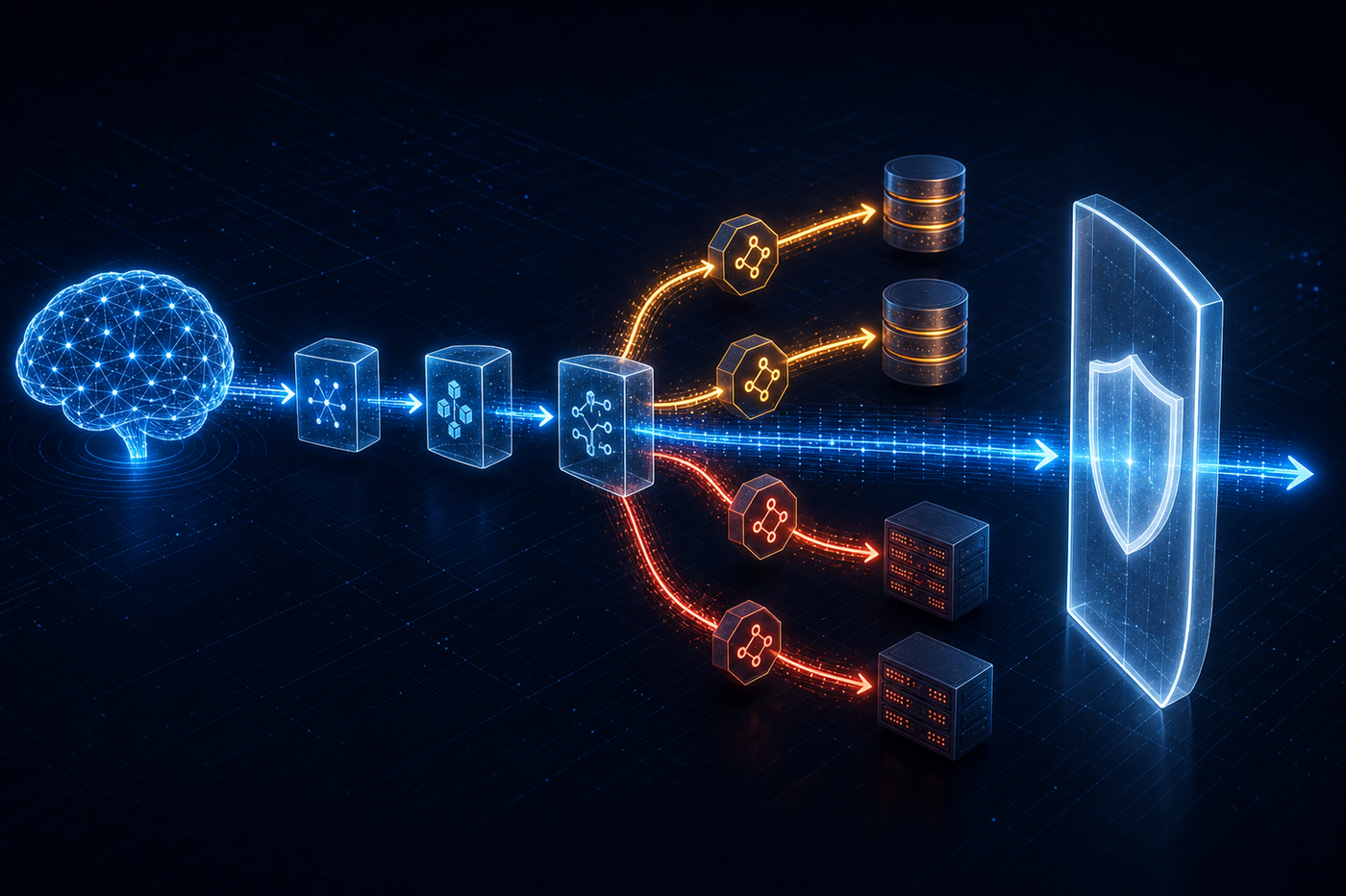
In agentic pipelines, tool-calling errors and propagation are execution events, not text generation events. A name extracted from a user message, or an account number surfaced from a retrieved document, can travel directly into a SQL query argument, an API POST body, or an external service call. The model never echoes it as output. The output-layer guardrail never fires. The data has already moved.
The structural failure is architectural. Most PII detection is wired to the text generation path. Tool call arguments are structured payloads, dispatched before any output exists to scan. By the time a response reaches the enforcement layer, the PII has already been written to an external system or passed to a downstream process with no record that it happened.
What makes this worse is the audit gap. Without AI agent observability, a leak through a tool argument payload leaves nothing behind by default in most pipeline implementations. No log of what argument values were passed. No record that a health identifier traveled through a CRM write call.
Closing this blind spot requires inspection at the tool invocation layer, before the call executes. That means intercepting the argument payload, running PII classification against structured field values, and blocking or redacting the call when sensitive data is present. Output scanning does not reach the point where the action happens.
Masking and Redaction Strategies
Detection finds the problem. What happens next determines whether the model stays useful.
Four options exist once PII is flagged, and each trades coverage against output quality differently:
- Full redaction removes the span entirely. Clean for compliance, but the model loses context it may need to generate a coherent response. A customer support agent that can no longer reference the account in question produces shallow, generic answers. False positives here degrade quality fast.
- Placeholder substitution replaces the span with a typed label:
[PERSON],[ACCOUNT_ID],[PHONE]. The model retains structural context about what kind of entity was present without seeing the actual value. Works well when the entity type matters more than the specific value. - Pseudonymization replaces the real value with a consistent fictional one: "John Smith" becomes "User_4821" throughout the session. The model can reason coherently across turns, and the original value stays recoverable if a reversible token map is maintained. Useful in analytics and logging contexts where downstream processing needs relational consistency.
- Selective masking strips only the identifying fragment and preserves surrounding context. "Please update the policy for John Smith, account 8847" becomes "Please update the policy for [PERSON], account [ID]." The instruction stays parseable; the PII does not cross the boundary.
The right choice depends on whether the model needs the value, the type, or neither. Aggressive redaction in a RAG pipeline that retrieves customer records will tank response quality on exactly the queries the system was built for. Removing too much context causes models to hallucinate or produce shallow answers, while missing a single entity creates compliance exposure.
Compliance obligations that drive detection requirements
Three major regulatory frameworks drive the technical requirements your detection architecture has to satisfy.
| Framework | Core PII obligation | Technical requirement |
|---|---|---|
| GDPR | Lawful basis for processing; data minimization | Detect and block PII before it enters unauthorized processing contexts; pseudonymize where purpose doesn't require the original value |
| HIPAA | PHI protection in any system touching patient data | Inspect inputs, retrieval context, and tool call arguments for PHI before storage or transmission |
| CCPA | Right to deletion; disclosure of categories collected | Log what PII categories were processed per session to support deletion and disclosure requests |
| EU AI Act high-risk AI systems Article 10 | Data governance for high-risk systems | Detect PII in training and evaluation pipelines; enforce data minimization before fine-tuning runs |
The fine exposure is real. DLA Piper's 2025 GDPR enforcement survey found European regulators issued €1.2 billion in penalties in 2024, with the two-tier penalty structure reaching €20 million or 4% of global annual turnover for unlawful data processing.
What each framework requires technically is narrower than the compliance literature implies. GDPR's data minimization principle means your retrieval layer should not surface PII unnecessary for the specific query. HIPAA's minimum necessary standard means PHI should be stripped from retrieved chunks before those chunks enter the context window. EU AI Act Article 10 requires PII detection across training and evaluation datasets before a fine-tune runs.
Documenting a PII policy satisfies none of these obligations if the pipeline still surfaces protected data in outputs. Regulators look at what the system did, not what the policy said it would do.
Testing and validating your PII detection pipeline
Build your test corpus around the cases that break naive detection, beyond well-formed PII in predictable positions:
- Obfuscated formats: "j dot smith at company dot com," spaces inserted into phone numbers, SSNs with dashes replaced by spaces
- Synthetic PII in plausible context: generated names paired with realistic account numbers, physical locations, and health identifiers that exercise the full detection surface without touching real data
- Cross-turn leakage: multi-turn sequences where PII introduced in turn one surfaces indirectly in turn five via model synthesis
- Domain-specific identifiers: internal policy IDs, employee numbers, or patient MRNs that standard models miss
- Tool call payloads: structured JSON arguments carrying PII fields that text-based detection never sees
Tracking the right failure modes
Measure false negative rate and false positive rate separately. A false negative is an undetected PII exposure crossing the boundary: compliance exposure, regulatory liability. A false positive is useful context stripped from the model: degraded response quality, hallucinations on the queries the system was built for.
The acceptable tradeoff between these rates is not universal. A healthcare system handling PHI tolerates almost no false negatives. A general-purpose assistant tolerates very few false positives before users stop getting useful answers. Set that tradeoff explicitly before deployment, document the rationale, and treat it as a threshold the pipeline must maintain, not a one-time calibration decision.
Monitoring PII Leakage in Production
Pre-deployment detection catches the PII categories you planned for. Production monitoring catches what changed after you shipped.
User input distributions shift. A support chatbot launched for general queries starts receiving medical details when a new product line rolls out. A RAG corpus gets a document upload that includes employee records. New document types enter retrieval without a schema review. Each scenario introduces PII categories the original detection configuration was never calibrated for.
Effective production monitoring requires three things: a drift signal on PII category distribution, alerting thresholds tied to false negative rate instead of raw volume, and an audit trail that satisfies what a regulator will actually inspect.
Drift signals to track
- PII category frequency per session: if "PHI-adjacent" entities appear in 2% of sessions at launch and climb to 18% after a corpus update, that shift is the signal. Category rate trends surface it; absolute counts hide it.
- False negative rate on sampled outputs: run a semantic classifier on a representative sample of production outputs and compare against the primary detection layer. Growing divergence signals the main layer is missing new surface forms.
- Tool call argument payload composition: flag when new structured field types appear in tool invocations that were absent in pre-deployment testing.
Audit Trail Requirements
A PII enforcement event log needs more than a timestamp and a flag. Regulators reviewing a GDPR or HIPAA audit trail will look for:
- The pipeline stage where detection fired (input, retrieval, tool argument, output)
- The entity type flagged and the enforcement action taken (redact, block, allow with log)
- The session and turn ID, so the event can be reconstructed in context
- The policy rule that triggered the action, traceable to a versioned policy definition
Logging a flag without the enforcement action is observation. The audit trail only satisfies regulatory requirements when it records what the system did in response, beyond simply what it found.
How Openlayer handles context-aware PII detection and enforcement
Openlayer is a unified evaluation, observability, and governance platform. Its context-aware PII detection operates on pipeline state, not surface form. It distinguishes a name in a query template from the same name pulled from a retrieved customer record, and blocks exposure before downstream systems see it. That distinction separates detection that understands a span's role in the pipeline from detection that merely pattern-matches against it.
The tool call argument interceptor closes the agentic blind spot. PII traveling through a database query argument or API POST body bypasses output-layer guardrails entirely. Openlayer intercepts argument payloads before execution, at the only point where enforcement is still possible before the write has already committed.
PII guardrails plug into a five-action enforcement taxonomy: allow with logging, warn, block, redact, and escalate. Each action generates continuous compliance evidence mapping to EU AI Act Article 10 data governance obligations and GDPR's lawful processing requirements. The audit record captures the pipeline stage where detection fired, the entity type, the enforcement action taken, and the policy rule triggered, all supporting automated AI compliance evidence that is versioned and traceable.
For pre-deployment validation, PII detection runs as a first-class test primitive across over 175 pre-built tests, enforced as CI/CD evaluation gates before a model promotes to production. That coverage continues in production monitoring, with drift signals on PII category frequency and false negative rate across sampled outputs.
Final thoughts on building PII controls into LLM pipelines
The structural reality is that output scanning covers one of four entry points, and tool call arguments carrying PII to external systems bypass it entirely by design. Your pipeline needs detection that understands what role a span plays given where it came from and what the session recorded before it, beyond whether it pattern-matches against a known format. That distinction between logging a violation after the fact and blocking it before the data moves is the difference between observation and enforcement. Talk to the Openlayer team about where your current detection leaves that gap open.
FAQ
Does Langfuse handle context-aware PII detection, or does it delegate that to third-party libraries?
Currently, Langfuse delegates runtime enforcement to third-party libraries like LLM Guard or NeMo Guardrails and does not enforce natively. That architecture keeps Langfuse on the observation side of the enforcement boundary: it can log a PII violation after the fact, but nothing in its native stack intercepts a tool call argument carrying a health identifier before it writes to an external system.
How do real-time guardrails block PII leakage before it reaches end users instead of just logging it?
Blocking happens at the API boundary before the output exits: the guardrail intercepts the flagged content and applies one of five enforcement actions (allow with logging, warn, block, redact, or escalate) before delivery. In agentic pipelines, output-layer guardrails never see tool call argument payloads; enforcement must sit at the tool invocation layer.
What is context-aware PII detection in LLM pipelines, and how does it differ from regex or NER-based approaches?
Context-aware PII detection scores a span against the pipeline state that produced it: where the content came from (user input, retrieval, tool call return, model generation), what session history preceded it, and what semantic role it plays in the output. This differs from matching surface patterns. Regex and NER-based detection fail on paraphrased PII ("the patient described above"), inference-sourced exposure where no single span contains a recognizable entity, domain-specific identifiers like policy IDs or MRNs, and structured tool call payloads that text-based pipelines never inspect.
Best way to catch PII leaking through agentic tool calls before it hits an external database?
The only enforcement point that works is inspection at the tool invocation layer, before the call executes, not at the output layer, which never sees structured argument payloads. A tool call interceptor classifies the argument payload for PII and blocks or redacts the call when sensitive data is present; by the time a generated response reaches an output-layer guardrail, a database write carrying a customer identifier has already committed.
How do GDPR, HIPAA, and EU AI Act Article 10 translate into specific technical requirements for PII detection in an AI pipeline?
Each framework imposes a distinct technical obligation: GDPR's data minimization principle means the retrieval layer should not surface PII unnecessary for the specific query; HIPAA's minimum necessary standard requires PHI to be stripped from retrieved chunks before they enter the context window; EU AI Act Article 10 requires PII detection across training and evaluation datasets before a fine-tuning run. In each case, documenting a PII policy satisfies nothing if the pipeline still surfaces protected data in outputs. Regulators look at what the system did, not what the policy said it would do.