Governing Copilot Studio, Agentforce & Low-Code AI (July 2026)
Low-code AI platforms like Microsoft Copilot Studio, Salesforce Agentforce, and ServiceNow Now Assist have a real governance problem. The tools are designed for speed, and speed tends to outrun oversight. A business analyst configures an agent, connects it to a CRM, and pushes it live without a risk classification, a monitoring threshold, or a documented behavioral baseline. Multiply that across departments and you have dozens of agents in production with no audit trail. Salesforce AI governance and Microsoft Copilot Studio monitoring controls cover access and data handling, but output quality, drift detection, and per-inference traceability are largely on you.
TLDR:
- Low-code AI agents built in Copilot Studio or Agentforce carry the same EU AI Act obligations as custom-built models, regardless of who built them.
- Both platforms stop at access and data-handling controls; neither tracks groundedness scores, hallucination rates, or behavioral drift after deployment.
- A Copilot Studio flow can execute without errors and still return a hallucinated answer, so behavioral monitoring requires four layers: input logging, output scoring, drift detection, and audit trail continuity.
- Cross-platform governance requires a shared risk taxonomy and behavioral thresholds set at the governance layer, not inside each tool's native settings.
- Openlayer connects to Copilot Studio and Agentforce at the API boundary, running evaluation, observability, and governance across every inference: scoring responses against 100+ pre-built tests, detecting behavioral drift against a deployment baseline, and writing each inference to an immutable audit log for EU AI Act conformity evidence.
Why low-code AI platforms create distinct governance gaps
Low-code AI builders like Microsoft Copilot Studio, Salesforce Agentforce, and ServiceNow Now Assist put AI agent creation in the hands of business users who have no ML background. That's the point. But it creates a governance gap that traditional AI governance frameworks weren't designed to handle.
There are three distinct failure modes worth naming here.
- Builders configure agents without visibility into what the underlying model will do at runtime, so there's no behavioral baseline before deployment.
- There's no native mechanism to log what the agent said, under what conditions, and whether it stayed within its configured scope.
- When something goes wrong, there's no audit trail connecting the output back to a configuration decision or a model version.
The organizations deploying these agents aren't off the hook from a compliance standpoint. EU AI Act obligations, Salesforce ai governance requirements under internal risk frameworks, and sector-specific rules around data handling apply regardless of whether a developer or a business analyst built the agent.
| Gap | Why It Happens | Compliance Risk |
|---|---|---|
| No behavioral baseline | Agents go live without pre-deployment eval | No evidence of conformity at deployment |
| Output logging absent | Low-code builders don't expose log config | Audit trail requirements go unmet |
| Drift goes undetected | No monitoring after launch | Gradual failure invisible until incident |
| Ownership unclear | Business user built it; IT didn't review it | Regulatory accountability is unassigned |
How Copilot Studio agents access data and systems
Copilot Studio agents connect to data and systems through a layered connector architecture. At the foundation, agents use Power Platform connectors, which fall into three categories, each with a distinct access profile and governance implication:
- Standard connectors reach public services like SharePoint Online, Outlook, and Dynamics 365 with no additional configuration required.
- Premium connectors access Salesforce, SAP, and SQL Server but require a per-user Power Apps license before they can be activated in an agent flow.
- Custom connectors wrap any REST API behind an OpenAPI definition, letting teams expose internal microservices or legacy systems to agent actions.
Beyond connectors, agents can invoke Power Automate flows to run longer sequences of business logic, call Azure Functions directly for compute-intensive tasks, and query Dataverse tables for structured organizational data.
Governance Implications
Each connection type carries a distinct data exposure profile. A Standard connector to SharePoint can surface documents containing PII, financial records, or regulated content depending on the site permissions the agent inherits. Premium and custom connectors extend that exposure to external systems where data residency, retention, and access logging may operate under entirely different policies than your Microsoft tenant.
The governance gap here is specific: Copilot Studio logs that a connector was called, but it does not log what data was returned or how the agent used that data in its response. Without output-level monitoring sitting downstream of the connector invocation, you have connector activity records but no behavioral baseline for what the agent actually produced from that data.
Microsoft Copilot Studio's native governance controls and their limits
Microsoft Copilot Studio ships with a set of built-in governance controls that cover the basics: content moderation filters, topic-level conversation policies, and integration with Microsoft Purview for data loss prevention. For organizations already running on the Microsoft 365 stack, these controls feel natural because they inherit tenant-level permissions and Entra ID identity management without additional configuration.
But the coverage stops at the policy layer. Copilot Studio does not monitor live agent outputs for behavioral drift, does not track whether a deployed copilot's responses are shifting over time, and does not generate audit-ready evidence of what the system produced and when. Admins can restrict what topics an agent will engage with, but they cannot set a groundedness score threshold, a toxicity probability ceiling, or a demographic parity gate that blocks or flags outputs before they reach end users.
There are three specific gaps worth naming here:
- No runtime output evaluation: topic restrictions govern what a copilot will attempt, but there is no mechanism to score the quality or safety of what it actually produces during a live session.
- No drift detection: if a connected knowledge source changes or a model update alters response behavior, Copilot Studio has no alerting mechanism tied to output quality degradation.
- No structured audit trail: Microsoft Purview captures data flows and access events, but it does not produce per-inference records showing input, output, model version, and applied policy at the time of generation.
These gaps matter most in regulated industries. A financial services firm using Copilot Studio to surface customer account information, or a healthcare organization using it for internal clinical guidance, faces EU AI Act and sector-specific obligations that require exactly the kind of per-inference traceability that Copilot Studio's native controls do not supply.
Agentforce governance: what Salesforce provides natively
Salesforce positions Agentforce as a production-ready agentic AI layer, and the platform does include several built-in governance hooks. But understanding what those hooks actually cover, and where they stop, matters before teams assume compliance is handled.
Out of the box, Agentforce provides:
- Role-based access controls that govern which users can build, deploy, or interact with AI agents, tied to Salesforce's existing permission architecture.
- Topic and action boundaries that limit what an agent can do within a defined scope, preventing agents from invoking actions outside their configured intent.
- The Einstein Trust Layer, which handles prompt defense, data masking for PII passed through LLM calls, and a zero-retention agreement with underlying model providers so inference data is not used for training.
- Audit logs capturing agent interactions within the Salesforce ecosystem, surfaced through standard org-level logging tools.
These controls are real and meaningful for access governance and data handling within the Salesforce boundary. What they do not cover is behavioral governance at inference time: whether agent outputs are accurate, grounded, demographically consistent, or drifting in quality over weeks of production use. The Einstein Trust Layer prevents PII from reaching the model; it does not measure whether the model's responses are factually correct or whether output quality has degraded since deployment.
Where Native Coverage Ends
Three gaps appear consistently when teams move Agentforce into regulated or high-stakes workflows:
- Output quality monitoring is absent. There is no native mechanism to track groundedness scores, hallucination rates, or response quality metrics across agent sessions at scale.
- Drift detection does not exist at the behavioral level. If an agent's outputs shift because an underlying model was updated or prompt behavior changed, Salesforce logs capture the interaction but do not flag the regression.
- Cross-system audit trails are incomplete for regulatory purposes. Agentforce logs what happened inside Salesforce, but organizations subject to the EU AI Act compliance checklist or sector-specific AI regulations need evidence artifacts that span the full inference lifecycle, beyond the CRM layer alone.
Teams building customer-facing agents in financial services, healthcare, or any EU AI Act high-risk category will find that Agentforce's native governance answers the access and data-handling questions, but leaves the output quality and compliance documentation questions open.
The agent sprawl problem in low-code environments
Low-code AI builders like Microsoft Copilot Studio and Salesforce Agentforce have made it possible for non-technical teams to ship AI agents in days. That speed is genuinely useful. But it creates a governance gap that most organizations aren't tracking yet.
The problem isn't that these tools are poorly built. It's that they're designed for speed, and speed tends to outrun governance. A business analyst configures a customer-facing agent, connects it to a CRM, and pushes it live without a model registry entry, a risk classification, or a monitoring baseline. Multiply that across departments and you have dozens of agents in production with no behavioral record.
There are three specific channels where this tends to happen:
- Business units deploying Copilot Studio or Agentforce agents that ingest regulated customer data without compliance sign-off, because the tools present as productivity software and not as AI deployments subject to oversight.
- Product teams connecting agents to third-party LLM APIs through low-code connectors, bypassing any formal risk review that a traditional ML deployment would require.
- Data science teams fine-tuning or customizing agent behavior inside these builders in ways that never surface in a model registry, leaving no traceable artifact for auditors to inspect.
By the time an audit or incident surfaces one of these agents, it may have been running for months with no behavioral baseline on record. That gap is where regulatory obligations go unmet: no documentation, no monitoring thresholds, no evidence of conformity.
Regulatory obligations for low-code AI deployments
Low-code AI deployments sit in a regulatory gray zone that many compliance teams are still working through as of mid-2026. When a business analyst builds a customer-facing agent in Copilot Studio or an operations team wires Agentforce into a loan approval workflow, the resulting system may carry the same regulatory obligations as a custom-built model, regardless of whether anyone wrote a line of code.
There are three frameworks that matter most here.
- EU AI Act (high-risk classification): If a low-code agent informs credit decisions, employment screening, or benefits eligibility, it likely qualifies as a high-risk system under Annex III. That triggers conformity assessment requirements under Article 43, technical documentation obligations, and post-market monitoring logs. The August 2026 deadline for high-risk financial-services systems applies whether the system was built by an ML engineer or a business analyst using a no-code builder.
- NIST AI RMF: Organizations mapping to the NIST framework must account for low-code agents in their GOVERN and MEASURE functions. A system with no evaluation record, no named Model Owner, and no drift thresholds in place fails the MEASURE function regardless of how it was built.
- ISO 42001: Certification requires an AI management system that covers every deployed AI system in scope. A Copilot Studio agent processing regulated data that never entered the inventory is a gap an auditor will find.
The deployer, not the low-code vendor, owns these obligations. Microsoft and Salesforce provide the infrastructure; the organization deploying the agent owns the risk classification, the documentation, and the monitoring posture.
What effective production monitoring looks like for low-code agents
Production monitoring for low-code agents differs from traditional software monitoring in one concrete way: the failure modes are behavioral, not structural. A Copilot Studio flow can execute without errors and still return a hallucinated answer, cite a policy that was deprecated six months ago, or route a customer to the wrong escalation path. The system ran; the output was wrong.
There are four layers worth tracking in any serious monitoring setup.
- Prompt and context fidelity: what the agent received as input, including retrieved documents, conversation history, and injected system instructions, logged at inference time so any output can be traced back to its exact input state.
- Output quality scoring: automated scoring against grounding, relevance, and task completion criteria, run on every response instead of sampled, so low-frequency failure patterns don't disappear into aggregates.
- Behavioral drift detection: comparison of current output distributions against a validated baseline, flagged when response patterns shift beyond approved thresholds, such as groundedness scores falling below 85% or topic adherence dropping more than 10 percentage points (example thresholds).
- Audit trail continuity: a timestamped, immutable record linking each inference to the agent version, the retrieval artifacts used, and the scoring results, available for review without reconstruction.
The gap most low-code deployments have is between the second and third layers. Output scoring runs, but no baseline exists to drift against. Teams end up with quality scores that float without context, making it impossible to tell whether a score of 78% represents normal variation or a regression that started three weeks ago.
Building a governance framework across multiple low-code AI platforms

Organizations running AI across Copilot Studio, Agentforce, and similar low-code builders rarely operate on a single vendor's stack. The governance gap that opens up is not about any one tool's limitations; it's about what happens when three or four systems are making consequential decisions and no unified control layer connects them.
There are a few structural elements worth getting in place before that gap compounds.
Shared Risk Taxonomy
Start by agreeing on what risk means across tools before mapping individual systems to it. A "high-risk" output from a Copilot Studio agent and a "high-risk" output from an Agentforce flow may trigger different internal protocols today, not because the outputs differ in severity, but because the classification criteria were never aligned. Build a cross-tool risk tier that defines severity by output type and downstream impact, independent of which builder produced it. Teams assessing AI governance tools often find this taxonomy work precedes any platform selection.
Unified Audit Trail Requirements
Each tool generates its own logs. The governance problem is that those logs live in separate systems, use different schemas, and get reviewed by different teams on different schedules. Decide early what a complete audit record looks like across all your low-code AI deployments: the input passed to the agent, the output it produced, the model version that generated it, and the human review action taken. That record structure should be consistent whether the agent lives in Power Automate or Salesforce Flow.
Cross-Platform Behavioral Thresholds
Set behavioral thresholds at the governance layer, not inside each tool's native settings. If a demographic parity gap exceeding five percentage points triggers review in one system, it should trigger review in all of them. Thresholds defined inside individual builders create silent inconsistencies: a failure mode that only surfaces during audits, not during normal operations.
Owner Assignment at the System Level
Every deployed agent needs a named Model Owner and a named Governance Lead, regardless of which low-code builder produced it. The tool is not the unit of accountability; the system is.
How Openlayer governs Copilot Studio and Agentforce deployments
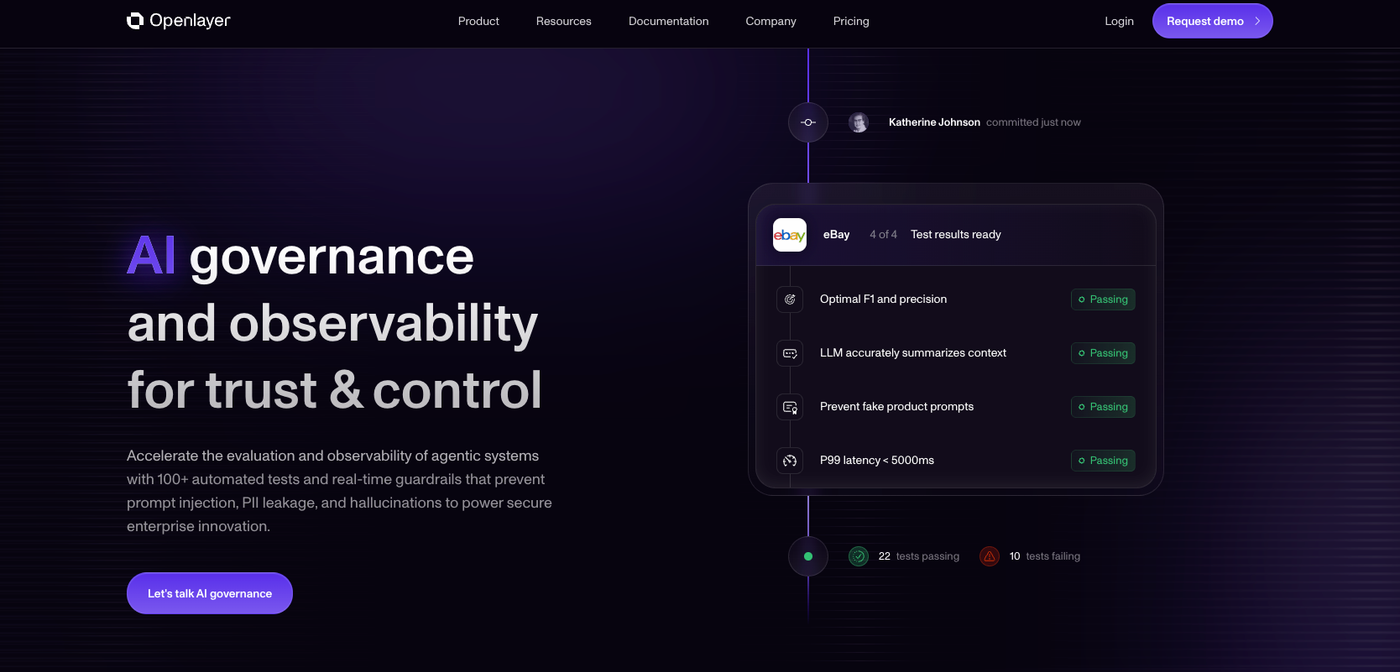
Openlayer connects to Copilot Studio and Agentforce deployments at the API boundary, capturing every prompt, retrieved chunk, tool call, and generated response before it reaches an end user. That interception layer is where governance moves from documentation to enforcement.
Here is what that looks like in practice across the three governance problems that matter most for low-code AI deployments:
Output Quality and Groundedness
Every response generated by a Copilot Studio or Agentforce agent is scored against Openlayer's 100+ pre-built tests, including groundedness, relevance, and toxicity. If a response fails to meet configured thresholds, say a groundedness score below 85%, the output is blocked before delivery. The scoring uses LLM-as-a-judge evaluation at 81.3% human correlation, so the quality bar reflects what a human reviewer would actually flag.
Behavioral Drift Detection
Low-code agents are rarely static. Knowledge base updates, connector changes, and underlying model updates all shift agent behavior without triggering a redeployment review. Openlayer tracks 13 session-level metrics across live traffic, flagging drift when output distributions shift outside the baseline set at deployment. When a Copilot Studio agent starts answering questions outside its intended scope, or an Agentforce agent begins citing sources it previously ignored, that shift surfaces as a drift alert before it becomes an incident.
Audit Trail Generation
Each inference event, prompt, retrieved context, output, quality score, and pass/fail verdict gets written to an immutable AI model audit log. For organizations subject to the EU AI Act's high-risk system requirements or internal AI governance policies, that log is a key part of the evidentiary record, though compliance remains a shared responsibility beyond any single tool. It covers who deployed the agent, what version ran, what thresholds were active, and whether any outputs were blocked, with no manual assembly required after the fact.
How the governance tool market handles these gaps
Dedicated governance platforms cover parts of this picture, though their coverage boundaries matter. Credo AI and IBM watsonx Governance are the two most widely cited players in the governance and compliance space, and understanding what they do and don't cover clarifies where an additional monitoring layer is needed.
Credo AI focuses on AI governance policy management: risk assessments, compliance mapping, and model documentation structured around frameworks like the EU AI Act and NIST AI RMF. It currently does not monitor live model outputs for behavioral drift, enforce output-quality thresholds at inference time, or generate per-inference audit trails that span the full inference lifecycle. The governance record Credo AI produces captures the policy and assessment layer; the monitoring layer sits outside its scope. Bottom line: Best for policy documentation teams that do not need runtime enforcement or per-inference monitoring.
IBM watsonx Governance covers AI governance within the IBM ecosystem, including model inventory, factsheet documentation, and bias detection capabilities. Runtime enforcement (blocking outputs that fail groundedness or toxicity thresholds before they reach end users) is not currently part of its architecture. Organizations running Copilot Studio or Agentforce agents outside the IBM stack will find that watsonx Governance's coverage ends at the inventory and documentation layer. Bottom line: Best for IBM-stack teams focused on model inventory and factsheet documentation, not cross-platform runtime governance.
Both platforms stop where Openlayer starts: at the inference boundary. Openlayer's evaluation, observability, and governance layer intercepts every prompt and response, scores it against configured thresholds, detects drift against a deployment baseline, and writes each event to an immutable audit log, covering the production monitoring gap that governance-documentation tools leave open.
Final thoughts on production monitoring and governance for low-code AI agents
The native controls in Copilot Studio and Agentforce cover access and data handling reasonably well. What they don't cover is what your agents actually produce at inference time, whether that behavior is drifting, and whether you have the per-inference records to satisfy an audit. Those gaps are yours to close, not the vendor's. If you want to dig into what that looks like for your deployments, get in touch.
FAQ
What's the difference between Copilot Studio's native governance controls and what a dedicated governance layer provides?
Copilot Studio's built-in controls govern access and topic scope, but stop before output quality. There is no native mechanism to score groundedness, detect behavioral drift, or produce per-inference audit records showing input, output, model version, and applied policy at the time of generation: the artifacts that EU AI Act high-risk system obligations and sector-specific regulations actually require.
How do I build an audit trail for Agentforce agents that satisfies EU AI Act high-risk requirements?
Agentforce logs activity within the Salesforce boundary, but a compliant audit trail requires more: each inference must be linked to a model version, the retrieval artifacts used, applied quality thresholds, and a pass/fail verdict, all timestamped and immutable. That record needs to span the full inference lifecycle, beyond the CRM layer alone, and must be generated automatically, not assembled manually after the fact.
Should I use the same behavioral thresholds across Copilot Studio and Agentforce agents, or configure them separately inside each tool?
Set behavioral thresholds at the governance layer, not inside each tool's native settings. When thresholds are configured separately per builder, a demographic parity gap or groundedness regression that would trigger review in one system can go undetected in another, a silent inconsistency that only surfaces during audits.
What is agent sprawl in low-code AI environments and why does it create compliance exposure?
Agent sprawl is the accumulation of deployed AI agents that were built and launched without entering a model registry, receiving a risk classification, or setting a monitoring baseline. For example, a finance team deploys a Copilot Studio agent for loan pre-screening without an EU AI Act risk classification or monitoring baseline. In low-code environments, business analysts and product teams can ship agents in days using tools like Copilot Studio or Agentforce, meaning dozens of agents can reach production across departments with no behavioral record, leaving organizations unable to meet EU AI Act Article 9 risk management documentation requirements or NIST AI RMF MEASURE function obligations.
Best way to govern Microsoft Copilot Studio monitoring when native controls don't cover output quality?
Connect an external governance layer at the API boundary that captures every prompt, retrieved chunk, and generated response before it reaches end users. From that interception point, automated scoring against groundedness, toxicity, and relevance criteria runs on every response, drift detection compares live output distributions against a deployment baseline, and each inference writes to an immutable audit log, covering the three gaps Copilot Studio's native controls leave open.