EU AI Act obligations for providers vs deployers: complete guide for May 2026
When you're figuring out your EU AI Act provider and deployer obligations, the first surprise is that you're probably both. Build a hiring model and you're a provider. Deploy a vendor chatbot and you're a deployer. Modify that chatbot's training data and you've just triggered Article 25, which converts you back into a provider with the full compliance stack. The roles shift based on what you do with each system, not what your company does overall, and the obligation sets are completely different.
TLDR:
- Providers develop and market AI systems; deployers use them professionally under their own authority
- Providers face heavier burdens: conformity assessments, CE marking, EU database registration by August 2026
- Deployers must implement human oversight, maintain usage logs, and report serious incidents to providers
- Substantial modifications to deployed systems trigger Article 25 reclassification, shifting full provider obligations
- Openlayer automates EU AI Act compliance with unified governance, continuous monitoring, and audit-ready evidence for both roles
Understanding the EU AI Act's risk-based approach
The EU AI Act assigns obligations based on risk instead of applying uniform rules to every AI system. Its four-tier classification determines what's required of you. Your role as either a provider or deployer shapes which obligations actually apply to you, even for the same system. Most of those requirements take effect in August 2026.
Who qualifies as a provider under the EU AI Act
Under Article 3 of the EU AI Act, a provider is any person or organization that develops an AI system (or has one developed on its behalf) and places it on the EU market or into service under their own name or trademark. Two conditions must both apply: development responsibility and market placement. Building a system purely for internal use, with no external market placement, doesn't automatically trigger provider status.
The territorial scope catches many US-based companies off guard. The Act applies whenever an AI system is used within the EU, or when its outputs are used there, regardless of where the provider is located.
Who qualifies as a deployer under the EU AI Act
Any person or organization using an AI system under its own authority in a professional context qualifies as a deployer under Article 3. Common examples include:
- Buying an off-the-shelf hiring screening tool
- Deploying a vendor-built credit scoring model
- Integrating a third-party customer service chatbot into your operations
This description fits most European businesses. The vast majority of organizations purchase AI, configure it, and use it instead of building from scratch.
Core obligations for deployers of high-risk AI systems
Article 26 sets the baseline floor for deployers. Once a high-risk system is live, these requirements activate immediately, with no grace period.
- Follow provider instructions on intended use. Operating outside the specified scope transfers liability to the deployer.
- Assign oversight to people with both the competence and authority to intervene when outputs go wrong.
- Verify input data is relevant and representative for your specific deployment context.
- Monitor system behavior on an ongoing basis after launch.
- Retain operation logs for at least six months, available to authorities on request.
- Complete a fundamental rights impact assessment before deploying in public-sector or sensitive contexts.
- Inform affected workers before deployment begins.
- Report serious incidents to the provider promptly.
What deployers must do
Being a deployer carries concrete, legally binding obligations. Deployers of high-risk systems must:
- Implement appropriate human oversight mechanisms to catch and correct AI errors before they affect people
- Maintain usage logs that document how and when the system was used
- Inform individuals when AI has influenced decisions made about them
The bar is lower than what providers face, but lower does not mean optional.
Core obligations for providers of high-risk AI systems
Providers of high-risk AI systems carry the heaviest pre-market burden. Every obligation below must be satisfied before placing a system on the EU market or putting it into service.
Key requirements for providers
- Register the system in the EU database before deployment and keep technical documentation current throughout the product lifecycle.
- Implement a quality management system covering risk management, data governance, and post-market monitoring procedures.
- Conduct a conformity assessment and affix CE marking where required before market entry.
- Implement logging capabilities so the system generates automatic event records traceable during audits.
Summary of deployer and provider requirements
| Obligation Category | Provider Requirements | Deployer Requirements |
|---|---|---|
| Pre-Market Activities | Conduct conformity assessment, affix CE marking, register system in EU database before deployment, develop quality management system covering risk management and data governance | No pre-market obligations; assumes provider completed conformity assessment and registration |
| Documentation | Maintain current technical documentation throughout product lifecycle, generate automatic event logs, keep records traceable during audits | Retain operation logs for minimum six months, preserve incident documentation, maintain records available to authorities on request |
| Human Oversight | Design and build oversight mechanisms into system architecture, provide instructions for deployer oversight implementation | Assign oversight to competent personnel with authority to intervene, implement oversight controls during live operation |
| Data Governance | Implement training data quality controls, document data sources and preprocessing methods, validate data representativeness for intended use cases | Verify input data is relevant and representative for specific deployment context, operate within data parameters specified by provider |
| Monitoring Obligations | Build post-market monitoring procedures into quality management system, track system performance across all deployments, aggregate incident data from deployers | Monitor system behavior during operation, report serious incidents to provider and authorities without delay, track system outputs in deployment environment |
| Transparency and Disclosure | Provide clear instructions on intended use and limitations, disclose system capabilities and constraints to deployers, register publicly accessible information in EU database | Inform affected individuals when AI influences decisions about them, notify workers before deployment, complete fundamental rights impact assessment in public-sector contexts |
| Incident Response | Investigate root causes of serious incidents, develop corrective action plans, report to market surveillance authorities in affected member state | Notify provider and relevant authorities of serious incidents, preserve logs supporting investigation, cooperate with provider technical analysis |
When deployers become providers under Article 25
Article 25 closes a gap that many deployers don't anticipate. You start as a deployer, but requalify as a provider under three conditions:
- You place your own name or trademark on an existing high-risk system
- You make a substantial modification that keeps the system high-risk or affects its compliance requirements
- You modify the intended purpose so a previously lower-risk system crosses into high-risk territory
Substantial modification is where most surprises happen. Fine-tuning a model on proprietary data, restructuring a RAG pipeline, or custom training on domain-specific datasets can all qualify. Once triggered, the full provider obligation stack activates: conformity assessments, CE marking, quality management systems, and EU database registration. The compliance burden transfers entirely, and fast.
AI literacy requirements for both providers and deployers
Article 4 places a shared obligation on both providers and deployers: take reasonable measures so that staff who operate or interact with AI systems have enough AI literacy to understand system capabilities, recognize limitations, and interpret outputs in context. The requirement applies to anyone whose role involves working with AI systems, beyond technical teams. Literacy expectations scale with context, meaning the depth required depends on the system's risk level, its intended use, and the individual's role within that workflow.
- Providers must build literacy into staff training programs that cover the AI systems they develop and deploy.
- Deployers must prepare their own teams to understand system behavior, limitations, and appropriate use.
Serious incident reporting obligations and timelines
When a high-risk AI system causes or contributes to a serious incident, the clock starts immediately. Providers must report serious incidents to market surveillance authorities in the member state where the incident occurred. Deployers are responsible for notifying the provider and relevant authorities without undue delay. The Act defines a serious incident as any event resulting in death, serious harm to health, substantial property damage, or serious infringement of fundamental rights.
- Providers carry the technical investigation burden, supplying root cause analysis and corrective action plans.
- Deployers must preserve logs and incident documentation to support that investigation.
Transparency and disclosure requirements for limited-risk systems
Article 50 extends disclosure requirements beyond high-risk classifications to any AI system that interacts with people or generates content. Providers must embed machine-readable watermarks in AI-generated text, images, audio, and video. Deployers must notify users when they are interacting with a chatbot or AI system, unless that fact is already obvious from context. Where synthetic media shows real people, deepfake disclosures are mandatory. All Article 50 obligations take effect August 2026.
Compliance strategies for organizations in both roles simultaneously
Many organizations occupy both roles at once. A bank might build its own credit scoring model as a provider while deploying a third-party document processing tool as a deployer.
- Determine provider vs. deployer status based on development responsibility and market placement.
- Map the corresponding obligation set independently.
- Assign clear internal ownership to the right team.
Where your team makes substantial modifications to deployed systems, build a review trigger into your development workflow. Article 25 reclassifications move fast, and the compliance burden transfers completely once triggered.
Automating governance for EU AI Act compliance with Openlayer
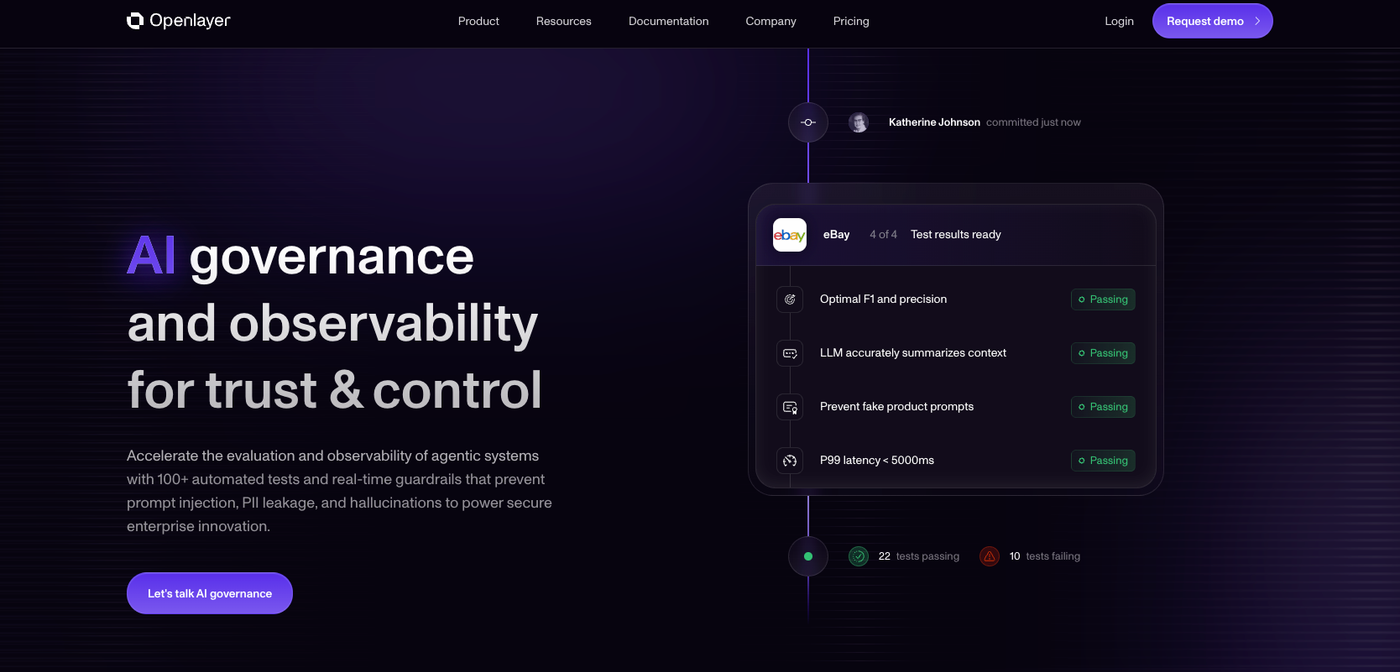
Whether you're building AI systems, deploying third-party tools, or occupying both roles at once, Openlayer maps your obligations to the EU AI Act automatically. Provider teams get automated testing across 100+ safety and behavioral checks, continuous post-market monitoring, and audit-ready evidence that feeds conformity assessment documentation. Deployer teams get human oversight controls, automated inference logging, and incident detection workflows that notify the right stakeholders without manual triage.
Both roles share one governance layer: a unified system inventory, risk scoring, and framework mapping that updates continuously. When Article 25 reclassifications happen, your compliance evidence travels with the project.
Final thoughts on clarifying provider and deployer roles
Most compliance confusion stems from treating provider and deployer as organizational labels when they're actually system-specific designations that shift based on what you build, modify, or deploy. According to a 2026 Vision Compliance report, 78% of organizations across eight industries have not taken meaningful steps toward AI Act compliance despite the August 2026 deadline.
EU AI Act provider vs deployer obligations differ dramatically in scope and timing, so getting the classification wrong means missing requirements or overbuilding where it's unnecessary. Track your role separately for each AI system in your inventory, watch for Article 25 triggers during modifications, and keep compliance evidence aligned with whichever obligation set currently applies. Talk to our team about automating role detection and mapping obligations automatically as your systems change.
FAQ
EU AI Act obligations for providers vs deployers: what's the main difference?
Providers develop AI systems and place them on the market, carrying pre-market obligations like conformity assessments, CE marking, and quality management systems. Deployers use AI systems in professional contexts and face runtime requirements including human oversight, logging, and fundamental rights impact assessments. The same system triggers different obligations depending on your role.
Can you switch from deployer to provider status after deployment?
Yes. Article 25 reclassifies deployers as providers when you place your name on the system, make substantial modifications that affect compliance, or change the intended purpose to high-risk. Fine-tuning on proprietary data or restructuring a RAG pipeline often qualifies as substantial modification, triggering the full provider obligation stack immediately.
What counts as a serious incident under the EU AI Act?
Any event causing death, serious health harm, substantial property damage, or serious infringement of fundamental rights qualifies. Providers must report to market surveillance authorities in the member state where the incident occurred, while deployers notify both the provider and relevant authorities without delay. Both roles must preserve logs and incident documentation.
How do you handle compliance when acting as both provider and deployer?
Assess roles at the project level, not organizationally. For each AI system in your inventory, determine provider vs. deployer status based on development responsibility and market placement, map the corresponding obligation set independently, and assign clear internal ownership. When teams make substantial modifications to deployed systems, build a review trigger into development workflows to catch Article 25 reclassifications before they shift the compliance burden.
When do most EU AI Act obligations take effect?
Most provider and deployer obligations for high-risk AI systems take effect in August 2026. Transparency and disclosure requirements under Article 50, including machine-readable watermarks and chatbot notifications, also activate in August 2026 with no grace period once live.