Credo AI reviews, pricing, and alternatives (January 2026)

Looking into Credo AI reviews because you need to prove compliance with the EU AI Act or NIST RMF? Credo AI handles that part well. It maps your AI systems to regulatory requirements and generates audit-ready documentation. The gap shows up when you need to prevent risks in production, not simply document them. If you're deploying GenAI or agents at scale, you'll want tools that combine compliance automation with real-time guardrails, automated testing, and continuous monitoring. This post covers what Credo AI delivers and where alternatives step in.
TLDR:
- Credo AI maps AI projects to regulatory frameworks but lacks real-time guardrails and automated tests
- You need external tools to block prompt injections or PII leakage at inference time with Credo AI
- Openlayer combines compliance automation with 100+ behavioral tests and runtime security controls
- Openlayer delivers operational governance with automated framework mapping to EU AI Act, NIST, and ISO 42001
What is Credo AI and how does it work?
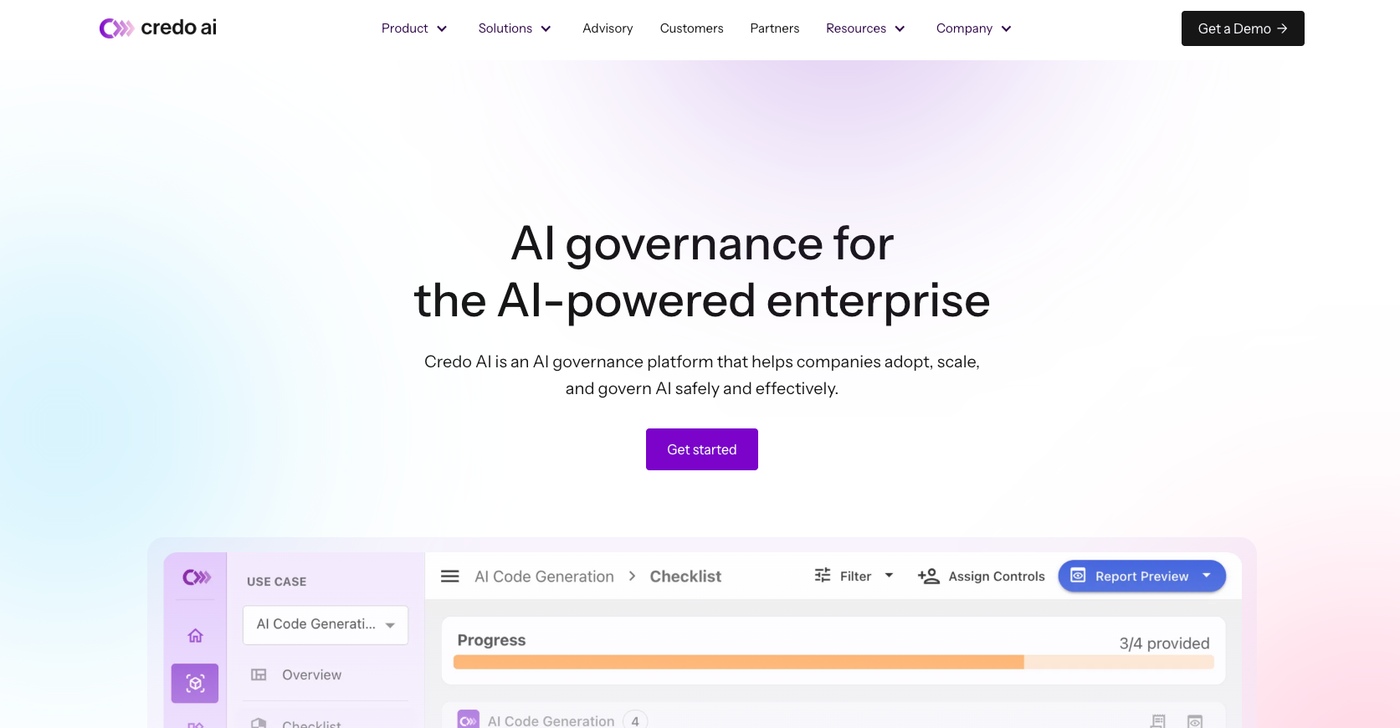
Credo AI is an AI governance tool built for organizations managing regulatory compliance and risk across AI systems. It functions as an intelligence layer above your AI infrastructure, translating technical artifacts into compliance insights for governance teams, product leaders, and data scientists. The experience is policy documentation focused. You configure workflows, complete assessment questionnaires, and generate audit artifacts through a web interface. There's no code to write or technical tests to run. The tool helps governance teams prove compliance and manage risk through structured documentation instead of operational monitoring or testing of live AI systems.
The workflow includes three components:
- AI Registry that inventories all AI systems and captures metadata about models, owners, and deployment status;
- Policy Intelligence that automates risk assessments by suggesting relevant risks and controls for each use case;
- Policy Packs that translate regulatory frameworks like the EU AI Act or NIST AI RMF into structured governance workflows.
Credo AI targets enterprises in regulated industries where compliance teams need visibility into AI risk. Finance, healthcare, and government organizations moving AI from pilots to production make up the typical user base.
Why consider Credo AI alternatives?
Credo AI maps AI projects to regulatory frameworks like the EU AI Act and NIST AI RMF, then generates audit-ready reports for regulators and internal reviews. It delivers value for organizations building policy-driven governance frameworks from scratch or coordinating compliance workflows across multiple stakeholders. But, many teams look for alternatives because of technical and operational gaps:
- Credo AI does not provide real-time guardrails that block unsafe outputs before they reach production systems.
- Runtime enforcement happens through external integrations instead of built-in controls.
- Teams needing to prevent prompt injections or PII leakage at inference time face limitations.
In addition to those three gaps, there are three major categories of limitations that cause teams to consider alternatives to Credo AI.
Automated behavioral tests
Credo AI lacks a library of automated behavioral tests. Teams must define most evaluations themselves through the Lens framework or connect external testing systems. Organizations deploying agents or generative workflows often need preset tests for hallucinations, bias, toxicity, and security vulnerabilities.
Limited observability
Fine-grained observability is limited. Credo AI provides governance-level dashboards showing policy completion status, but lacks per-request latency tracking, per-trace debugging, or low-level metrics on individual inferences needed to diagnose regressions in high-volume production systems.
Integration constraints
Integration constraints surface for multi-cloud or non-traditional AI deployments. The product integrates primarily with Databricks and major cloud providers. Implementation complexity and cost considerations for smaller organizations also drive alternative searches. With Gartner predicting only 48% of AI projects making it into production and taking an average of 8 months to transition from prototype, and MIT research revealing that 95% of generative AI pilots are failing with only 5% achieving rapid revenue acceleration, organizations need tools that accelerate deployment rather than add complexity.
Best Credo AI alternatives in January 2026
We assessed seven alternatives based on their governance capabilities, technical testing depth, real-time security controls, and regulatory compliance automation.
Best overall Credo AI alternative: Openlayer
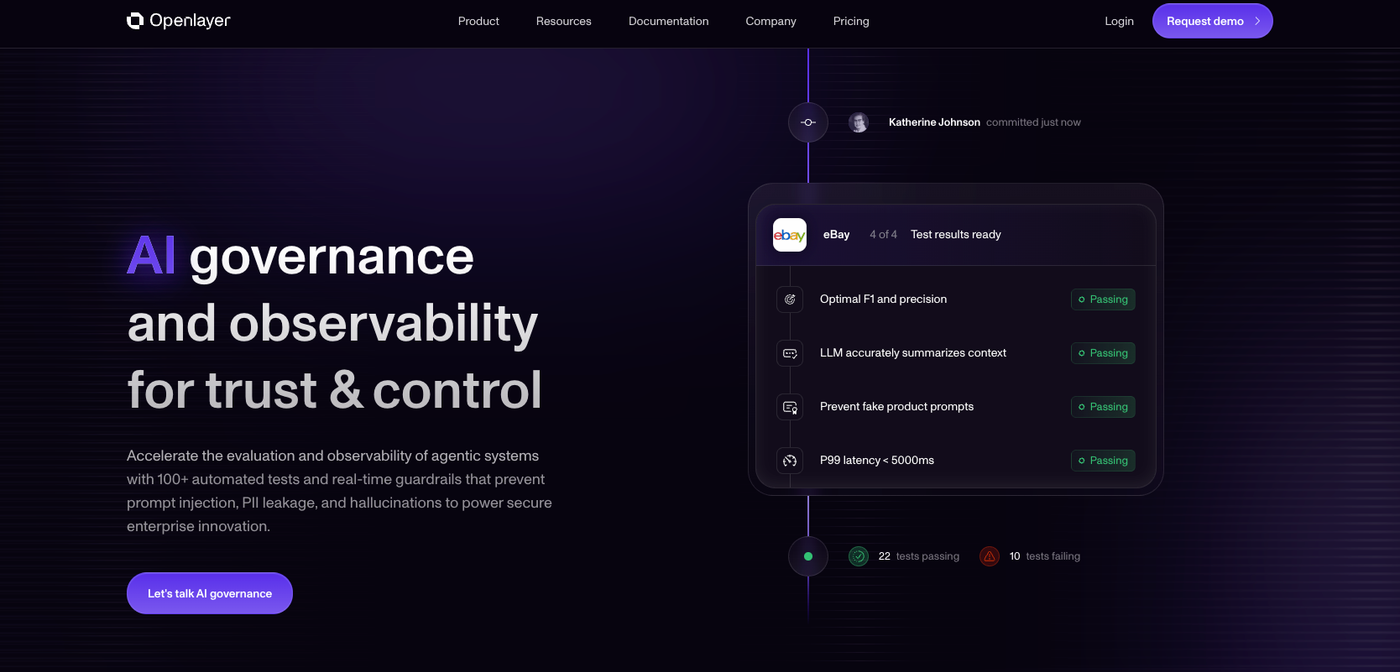
Openlayer is an AI governance and observability solution that combines automated testing, real-time security guardrails, continuous monitoring, and compliance automation across ML, GenAI, and agentic systems in both development and production.
Key features
Openlayer includes a number of features that make it a compelling alternative to Credo AI:
- 100+ automated behavioral tests across hallucinations, bias, toxicity, PII leakage, prompt injection, drift, latency, and robustness for text, vision, tabular, audio, and agents that integrate into CI/CD pipelines
- Real-time guardrails that prevent prompt injections, PII/IP leakage, and malicious queries by automatically blocking unsafe outputs before they reach downstream systems
- Continuous monitoring of outputs, latency, regressions, and anomalies with automated alerts tied to policy thresholds and risk scoring
- Automatic mapping to EU AI Act, NIST RMF, ISO 42001, OWASP, and LGPD with continuous risk assessments and audit-ready dashboards
What Openlayer is good for
Openlayer is good for regulated enterprises in financial services, insurance, healthcare, telecom, and utilities that have deployed GenAI systems in production and need unified oversight across models, agents, and data pipelines with both technical enforcement and regulatory alignment.
The bottom line
Openlayer delivers operational AI governance with runtime enforcement instead of just policy documentation, combining the compliance mapping Credo AI provides with deep technical testing, security guardrails, and production monitoring that Credo AI requires external tools to achieve.
IBM WatsonX.governance
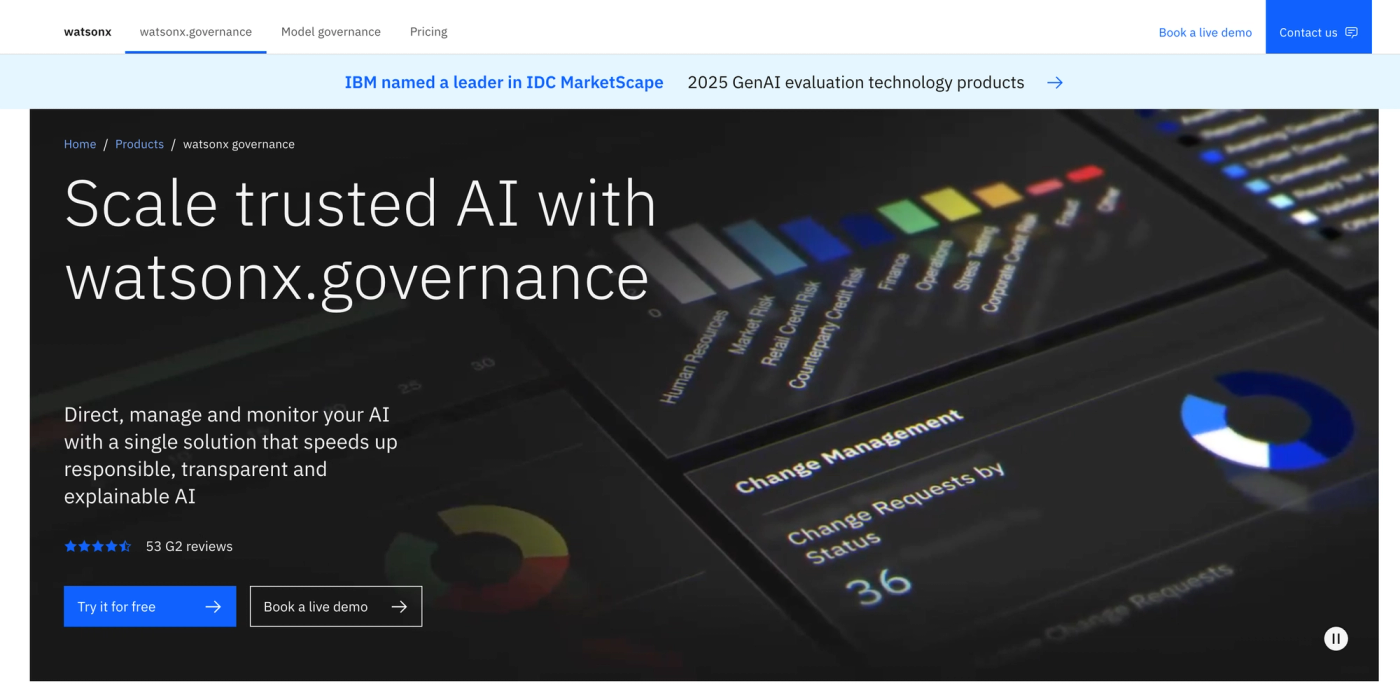
IBM Watsonx Governance delivers policy-driven oversight and framework mapping for fairness and explainability within the IBM ecosystem, offering governance dashboards and workflow-level controls for organizations using Watsonx.
Key features
IBM WatsonX includes a number of features that make it a compelling alternative to Credo AI:
- Policy-driven risk dashboards with framework alignment to EU AI Act, NIST, and ISO standards
- Fairness and explainability checks focused on bias detection
- Integration with IBM's data and AI suite including Watsonx orchestrate for agent workflows
What IBM WatsonX is good for
IBM watsonx is good for enterprises standardized on IBM infrastructure that want vendor-delivered governance services and tight integration with the broader Watsonx ecosystem.
The bottom line
IBM watsonx is limited to the IBM stack with minimal cross-platform visibility for non-IBM AI systems, no real-time blocking of prompt injections or data exfiltration, and lacks multimodal or adversarial testing across edge cases.
Braintrust
Braintrust is an evaluation and observability platform focused on prompt engineering and LLM application testing through user-defined evaluations and trace analysis.
Key features
Braintrust includes a number of features that make it a compelling alternative to Credo AI:
- Prompt playground for iterative testing and comparison across LLM providers
- Custom evaluation framework requiring teams to build their own test suites
- Trace-level debugging with cost and latency tracking across LLM calls
- Application-level observability for prompt chains and multi-step workflows
What Braintrust is good for
Braintrust is good for engineering teams experimenting with prompts and LLM applications who need flexible evaluation frameworks and are willing to invest time building custom test suites for their specific use cases.
The bottom line
Braintrust delivers prompt-level experimentation and trace analysis but requires a lot of engineering effort to build test coverage, lacks real-time security guardrails to prevent prompt injections or PII leakage, and provides no compliance automation for regulatory frameworks like EU AI Act or NIST RMF.
LangSmith
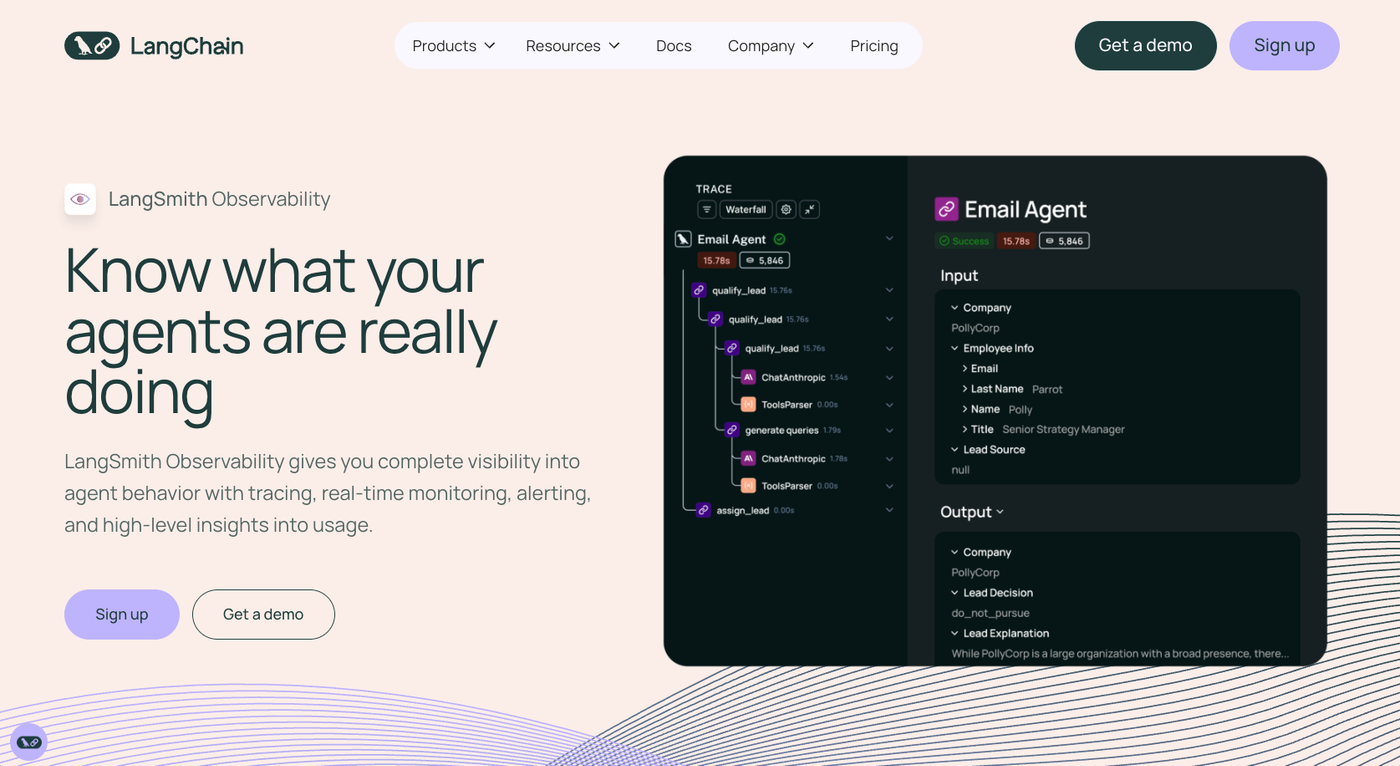
LangSmith is LangChain's native observability and evaluation platform designed for debugging and monitoring LLM applications built with the LangChain framework through trace analysis and prompt experimentation.
Key features
- Native integration with LangChain ecosystem for workflow tracking
- Trace-level debugging with detailed visibility into chain execution and LLM calls
- Prompt playground for testing and comparing outputs across different configurations
- Cost and latency tracking across LLM providers and chain components
- Dataset management for evaluation with custom scoring functions
What LangSmith is good for
LangSmith is good for teams heavily invested in the LangChain ecosystem who need deep visibility into chain execution and want integrated debugging tools for their LangChain-based applications.
The bottom line
LangSmith delivers strong observability for LangChain workflows but remains tightly coupled to that framework, requires teams to build their own test suites for complete coverage, lacks real-time guardrails to prevent prompt injections or data exfiltration, and provides no compliance automation for regulatory frameworks like EU AI Act or NIST RMF.
Langfuse

Langfuse is an open-source LLM observability and analytics platform focused on trace analysis, prompt management, and user-defined evaluations for debugging and monitoring LLM applications across frameworks.
Key features
- Open-source architecture with self-hosting options for data privacy
- Detailed trace analysis with session tracking and user-level insights
- Prompt management and versioning for iterative experimentation
- Custom evaluation framework requiring teams to define their own scoring logic
- Cost tracking and latency monitoring across LLM providers
- Integration with multiple LLM frameworks beyond a single ecosystem
What Langfuse is good for
Langfuse is good for engineering teams that favor open-source tooling and need flexible trace-level debugging across multiple LLM frameworks, with the technical capacity to build custom evaluation suites for their specific use cases.
The bottom line
Langfuse delivers complete trace analysis and open-source flexibility but requires a lot of engineering investment to build test coverage, lacks real-time guardrails to prevent prompt injections or data exfiltration, and provides no compliance automation for regulatory frameworks like EU AI Act or NIST RMF.
Feature comparison: Credo AI vs top alternatives
Assessing governance and observability tools requires looking at technical depth, runtime enforcement, and compliance automation. The table below compares Credo AI against Openlayer and other governance tools across testing, security, monitoring, and regulatory alignment.
| Feature | Credo AI | Openlayer | IBM Watsonx Governance | Braintrust | LangSmith | Langfuse |
|---|---|---|---|---|---|---|
| Pre-built test library | Limited (Lens framework, user-defined) | 100+ automated tests | Bias and explainability checks only | User must build tests | Prompt/LLM evals only | User must build tests |
| Real-time guardrails | No (external integrations) | Yes (blocks prompt injection, PII, data exfiltration) | No (detection only) | No (alerts only) | No | No |
| Continuous monitoring | High-level governance dashboards | Full-stack monitoring with anomaly detection | Policy-tied dashboards | Trace analysis | Traces and cost tracking | Detailed traces |
| Compliance automation | Automatic framework mapping | Automatic mapping to EU AI Act, NIST, ISO 42001, OWASP, LGPD | Manual, service-heavy mapping | No compliance features | No compliance features | No compliance features |
| Multimodal support | Yes (via integrations) | Text, vision, tabular, audio, agents | Limited | Application-level | LLM-focused | LLM-focused |
| Framework support | Stack-agnostic (via integrations) | All frameworks and models | IBM stack primarily | Stack-agnostic | LangChain-focused | Stack-agnostic |
| CI/CD integration | Workflow-based | Native test integration | Limited | Evaluation gates | Limited | Limited |
| Drift detection | No (external tools) | Yes (automated) | Limited | No | No | No |
Credo AI delivers framework mapping and policy workflows but requires external systems for technical testing and runtime enforcement. Openlayer pairs compliance automation with operational controls that detect and block risks before production.
Why Openlayer is the best Credo AI alternative
Credo AI delivers policy documentation and regulatory mapping for organizations building governance frameworks. Openlayer focuses on operational governance with runtime enforcement. While the solution helps you prove compliance through structured workflows and audit artifacts, Openlayer enforces rules at runtime with 100+ automated tests that validate every model update before release and real-time guardrails that block prompt injections and PII leakage before they reach downstream systems. You get both compliance mapping and the technical controls required to deliver it.
Credo AI excels at risk documentation through policy workflows and assessment questionnaires. But, Openlayer combines compliance automation with continuous monitoring, anomaly detection, and automated alerts tied to policy thresholds. You replace manual governance processes with unified oversight across evaluation, observability, security, and compliance.
Teams looking at Credo AI alternatives typically have AI systems already in production. Openlayer delivers governance as an operational layer, giving you the control and visibility required to scale AI responsibly across regulated environments.
Final thoughts on assessing governance options
Credo AI handles policy workflows and regulatory mapping for teams building governance frameworks. But most organizations looking at Credo AI alternatives already have AI in production and need runtime enforcement alongside compliance documentation. Openlayer combines both: automated tests that validate every release, guardrails that block unsafe outputs, and continuous monitoring tied to regulatory frameworks. You get governance that operates at the speed your engineering teams ship.
FAQ
Why should you consider alternatives to Credo AI?
Credo AI focuses on policy documentation and framework mapping but lacks real-time guardrails to block unsafe outputs, automated behavioral tests for hallucinations or bias, and fine-grained observability for debugging production systems. Teams needing runtime enforcement, preset security tests, or per-request monitoring often require tools that combine compliance automation with technical controls.
What features should you favor when comparing AI governance tools?
Favor real-time guardrails that prevent prompt injections and PII leakage before they reach production, automated test libraries covering hallucinations and toxicity across modalities, continuous monitoring with anomaly detection and drift tracking, and automatic mapping to regulatory frameworks like EU AI Act and NIST RMF with audit-ready evidence collection.
How does Openlayer differ from Credo AI for enterprise governance?
Credo AI delivers compliance through policy workflows and assessment questionnaires, while Openlayer enforces governance at runtime with 100+ automated tests integrated into CI/CD pipelines, real-time guardrails that block unsafe outputs, continuous monitoring with automated alerts, and the same regulatory mapping Credo AI provides, combining documentation with technical enforcement in one system.
When should you move from policy-based governance to operational governance?
Move to operational governance when you have AI systems deployed in production that require runtime enforcement, when manual risk assessments consume more than 10 hours per week, or when you need to prevent security vulnerabilities like prompt injection and data exfiltration before they impact users instead of documenting them after detection.