EU AI Act Credit Scoring High-Risk System Guide (July 2026)


Your credit scoring system probably crosses the EU AI Act's high-risk threshold even if it's positioned internally as analytics and not a credit decision. The scope question is where most compliance teams lose time, and the documentation requirements that follow from getting it wrong are substantial. This is a breakdown of what Annex III 5(b) actually covers, how provider and deployer obligations split, and what audit-ready evidence looks like for each.
TLDR:
- EU AI Act Annex III 5(b) covers any credit scoring model that informs a lending decision, including behavioral models and affordability engines, well beyond traditional scorecards.
- Fine-tuning a licensed third-party scoring model on proprietary data can shift a deployer to provider status, triggering full Annex IV documentation and conformity assessment obligations before August 2026.
- The 2023 SCHUFA ruling means GDPR Article 22 rights now apply at the scoring stage, requiring human oversight as a design requirement, not a reactive disclosure.
- Non-compliance with high-risk system obligations carries fines up to €15 million or 3% of global annual turnover; conformity assessment infrastructure takes months to build from scratch.
- Openlayer helps teams build the evidentiary infrastructure for Articles 9, 10, 12, 13, and 15 obligations by mapping pre-deployment test records, inference logs, and demographic parity checks to each requirement, with deployment gates that block promotion when thresholds are breached instead of only logging drift.
Credit scoring as a high-risk AI system: what Annex III 5(b) actually covers
Annex III of the EU AI Act lists the categories of AI systems automatically classified as high-risk. Item 5(b) covers AI systems used to assess the creditworthiness of people or to assign their credit score, meaning any model that produces, contributes to, or informs a lending decision about an individual falls within scope.
The coverage is broader than most compliance teams initially assume. A few clarifications worth making explicit:
- A model does not need to be the sole decision-maker to qualify. If a credit scoring model produces a feature, score, or recommendation that a human underwriter then acts on, the system still falls under 5(b). The EU AI Act does not require full automation for high-risk classification to apply.
- The scope covers natural persons, not businesses. A B2B credit risk model assessing corporate counterparties sits outside 5(b), though it may face obligations under other regulatory regimes.
- "Creditworthiness" extends beyond traditional credit scores. Behavioral risk models, affordability assessments, and income verification models that feed a lending decision are each within scope if they measure an individual's financial reliability.
- A deployer licensing a third-party scoring model inherits high-risk AI system obligations unless the provider has already completed conformity assessment and supplied the technical documentation required under Annex IV. The contractual transfer of documentation does not transfer liability.
The safe harbor under Article 6(3) allows a system to avoid high-risk classification if it poses "no material risk to health, safety, or fundamental rights," but credit decisions affecting individuals' access to financial products rarely clear that bar, and regulators have signaled they will review self-assessments closely.
Which credit scoring model types fall within scope
The EU AI Act places credit scoring systems in Annex III, Category 5(b), which covers AI used to assess the creditworthiness of natural persons or assign their credit scores. That classification is not limited to traditional FICO-style scoring engines. The scope is broader, and several model types that financial institutions currently run in production fall inside it.
Here is how the main categories break down:
- Traditional credit scorecards built on logistic regression or gradient boosted trees that produce a numeric credit score or creditworthiness classification for a natural person fall squarely within scope, regardless of whether the institution labels them "AI."
- Behavioral scoring models that ingest transaction history, account activity, or payment patterns to predict default probability are covered, even when positioned internally as "analytics" and not as credit decisions.
- Alternative data models that use non-traditional inputs such as utility payments, rental history, or device metadata to score thin-file or credit-invisible applicants are within scope, and carry heightened scrutiny given the EU AI Act financial services data governance requirements under Article 10.
- Affordability assessment engines that assess repayment capacity as a precondition for credit approval are covered when the output materially informs or automates the credit decision.
- Automated pre-screening and pre-approval systems that filter applicant pools before a human reviewer sees them are in scope if the filtering decision is consequential to whether a natural person receives credit.
One distinction worth drawing clearly: the Act covers systems that act on natural persons. Models used exclusively to score portfolios, assess institutional counterparty risk, or generate macro credit risk signals for internal treasury functions are not within the Article 6 and Annex III high-risk definition, provided no individual consumer creditworthiness determination is produced.
The GDPR dimension: SCHUFA and what it changes right now
The SCHUFA ruling by the Court of Justice of the European Union in December 2023 reshaped how GDPR applies to automated credit scoring in ways that directly intersect with EU AI Act obligations. The court held that a credit score produced by an automated system constitutes a "decision" under Article 22 of GDPR when that score has a determining influence on whether a third party such a bank, a lender, an insurer grants or denies a request. That ruling closed a loophole many credit bureaus had relied on: the argument that the score itself was not the decision, so Article 22 protections did not apply. The CJEU's SCHUFA decision analysis details the full scope of the ruling and its conditions.
For organizations building or deploying credit scoring models in the EU, the practical consequence is layered compliance. GDPR Article 22 rights (the right to human review, to contest outcomes, to receive a meaningful explanation) now apply at the scoring stage, extending beyond the lending decision stage. The EU AI Act then sits on top of that, requiring conformity assessment documentation, bias testing records, and post-market monitoring logs as separate obligations. A system that satisfies GDPR's explainability requirement by providing a generic score rationale may still fail the EU AI Act's human oversight standard under Article 14 if no qualified reviewer can actually intervene in the automated output before it propagates downstream.
The compliance gap this creates is concrete: many institutions built their GDPR response around disclosure templates and opt-out workflows, treating human review as a reactive right and not a proactive control. The EU AI Act treats human oversight as a design requirement. Those two postures are not compatible without architectural changes to how scoring outputs are held, reviewed, and released to downstream decision systems.
Provider vs. deployer roles: regulatory consequences for banks and fintechs
The EU AI Act draws a hard line between two roles, and where a financial institution sits determines what it must build, document, and prove before August 2026.
Banks and fintechs that train or substantially modify credit scoring models are classified as providers under Article 3. That means full Annex IV technical documentation, conformity assessment under Article 43, EU database registration, and ongoing post-market monitoring obligations. Institutions that deploy a third-party credit scoring model without modifying it fall under the deployer classification, carrying narrower but still consequential duties: human oversight implementation, fundamental rights impact assessments, and staff AI literacy under Article 4.
| Dimension | Provider | Deployer |
|---|---|---|
| Definition | Trains or substantially modifies a credit scoring model (Article 3) | Puts a third-party credit scoring model to work without modifying it (Article 26) |
| Technical documentation | Full Annex IV documentation required before market placement | Must receive and retain provider-supplied documentation |
| Conformity assessment | Article 43 conformity assessment required; declaration of conformity must be signed | Not required, but must verify provider has completed it |
| EU database registration | Required before deployment | Not required |
| Human oversight | Must design oversight into the system architecture | Must implement oversight measures in the deployment environment |
| Fundamental rights impact assessment | Required as part of risk management (Article 9) | Required before putting the system into operation (Article 26) |
| Post-market monitoring | Full ongoing monitoring obligation; incident reporting under Articles 61 and 72 | Must monitor performance in specific deployment environment and report serious incidents |
| When role changes | Deployer becomes provider if they fine-tune a licensed model on proprietary data | Becomes provider if system's intended purpose is expanded beyond original documentation |
The distinction matters most when a fintech licenses a scoring model from a vendor and then fine-tunes it on proprietary repayment data. That modification can shift the institution from deployer to provider status, triggering the full EU AI Act provider vs deployer obligations stack with little warning. But, three scenarios consistently produce misclassification:
- Fine-tuning a licensed model on institution-specific data without assessing whether the modification crosses the provider threshold, leaving conformity assessment obligations unmet and technical documentation unprepared.
- Embedding a third-party scoring API inside a proprietary decisioning layer and treating the combined system as a vendor product, when the institution's logic materially shapes credit outcomes and regulatory responsibility has shifted inward.
- Assuming a deployer designation eliminates audit exposure. Deployers remain subject to human oversight requirements, fundamental rights assessments, and Article 12 record-keeping obligations. An auditor who finds no oversight logs does not treat "we are only a deployer" as a defense.
Core provider obligations: Articles 9 through 15
The EU AI Act assigns six concrete obligations to providers of high-risk AI systems, each tied to a specific article and a specific evidentiary artifact auditors will request. Here is what each obligation requires in practice:
- Risk management system (Article 9): A documented, iterative process covering the full system lifecycle. In practice, that covers written risk identification records, mitigation measures tested against defined performance thresholds, and residual risk assessments updated after any model change or data drift event. See EU AI Act risk management system requirements for a detailed breakdown.
- Data governance (Article 10): Training, validation, and test datasets must be documented for relevance, representativeness, and bias. For credit scoring models in particular, this includes demographic coverage analysis across protected characteristics and written justification for any data exclusions.
- EU AI Act technical documentation (Annex IV): System architecture diagrams, intended purpose, training data provenance, performance metrics including accuracy and robustness figures, known limitations, and a post-market monitoring plan. This document must exist before conformity assessment begins.
- Record-keeping (Article 12): Logs sufficient to reconstruct system behavior after deployment, including input features passed at inference time, model version hash, output produced, and confidence score. These logs become the evidentiary source for post-market monitoring records.
- Accuracy, robustness, and cybersecurity (Article 15): Systems must meet declared performance metrics across the full intended operating range. For credit models, this requires fairness testing across demographic groups, with demographic parity gaps documented and within approved thresholds before deployment.
- Conformity assessment (Article 43): For credit scoring systems listed under Annex III, providers conduct an internal conformity assessment against Annex I requirements and produce a signed declaration of conformity before placing the system on the market.
Deployer obligations under Article 26
Article 26 places the compliance weight on deployers: the organizations that put high-risk AI systems to work in live production environments. For credit scoring, that means banks, lenders, and fintech firms bear direct regulatory obligations regardless of whether they built the underlying model.
There are four obligation categories deployers must own:
- Deployers must assign human oversight to individuals with the authority and competence to interpret model outputs, override decisions, and suspend the system when outputs appear unreliable. Oversight is not a checkbox; the designated person must understand what the credit scoring model can and cannot do.
- Deployers must conduct a fundamental rights impact assessment before putting a high-risk credit scoring system into operation, documenting which populations the system acts on and what adverse outcomes are foreseeable.
- Deployers must monitor system performance in their specific deployment environment, because a model that performed adequately in development may behave differently against a live applicant pool with different demographic characteristics.
- Deployers must report serious incidents to the provider and, where required, to national competent authorities within the Article 61 and 72 reporting windows.
One point worth clarifying: deployers who modify a system's intended purpose beyond what the original provider specified take on provider-level obligations for that expanded use. A lender that repurposes a generic creditworthiness model to screen small business applicants in ways the original documentation did not cover is no longer operating as a deployer under Article 26. That boundary has real compliance weight, and crossing it without recognizing it is one of the more common compliance gaps in practice.
Conformity assessment and EU AI database registration
Before deploying a credit scoring system under the EU AI Act, providers face two distinct procedural obligations that run in parallel: conformity assessment and EU database registration. Getting the sequencing wrong here is a common gap teams catch late.
Conformity Assessment
Credit scoring systems classified as high-risk under Annex III must complete a conformity assessment under Article 43 before market placement. For most credit scoring providers, this takes the form of internal control procedures in place of third-party certification, provided the provider follows harmonized standards.
The conformity assessment record must contain:
- Evidence that internal quality management procedures were followed across the system lifecycle
- Test results showing the system meets Article 15 accuracy, robustness, and cybersecurity requirements
- A signed declaration of conformity from an authorized representative
EU AI Database Registration
Once conformity assessment is complete, providers must register the system in the EU database before deployment. Registration fields include system name, provider identity, intended purpose, risk classification, and the conformity assessment body if a notified body was involved.
Registration is not a one-time filing. If the system undergoes a substantial modification after deployment, the conformity assessment process restarts and the database entry requires updating to reflect the new system version and any revised risk classification.
Overlapping regulatory obligations: GDPR, DORA, and banking rules
Credit scoring AI systems sit at the intersection of multiple overlapping regulatory regimes, and meeting EU AI Act obligations alone does not clear the full compliance picture. Three frameworks in particular interact directly with high-risk credit scoring deployments.
GDPR
The General Data Protection Regulation governs how personal data feeds into credit models. Article 22 gives individuals the right not to be subject to solely automated decisions with legal or similarly material effects, which credit decisions plainly are. This creates a requirement to either obtain explicit consent, make the decision necessary for a contract, or provide meaningful human review. The audit trail your EU AI Act compliance work generates (the human oversight logs required under Article 14 in particular) doubles as evidence of GDPR Article 22 compliance when human review is genuine and not merely nominal.
DORA
The Digital Resilience Act, which became applicable in January 2025 and is now in force, requires financial entities to maintain ICT risk management frameworks that cover AI systems as active tech components. For credit scoring, DORA's requirements around incident classification and third-party provider oversight mean that model failures, including drift events that degrade scoring accuracy, must be classified and reported through DORA's incident taxonomy alongside any EU AI Act post-market monitoring obligations.
EBA Guidelines on Internal Governance
The European Banking Authority's guidelines on loan origination and monitoring require that credit decisions be explainable to the borrower and auditable by supervisors. Where the EU AI Act requires technical documentation and human oversight records, EBA guidelines require that the explanations reach the applicant in plain language. These are complementary obligations but not identical ones: a model that passes conformity assessment may still fail EBA expectations if its explanation outputs are technically accurate but practically unintelligible to the person denied credit.
Enforcement, penalties, and the updated compliance timeline
The EU AI Act's penalty structure applies in tiers. Non-compliance with high-risk system obligations under Article 99(3) carries fines of up to €15 million or 3% of global annual turnover, whichever is higher. Violations of prohibited AI practices under Article 99(6) reach €35 million or 7% of total worldwide annual turnover.
On the compliance timeline, GPAI provider obligations became enforceable in August 2025. High-risk financial services obligations, including credit scoring systems, carry an August 2026 deadline. That window is short given what conformity assessment requires in practice.
Here is where teams most often underestimate their exposure:
- Conformity assessment under Article 43 requires documented evidence, not internal confidence alone that controls exist. If the audit trail has gaps, the assessment fails regardless of how the system actually performs.
- Post-market monitoring logs must capture sufficient data to reconstruct system behavior after deployment, per Article 12. A system that produces good decisions without logging the inputs, preprocessing steps, and output distributions has no evidentiary record to present.
- Serious incident reporting under Articles 61 and 72 carries a 15-day window. Without automated detection and a defined escalation path, that window closes before most teams have finished triaging.
Regardless of whether enforcement timelines continue to shift, the documentation and monitoring infrastructure required for conformity assessment takes months to build. Teams that wait for a final regulatory signal before scoping that work will not close the gap in time.
Building a compliance infrastructure for credit scoring AI
Three structural problems recur when financial institutions try to get credit scoring AI into EU AI Act compliance shape: documentation that describes the model without capturing how it behaves in production, monitoring that logs outputs without blocking on drift, and governance records that exist as static files instead of live audit artifacts. Governance platforms such as Credo AI and IBM watsonx.governance cover the policy documentation layer (risk categorization workflows, pre-deployment policy records, and audit-ready compliance reports) but stop short of monitoring live model outputs or enforcing deployment gates at runtime. Getting all three problems right requires building them as a connected system, not as separate workstreams.
Documentation That Holds Up Under Audit
Annex IV technical documentation is not a one-time deliverable. It needs to reflect the model actually running in production, which means version-locking every artifact: the model hash deployed, the training data snapshot used, the preprocessing pipeline applied, and the evaluation results that cleared the deployment gate. A documentation package that describes model architecture without linking to the specific artifact in the registry is not traceable, and an auditor will treat that gap as a missing control, not an administrative oversight.
Monitoring as Enforcement, Beyond Observation
Drift alerts and fairness dashboards are observation. Blocking inference when a demographic parity gap exceeds 5 percentage points is enforcement. The distinction matters because the EU AI Act's post-market monitoring obligations under Article 9 (risk management), Article 12, and Annex IV require that providers evidence ongoing conformity, beyond logging ongoing awareness. Configure gates that halt promotion when groundedness scores fall below your deployment floor, and set explicit alert owners so that a triggered threshold has a named person responsible for clearing it within a defined window. Logging the anomaly without that blocking step is observation presented as if it were a complete control.
Governance Records as Live Artifacts
Conformity assessment records go stale the moment a model update ships without a corresponding documentation update. Treat the audit trail as an append-only log: every evaluation run, every threshold change, every incident record, and every human oversight log should write to the same traceable artifact chain. When a national competent authority requests evidence of conformity, the response is not a document assembled after the fact; it is a set of records that have been accumulating since the system entered production.
How Openlayer maps to EU AI Act credit scoring obligations
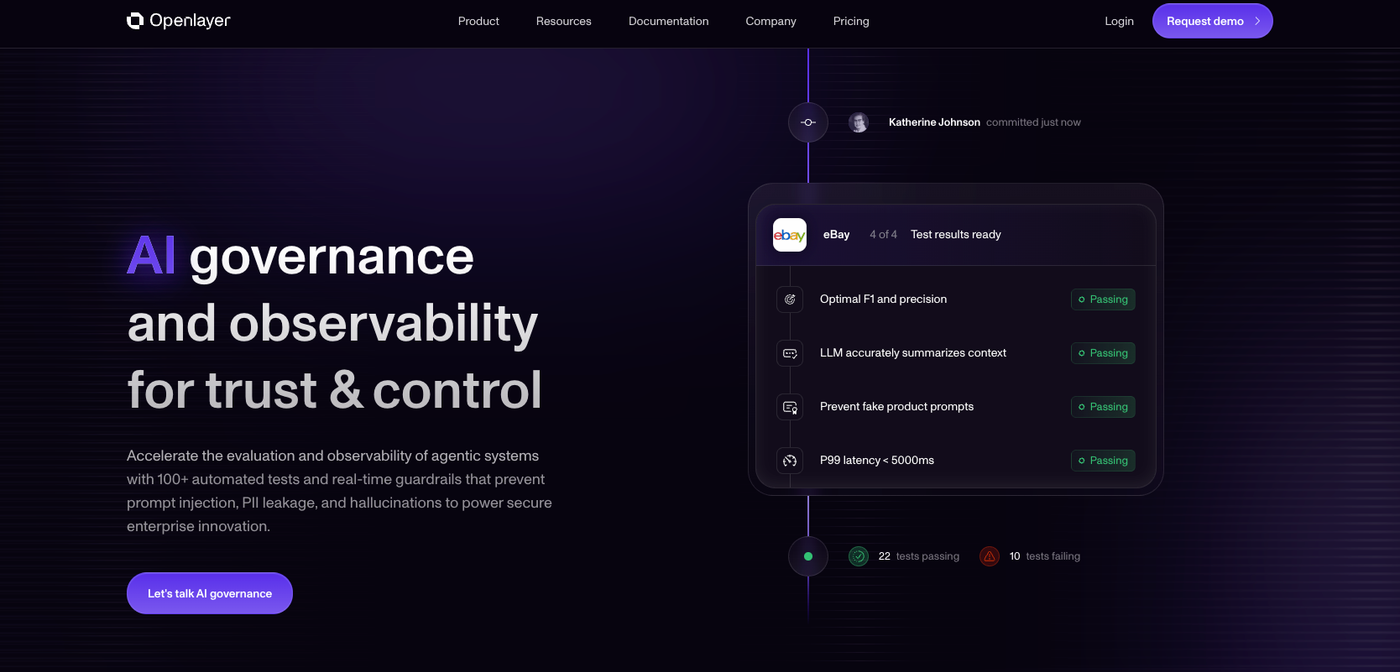
Mapping Openlayer's capabilities to the specific Article 9, Article 10, Article 12, Article 13, and Article 15 obligations that govern credit scoring systems starts with understanding what each obligation actually requires at the artifact level, then tracing which gap in the compliance chain each Openlayer capability closes.
Here is how that mapping works across the five core obligation areas:
- Article 9 (risk management system): Risk management under the EU AI Act requires documented identification of foreseeable risks, residual risk evaluation, and evidence that risk controls were tested. Openlayer's pre-deployment evaluation suite runs over 175 pre-built tests against credit scoring models before promotion, producing pass/fail records and flagged failure modes that become the evidentiary record for the risk management file. An evaluator reviewing a conformity assessment can trace each tested risk scenario to a dated test result, not a policy statement.
- Article 10 (data and data governance): The regulation requires that training, validation, and test datasets be audited for bias and that data governance practices be documented. Openlayer's fairness evaluation layer runs demographic parity checks across protected characteristics and flags when any group's selection rate falls below 80% of the highest group's rate (a common fairness threshold; calibrate to your regulator's standard), generating a dated metric record tied to the specific dataset version and model artifact hash. That record populates the data governance section of the Annex IV technical documentation directly.
- Article 12 (record-keeping): Article 12 requires that high-risk systems log sufficient information to reconstruct system behavior after deployment. Openlayer captures raw input feature vectors, preprocessing transformations applied, confidence distributions, output predictions, and the model version hash for every inference, writing each to an immutable audit trail. When a regulator requests reconstruction of a specific credit decision, the decision chain log exists as a retrievable artifact, not a gap in the record.
- Article 13 (transparency and provision of information): Article 13 requires providers to give deployers information on the system's capabilities, limitations, and appropriate oversight conditions: the information deployers need to implement oversight correctly. Openlayer's evaluation reports, including accuracy metrics, known failure modes, and demographic performance breakdowns by group, are exportable as structured documentation artifacts that serve as the required artifact providers supply to deployers, without requiring manual assembly from scattered monitoring outputs.
- Article 15 (accuracy, robustness, and cybersecurity): Article 15 requires that high-risk systems maintain their performance levels throughout the lifecycle. Openlayer's production monitoring layer tracks prediction drift, demographic parity gaps, and groundedness scores continuously, with configurable thresholds that trigger alerts when performance degrades. But alerting is observation. The enforcement layer blocks model promotion when evaluation scores fall below the deployment floor, so a degraded model version cannot reach production without a named approver clearing the gate. That blocking step is what separates enforcement from observation, and it is what Article 15 lifecycle performance obligations require in practice.
The governance competitor field covers parts of this mapping. Credo AI and IBM watsonx.governance both generate policy documentation and support risk categorization workflows, but neither monitors live credit scoring outputs at inference time or enforces deployment gates when performance thresholds are breached. Openlayer's unified evaluation, observability, and governance platform closes that gap across the full lifecycle. The documentation they produce satisfies the pre-deployment record requirements; the runtime gap remains open. Openlayer closes that gap by operating across the full lifecycle: evaluation records before deployment, inference logs during operation, and drift alerts with blocking gates after deployment, with each output traceable to the specific regulatory obligation it satisfies.
Final thoughts on meeting EU AI Act requirements for credit scoring systems
The compliance picture for credit scoring AI is genuinely layered: Annex III classification, GDPR Article 22 after SCHUFA, DORA incident taxonomy, EBA explainability expectations, and the provider-deployer line that moves when you fine-tune a licensed model. None of those interact cleanly without deliberate architecture. Your audit trail, monitoring gates, and conformity records need to be live artifacts, not documents you assemble when a regulator asks. Reach out to the Openlayer team to work through what that looks like for your specific setup.
FAQ
What AI systems actually fall under EU AI Act Annex III 5(b) credit scoring obligations?
Any model that produces, contributes to, or informs a lending decision about an individual falls within scope, including behavioral scoring models, affordability assessment engines, alternative data models, and automated pre-screening systems. The classification applies regardless of whether a human underwriter makes the final call; if the model's output materially shapes a credit decision for a natural person, it is in scope. B2B models assessing corporate counterparties sit outside 5(b), but that distinction disappears the moment any individual consumer creditworthiness determination enters the output.
How do I build an audit trail that satisfies EU AI Act Article 12 record-keeping requirements for a credit scoring model?
Article 12 requires logs sufficient to reconstruct system behavior after deployment, which means capturing raw input feature vectors, preprocessing transformations applied, confidence distributions, output predictions, and the model version hash for every inference. Store these as an immutable, append-only record, not a report assembled after the fact. When a regulator requests reconstruction of a specific credit decision, the decision chain log must exist as a retrievable artifact; a documentation package that describes model architecture without linking to the deployed artifact hash does not satisfy the evidentiary standard.
Credo AI vs. Openlayer for EU AI Act credit scoring compliance?
Credo AI covers pre-deployment policy documentation and risk categorization workflows but does not monitor live credit scoring outputs at inference time or enforce deployment gates when performance thresholds are breached. That means the runtime gap (drift accumulating past a threshold, a demographic parity gap widening, a degraded model reaching production) stays open. Openlayer closes that gap by operating across the full lifecycle: evaluation records before deployment, inference logs during operation, and drift alerts backed by blocking gates that halt model promotion when scores fall below the deployment floor.
What is the difference between provider and deployer obligations under the EU AI Act, and when does a fintech cross the line?
Providers (organizations that train or substantially modify a credit scoring model) carry the full obligation stack: Annex IV technical documentation, conformity assessment under Article 43, EU database registration, and post-market monitoring. Deployers (organizations that put a third-party model to work without modifying it) face narrower but still binding duties: human oversight implementation, fundamental rights impact assessments, and Article 4 AI literacy requirements. The line moves when a fintech fine-tunes a licensed model on proprietary repayment data; that modification can trigger full provider status with no administrative warning, leaving conformity assessment obligations unmet and technical documentation unprepared.
What does "monitoring" for EU AI Act Article 15 compliance actually require beyond setting up drift alerts?
Drift alerts are observation: they tell you something went wrong after it already happened. Article 15 lifecycle performance obligations require enforcement: a blocking gate that halts model promotion when a demographic parity gap exceeds 5 percentage points or a groundedness score falls below your deployment floor, with a named approver required to clear the gate before the degraded version reaches production. (Calibrate specific thresholds to your institution's risk appetite and the applicable regulatory floor.) Logging the anomaly without that blocking step is observation presented as if it were a complete control, and an auditor reviewing your conformity assessment record will treat that gap accordingly.