Best Real-Time AI Security Guardrails (December 2025)
Most AI security tools tell you what happened yesterday. But if you're running models in production, you need protection that works right now, during inference, before a prompt injection or data leak becomes a compliance incident. Real-time AI security means blocking threats as requests flow through your systems, not reviewing logs after the damage is done. We compared the tools that actually stop attacks at runtime to help you see which ones deliver on that promise.
TLDR:
- Real-time AI security guardrails block prompt injections and PII leaks during inference
- Automated compliance mapping to EU AI Act, NIST RMF, and ISO 42001 runs without manual setup
- Most competitors offer monitoring after deployment, not runtime threat prevention
- Openlayer blocks threats at inference with SOC 2 compliance for regulated industries
What are real-time AI security guardrails?
Real-time AI security guardrails are automated controls that monitor and enforce safe boundaries on AI system behavior during inference. They intercept threats like prompt injections, jailbreak attempts, and data exfiltration before they reach production.
These guardrails operate in milliseconds, assessing every prompt and output against security policies. They automatically block malicious queries and prevent sensitive data leakage as requests flow through your systems. This real-time enforcement matters for AI systems handling customer data, financial transactions, or regulated information where a single breach can trigger compliance violations.
How we ranked real-time AI security guardrails
We compared real-time AI security solutions against five criteria:
- Real-time detection and blocking. The system must intercept and stop threats during inference, preventing prompt injections, jailbreaks, and PII leakage before they reach downstream systems.
- Multimodal testing coverage. Support for text, vision, tabular, and audio workloads. Production AI systems rarely operate on a single modality.
- Automated compliance mapping. Security controls must map to frameworks like EU AI Act, NIST RMF, OWASP, and ISO 42001 without manual configuration.
- CI/CD integration. Git hooks and pipeline triggers that fit into existing development workflows.
- Deployment flexibility. On-premises, private cloud, or hybrid environments to meet data residency requirements.
Best overall real-time AI security guardrails: Openlayer
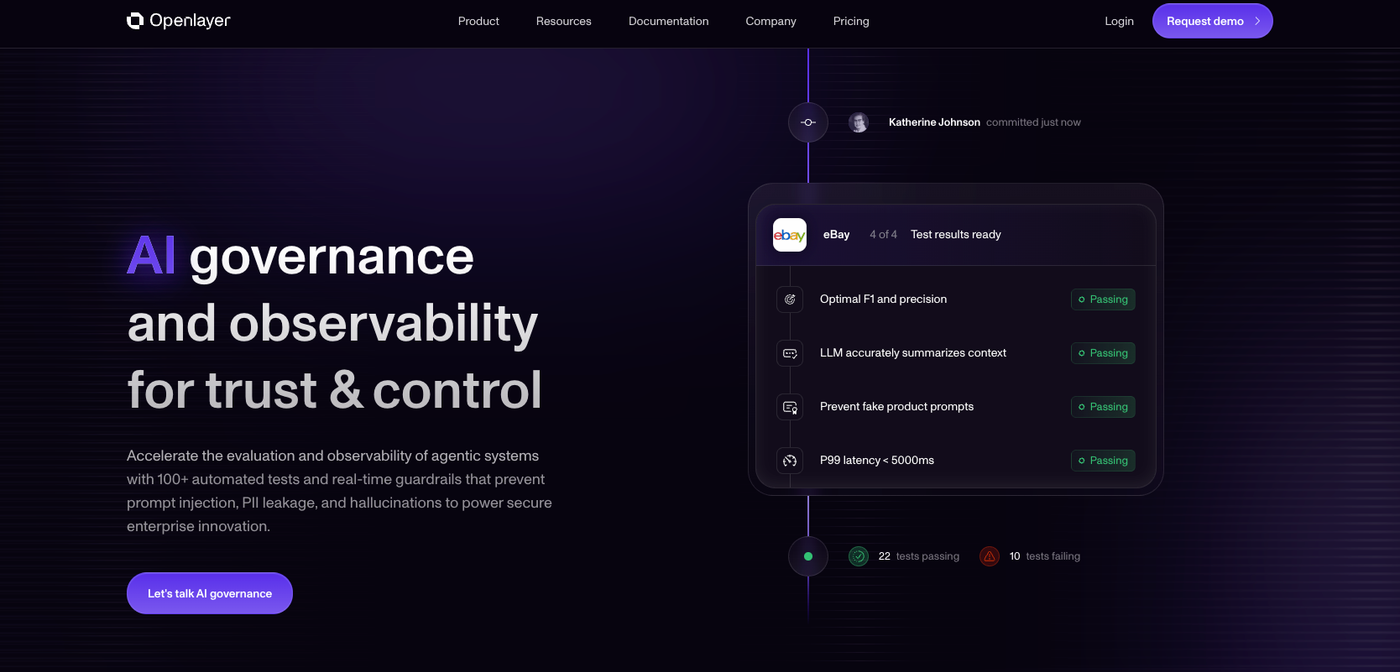
Openlayer blocks threats at runtime, tests AI behavior across modalities, and automates compliance mapping. Prompt injection ranks as the top AI security risk in OWASP's 2025 assessment. We stop prompt injections, jailbreaks, and PII leakage during inference before they reach downstream systems. The architecture handles development evaluation, production monitoring, and compliance in one layer.
Pre-built testing library
The 100+ prebuilt tests cover text, vision, audio, and agentic workflows, with prompt evaluation running on every request. Tests integrate into CI/CD pipelines to catch vulnerabilities before deployment.
Conformance to regulatory Frameworks
Compliance mapping runs automatically with mapping to EU AI Act, NIST RMF, ISO 42001, and OWASP frameworks runs continuous risk assessment without manual configuration.
Multiple deployment options
Deployment options include on-premises, private cloud, and hybrid environments for data residency requirements.
Support for multiple AI systems
Openlayer supports traditional ML, LLMs, RAG systems, and autonomous agents. REST APIs, CLI, and SDKs integrate through OpenTelemetry support. SOC 2 compliance makes it viable for regulated industries like financial services, healthcare, and telecom.
Arize AI

Arize AI focuses on ML observability and model performance management. The tool tracks model behavior in production through drift detection and performance monitoring, but does not provide real-time threat prevention during inference.
Key features
Arize includes a number of key features and capabilities for real-time AI security:
- Model performance tracking
- Data distribution drift detection
- LLM evaluation tools
- Performance tracing
- Integration with major cloud providers.
Limitations
The tool lacks runtime security guardrails that block threats like prompt injections or PII leakage during inference. Compliance mapping to frameworks like EU AI Act or NIST RMF requires manual configuration. Security analysis happens retrospectively instead of at runtime.
The bottom line
Arize suits teams focused on observability, not active security controls. Teams requiring real-time threat blocking need separate security tooling.
Fiddler AI
Fiddler AI focuses on AI observability with explainability and responsible AI governance for enterprise deployments. The tool helps teams understand model decisions through interpretability features and fairness assessments.
Key features
Fiddler includes a number of key features and capabilities for real-time AI security:
- Monitoring model performance and detecting data drift in production.
- Explainability tools break down predictions to surface feature importance and decision paths.
- Fairness assessment frameworks look at models for bias across demographic segments.
- LLM observability tracks generative AI responses with content moderation capabilities.
- SOC 2 and HIPAA compliance features support regulated industries.
Limitations
Fiddler lacks runtime security guardrails that actively block threats during inference. The system explains decisions after they occur instead of preventing security threats in real time.
The bottom line
Teams looking for model interpretability over active security controls will find value in Fiddler's explainability features.
Arthur AI
Arthur AI monitors AI performance and manages MLOps workflows for enterprise deployments. The system tracks model behavior across development and production with focus on operational metrics.
Key features
Arthur AI includes a number of key features and capabilities for real-time AI security:
- LLM evaluation tools with firewall functionality for generative AI systems
- Model deployment monitoring with drift detection and performance tracking
- Observability dashboards for model behavior and prediction analysis
Limitations
Arthur provides monitoring infrastructure but lacks behavioral testing suites. The system does not include prebuilt test libraries for multimodal workloads or adversarial robustness scenarios. Automated compliance mapping to regulatory frameworks like EU AI Act, NIST RMF, or ISO 42001 requires manual configuration. Finally, security guardrails focus on monitoring, not active prevention during inference. Teams requiring extensive security testing and automated governance will need supplementary tooling.
The bottom line
Arthur suits organizations that want performance monitoring first and foremost. Teams requiring integrated security testing with automated regulatory compliance should look at solutions with built-in governance automation.
Superwise
Superwise provides monitoring and governance for AI applications in production. The tool tracks model behavior after deployment, not blocking threats during inference.
Key features
Superwise includes a number of key features and capabilities for real-time AI security:
- Data quality monitoring that validates pipeline inputs before they reach models, catching schema violations and data integrity issues early in the workflow
- Drift detection across multiple data types to identify when model inputs or outputs shift from expected patterns over time
- Bias and fairness monitoring that helps teams document compliance with regulatory requirements through ongoing measurement
- Incident correlation that groups related alerts to reduce noise and help teams identify root causes faster
Limitations
Superwise does not offer runtime protection against prompt injections or PII leakage. The system lacks multimodal testing for vision, audio, or agentic workflows. Security analysis happens through post-deployment monitoring, not active guardrails that prevent threats during inference.
The bottom line
Teams focused on governance documentation will find value here. Organizations that need real-time threat prevention should consider solutions with runtime blocking capabilities.
Feature comparison table of real-time AI security guardrails
| Feature | Openlayer | Arize AI | Fiddler AI | Arthur AI | Superwise |
|---|---|---|---|---|---|
| Real-time security guardrails | ✓ | ✗ | Partial | Partial | ✗ |
| Automated compliance mapping | ✓ | ✗ | ✗ | ✗ | ✗ |
| Multimodal testing (100+) | ✓ | ✗ | ✗ | ✗ | ✗ |
| CI/CD integration | ✓ | ✓ | ✓ | ✓ | ✓ |
| Runtime threat blocking | ✓ | ✗ | Partial | Partial | ✗ |
| Regulatory framework support | ✓ | ✗ | Basic | Basic | Basic |
FAQ
How do real-time AI security guardrails differ from post-deployment monitoring?
Real-time guardrails intercept and block threats during inference in milliseconds, preventing prompt injections and PII leakage before they reach downstream systems. Post-deployment monitoring analyzes threats after they occur, which means malicious queries may already have accessed sensitive data or triggered compliance violations.
What types of threats can AI security guardrails detect and block?
Security guardrails detect prompt injections, jailbreak attempts, data exfiltration, and PII leakage at runtime. They look at every prompt and output against security policies during inference, automatically blocking malicious queries before they reach production systems or expose sensitive information.
Can I deploy AI security guardrails in on-premises environments?
Yes, enterprise-grade solutions support on-premises, private cloud, and hybrid deployments to meet data residency requirements. This deployment flexibility matters for regulated industries like financial services and healthcare where data cannot leave organizational boundaries due to compliance mandates.
How long does it take to integrate security guardrails into existing CI/CD pipelines?
Integration typically takes 2-3 hours using REST APIs, CLI, or SDKs with OpenTelemetry support. Git hooks and pipeline triggers fit into existing development workflows without requiring infrastructure changes, and automated testing runs on every code commit or model version update.
Do I need separate tools for different AI modalities like text, vision, and audio?
No, multimodal security solutions test text, vision, tabular, audio, and agentic workflows through a single platform. Production AI systems rarely operate on one modality, so unified testing coverage prevents security gaps that arise when using separate tools for each data type.
Final thoughts on implementing runtime AI protection
AI security tools that block threats during inference give you protection where it matters most. You can't afford to wait for post-deployment analysis when handling customer data or financial transactions. Runtime guardrails catch prompt injections, jailbreaks, and PII leakage before they reach downstream systems. Start testing your AI behavior across modalities and automate compliance mapping to reduce manual security work.