The 6 best AI governance tools in May 2026
Every AI governance tool claims to handle compliance, but many of them focus primarily on inventory and risk assessments instead of active enforcement. When your model hallucinates in production or a prompt injection surfaces PII, documentation doesn't prevent the breach. Runtime enforcement does. We assessed six platforms against the same practical question: do they actively block risks before they reach users, or do they just generate reports after the fact? The tools below were scored on automated testing, real-time guardrails, and whether compliance is an outcome of how you build or a separate process you manage in parallel.
TLDR:
- AI governance tools track models, risks, and compliance across NIST RMF, EU AI Act, and ISO 42001.
- Most tools document policies after the fact; few enforce security in production with runtime guardrails.
- Credo AI focuses on policy mapping and audit trails but lacks real-time monitoring capabilities.
- IBM watsonx.governance covers multi-cloud deployments but offers no prompt injection blocking.
- Openlayer combines CI/CD-integrated testing with production enforcement and automated compliance evidence.
What are AI governance tools?

AI governance tools are software solutions that help organizations identify, inventory, monitor, and control AI systems across their entire lifecycle. They sit between your AI deployments and the regulatory, ethical, and business requirements those systems must meet.
Why do enterprises need them now? Because AI is no longer experimental. Models are making credit decisions, triaging patient data, and routing customer support at scale.
When something goes wrong, "we didn't know" is not a defensible answer to a regulator. According to a 2026 industry report, 91% of AI tools in enterprise use are unmanaged by security or IT teams, with employees connecting them to email, document repositories, and customer data without formal risk assessment.
Good AI governance tools do more than store policy documents. They track which models are running, who owns them, what risks they carry, and whether those risks are actively monitored. They map AI systems to frameworks like NIST RMF, EU AI Act, and ISO 42001, and they generate audit-ready evidence automatically, not through manual spreadsheets. Organizations implementing AI governance best practices require tools that enforce controls across the full model lifecycle.
How we assessed AI governance tools
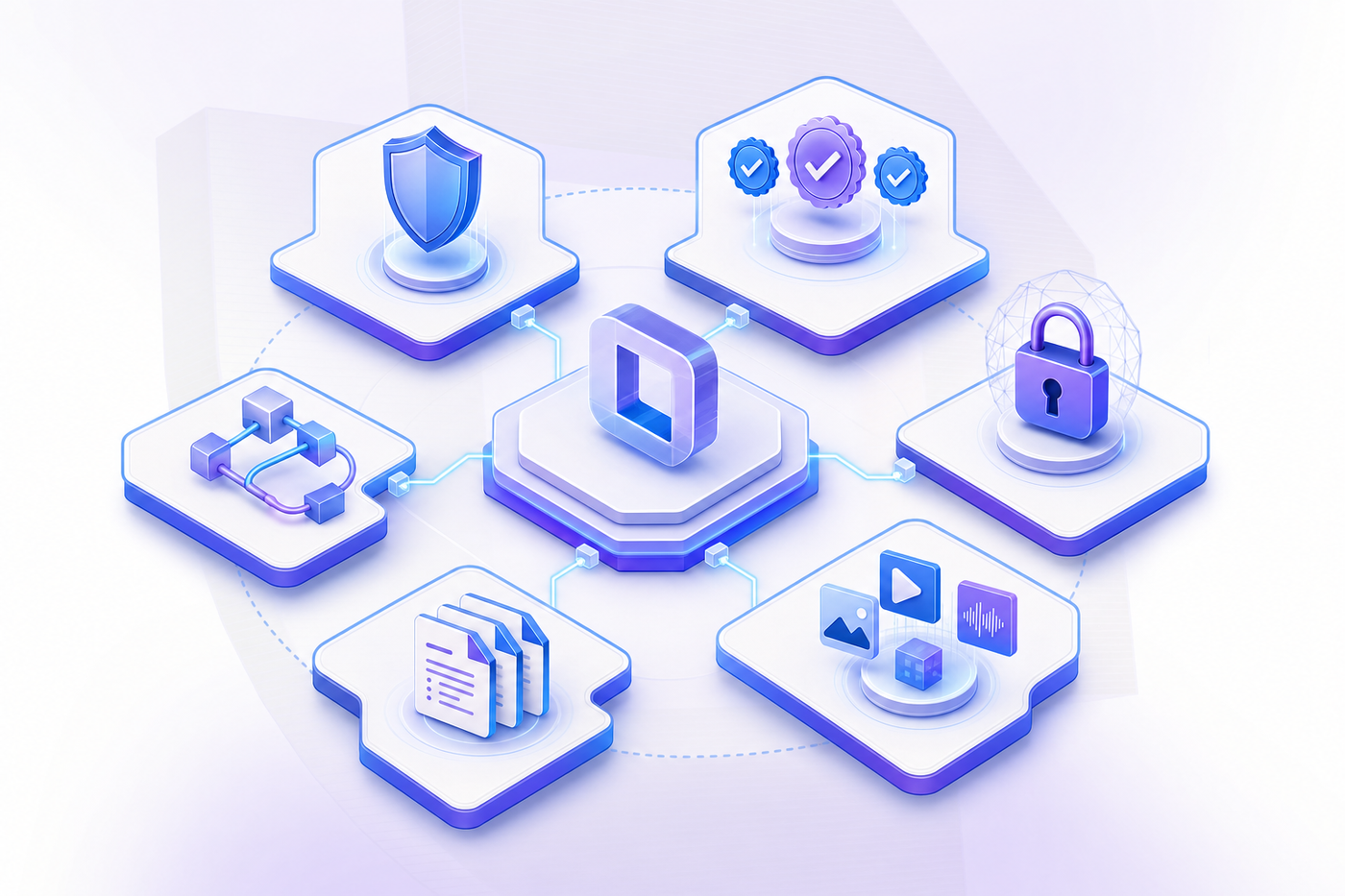
Every tool on this list was assessed against the same set of practical criteria. These are factors that matter to buyers in regulated industries, not abstract benchmarks.
- Runtime enforcement: does the tool actively block or flag risks in production, or does it only document policies after the fact?
- Automated compliance mapping: can it map AI systems to EU AI Act, NIST RMF, ISO 42001, and similar frameworks without manual configuration?
- Real-time security guardrails: does it detect and prevent prompt injection, PII leakage, and data exfiltration before they reach downstream systems?
- CI/CD integration: can governance and testing fit into existing development pipelines instead of sitting outside them?
- Multi-modal and multi-system coverage: does it handle traditional ML, LLMs, agents, and RAG pipelines under one roof?
- Audit-ready evidence generation: does it produce exportable, regulator-friendly records automatically, or does it require manual assembly?
Each evaluation drew on publicly documented capabilities across vendor sites, product documentation, and independent analyst coverage.
Best overall AI governance tool: Openlayer
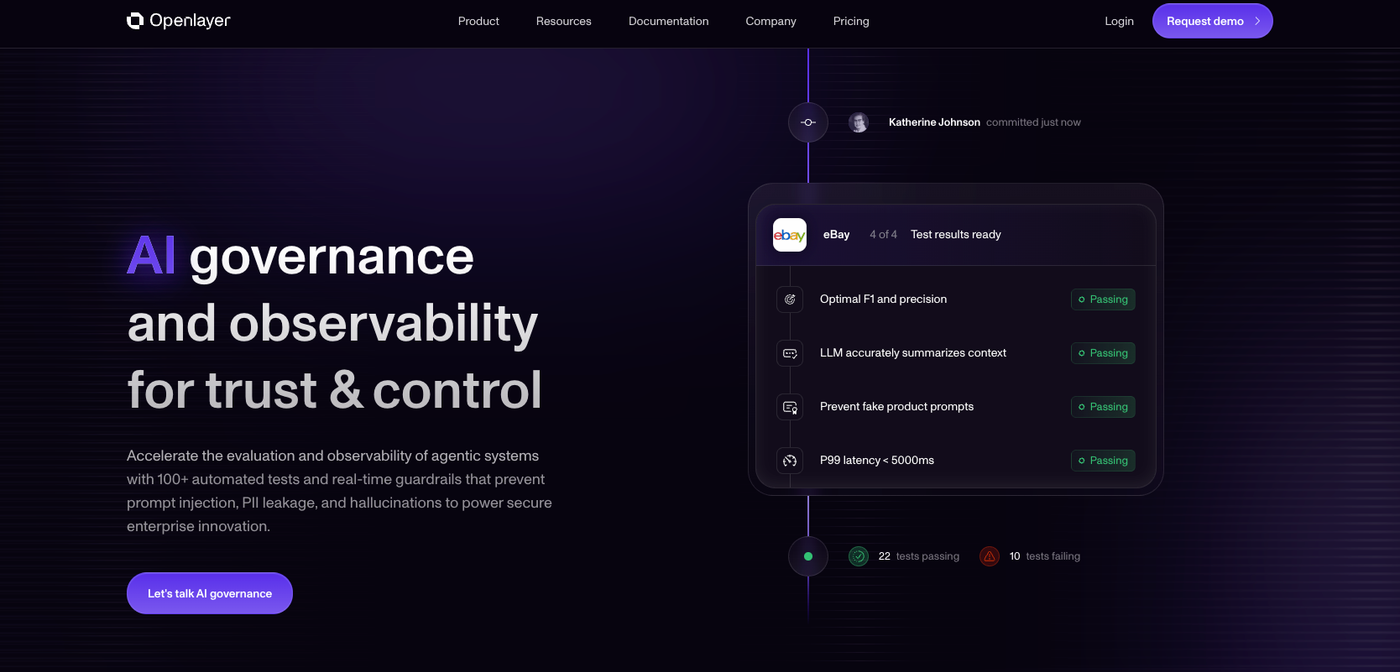
Openlayer is an AI governance and observability platform built for teams that need enforcement, not documentation. It combines CI/CD-integrated testing, real-time security guardrails, and automated compliance evidence into a single workflow.
Organizations running LLM-based products, agentic systems, and traditional ML at scale use it to prove model safety to regulators with evidence instead of assertions.
Key features
- Over 100 automated tests run as CI/CD pipeline primitives, covering bias, toxicity, hallucinations, and latency before any model ships.
- Real-time security guardrails block prompt injections and PII leakage before they reach downstream systems.
- Automated compliance evidence maps AI systems to EU AI Act, NIST RMF, and ISO 42001 without manual configuration.
- Continuous production monitoring detects drift, regressions, and safety violations as they occur across live deployments.
- Multi-modal and multi-system coverage spans traditional ML, LLMs, RAG pipelines, and agentic workflows under one roof.
Limitations
- Openlayer is purpose-built for technical governance, so non-technical policy teams may face a steeper onboarding curve compared to documentation-first platforms.
- Organizations that only need basic AI inventory and policy mapping may find the platform's depth exceeds their current requirements.
- Pricing is not publicly listed, so cost evaluation requires direct engagement with the sales team.
Bottom line
Openlayer is best suited for enterprises in regulated industries, including financial services, insurance, healthcare, and telecom, that are already deploying AI in production and need governance that holds up under regulatory scrutiny. AI and ML engineering teams, compliance officers, and Chief AI Officers benefit most, particularly those who need testing and monitoring unified in a single platform instead of managed across separate tools.
Credo AI
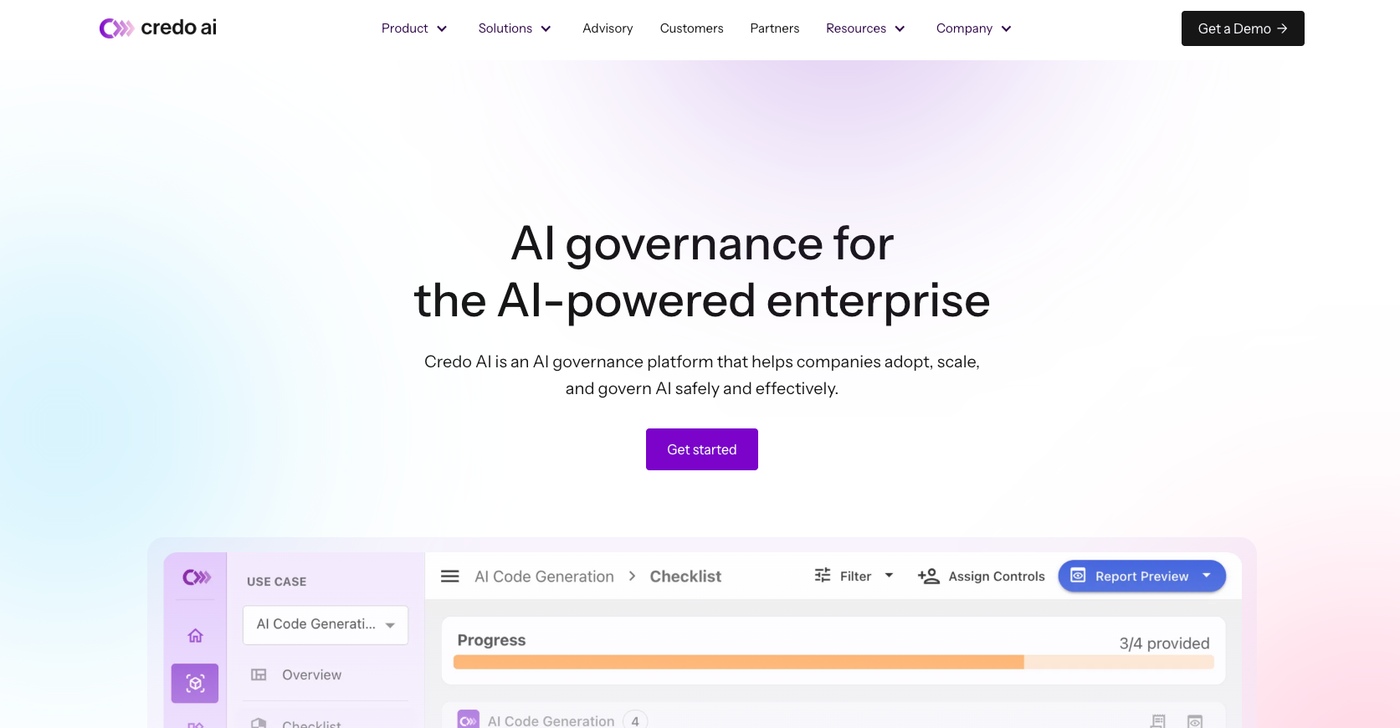
Credo AI is one of the more well known names in AI governance, with a focus on policy enforcement, risk assessment, and audit-ready documentation. It sits closer to the compliance and reporting end of the range, helping teams map AI systems to regulatory requirements like the EU AI Act and NIST AI RMF. Governance and legal teams are as much the target audience as technical ones.
Key features
- AI use case inventories and risk assessments generate audit-ready evidence packages for regulators.
- Direct framework mapping connects controls to EU AI Act and NIST AI RMF requirements with tracked attestations.
- Integration with existing ML pipelines pulls in model metadata and evaluation results automatically.
- Governance records and audit trails are maintained over time, supporting enterprises under active regulatory scrutiny.
Limitations
- Credo AI has limited support for real-time model monitoring or continuous production testing.
- Teams that need production-level observability alongside governance will likely need a separate tool.
- Pricing is not publicly listed and operates on an enterprise sales model.
Bottom line
Credo AI is best suited for enterprises focused on policy alignment, audit preparation, and regulatory documentation over runtime enforcement. Governance, legal, and compliance teams benefit most, particularly those managing active regulatory scrutiny who need a reliable audit trail and framework mapping over production-level monitoring.
IBM watsonx.governance
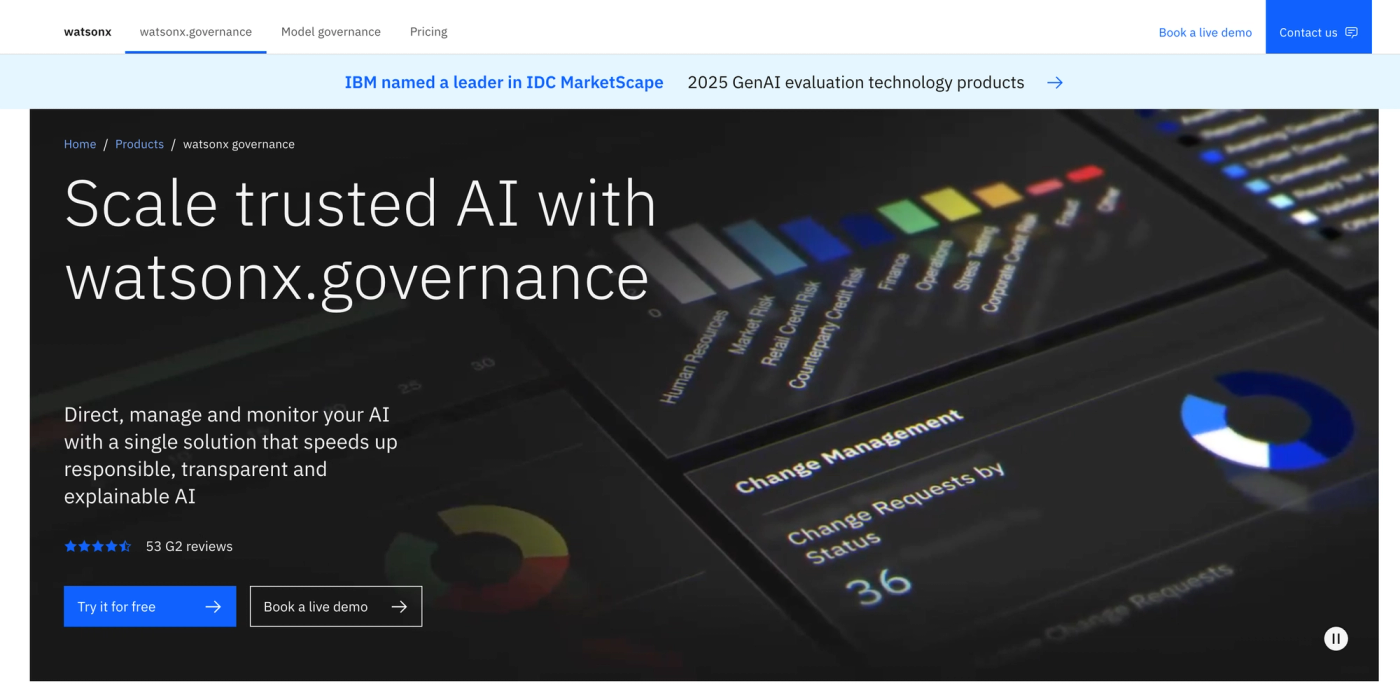
IBM watsonx.governance is designed for enterprises running AI across multi-cloud and hybrid environments, with a focus on fairness, explainability, and policy-driven lifecycle management. It covers traditional ML, generative AI, and agentic systems within the IBM ecosystem and extends to select multi-cloud deployments. Governance and risk teams at organizations already standardized on IBM infrastructure are the primary audience.
Key features
- Agent observability with accuracy tracking, hallucination detection, and reasoning trace capture across agentic workflows
- Risk governance aligned to banking and insurance MRM standards and evolving AI regulations across development and production stages
- Model lifecycle management spanning IBM Cloud, AWS, Azure, Oracle Cloud, on-premises, and hybrid environments
- Framework mapping to EU AI Act, NIST AI RMF, and ISO 42001 through policy dashboards and attestation workflows
Limitations
- No real-time guardrails for prompt injection blocking or PII detection and redaction in production
- No CI/CD integration for automated pre-deployment testing, so governance sits outside the development pipeline
- Compliance evidence requires manual setup and IBM service involvement, instead of automated, continuous collection
- Coverage is largely IBM-native; governing non-IBM AI systems requires additional tooling and manual evidence stitching
- Pricing is not publicly listed for enterprise tiers; the Essentials SaaS plan is billed at USD $0.60 per resource unit
Bottom line
IBM watsonx.governance fits large enterprises already deep in the IBM ecosystem, particularly those with FedRAMP compliance requirements or a preference for IBM-delivered services. It works best when your AI estate is IBM-native. Teams that need runtime security enforcement, CI/CD-integrated testing, or automated compliance evidence across a mixed-vendor AI stack will reach its limits quickly.
OneTrust
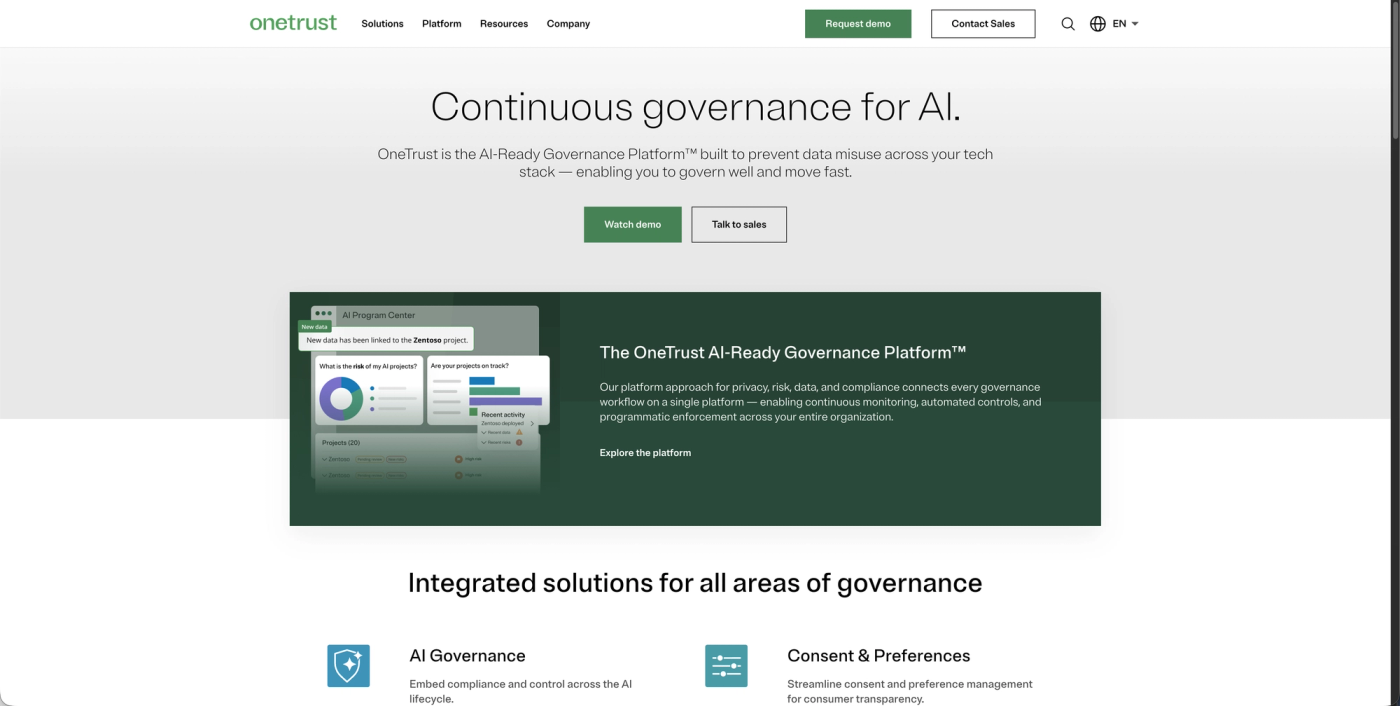
OneTrust is a data privacy and trust management platform that has extended into AI governance through a dedicated module built on top of its existing privacy, security, and compliance suite. It is designed for organizations that already use OneTrust for regulatory workflows and want to bring AI oversight into the same environment. Governance, legal, and privacy teams are the primary audience, not engineering or ML operations teams. The platform covers documentation and workflow management but does not extend to the technical layer: there is no model-level testing, no bias or hallucination detection, no CI/CD integration, and no runtime enforcement.
Key features
- AI system inventory and risk tiering with metadata documentation for each registered model or use case
- Integration with existing OneTrust privacy workflows, connecting AI governance to GDPR, CCPA, and similar data protection requirements
- Framework mapping to EU AI Act and NIST AI RMF through policy documentation and attestation workflows
- These capabilities connect to broader third-party risk management and vendor assessment processes already in use across the platform, which is useful for teams managing EU AI Act provider and deployer obligations
Limitations
- No runtime enforcement: the platform does not block prompt injections, detect PII leakage, or intercept adversarial inputs in production
- No CI/CD integration for automated pre-deployment testing; governance sits outside the development pipeline
- No model-level testing, evaluation, or bias detection: coverage is limited to documentation and workflow management
- Compliance evidence requires manual assembly instead of automated, continuous collection
- Pricing is not publicly listed and operates on an enterprise sales model
Bottom line
OneTrust fits organizations that already rely on it for privacy and compliance work and want a lightweight way to extend those workflows into AI oversight. It works best when the priority is policy documentation and regulatory alignment over technical enforcement. Teams that need production monitoring, automated testing, or runtime security controls will need a separate tool to cover those gaps.
Collibra
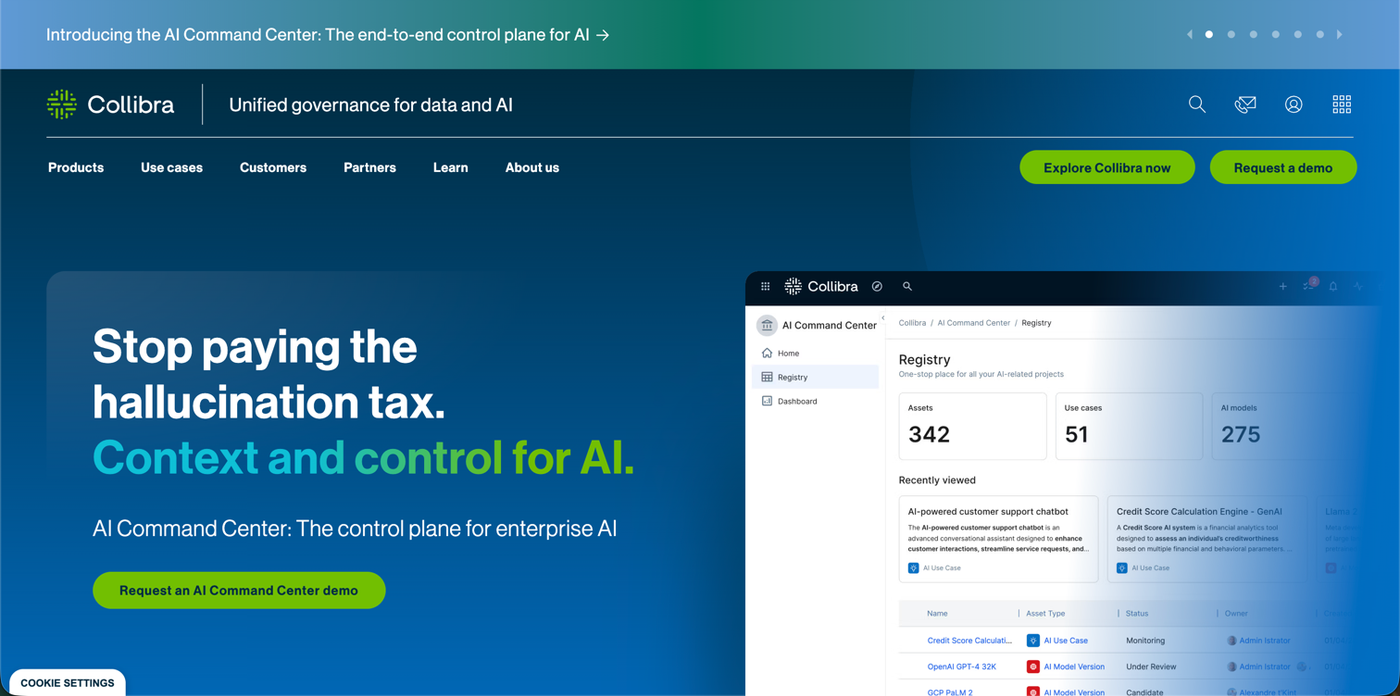
Collibra is a data governance and catalog platform that has extended into AI governance through policy management, data lineage tracking, and compliance workflows. It is built for large enterprises managing complex data estates and works best for organizations that treat AI systems as another category of data asset to document and track. Governance, legal, and data stewardship teams are the primary audience, not engineering or ML operations teams.
Key features
- Data catalog and lineage tracking that covers AI systems alongside other enterprise data assets, with metadata documentation for each registered model or use case
- Policy management and intake workflows that route new AI systems through review and approval processes consistent with existing data governance structures
- Compliance workflow support for EU AI Act and NIST AI RMF through template-based documentation and manual evidence uploads
- Integration with existing Collibra data stewardship workflows, reducing onboarding friction for organizations already standardized on the platform
Limitations
- No runtime enforcement: the platform does not block prompt injections, detect PII leakage, or intercept adversarial inputs in production
- No prebuilt test library or CI/CD integration for automated pre-deployment testing; governance sits outside the development pipeline
- No continuous production monitoring for drift, regressions, or live model behavior; coverage is limited to lineage and documentation
- Compliance evidence requires manual uploads and approvals instead of automated, continuous collection
- Pricing is not publicly listed and operates on an enterprise sales model
Bottom line
Collibra fits organizations that already rely on it for data cataloging and want to extend those workflows into AI oversight without adopting a separate platform. It works best when the priority is documentation, lineage, and policy alignment instead of technical enforcement. Teams shipping ML, LLM, or agentic systems into production and needing runtime security controls, automated testing, or continuous compliance monitoring will need a separate tool to cover those gaps.
complete AI
complete AI is a risk management and compliance platform built around AI portfolio discovery, regulatory readiness, and automated framework mapping. It targets governance and legal teams that need to classify AI systems, identify compliance gaps, and prepare documentation for regulators. Organizations focused on EU AI Act readiness and audit preparation are its primary audience, not engineering or ML operations teams.
Key features
- Built-in frameworks for EU AI Act, NIST AI RMF, ISO 42001, and NYC Local Law 144 with automated control mapping and gap analysis
- Automatic discovery of all AI systems including shadow AI, with continuous evaluation for bias, hallucinations, and robustness pre- and post-deployment
- Guardian Agents that observe agent behavior and score risks across agentic workflows
- Operative Agents that activate kill switches and block unsafe requests in real time within the complete AI environment
- Risk tiering and gap analysis reports that map AI systems to applicable regulatory requirements and flag missing controls
Limitations
- No runtime gateway: the platform identifies compliance gaps but does not intercept AI interactions or apply controls at the inference layer
- No CI/CD integration for automated pre-deployment testing; governance sits outside the development pipeline
- No PII detection and redaction in production; coverage is limited to risk assessment and documentation
- Compliance evidence requires manual assembly instead of automated, continuous collection
- Pricing is not publicly listed and operates on an enterprise sales model
Bottom line
complete AI fits organizations focused on EU AI Act classification, regulatory readiness assessments, and AI portfolio visibility. Governance and legal teams benefit most, particularly those preparing for regulatory submissions or building an initial inventory of AI systems. Teams deploying models in production that need runtime security controls, CI/CD-integrated testing, or automated compliance evidence will need a separate tool to cover those gaps.
Feature comparison table of AI governance tools
No single tool wins every category. Here is how each one stacks up across the criteria that matter most in regulated deployments.
| Capability | Openlayer | Credo AI | IBM watsonx | OneTrust | Collibra | complete AI |
|---|---|---|---|---|---|---|
| 100+ automated tests | Yes | No | No | No | No | No |
| Real-time security guardrails | Yes | No | No | No | No | No |
| CI/CD integration | Yes | No | Yes | No | No | No |
| Production monitoring | Yes | No | Yes | No | No | Yes |
| Runtime enforcement | Yes | No | No | No | No | No |
| EU AI Act compliance | Yes | Yes | Yes | Yes | Yes | Yes |
| NIST RMF mapping | Yes | Yes | Yes | Yes | No | Yes |
| ISO 42001 support | Yes | Yes | Yes | No | No | Yes |
| Multi-modal support | Yes | No | Yes | No | No | Yes |
Regulatory framework mapping is table stakes at this point. Where tools diverge sharply is runtime enforcement and automated testing, the capabilities that separate governance tools that prevent incidents from ones that document them afterward.
Why Openlayer is the best AI governance tool
Governance by documentation breaks down at scale. When a model drifts, a prompt gets manipulated, or PII surfaces in an output, policy records don't stop the incident. Runtime controls do. Openlayer covers the full arc from CI/CD-integrated testing before release to live guardrails blocking threats in production, without requiring separate vendors for each layer.
Here is what that looks like in practice:
- 100+ automated tests run as pipeline primitives, catching bias, toxicity, hallucinations, and latency regressions before any code ships.
- Security guardrails intercept prompt injections and adversarial inputs in real time, in production.
- Compliance evidence is captured automatically across NIST RMF, EU AI Act, and ISO 42001, with no manual assembly required.
Most tools govern by documenting. Openlayer governs by enforcing.
Final thoughts on governance tooling for AI systems
Most AI governance tools help you document what went wrong after an incident. The ones worth deploying stop problems before they reach production. Your stack should test for bias and toxicity in CI/CD, block adversarial inputs at runtime, and generate compliance records automatically. Governance becomes easier when it's built into how you ship, instead of tracked separately after the fact.
FAQ
How do I choose the right AI governance tool for my organization?
Start by assessing whether you need runtime enforcement or documentation. If your priority is preventing incidents in production through real-time guardrails and automated testing, focus on tools with CI/CD integration and security controls. If your focus is policy alignment and audit preparation, governance-first platforms may fit better.
Which AI governance tools work best for teams already deploying models in production?
Teams with live deployments need continuous monitoring and runtime enforcement, not compliance documentation alone. Look for platforms that detect drift, bias, and safety violations as they happen, integrate with existing ML pipelines, and generate audit-ready evidence automatically.
What is the difference between compliance mapping and runtime enforcement in AI governance?
Compliance mapping connects your AI systems to regulatory frameworks like EU AI Act, NIST RMF, or ISO 42001, tracking which controls apply and documenting adherence. Runtime enforcement actively blocks threats in production (prompt injections, PII leakage, adversarial inputs) before they cause incidents.
When should I integrate AI governance into CI/CD pipelines versus treating it as a separate process?
Integrate governance into CI/CD when you need to catch issues before deployment instead of finding them in production. Running automated tests for bias, toxicity, and security vulnerabilities as pipeline primitives prevents regressions from reaching users and makes compliance a byproduct of your build process.
Can AI governance tools handle both traditional ML models and LLM-based systems?
Not all tools cover both. Traditional ML monitoring requires drift detection and data quality checks, while LLM governance demands hallucination detection, prompt injection prevention, and context evaluation for RAG systems. Multi-modal platforms handle tabular, text, vision, and audio under one roof, but many vendors specialize in one domain at the expense of the other.