Best AI governance platforms for enterprise security (December 2025)
Most enterprise AI security platforms tell you what went wrong after it's already in production. That's too late. We're seeing teams get hit with prompt injections, PII leaks, and compliance violations because their governance layer only documents problems instead of blocking them. We ranked the solutions that actually stop issues before they ship.
TLDR:
- AI governance software enforces security, compliance, and risk controls across ML and GenAI systems.
- Real-time blocking of prompt injection and PII leakage prevents threats before they reach production.
- Automated compliance mapping to EU AI Act, NIST RMF, and ISO 42001 reduces manual audit work.
- Most tools focus on documentation; runtime enforcement catches issues in hours instead of weeks.
- Openlayer provides 100+ behavioral tests with CI/CD integration across development and production.
What are AI governance software tools?
AI governance software helps organizations manage, monitor, and control AI systems throughout their lifecycle. These tools provide risk assessment, compliance monitoring, bias detection, and security controls to support responsible AI development and deployment. Right now, only 29% of large enterprises have a dedicated AI governance plan in place. But growing concerns about ethical AI usage, government regulations, and data privacy are pushing organizations to invest in these capabilities.
Enterprise AI governance tools differ from traditional MLOps solutions by embedding policy, ethics, transparency, and risk management workflows directly into AI operations. MLOps focuses on deployment pipelines and infrastructure. Governance tools answer questions about compliance, fairness, and accountability. They provide the framework for proving your AI systems meet regulatory standards and internal policies before and after production.
How we ranked AI governance software tools
We graded each tool against criteria that matter most when securing and governing AI at enterprise scale. Our methodology focused on five core dimensions.
- Real-time security guardrails. These block prompt injection, jailbreaks, and PII leakage before reaching downstream systems
- Automated regulatory compliance. The solution automatically maps to EU AI Act, NIST RMF, ISO 42001, OWASP, and other frameworks
- Production monitoring capabilities. This includes drift detection, anomaly alerts, and continuous risk scoring
- Enterprise deployment. Solutions which provide flexibility across on-premises, private cloud, and hybrid environments
- Testing coverage. How does the solution deal with multimodal AI systems such as LLMs, agents, vision models, and tabular ML
We analyzed publicly available product documentation, regulatory framework support, integration capabilities, and deployment options for each vendor.
Best overall AI governance software tool: Openlayer
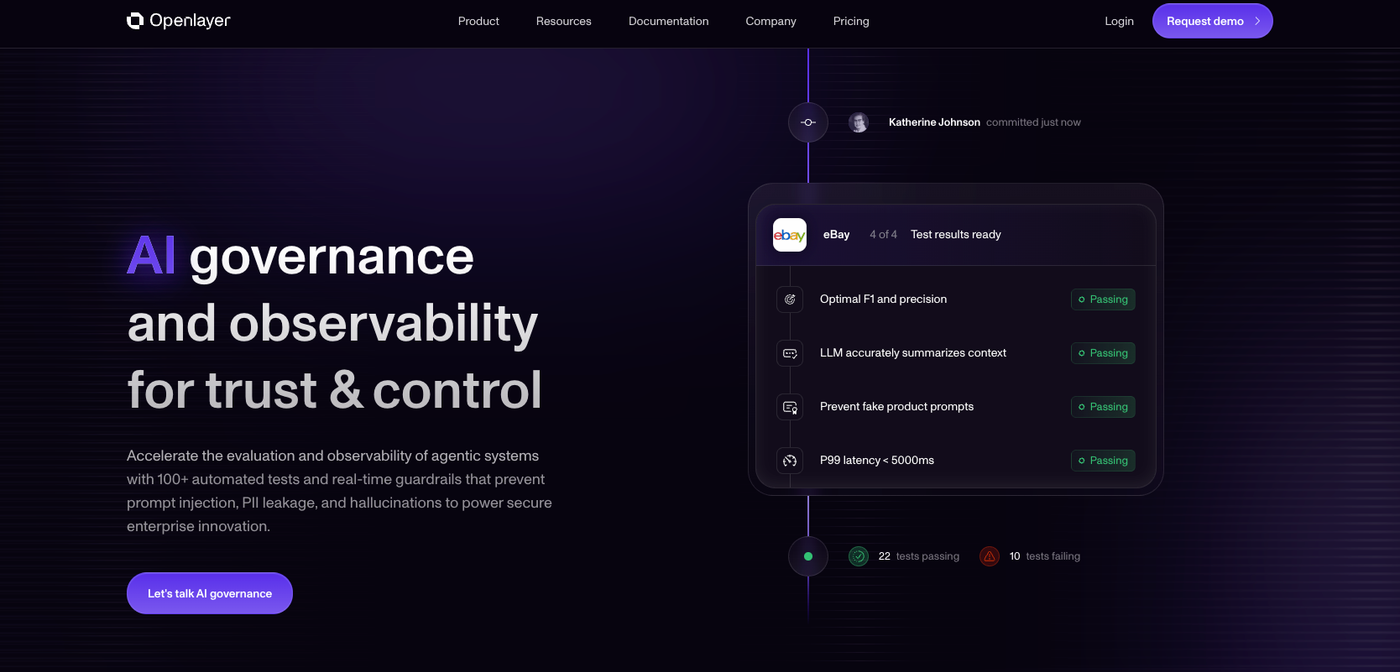
Security and compliance rank as the greatest AI implementation challenge for over half of enterprise leaders. Openlayer solves this through governance that enforces policies at runtime instead of documenting them after the fact.
Competitors specialize in assessment or documentation. We built governance into the operations layer. Prompt injections get blocked before reaching your systems, behavioral tests run automatically in CI/CD pipelines, and compliance mappings update as frameworks evolve. Teams using Openlayer catch critical issues within hours instead of weeks.
What sets Openlayer apart are features designed for AI governance and a flexible deployment model.
Testing
The Openlayer test library includes 100+ prebuilt evaluations spanning text, vision, tabular, audio, and agent workflows. These tests detect hallucinations, bias, toxicity, drift, and adversarial vulnerabilities as CI/CD primitives, validating each release before production deployment.
Proactive security
LLM guardrails run in real time to block prompt injections, data exfiltration, and PII leakage before sensitive information reaches downstream systems. Automated compliance mapping covers EU AI Act, NIST RMF, ISO 42001, OWASP, and LGPD with continuous risk assessments and AI compliance certification evidence collection for audit review.
Flexible deployment
Openlayer supports agents, RAG systems, LLM applications, and traditional ML models with the same governance layer. Controls run at runtime, not only after deployment, providing verifiable proof of compliance.
Credo AI
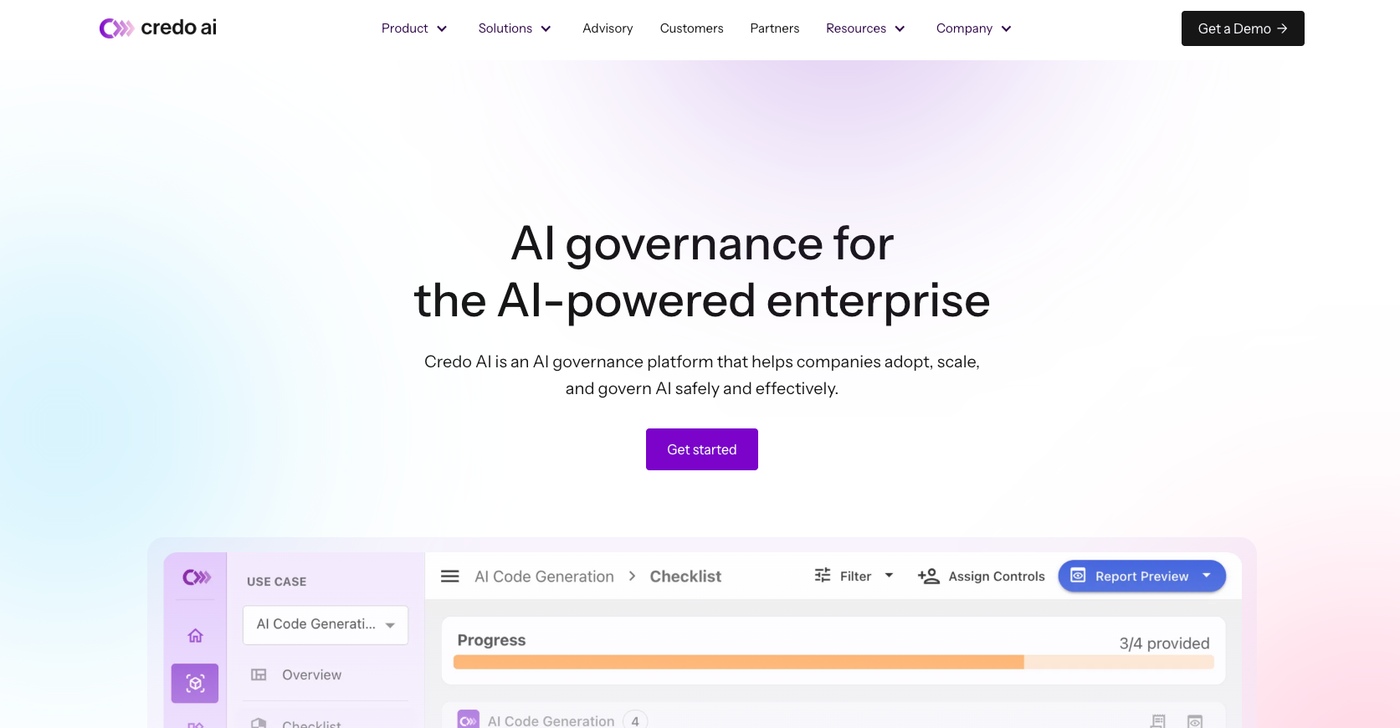
Credo AI focuses on risk assessment and regulatory compliance mapping for AI systems. The solution provides centralized metadata management and automated governance reporting.
Key features
Credo AI includes a number of features for AI governance:
- Centralized repository for AI metadata and documentation that tracks model lineage, training data sources, and deployment history across your AI portfolio
- Risk assessment tools that look at models for bias, fairness issues, and security vulnerabilities before deployment
- Automated governance reports that generate stakeholder-ready documentation for audit and compliance reviews
- EU AI Act compliance features with framework mapping to help organizations meet regulatory requirements
Limitations
Credo AI handles compliance documentation and risk assessment but doesn't monitor AI systems in production. The solution won't block threats like prompt injection or PII leakage as they happen.
The bottom line
Credo AI works for organizations that need compliance documentation and audit trails. Teams requiring runtime security controls or continuous production monitoring will need separate tools.
IBM WatsonX.governance
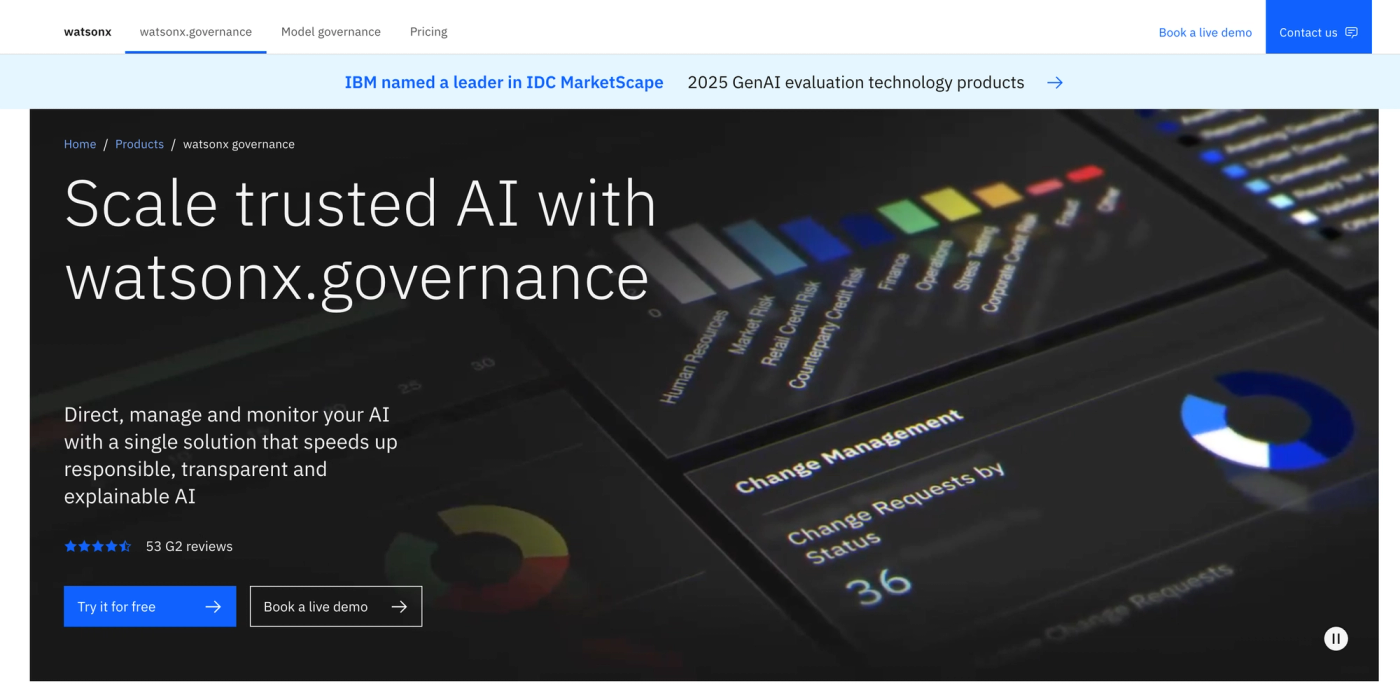
IBM WatsonX Governance coordinates oversight through policy-driven workflows tied to IBM's data and AI suite.
Key features
IBM WatsonX.governance includes a number of features for AI governance:
- Policy controls for fairness and explainability integrated across WatsonX environments
- Framework mapping to EU AI Act, NIST, and ISO standards with dashboards that track policy adherence and risk levels
- Integration with WatsonX.data and WatsonX.ai for unified management across IBM's AI stack
Limitations
Governance operates primarily within IBM's environment with limited visibility across non-IBM systems. WatsonX detects vulnerabilities but does not block prompt injections or data exfiltration in real time. It lacks multimodal and adversarial testing across agents and edge cases. Framework mapping requires manual configuration and service-heavy implementation. WatsonX governance works for IBM-centric estates but struggles in multi-cloud or hybrid environments where cross-stack oversight matters.
The bottom line
WatsonX fits enterprises standardized on IBM infrastructure seeking governance delivered through IBM services with tight ecosystem integration.
Collibra
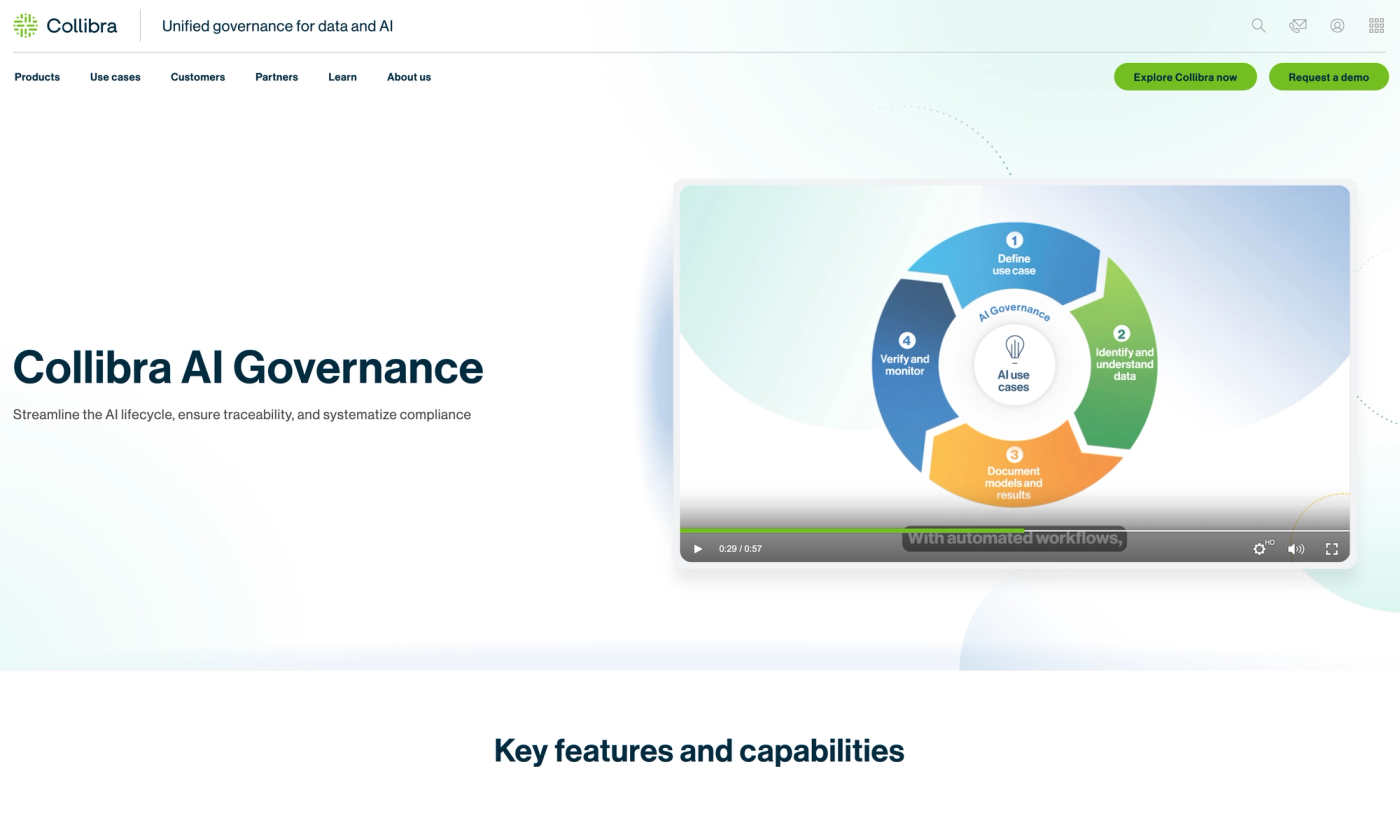
Collibra extends its data governance capabilities to AI oversight, connecting AI projects to underlying data assets through its existing catalog infrastructure.
Key features
Collibra includes a number of features for AI governance:
- AI Governance application that documents and monitors AI use cases with a business-user interface
- Integration with Collibra Data Catalog, Data Quality, and Data Privacy for unified data and AI visibility
- Risk ratings to prioritize AI initiatives based on sensitivity and compliance requirements
- Data lineage tracking showing how data feeds models and training data quality
Limitations
The limitation is scope. Collibra governs the data feeding models, not model behavior in production. It lacks real-time guardrails, behavioral testing across modalities, and runtime monitoring of outputs. The solution cannot detect prompt injections, drift, or adversarial attacks. Collibra adapts data governance to AI rather than providing AI-native governance. Enterprises requiring model behavior oversight, security guardrails, and automated testing need purpose-built solutions that address the full AI system lifecycle beyond data lineage.
The bottom line
Collibra fits organizations already using Collibra for data governance that want to extend oversight to AI projects and connect use cases to data assets.
Holistic AI
Holistic AI provides AI risk management and project tracking capabilities for enterprise AI inventory management. The solution helps organizations assess systems for bias and maintain regulatory compliance.
Key features
Holistic AI includes a number of features for AI governance:
- AI project tracking and inventory management systems that catalog AI deployments across the organization
- Bias assessment tools that look at model fairness across protected attributes and demographic groups
- Regulatory compliance monitoring aligned with global AI frameworks including the EU AI Act and NIST AI RMF
- Risk scoring and mitigation recommendations based on model characteristics and deployment context
Limitations
Holistic AI focuses on assessment, not operational enforcement. The solution won't block security threats in real time or run continuous behavioral tests during production.
The bottom line
Holistic AI supports compliance tracking and risk assessment workflows. Teams requiring runtime security controls or automated testing will need additional tools.
Feature comparison table of AI governance software tools
| Feature | Openlayer | Credo AI | IBM WatsonX Governance | Collibra | Holistic AI |
|---|---|---|---|---|---|
| Real-time security blocking | Yes | No | No | No | No |
| 100+ behavioral tests | Yes | No | No | No | No |
| Multi-framework compliance | Yes | Yes | Yes | Limited | Yes |
| CI/CD integration | Yes | No | Limited | No | No |
| Cross-environment support | Yes | Limited | Limited | Yes | Yes |
| Automated evidence collection | Yes | Yes | Limited | No | Limited |
| Production monitoring | Yes | No | Limited | Limited | Limited |
Most solutions focus on assessment and documentation. Openlayer adds runtime enforcement and continuous testing across development and production.
FAQ
What's the difference between AI governance and MLOps tools?
MLOps tools handle deployment pipelines and infrastructure, while AI governance tools enforce policy, ethics, and compliance throughout the AI lifecycle. Governance platforms answer questions about regulatory alignment, fairness, and accountability with automated evidence collection and risk scoring.
How do real-time security guardrails work in production?
Real-time guardrails analyze inputs and outputs as they flow through your AI systems, blocking threats like prompt injections and PII leakage before they reach downstream applications. This prevents security incidents instead of detecting them after the fact.
When should I implement behavioral testing for AI systems?
Implement behavioral testing before your first production deployment and maintain it throughout the model lifecycle. Tests should run automatically in CI/CD pipelines to catch regressions, bias, and security vulnerabilities before each release reaches users.
Can AI governance tools work across different cloud environments?
Enterprise AI governance platforms support on-premises, public cloud, and hybrid deployments to accommodate strict data residency requirements. Look for solutions that integrate with your existing infrastructure through APIs and SDKs instead of requiring a complete re-platform.
What compliance frameworks do AI governance platforms typically support?
Leading platforms automatically map AI projects to EU AI Act, NIST RMF, ISO 42001, OWASP, and LGPD with continuous risk assessments. This automated mapping reduces manual compliance work and generates audit-ready documentation for regulatory reviews.
Final thoughts on enterprise AI governance solutions
Effective AI governance software enforces policies during operations, not only after something breaks. Openlayer combines real-time security blocking with automated testing and compliance mapping across your entire AI stack. You get one governance layer that works for ML models, GenAI applications, and agent systems from development through production. Focus on tools that prevent risks before deployment instead of documenting them afterward.