AI Model Governance Frameworks for Enterprise Teams in May 2026
If your AI model governance framework lives in a presentation deck or a static PDF, the problem surfaces when regulators ask for evidence of what your models did three months ago. With EU AI Act high-risk obligations enforceable in August 2026, NIST AI RMF shaping US procurement, and ISO 42001 certification as the proof standard, governance moved from policy writing to runtime enforcement.
This post covers the major AI governance frameworks shaping 2026 practice, how to structure traceable accountability, and how to wire governance into CI/CD so your framework generates compliance evidence automatically.
TLDR:
- AI governance became mandatory in 2025-2026 due to EU AI Act enforcement (high-risk obligations by August 2026), NIST AI RMF adoption, and high-profile failures.
- Four frameworks shape enterprise governance: NIST AI RMF (Govern/Map/Measure/Manage), Singapore's Model AI Governance Framework, EU AI Act (risk-tiered), and ISO 42001 (certifiable).
- Governance collapses without clear roles: assign an AI governance lead, model owners for each system, and an independent review board before deployment.
- 43% of organizations cite regulatory complexity as their top barrier; solve by picking one framework as your spine and mapping others onto it.
- Openlayer connects evaluation, observability, and governance with runtime enforcement that blocks non-compliant outputs before they leave the API boundary.
What AI model governance means for enterprise teams
For enterprise teams, AI model governance is the set of policies, controls, and accountability structures that determine how AI models are built, tested, deployed, and monitored over time. It covers who owns decisions about model behavior, how risks get documented and tracked, and what evidence gets produced when auditors or regulators ask questions.
The scope matters here. Governance applies across the full model lifecycle, from training data selection through production monitoring, and it spans every stakeholder who touches a model: data scientists, product leads, legal, compliance, and executive sponsors.
Why enterprise AI governance became mandatory in 2025 and 2026
Three specific developments turned AI governance from a nice-to-have into a hard requirement for enterprise teams in 2025 and 2026: binding EU regulation with real deadlines, a US federal procurement signal, and a run of public model failures that exhausted board-level tolerance for informal risk management:
- The EU AI Act began enforcement in earnest, with GPAI provider obligations active as of August 2025 and high-risk financial-services obligations carrying an August 2026 deadline.
- The NIST AI Risk Management Framework gained traction as a procurement signal in the US public sector.
- High-profile model failures in hiring (Amazon's scrapped recruitment model), lending (Apple Card gender-bias complaints), and healthcare (Epic's sepsis prediction algorithm accuracy disputes) made boards and regulators far less tolerant of "we'll fix it later" postures.
The result: governance is now a precondition for deployment, not an audit-time afterthought.
Core principles behind effective AI governance frameworks
Across every major framework, from NIST AI RMF to Singapore's Model AI Governance Framework, a few structural principles appear consistently. Understanding them helps teams build governance programs that hold up under scrutiny instead of just checking boxes.
There are four principles worth anchoring to:
- Accountability must be assigned, not assumed. Every AI system needs a named owner, a documented decision trail, and a clear escalation path.
- Risk assessments need to be proportionate. A low-stakes internal tool and a credit-scoring model carry different exposure profiles. Governance overhead should scale with actual risk.
- Human oversight stays in the loop. For high-stakes decisions, frameworks require meaningful human review before or after automated outputs, not a nominal sign-off.
- Documentation supports auditability. Model cards, data lineage records, and decision logs must exist before an audit arrives. Retroactive documentation rarely holds up under regulatory review.
Major AI governance frameworks enterprises are using in 2026

Several major frameworks have become the reference points for enterprise AI governance teams in 2026. Each takes a distinct approach to risk, accountability, and oversight.
- The NIST AI Risk Management Framework (AI RMF) organizes AI governance into four functions: Govern, Map, Measure, and Manage. It gives teams a structured way to identify risk, assign ownership, and build repeatable processes without being prescriptive about tooling or sector.
- Singapore's Model AI Governance Framework, now in its second edition with a dedicated extension for generative AI and agentic AI, takes a layered approach that separates accountability between developers, deployers, and operators. The IMDA and PDPC jointly maintain it, and it has become a reference standard across Southeast Asia.
- The EU AI Act introduces mandatory, legally binding obligations tiered by risk level, with high-risk AI systems in sectors like finance and healthcare facing audit, transparency, and human oversight requirements by August 2026.
- ISO/IEC 42001 provides a certifiable management system standard for AI, filling the gap between policy documentation and demonstrable organizational compliance.
The table below provides a high-level overview of each framework, how enterprises need to consider it, and the framework's primary focus.
| Framework | Origin | Binding? | Primary focus |
|---|---|---|---|
| NIST AI RMF | United States | Voluntary | Risk identification and management |
| Singapore Model AI Governance Framework | Singapore (IMDA/PDPC) | Voluntary | Layered accountability across AI supply chain |
| EU AI Act | European Union | Mandatory | Risk-tiered regulation with legal obligations |
| ISO/IEC 42001 | International | Certifiable | AI management system standard |
Most enterprise teams are not choosing one framework exclusively. They are mapping across multiple standards simultaneously, which creates its own coordination challenge.
NIST AI RMF: govern, map, measure, and manage functions explained
The NIST AI Risk Management Framework organizes AI governance into four interconnected functions: Govern, Map, Measure, and Manage. Together, they give enterprise teams a structured way to think about risk across the full AI lifecycle instead of treating compliance as a one-time audit.
Here is how each function works in practice:
- Govern sets the organizational foundation: policies, roles, accountability structures, and risk tolerance thresholds that apply across all AI systems.
- Map identifies where risk lives: intended use case, affected stakeholders, data provenance, and failure modes before a model reaches production.
- Measure applies quantitative and qualitative methods to assess identified risks: bias testing, performance benchmarking, and monitoring against defined thresholds.
- Manage is where assessed risks get treated, accepted, transferred, or escalated through documented response plans with clear ownership.
Singapore Model AI Governance Framework: layered accountability across the AI supply chain
Singapore's Model AI Governance Framework is published by the Infocomm Media Development Authority (IMDA) and the Personal Data Protection Commission (PDPC). Now in its second edition, with dedicated extensions for generative AI and agentic AI, it takes a layered approach to accountability across the full AI supply chain, assigning distinct obligations to developers, operators, and deployers based on the degree of control each party exercises over the system.
The framework organizes AI governance across five core areas:
- Accountability structures: A principal hierarchy assigns governance responsibilities to AI developers, operators, and deployers based on what each party controls. A developer who builds a foundation model carries different obligations than the deployer who integrates it into a customer-facing product.
- Internal governance: Organizations set policies and processes covering AI decision-making, risk assessment, change management, and incident escalation, documented at the organizational level and not limited to individual models.
- Risk management: Risk is assessed across the AI lifecycle, covering both technical failure modes and broader societal impacts, including privacy, fairness, and access.
- Human-centric values: The framework requires that AI systems respect individual rights, fairness, and transparency, with those commitments documented and verifiable beyond a policy statement.
- Generative AI and agentic AI extension: The second-edition extension tackles risks specific to foundation model deployments and autonomous agents, including hallucination, output attribution, and accountability across multi-step action chains.
One practical note: the Singapore framework is voluntary. Organizations outside Singapore adopt it as a reference standard for multi-jurisdictional governance, particularly teams with operations across Southeast Asia, because its layered accountability model maps well to AI supply chains that involve third-party models, multiple deployers, and cross-border data flows. For US-focused organizations without Southeast Asian exposure, NIST AI RMF serves as the more natural internal spine, with the Singapore framework as a supplementary reference for supply-chain accountability structures.
EU AI Act compliance requirements for high-risk systems
Under the EU AI Act, high-risk AI systems face a defined set of obligations that took effect in August 2025 for most categories, with financial services systems carrying an August 2026 deadline. There are four areas where compliance work concentrates:
- Risk management systems must be maintained throughout the entire lifecycle of a high-risk system, not set up once at deployment.
- Technical documentation must cover model architecture, training data sources, known limitations, and compute used so that auditors can assess conformity on demand.
- Human oversight measures must be built into the system so that a qualified person can interpret outputs, recognize errors, and intervene.
- Accuracy, robustness, and cybersecurity requirements apply continuously, meaning a model that degrades in production can fall out of compliance even if it passed initial conformity assessment.
AI literacy requirements apply to both providers and deployers under Article 4, covering anyone who operates these systems, beyond those who build them.
ISO 42001 certification: building an AI management system
ISO 42001 is the international management system standard for AI, published by the International Organization for Standardization in 2023. Where the EU AI Act tells you what outcomes to achieve, ISO 42001 tells you how to build the internal system that produces those outcomes consistently.
The standard follows a Plan-Do-Check-Act structure across four core areas:
- Scope and context definition: specifying which AI systems fall under the management system, who the affected stakeholders are, and what obligations apply to each.
- Risk and impact assessment: identifying harms across the AI lifecycle before deployment, beyond the point of model release.
- Controls implementation: applying Annex A controls covering data governance, model documentation, human oversight mechanisms, and incident response.
- Performance evaluation and continual improvement: measuring whether controls work through internal audits, management reviews, and corrective action processes.
Third-party certification is awarded by an accredited auditor after a two-stage audit: a documentation review followed by an on-site assessment of whether the management system is actually running.
One practical note: ISO 42001 governs the management system, not the model itself. A certified organization can still deploy a poorly performing model. Certification signals process maturity, not model quality.
Building governance roles and accountability structures
Accountability gaps are where AI governance frameworks collapse in practice. A well-documented policy means little if no one owns enforcement when a model misbehaves or an audit request arrives. There are three core roles that enterprise teams need to define clearly before any governance framework can function:
- An AI governance lead or "Chief AI Officer" holds cross-functional authority to set policy, arbitrate risk decisions, and represent the organization in regulatory proceedings. Without this role, governance devolves into a coordination problem nobody has the authority to solve.
- Model owners sit at the team level and carry responsibility for a specific model's performance, fairness metrics, and documentation throughout its lifecycle. They are the ones who answer when auditors ask why a threshold was set where it was.
- An independent review board or ethics committee provides the checks on high-stakes deployment decisions, reviewing risk assessments before launch and periodically after. This body needs genuine independence; a committee composed only of the team shipping the model cannot provide meaningful oversight.
Mapping accountability to the AI lifecycle
Roles without lifecycle mapping create coverage gaps. You need to look at governance based on roles instead of job titles:
- The model owner and data team cover development-stage documentation and bias testing
- The ethics committee signs off on risk classification pre-deployment
- The model owner and ops team handle drift detection and incident escalation in production
- The governance lead packages evidence for regulatory audits; and the model owner manages retention and the final audit trail at decommissioning. This role also coordinates across all stages without becoming a bottleneck: distributed ownership with clear escalation paths keeps governance from collapsing to a single point of failure.
For additional guidance, enterprise teams often reference cross-industry AI governance role mapping patterns that show how approval workflows, monitoring responsibilities, and retirement procedures map to specific roles.
Creating an AI inventory and risk classification system
Before any governance framework can function, teams need a clear picture of which AI systems they actually have in deployment and how much risk each one carries. Without that inventory, policies float free of reality.
There are two parts to get right here: cataloging what exists and assigning risk tiers that determine how much oversight each system requires.
Building the AI system inventory
A working inventory captures more than a list of model names. For each system, teams should record:
- The business function it serves and the decisions it influences, whether those are customer-facing recommendations, internal credit scoring, or automated content moderation
- Data inputs and outputs, including whether personal or sensitive data flows through the system
- Who owns the system, who deployed it, and which vendors or third-party models are involved
- Current monitoring status and when the system last went through a formal evaluation
Assigning risk tiers
Once the inventory exists, each system gets classified. Most frameworks organize this into three or four tiers based on the severity of potential harm, the reversibility of decisions, and the degree of human oversight in the loop.
| Risk Tier | Characteristics | Governance Requirements |
|---|---|---|
| Critical | Decisions affect rights, safety, or big financial outcomes with limited human review | Pre-deployment audits, continuous monitoring, documented appeals process |
| High | Substantial impact on individuals or operations; some human oversight present | Regular evaluations, bias testing, documented model cards |
| Medium | Decisions are advisory or easily reversed; humans retain final authority | Periodic reviews, basic documentation |
| Low | Minimal impact; outputs are informational with no direct decision authority | Lightweight logging, standard change management |
The risk tier a system lands in should drive everything downstream: how frequently it gets tested, what documentation it requires, and what triggers a mandatory review cycle.
Wiring governance across the AI lifecycle
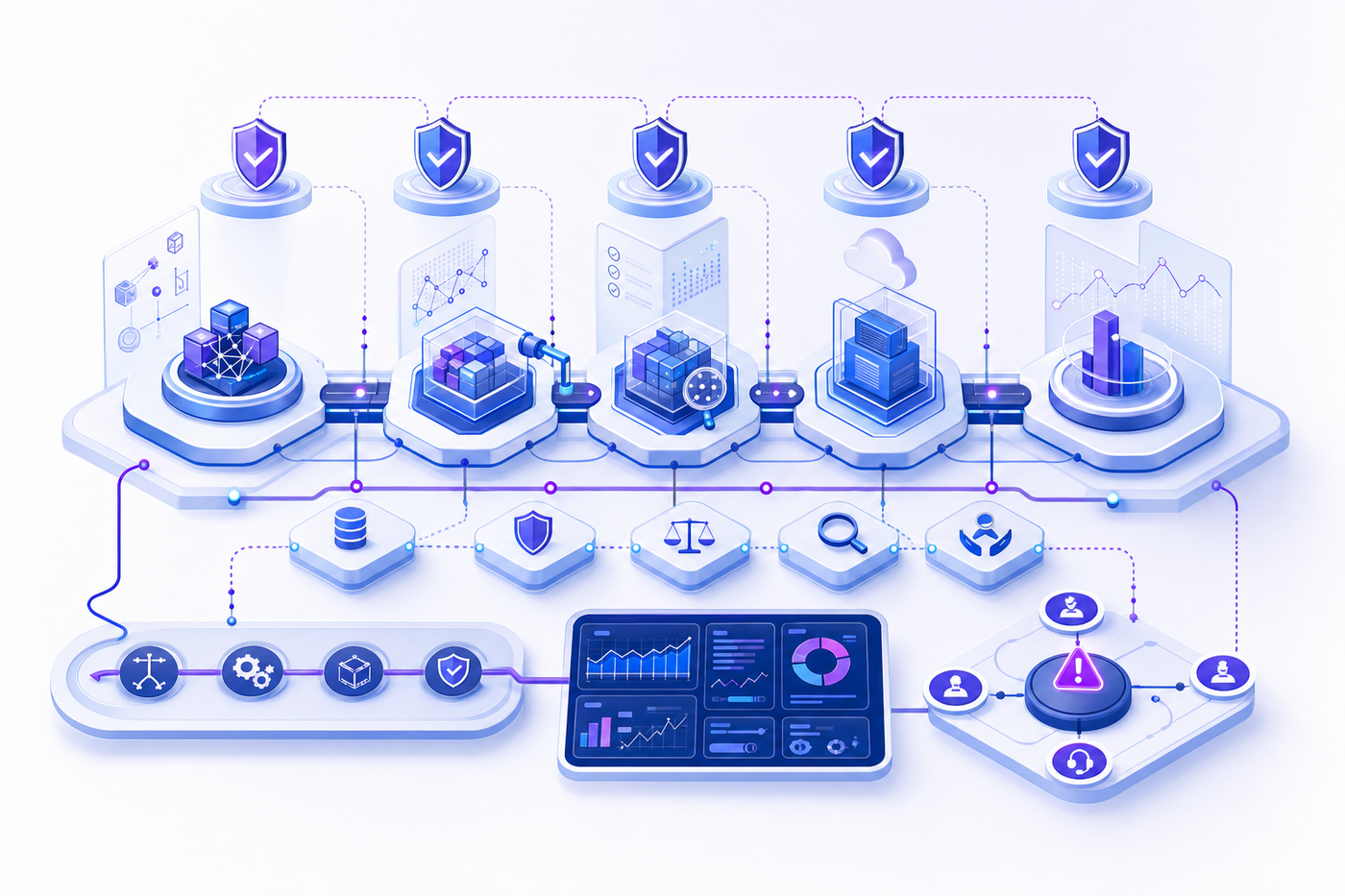
Governance frameworks that run parallel to engineering workflows get ignored. The ones that hold up are wired directly into the tools teams already use, so compliance work happens as a byproduct of shipping, not as a separate review cycle.
The integration points vary by lifecycle stage, but a few carry the most weight:
- During development, documentation requirements attach to the model registration process itself. Teams record training data sources, known limitations, and intended use cases before a model is eligible for review, not after.
- At the pre-deployment gate, automated evaluation runs against documented thresholds; for example, a groundedness score below 85% or a demographic parity gap above 5% blocks the build. If those metrics flag a problem, the deployment doesn't proceed. CI/CD integration makes this a hard gate, not a soft recommendation.
- In production, continuous monitoring watches for drift and degradation against the baselines set at deployment. Alerts route to the model owner automatically when thresholds are breached, with escalation paths defined in advance so incidents don't sit in an inbox.
- For incident response, documented runbooks specify who gets notified, what evidence gets preserved, and what remediation steps apply based on the risk tier of the affected system.
The audit trail builds itself when controls are embedded this way. Teams aren't reconstructing compliance evidence after the fact; they're generating it continuously as a side effect of normal operations.
Common implementation challenges and how to overcome them
Three barriers appear most consistently when enterprise governance programs stall. According to ModelOp's 2026 AI Governance Benchmark Report, 43% of organizations cite regulatory and compliance complexity as their primary obstacle, while 36% each point to skills gaps and unclear ownership and accountability.
The mitigation strategies for each look different in practice:
- Regulatory complexity compounds when teams try to track every framework in parallel. A more workable approach is picking one framework as your internal spine, NIST AI RMF is a practical starting point for most US-based organizations, and mapping other obligations onto it instead of maintaining separate documentation tracks for each.
- Skills gaps tend to block governance programs that require ML expertise to operate. If a compliance officer needs an engineer to pull evaluation results or interpret a risk dashboard, governance becomes a coordination bottleneck instead of a standing function. Tooling needs to give non-technical stakeholders direct access.
- Ownership gaps are usually a timing problem. Assigning model ownership retroactively, after a system is already in production, creates exactly the accountability voids that auditors find. Ownership decisions need to happen at intake, before development begins.
AI governance maturity levels: from ad hoc to optimized
Most enterprise AI programs pass through recognizable stages of governance maturity. Understanding where your organization sits determines which controls are realistic to implement now and which require foundational work first.
There are four broad levels to consider:
- Ad hoc: Models ship without documented ownership, risk classification, or review gates. Governance exists informally, if at all, and depends on individual judgment.
- Repeatable: Teams apply basic controls consistently, such as bias checks before deployment and incident logging after, but processes live in siloed documents instead of a shared framework.
- Defined: The organization has a formal AI model governance framework with assigned roles, documented policies, and audit trails spanning the model lifecycle.
- Optimized: Governance is wired into CI/CD pipelines and procurement, with automated compliance mapping, real-time monitoring, and board-level reporting.
Most regulated enterprises in 2026 sit between repeatable and defined. The gap to strategic is less about policy writing and more about enforcement: whether controls actually run against live models or exist only on paper.
What moving up the maturity curve requires
Each transition needs a focused investment: ad hoc to repeatable means standardizing risk classification; repeatable to defined means consolidating siloed checklists into a single framework with traceable ownership; defined to optimized means replacing manual review gates with automated tests that block non-compliant outputs and generate audit-ready evidence continuously, an outcome that dedicated AI governance platforms automate as a byproduct of normal operations.
Unifying evaluation, observability, and governance
Most governance frameworks stay in the documentation layer: policies get written, roles get assigned and then audits happen after the fact. Openlayer closes that gap by connecting evaluation and observability to active enforcement in a single workflow.
There are three capabilities that work together here:
- Evaluation runs tests against your models before and during deployment, covering quality, fairness, and safety across 100+ pre-built tests with LLM-as-a-judge scoring calibrated against human reviewer benchmarks.
- Observability tracks model behavior in production continuously, surfacing drift, anomalies, and output degradation as they happen.
- Governance ties those signals to policy, generating audit-ready evidence and mapping findings to regulatory requirements automatically.
Final thoughts on enterprise AI governance that holds up
Frameworks document what should happen, but enforcement determines what actually happens when a model misbehaves or an auditor asks questions. The governance programs that work are the ones where controls block non-compliant outputs before they reach production and evidence collection happens continuously as models ship. Get in touch if you need evaluation, monitoring, and compliance mapping in a single system that doesn't add manual review cycles. Your next regulatory audit will ask for proof of what your models did, and assembling that evidence after the fact rarely passes scrutiny.
FAQ
What's the difference between AI governance frameworks that focus on documentation vs active enforcement?
Documentation-focused frameworks organize policy artifacts and risk assessments but rely on manual processes to translate findings into action; enforcement-focused systems block non-compliant outputs in real time through automated guardrails and CI/CD gates. Most teams need both: policy frameworks like Singapore's Model AI Governance Framework or ISO 42001 provide audit structure, while enforcement platforms wire those controls directly into model deployment pipelines so violations trigger hard stops before reaching production.
Should I use Singapore's Model AI Governance Framework or NIST AI RMF for US-based enterprises?
NIST AI RMF maps more naturally to US regulatory expectations and procurement requirements, organizing work into four lifecycle functions (Govern, Map, Measure, Manage) without prescribing sector-specific tooling. Singapore's Model AI Governance Framework takes a layered accountability approach across developers, deployers, and operators that works well for multi-jurisdictional teams but adds coordination overhead if your primary obligations are US-focused. For most US enterprises, NIST serves as the internal spine with other frameworks mapped onto it.
How do I assign model ownership without creating bottlenecks?
Assign ownership at intake, before development starts, naming a specific model owner accountable for performance, fairness metrics, and documentation throughout the lifecycle. Pair this with distributed decision authority: the model owner handles day-to-day monitoring and threshold adjustments, the governance lead arbitrates cross-functional risk decisions and regulatory escalations, and an independent review board signs off on high-stakes deployments. Escalation paths should be documented in advance so incidents route automatically without waiting for coordination.
Can compliance mapping be automated across multiple frameworks?
Yes, if your platform can tag test results and monitoring outputs to specific regulatory requirements. Automated mapping means groundedness tests, bias evaluations, and drift alerts generate audit-ready evidence tied to EU AI Act Article 15, NIST AI RMF Measure functions, or ISO 42001 Annex A controls without manual documentation assembly. Teams using this approach replace periodic manual review cycles with continuous background generation, but the mapping logic itself needs to stay current as frameworks evolve.
What triggers a mandatory governance review for a model already in production?
Performance drift below documented thresholds, a confirmed incident involving PII leakage or discriminatory outputs, regulatory obligation changes affecting the system's risk tier, or substantial changes to the model's intended use case all require formal review cycles. The frequency otherwise depends on risk classification: critical-tier systems require quarterly evaluations, high-risk systems semi-annual, and medium-risk annual unless an alert fires earlier.