AI Model Audit: A Complete Guide for June 2026


Pre-launch evaluation confirmed your model worked. It passed your test suite, met performance targets, and deployed without blocking issues. Then someone asks for the audit record. A regulator requests evidence of bias testing across demographic subgroups. An internal review surfaces a fairness gap your original evaluation didn't measure. An incident three months into production requires you to reconstruct exactly what the model did and why. An AI model audit builds that evidentiary trail by logging what was tested, what thresholds applied, and what the model output at each decision point. If you generate those records as the model runs, the audit pulls from a structured source. If you don't, you're piecing together explanations after the fact from incomplete logs and memory.
TLDR:
- AI model audits produce documented evidence of what was tested, thresholds applied, and who signed off; meeting regulatory and governance requirements the EU AI Act and NIST AI RMF now demand.
- Audits cover six areas: performance testing, fairness evaluation, data lineage, safety assessment, governance documentation, and regulatory mapping.
- Bias testing requires multiple fairness metrics tracked in parallel (demographic parity, equalized odds, predictive parity) because optimizing for one can worsen another.
- Audit trails need four record types: model versioning, inference logs, human review records, and evaluation history all timestamped, immutable, and attributable.
- Openlayer covers evaluation, production monitoring, and audit trail generation in one platform, with automated threshold enforcement and compliance documentation across the full model lifecycle.
What is an AI model audit
An AI model audit is a structured evaluation of an AI system's behavior, outputs, and development history against a defined set of criteria. That criteria typically spans performance benchmarks, fairness and bias thresholds, data quality standards, and regulatory requirements such as the EU AI Act or NIST AI RMF.
The scope depends on context. There are three primary audit types practitioners encounter:
- Compliance audits assess whether a model meets legal or regulatory obligations, such as documenting training data provenance, maintaining risk classifications, or producing evidence of human oversight mechanisms for high-risk systems.
- Performance audits measure whether a model behaves as intended across real-world input distributions, including edge cases, demographic subgroups, and adversarial inputs, beyond held-out test sets from development.
- Fairness and bias audits assess whether model outputs produce disparate outcomes across protected groups, using metrics like demographic parity or equalized odds with explicit pass/fail thresholds, for example, flagging deployment if a demographic parity gap exceeds 5%.
What separates an audit from routine model evaluation is accountability and traceability. An audit produces a documented record: what was tested, what thresholds were applied, what passed, what failed, and who signed off. That record is what regulators and internal governance functions actually ask for when something goes wrong.
Why AI model audits matter in 2026
Regulatory pressure and real-world AI failures came together in 2026 to make model auditing a core engineering and compliance obligation, not an optional governance exercise. Three forces are driving this shift:
- The EU AI Act's high-risk system obligations take effect in August 2026, requiring conformity assessments, bias evaluations, and monitoring for AI deployed in hiring, credit, healthcare, and other regulated domains. Organizations without audit records face fines up to €15 million or 3% of global annual turnover for high-risk system non-compliance, as defined in Article 99.
- NIST AI RMF adoption accelerated as US federal agencies and their contractors began requiring AI Risk Management Framework alignment as a procurement condition, making structured audits a prerequisite for public-sector contracts.
- High-profile model failures in production exposed the gap between pre-deployment testing and live behavior. Models that passed internal QA checks produced biased outputs, hallucinated regulatory guidance, and drifted silently over time once deployed against real user traffic.
The practical consequence: teams that treated model evaluation as a one-time pre-launch gate are now rebuilding their processes to support continuous, evidence-generating audits that satisfy both internal risk functions and external regulators.
Core components of an AI model audit
An AI model audit covers several interconnected areas, each targeting a different layer of risk. Here are the core components most teams work through:
- Performance and accuracy testing verifies that the model meets the quality thresholds it was built for, including accuracy, precision, recall, and task-specific benchmarks across representative data slices.
- Fairness and bias evaluation checks whether outputs differ systematically across demographic groups, protected attributes, or subpopulations in ways that violate equity thresholds.
- Data lineage and quality review traces training and evaluation data back to its source, checking for contamination, representational gaps, or provenance issues that could affect downstream behavior.
- Safety and content risk assessment tests model outputs against harm categories, including toxicity, hallucination rates, and refusal behavior under adversarial prompting.
- Governance and documentation review confirms that required records exist: model cards, intended use documentation, risk classifications, and evidence of human oversight controls.
- Regulatory compliance mapping checks whether the model's documentation, risk tier, and monitoring setup satisfy applicable frameworks such as the EU AI Act or NIST AI RMF.
Each component generates evidence. Together, they produce the audit trail that regulators, internal governance teams, and third-party reviewers can inspect when accountability is required.
Regulatory frameworks driving AI audits
Three regulatory frameworks now set the practical agenda for AI model audits, each with distinct scope, obligations, and enforcement timelines.
EU AI Act
The EU AI Act is the most prescriptive. High-risk AI systems (those used in hiring, credit scoring, biometric identification, and similar domains) face mandatory conformity assessments, technical documentation requirements, and ongoing post-market monitoring, with financial-services obligations enforceable from August 2026.
In audit terms, that translates to five concrete obligations:
- Technical documentation (Annex IV): system architecture, training data description, risk management procedures, and accuracy metrics, maintained and updated through the system's active life.
- Data governance records (Article 10): evidence that training and validation data was reviewed for biases, gaps in coverage, and potential discriminatory outcomes, with documented remediation steps.
- Conformity assessment (Article 43): either a third-party audit or self-assessment with a signed EU declaration of conformity before the system goes live in the EU market.
- Post-market monitoring (Article 72): a live monitoring plan that tracks performance against the conformity baseline, with incident-reporting obligations to national authorities for serious malfunctions.
- Human oversight controls (Article 14): documented mechanisms that allow a human operator to override, pause, or stop the system with evidence that those controls were tested before deployment.
Organizations without these records in place before August 2026 face fines up to €15 million or 3% of global annual turnover for high-risk system non-compliance, and cannot lawfully deploy in covered domains.
NIST AI RMF
The NIST AI Risk Management Framework structures audit activity around four functions: Govern, Map, Measure, and Manage. Though voluntary in the US, it has become the de facto audit blueprint for federal contractors and enterprise procurement requirements. Here is what each function requires in audit terms:
- Govern: defines organizational policies, roles, and accountability structures for AI risk. Audit evidence here includes documented risk tolerance thresholds, defined escalation paths, and assigned ownership for each model in production.
- Map: identifies AI risks in context. This covers who is affected, what harm categories apply, and how the system interacts with regulated data or protected populations. The output is a risk context record for each deployed system.
- Measure: quantifies identified risks through testing, evaluation, and monitoring. This is where fairness benchmarks, adversarial test results, and performance metrics against demographic subgroups get documented and retained.
- Manage: acts on measurement results by applying mitigations, setting deployment gates, and triggering review when thresholds are breached. Audit evidence includes remediation records and threshold-override justifications.
Federal agencies and their contractors now commonly require NIST AI RMF alignment as a procurement condition, so organizations without structured evidence across all four functions face disqualification from public-sector bids, beyond a compliance gap alone.
ISO 42001
ISO 42001 is the international management system standard for AI. Organizations pursuing certification must show documented risk assessments, defined accountability structures, and evidence of continuous improvement, all of which feed directly into audit readiness. The standard's audit requirements break into three practical areas:
- AI policy and scope documentation: a formal AI management system policy signed by senior leadership, with a defined scope statement that names which systems fall under it and which are excluded, with reasons documented. Auditors check that the scope reflects reality rather than aspirational coverage.
- Risk assessment and treatment records: documented assessments for each AI system in scope, identifying harms to individuals and society, likelihood estimates, and the controls applied to reduce risk to an acceptable level. These records must be reviewed and updated when systems change.
- Internal audit and management review evidence: records showing the organization conducted internal audits of its AI management system, reviewed nonconformities, and tracked corrective actions to closure. Certification bodies treat a gap in this cycle as a major nonconformity.
ISO 42001 certification is increasingly appearing as a vendor qualification criterion in enterprise procurement, particularly in regulated industries where buyers want documented evidence of systematic AI governance before signing contracts.
Testing for bias and fairness
Bias testing sits at the center of any credible AI model audit. A model that performs well on aggregate metrics can still produce systematically worse outcomes for specific demographic groups, and aggregate accuracy numbers will never surface that gap on their own.
There are two primary categories of bias to check for.
- Representation bias occurs when training data over- or under-represents certain groups, causing the model to perform reliably for some populations while failing others. A credit scoring model trained mostly on applicants from high-income zip codes, for example, will likely underperform for applicants from lower-income areas.
- Measurement bias arises when the labels or ground truth used during training reflect existing human prejudice. A hiring model trained on historical promotion decisions inherits whatever discrimination those decisions already contained.
Key fairness metrics to collect

Fairness is not a single number. Auditors typically track several metrics in parallel, because optimizing for one can worsen another.
| Metric | What it measures | Watch out for |
|---|---|---|
| Demographic parity | Whether positive outcome rates are equal across groups | Can mask quality differences in predictions |
| Equalized odds | Whether true positive and false positive rates are equal across groups | Requires careful threshold calibration per group |
| Predictive parity | Whether precision is consistent across groups | May conflict with equalized odds mathematically |
| Individual fairness | Whether similar individuals receive similar predictions | Hard to scale without a well-defined similarity function |
A reasonable starting threshold is flagging any demographic parity gap exceeding 5% for human review before deployment proceeds. Organizations subject to the EU AI Act's bias audit requirements should document these threshold decisions as part of their conformity assessment records.
Model explainability and transparency techniques
Auditors and regulators increasingly expect more than a model that performs well on a test set. They want to understand why a model makes the decisions it does. That's where explainability and transparency techniques come in.
There are two broad categories of methods here, and they serve different purposes.
Interpretability by design
Some models are inherently interpretable. Decision trees, linear regression, and rule-based systems expose their reasoning directly in their structure. When a linear model assigns a loan decision, you can trace each feature's contribution to the output by reading the coefficients. No additional tooling required.
The limitation is real, though: these models typically underperform deep neural networks on complex tasks. Choosing interpretability by design usually means accepting a performance ceiling.
Post-hoc explanation methods
For black-box models, post-hoc techniques approximate what the model is doing after the fact:
- SHAP (SHapley Additive exPlanations) assigns each input feature a contribution value for a specific prediction, grounded in cooperative game theory. A SHAP value of +0.34 on "account age" tells you that feature pushed the model's output 0.34 units toward the positive class for that instance.
- LIME (Local Interpretable Model-agnostic Explanations) fits a simpler surrogate model around a single prediction to approximate local behavior. It answers "what mattered for this specific output" instead of "what the model does globally."
- Attention visualization, for transformer-based models, surfaces which tokens the model weighted most heavily, though researchers debate whether attention weights reliably reflect causal reasoning.
Each method has failure modes. SHAP can be computationally expensive at scale. LIME explanations are sensitive to perturbation sampling and can be unstable across runs. Neither guarantees that the explanation reflects the model's true internal mechanism. For teams working through SHAP versus LIME tradeoffs under compliance timelines, the choice often comes down to whether computational cost or explanation stability matters more for your specific audit context.
For audit purposes, the key question is whether your explanation method is consistent, reproducible, and scoped to the decisions regulators or stakeholders actually care about.
Building an AI audit trail

An audit trail is the evidentiary backbone of any AI model audit. Without it, you cannot reconstruct what a model did, why it behaved a certain way, or whether a decision was made within acceptable parameters.
There are four categories of records that a complete audit trail must capture.
- Model versioning records log every change to model weights, architecture, hyperparameters, and training data. If a model's behavior changes after a retraining cycle, versioning records let you pinpoint exactly what changed and when.
- Inference logs capture inputs, outputs, confidence scores, and latency at the request level. These are the raw material for behavioral audits, bias investigations, and incident reconstruction.
- Human review records document every instance where a model output was reviewed, overridden, or escalated by a human operator, including the reviewer's identity, the reason for intervention, and the outcome.
- Evaluation run history preserves the results of every test suite executed against the model, including which tests passed, which failed, the thresholds applied, and who approved the results before deployment.
Each category serves a distinct evidentiary function. Versioning answers "what was running." Inference logs answer "what did it do." Human review records answer "where did humans intervene." Evaluation history answers "what was proven safe before it shipped."
One hard rule applies across all four: records must be timestamped, immutable, and attributable to a specific actor or automated process. Logs that can be edited after the fact, or that lack a clear chain of custody, will not hold up under regulatory review.
Auditing AI agents and multi-step systems
Agentic AI systems introduce audit challenges that static model reviews were never designed to handle. A single user request can trigger chains of LLM calls, tool invocations, memory reads, and external API queries, and a failure anywhere in that chain can produce a harmful or non-compliant output with no obvious point of origin.
There are a few distinct challenges here worth separating out.
Attribution across multi-step chains
When an agent produces a bad output, the question of why spans multiple steps. Was it the initial prompt interpretation? A tool that returned stale data? A downstream LLM call that hallucinated a fact? Auditing agents means logging every step with enough fidelity to replay and interrogate the full execution path, beyond just the final response.
Tool use and grounding assessment
Agents that call external tools or retrieve documents introduce grounding risk at each step. Your audit scope needs to cover whether retrieved context was relevant, whether the agent used it faithfully, and whether tool outputs were validated before being passed downstream. A groundedness score on the final output alone won't catch a mid-chain retrieval failure.
Non-determinism and reproducibility
Agentic systems are harder to reproduce than single-inference models. The same input can produce different execution paths depending on tool availability, memory state, or sampling temperature. Audits need session-level logging that captures the full state at each decision point; otherwise you cannot confirm whether a specific behavior was a one-off or a systemic pattern.
Pre-deployment validation and testing
Pre-deployment validation is the controlled window before real users encounter the model. Failures here are recoverable. Failures in production are incidents. The goal is to exhaust your anticipated failure modes (prompt injection susceptibility, demographic performance gaps, hallucination on edge-case inputs, refusal failures under adversarial prompting) before the model leaves your hands, with documented evidence that it passed.
Four test categories form the minimum bar before any deployment proceeds:
- Regression testing compares the candidate model against a validated baseline to confirm that new training runs or prompt changes haven't degraded performance on previously passing cases. A model that improves on aggregate metrics while failing subpopulations it once handled correctly has regressed, even if headline numbers look better.
- Adversarial and red-team testing probes known attack surfaces: prompt injections, jailbreak attempts, out-of-distribution inputs, and edge cases outside the training distribution. If your model will face adversarial users in production, you need evidence it was tested against adversarial inputs before shipping.
- Fairness benchmarking across demographic cohorts runs the model against labeled subpopulation slices to verify that performance gaps stay within acceptable thresholds, beyond confirming that overall accuracy meets the bar.
- Acceptance thresholds act as hard deployment gates. A groundedness score below 85%, a demographic parity gap above 5%, or a toxicity rate above a defined ceiling blocks the deployment outright. Soft recommendations that teams can override don't constitute gates.
Pre-deployment catches what you anticipated. Production will surface what you didn't.
Production monitoring and continuous auditing
One-time audits capture a snapshot. But AI models degrade: their behavior changes as input distributions change, user patterns evolve, and upstream data sources drift. A production monitoring program treats the audit as an ongoing process, not a point-in-time event. Here is what you should considering monitoring continuously:
- Track output quality metrics on live traffic, beyond held-out test sets. Score for accuracy, groundedness, and safety on real requests as they arrive, so degradation shows up before it compounds.
- Watch for data and concept drift by comparing incoming request distributions against your pre-deployment baseline. A meaningful shift in input patterns is an early signal that your evaluation results may no longer reflect current model behavior.
- Set threshold-based alerts that trigger review automatically. For example, flag when groundedness scores drop below 85% or when demographic parity gaps exceed 5% across a rolling window.
- Log model decisions with enough context to reconstruct reasoning after the fact. Audit trails are only useful if they capture inputs, outputs, and any intermediate steps at the time they occurred.
Connecting monitoring back to the audit record
Production data should feed back into your audit documentation. When a threshold breach triggers a review, that review becomes part of the compliance record. When a drift signal leads to retraining, the updated model enters a new audit cycle. This closes the loop between live behavior and the documented evidence your governance team needs for regulatory review or incident response.
Audit-ready documentation requirements
Auditors expect a specific evidence package, and the gap between what teams actually have on record and what auditors ask for is where most AI audits stall. Getting documentation right before an audit begins saves weeks of reconstruction work. There are four core documentation artifacts every AI model audit requires.
- Model cards capture the intended use case, known limitations, training data sources, and performance benchmarks across demographic subgroups. A model card without subgroup performance data is incomplete for any audit touching fairness obligations.
- Data lineage records trace every dataset used in training and fine-tuning back to its origin, including consent status, data processing steps, and any filtering or resampling applied. Regulators under the EU AI Act treat missing lineage as a documentation failure, not a minor gap.
- Evaluation logs preserve the full history of test runs: which tests ran, what thresholds were set, what scores the model produced, and who approved the results. Logs without timestamps or reviewer sign-offs are treated as incomplete.
- Incident and change records document every post-deployment intervention, including prompt changes, model version swaps, and threshold adjustments, alongside the reason for the change and its measured effect on behavior.
Version control for models
Static documentation fails as soon as the model changes. Each artifact above needs to be versioned alongside the model it describes, so auditors can reconstruct exactly what was deployed at any point in time. A model card that reflects the current version but not the version running six months ago during an incident is not useful evidence.
Common audit failures and how to avoid them
Audit failures rarely announce themselves in advance. They surface during regulatory review, incident response, or third-party assessment, at which point the cost of remediation has already compounded. The patterns are consistent enough across organizations that they're worth naming directly. Here are some of the most common audit failures:
- Documentation gaps surfaced late: teams without formal governance records (no data lineage, no evaluation rationale, no deployment sign-offs) cannot reconstruct a conformity trail after the fact.
- Fairness testing scoped too narrowly: checking demographic parity on one protected attribute while skipping intersectional combinations, or testing only on the training distribution instead of the actual deployment population, leaves real disparity undetected until an external review finds it.
- Monitoring that stops at uptime: infrastructure health metrics confirm the model is serving requests, not that it's serving them correctly — behavioral drift, quality degradation, and new bias go undetected without production-level evaluation against behavioral thresholds.
- Audit trails that exist but aren't reproducible: logging outputs without preserving the model version, prompt template, and evaluation criteria in effect at the time makes historical review nearly impossible.
- Shadow deployments outside the governance perimeter: unregistered fine-tuned models, third-party LLM APIs added without risk review, and off-the-shelf generative tools processing regulated data without compliance sign-off all accumulate exposure silently.
The structural fix across each of these is the same: governance touchpoints need to be integrated into the development and deployment workflow before the audit happens, not retrofitted after.
How Openlayer supports end-to-end AI model auditing
Governance platforms like Credo AI and IBM watsonx.governance focus on policy documentation, risk classification, and compliance workflow management: core capabilities for building organizational AI governance frameworks. What they don't provide is active runtime enforcement or behavioral monitoring once models are deployed. Credo AI structures governance processes and generates compliance documentation but does not monitor live model outputs or enforce thresholds in production. IBM watsonx.governance similarly focuses on policy definition and audit trail generation without real-time behavioral validation or automated threshold enforcement at inference time.
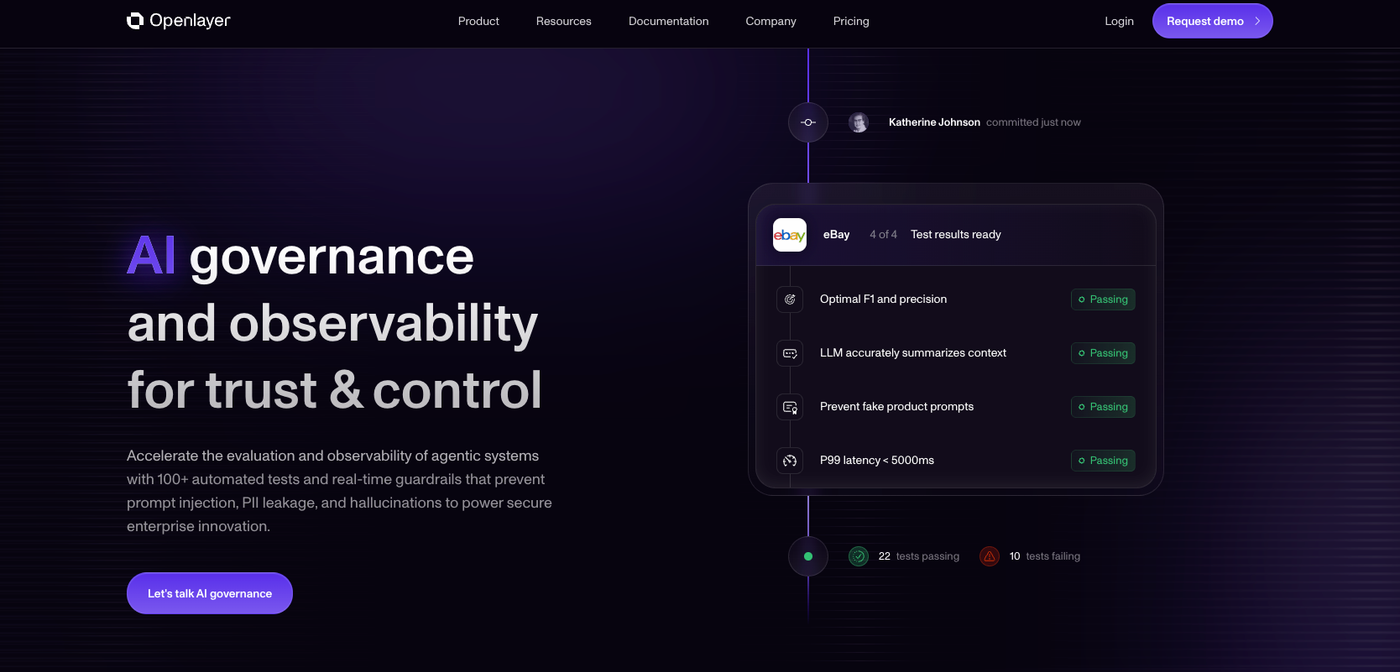
Openlayer sits at the intersection of evaluation, observability, and governance: covering the full AI model audit lifecycle from development through production, instead of treating each stage as a separate concern. Where governance-layer platforms stop at policy and documentation, Openlayer adds active runtime enforcement and continuous behavioral monitoring.
Here's how the coverage maps across the audit workflow:
- Evaluation and testing before deployment: Openlayer runs 100+ pre-built tests across safety, fairness, and performance dimensions, with LLM-as-a-judge scoring that Openlayer benchmarks at 81.3% human correlation. Teams can set hard gates (for example, block deployment if groundedness falls below 85% or if demographic parity gap exceeds 5%) so audit evidence is generated automatically, not assembled after the fact.
- Production monitoring and drift detection: Once a model is live, Openlayer tracks output quality, behavioral drift, and 13 session-level metrics in real time. When thresholds are breached, enforcement is active, with logging for later review as well.
- Audit trail and compliance documentation: Every test run, threshold decision, and monitoring event is recorded in a structured audit trail. This gives governance leads the evidence layer regulators and internal reviewers expect, without requiring teams to reconstruct it manually at audit time.
- Shadow AI and model registry coverage: Openlayer's governance layer provides for model inventory tracking, so unregistered fine-tuned models and third-party API integrations don't accumulate outside the audit perimeter undetected.
SDKs in Python, TypeScript, Java, and Go mean the evaluation and monitoring hooks integrate directly into existing CI/CD pipelines, so audit checkpoints become part of the standard release process instead of a parallel compliance exercise.
Final thoughts on building auditable AI systems
The organizations that survive regulatory review are the ones that built audit trails, fairness tests, and production monitoring into their deployment workflows before they needed them. Waiting until an audit happens to assemble documentation, behavioral evidence, and compliance records means you're reconstructing history instead of producing it, and that gap shows. Your audit readiness is a function of whether the right records exist at the moment something goes wrong, not whether you can generate them afterward. If you're setting up evaluation and monitoring infrastructure that needs to satisfy real governance scrutiny, reach out and we'll walk through what end-to-end coverage requires.
FAQ
Can I audit an AI system without historical data or documentation?
No; a credible audit requires baseline evidence. At minimum, you need model version records, evaluation run history, and inference logs to reconstruct behavior and prove conformity. Organizations without those artifacts must rebuild them prospectively before attempting an audit, which is why governance touchpoints need to integrate into the development workflow from the start, not after deployment.
AI model audit vs continuous monitoring: which do I actually need?
Both, because they serve different evidentiary functions. A pre-deployment audit proves a model was safe when it shipped; production monitoring proves it stayed safe afterward. Models drift, input distributions change, and performance degrades over time; one-time audits capture a snapshot that becomes stale within weeks. You need the audit for regulatory conformity and the monitoring to maintain it under live traffic.
What's the fastest way to prove EU AI Act conformity for a high-risk model already in production?
Start with documentation and traceability gaps, not technical testing. Regulators expect model cards, data lineage records, evaluation logs with approval sign-offs, and incident/change records; if those don't exist or aren't versioned alongside the deployed model, no amount of retrospective testing will satisfy Article 43 conformity assessment requirements. Once the evidence layer is in place, run fairness benchmarks across demographic subgroups and set up continuous monitoring with threshold-based alerts, because post-market monitoring obligations are ongoing, not one-time.
How do you audit agentic AI when execution paths aren't deterministic?
Log every step with enough fidelity to replay the full decision chain (inputs, tool calls, retrieved context, intermediate LLM outputs, and final responses) so you can trace a failure back to its origin even when the same input produces different execution paths across runs. Session-level logging that captures state at each decision point turns non-determinism from an audit blocker into a navigable trace. Without that granularity, you cannot confirm whether a specific behavior was a one-off or a systemic pattern.
Should I build audit trails in-house or use a platform with built-in compliance mapping?
If you're facing regulatory deadlines under the EU AI Act or NIST AI RMF procurement requirements, building audit infrastructure from scratch will consume months you likely don't have. Platforms with pre-built framework mappings, automated evidence capture, and structured evaluation workflows deliver audit-ready documentation without custom engineering. The ROI calculation is simple: custom-built governance infrastructure costs engineering capacity you could spend shipping features, and regulatory timelines don't wait for internal tooling sprints to finish.