AI Governance for Insurance: Risk Management July 2026
When an insurance AI model flags a claim for investigation, assigns a risk score that increases a premium, or routes an application to manual review, that decision creates a compliance trail the moment it happens. Regulators expect insurers to explain why each decision was made, show that the model was monitored for fairness and drift after deployment, and produce structured incident records when outputs breach defined thresholds. The August 2026 deadline for EU AI Act high-risk obligations means these records need to exist at deployment, not be assembled retrospectively when an auditor requests them. Most insurers have governance policies in place but lack the runtime enforcement layer that converts policy into evidence: real-time fairness monitoring, conformity assessment documentation tied to specific model versions, and post-market monitoring logs structured for regulatory review. This guide covers the compliance requirements insurance teams face across AI governance for insurance, the specific artifacts examiners ask for, and how to build a governance program that produces audit-ready records continuously instead of episodically.
TLDR:
- Insurance AI classifies as high-risk under EU AI Act Article 6 and Annex III, triggering pre-deployment documentation, conformity assessment, human oversight logs, and post-market monitoring with August 2026 deadline.
- NAIC Model Bulletin requires audit-ready AI inventories, named accountability, unfair discrimination testing with documented demographic parity thresholds, and ongoing performance monitoring.
- Continuous fairness monitoring must track demographic parity gaps exceeding 5%, proxy variable weight changes, and cohort-level performance across protected classes to catch distribution drift.
- Adverse action explainability requires SHAP-level factor attribution translated to plain language, traceable to model version, with complete evidence chains including input features and post-processing logs.
- Openlayer runs 100+ pre-built tests generating conformity assessment records, blocks outputs breaching thresholds before API exit, and maintains audit trails linking evaluation results to deployment events and incident logs.
Why Insurance AI Is Classified as High-Risk Under the EU AI Act
The EU AI Act's risk classification framework places insurance AI systems in the high-risk category by default, and the reasoning is structural, not incidental. Insurance models make or inform decisions about access to financial products, pricing, and coverage: outcomes that carry direct material consequences for individuals. When a model influences whether someone qualifies for life insurance or what premium they pay, regulators treat that as a high-stakes automated decision requiring formal oversight.
Article 6 and Annex III of the EU AI Act name credit scoring and risk assessment in financial services as high-risk use cases explicitly. Insurance underwriting, claims triage, fraud detection, and actuarial modeling all fall within that perimeter. The classification applies whether the insurer built the model internally or acquired it from a third-party vendor; the deployer carries the obligation regardless of origin.
What High-Risk Classification Means in Practice
High-risk designation triggers a specific set of pre-deployment and ongoing requirements that go well beyond standard software compliance:
- Technical documentation (Annex IV): system architecture diagrams, training data sources and governance practices, performance benchmarks across accuracy and robustness dimensions, known failure modes and foreseeable misuse scenarios, and a post-market monitoring plan.
- Conformity assessment record (Article 43): evidence that internal control procedures were followed, test results confirming conformity with Annex I requirements, and a signed declaration of conformity.
- Human oversight implementation: documented measures showing that a qualified reviewer can intervene, override, or halt model outputs during operation, both theoretically and in practice, with logs showing the override capability was functional.
- Post-market monitoring log: ongoing performance data collected after deployment, plus incident reports filed with national authorities within 15 days of serious incidents.
The August 2026 deadline for high-risk financial services obligations means insurers who have been treating AI governance as a future planning exercise are now in the execution window.
NAIC Model Bulletin Requirements for Insurance AI Systems
The National Association of Insurance Commissioners adopted its Model Bulletin on Artificial Intelligence Systems in 2023, and by mid-2026 most state insurance regulators have either adopted it directly or issued substantially similar guidance. The bulletin doesn't carry the force of statute in every jurisdiction, but insurers treating it as optional guidance have found themselves on the wrong side of market conduct examinations.
There are four obligation areas that matter most for AI governance programs.
Documentation and Inventory Requirements
Insurers must maintain a current inventory of AI systems used in insurance decisions, with documentation covering intended use, data inputs, model logic, and validation results. The bulletin requires this inventory to be available on demand during regulatory examination, which means documentation practices need to produce audit-ready records continuously, beyond deployment alone.
Accountability and Governance Structure
The bulletin requires insurers to assign named accountability for each AI system, covering model development, validation, and ongoing monitoring. Governance committees must have visibility into AI systems that affect underwriting, rating, or claims outcomes, with documented escalation paths when a system produces results that warrant review.
Unfair Discrimination Testing
This is where the bulletin has real teeth. Insurers must test AI systems for proxy discrimination, including disparate impact on protected classes, and document those results. A model that improves loss ratio but produces demographic parity gaps exceeding acceptable thresholds cannot simply be deployed on business performance grounds alone.
Ongoing Monitoring Obligations
Post-deployment monitoring is not optional under the bulletin. Insurers must track model performance against defined thresholds and document when performance changes warrant revalidation or intervention.
Continuous Fairness and Bias Monitoring in Insurance Pricing and Underwriting
Bias in insurance AI is not an abstract risk. When a pricing model trained on historical claims data produces systematically higher premiums for applicants from majority-minority zip codes, the model is encoding past discrimination into future decisions, and regulators are watching.
There are three monitoring obligations that matter here.
Disparity Detection Across Protected Classes
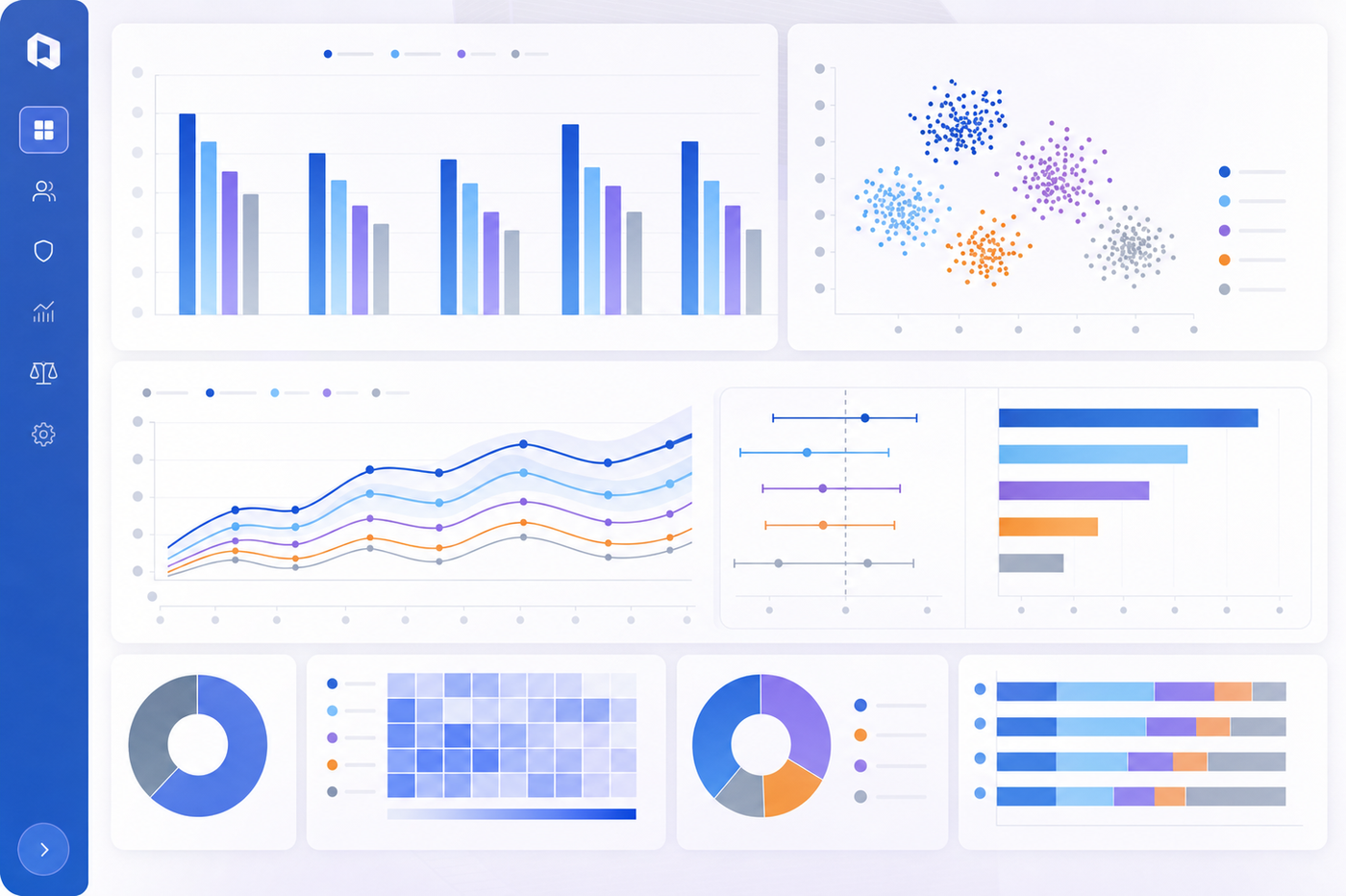
At minimum, monitor demographic parity gaps across race, gender, age, and geography for every model that touches pricing, underwriting, or claims routing. A gap exceeding 5% on any protected attribute should trigger an automatic review before the output reaches a decision workflow.
Proxy Variable Surveillance
Many insurance features link to protected characteristics without naming them directly. Credit score, zip code, occupation, and vehicle type can all function as proxies. Monitor feature importance distributions over time; if a proxy variable's weight increases sharply post-deployment, that shift warrants investigation regardless of whether the model's aggregate accuracy held steady.
Cohort-Level Performance Tracking
Aggregate accuracy metrics hide subgroup failure. Track precision, recall, and calibration separately for each demographic cohort, beyond the overall population. A model that performs well on average while systematically miscalibrating for a specific age bracket or geographic cluster carries regulatory exposure even if its headline metrics look clean.
The monitoring cadence matters as much as the metrics. Static fairness assessments conducted at deployment do not catch distribution shift. Input populations change as economic conditions shift, as new products launch, and as agent behavior evolves. Fairness monitoring needs to run continuously, with documented thresholds and escalation paths, so that evidence of ongoing compliance is available when examiners ask for it.
Explainability Requirements for Adverse Action Decisions
When an AI model denies a loan, flags a claim for investigation, or assigns a risk score that increases a premium, the insurer must be able to explain why. That obligation is not new, but AI has made it harder to meet.
Adverse action notices have long required plain-language explanations citing the specific factors that drove a decision. What has changed is the model layer underneath. A gradient boosted tree or a neural network can produce a decision without a single human-readable rule behind it. Regulators and courts expect the same level of factor-level disclosure regardless.
There are a few distinct layers to this requirement.
Factor Attribution at the Prediction Level
Most regulatory guidance expects insurers to identify the top factors that contributed to an adverse outcome and rank them by magnitude of effect. Techniques like SHAP values produce per-prediction feature attributions that can satisfy this requirement, assigning each input variable a contribution score for a specific decision. But generating SHAP values at inference time is not sufficient on its own. The attribution output must be:
- Translated into plain language a policyholder can understand, not raw feature names or coefficient values.
- Traceable to the model version that produced the decision, so the explanation is auditable if the model is later updated.
- Consistent across similar inputs, so two applicants with near-identical profiles receive materially similar explanations instead of contradictory ones.
Documentation the Regulator Will Ask For
When a state insurance commissioner or a fair lending examiner reviews an adverse action, they are not asking for a general description of the model. They want the specific evidence chain for the decision in question. That record typically needs to include the input feature values passed to the model at the time of the decision, the attribution scores for the top factors, the model version hash, and a log of any post-processing steps applied before the output was used. Without that chain, the explanation is a reconstruction, not a record, and reconstructions do not hold up well in enforcement proceedings.
Human Oversight Documentation for Automated Claims and Underwriting Systems
Regulators and auditors reviewing automated claims processing or underwriting systems want to see more than a description of how the model works. They want evidence that a human was genuinely positioned to intervene, and that the intervention capability was functional, beyond declaration in a policy document.
There are three documentation artifacts that satisfy this requirement in practice.
Override Logs
Every instance where a human reviewer reviewed, modified, or rejected a model output should produce a structured record. That record needs the model's original output, the reviewer's decision, the rationale category (for example: edge case, data quality concern, regulatory exception), and a timestamp. An audit trail with override rates near zero is itself a signal worth investigating. It may indicate that human review is rubber-stamping model outputs instead of functioning as a genuine check.
Escalation Records
When a claim or application hits a defined threshold, such as a liability value above a set floor or a risk score in an ambiguous band, the escalation path should be documented before the model goes live. Who receives the escalation, within what timeframe, and what decision authority do they hold? These answers belong in the system's governance record, not reconstructed after an incident.
Scope Boundary Documentation
Automated underwriting systems frequently operate within defined eligibility corridors. The model handles applications that fall within specified parameters; cases outside those parameters route to human underwriters. That boundary needs to be documented explicitly, including what triggers the routing, how the boundary is reviewed as risk profiles shift, and who owns the decision to adjust it.
Human oversight documentation does not need to be elaborate. But it does need to be specific enough that an auditor can determine, for any given decision the system made, whether a human had the information and the authority to override it.
Post-Market Monitoring and Drift Detection Under EU AI Act Article 72
Article 72 of the EU AI Act imposes ongoing post-market monitoring obligations on providers of high-risk AI systems, and for insurance carriers, those obligations translate into a continuous data collection and reporting cycle that runs parallel to normal operations.
The requirement is straightforward in principle: once a high-risk system is deployed, providers must actively gather performance data from real-world use, assess whether the system continues to perform within its intended parameters, and report serious incidents to national authorities within 15 days. In practice, insurance AI systems face a particular challenge here because the inputs they receive drift over time in ways that are difficult to anticipate at deployment.
There are two categories of drift that matter most for insurance model oversight.
The first is data drift, where the statistical distribution of incoming data moves away from the training distribution. A property underwriting model trained on pre-2024 claims data, for example, may encounter climate-related loss patterns in 2026 that fall outside the range it was calibrated on. The model continues to produce outputs, but those outputs are increasingly unreliable relative to the underlying risk.
The second is concept drift, where the relationship between inputs and the correct output changes even if the input distribution stays stable. Fraud detection models are especially vulnerable here: as fraud patterns evolve, a model's learned decision boundary becomes misaligned with actual fraud behavior, and false negative rates rise without any obvious signal in the raw input data.
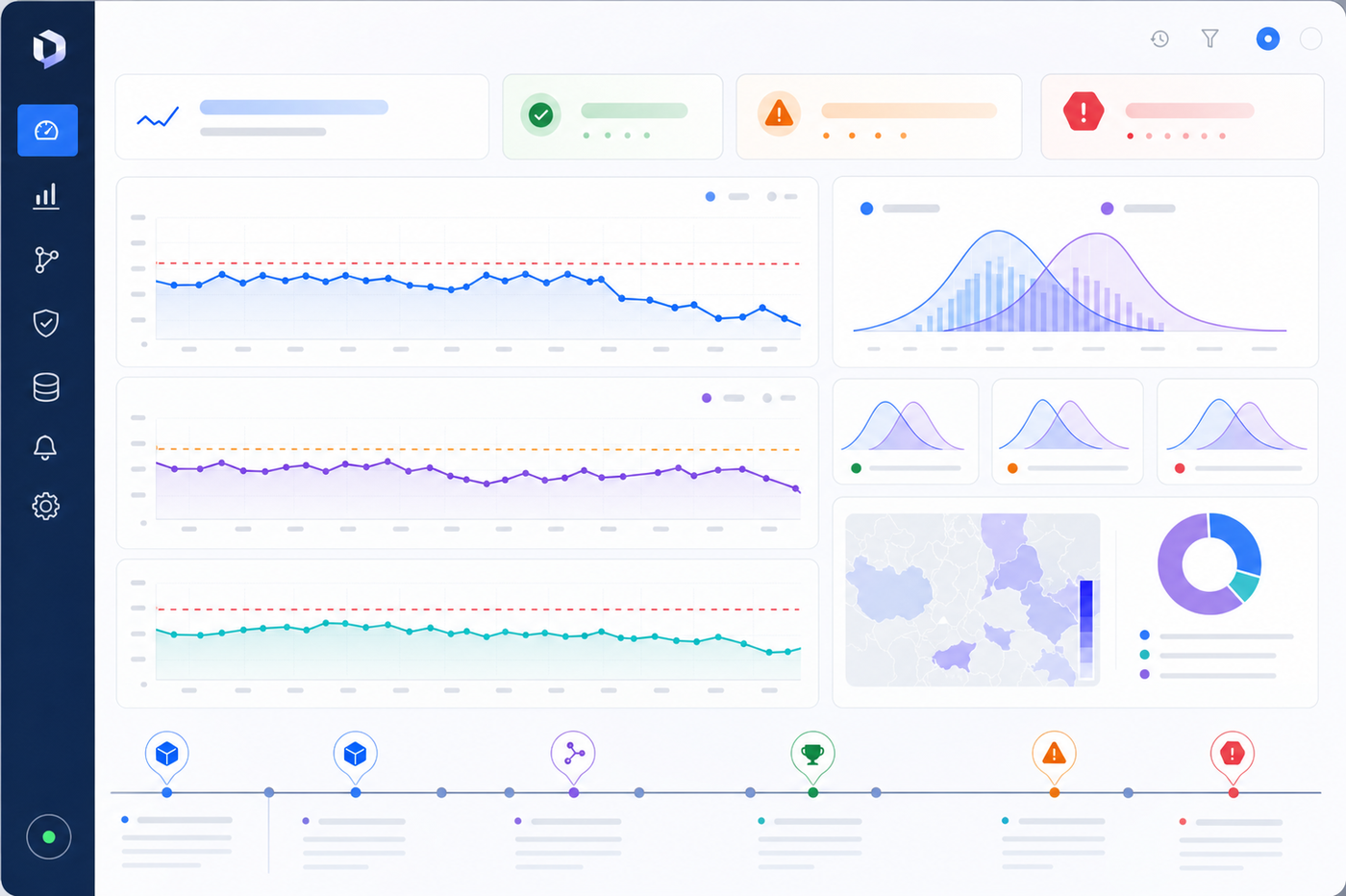
For Article 72 compliance, insurance teams need monitoring infrastructure that can detect both types of drift and produce the evidence artifacts auditors expect to see. That means tracking model outputs against ground truth labels as they accumulate, monitoring feature distributions against training baselines, and logging when performance metrics cross pre-defined thresholds. If a demographic parity gap exceeds 5% or a groundedness score drops below your deployment floor, the monitoring record should capture the exact timestamp, the metric value, and the response taken.
Openlayer's production monitoring layer covers this by continuously tracking behavioral metrics against the thresholds set at deployment, flagging drift before it compounds into a reportable incident, and writing every metric observation into a structured audit trail that maps directly to Article 72's documentation requirements. The evidence record generated is not a monitoring dashboard export but a structured artifact containing metric scores, threshold breach events, and response logs that an auditor can review without reconstruction.
Conformity Assessment and Technical Documentation Requirements
For insurance AI systems classified as high-risk under the EU AI Act, conformity assessment under Article 43 requires documented evidence before deployment, not retrospective records assembled after an audit request arrives.
There are two categories of obligation worth separating out here: pre-deployment documentation and ongoing post-deployment records.
Pre-Deployment Documentation
- Technical documentation (Annex IV): system architecture diagrams, intended purpose and covered use cases, training data description and data governance practices, performance metrics including accuracy and robustness benchmarks, known limitations and foreseeable misuse scenarios, and risk management procedures specific to insurance decision contexts such as underwriting or claims triage.
- Conformity assessment record: evidence that internal control procedures were followed, test results showing conformity with Annex I requirements, and a signed declaration of conformity from an authorized representative.
- EU database registration: system name, provider identity, intended purpose, risk classification, and conformity assessment body if a third party was involved.
Post-Deployment Records
- Post-market monitoring log: ongoing performance data collected after deployment, incident reports submitted to national authorities within 15 days of serious incidents, and periodic summary reports for continuous learning systems that update on new claims or policyholder data.
- Human oversight record: documentation of oversight measures implemented, with logs confirming that override capability was available and functional during operation, which matters in insurance contexts where automated denial decisions carry regulatory and consumer-protection exposure.
The August 2026 deadline for high-risk financial services obligations means these records need to exist at go-live, not be backfilled afterward, following an EU AI Act compliance checklist.
Third-Party AI Vendor Management and Responsibility Allocation
Most insurance AI deployments don't run on models built entirely in-house. Underwriting engines pull risk scores from third-party vendors. Claims processing pipelines connect to external fraud detection APIs. Customer-facing tools depend on foundation models hosted by cloud providers. Each connection point carries compliance exposure that internal governance programs often fail to account for.
Responsibility allocation across that vendor chain is where many insurers' governance frameworks break down. A carrier may document its own model development practices thoroughly, yet have no visibility into how a vendor's model was trained, what data it used, or whether its outputs have been audited for bias in insurance contexts. When a regulator asks for evidence of fairness testing on an underwriting model, "our vendor handles that" is not a defensible answer.
There are three areas where vendor responsibility allocation requires explicit governance treatment.
- Contractual obligation transfer: Vendor contracts should specify which party owns documentation requirements, bias audit obligations, and incident reporting duties. If a third-party model produces a discriminatory rate recommendation, the contract should name who maintains the audit trail, who conducts the root cause investigation, and who files the regulatory disclosure. Leaving these undefined means the carrier absorbs the liability by default.
- Model transparency requirements: Before integrating a vendor model into a regulated workflow, carriers should require documented evidence of training data provenance, known failure modes, and performance benchmarks across demographic groups. A vendor unwilling to supply this documentation presents a governance gap that no internal monitoring program can fully close.
- Runtime monitoring ownership: Even when a model is vendor-supplied, the carrier deploying it in a regulated context typically bears responsibility for its runtime behavior. Internal monitoring of vendor model outputs, including drift detection and fairness metric tracking, gives carriers the evidence base needed to prove ongoing oversight instead of assuming the vendor's internal controls are sufficient.
Building an AI Governance Program That Satisfies Multi-Framework Compliance
Most insurance AI programs sit under three overlapping frameworks at once: the EU AI Act (for any insurer operating in or serving European markets), NIST AI RMF, and ISO 42001. Each imposes distinct obligations, but the documentation artifacts they require share enough structure that a single governance program can satisfy all three without maintaining three separate compliance tracks.
Here is how the frameworks map against each other across the obligations that matter most for insurers.
Framework Obligation Crosswalk
| Obligation Area | EU AI Act | NIST AI RMF | ISO 42001 |
|---|---|---|---|
| Risk classification | High-risk (Annex III) | GOVERN/MAP tiers | Clause 6 risk assessment |
| Technical documentation | Annex IV record | AI RMF profile | Clause 8 documentation |
| Bias and fairness testing | Article 10, 15 | MEASURE function | Clause 9 performance eval |
| Human oversight | Article 14 | GOVERN function | Clause 5 leadership/oversight |
| Incident reporting | Article 73 | RESPOND function | Clause 10 corrective action |
| Ongoing monitoring | Article 72 | MONITOR function | Clause 9 monitoring |
The practical implication: teams that build their documentation around Annex IV requirements will find that the same record satisfies the AI RMF profile structure and ISO 42001 Clause 8. The artifact that moves between frameworks is not a summary, it is the actual technical record containing system architecture, training data provenance, performance metrics, and known failure modes.
What Each Framework Demands in Practice
The three frameworks share a logic but each adds something the others do not cover fully.
- EU AI Act (Annex III, Articles 9-17): For insurers, underwriting models and claims scoring systems likely qualify as high-risk under Annex III. Pre-deployment obligations include a complete Annex IV technical documentation package, a conformity assessment under Article 43, and EU database registration. Post-deployment, Article 72 requires a post-market monitoring plan with ongoing performance data collection, and Article 73 requires serious incident reports filed with national authorities within 15 days. The August 2026 deadline for high-risk financial services systems means these obligations are not prospective planning items.
- NIST AI RMF (GOVERN, MAP, MEASURE, MANAGE): The RMF does not impose deadlines, but it supplies the risk taxonomy insurers need to classify models the EU AI Act does not explicitly name. The GOVERN function asks who owns accountability; MAP asks where risk lives in the system; MEASURE asks how you will detect when risk materializes; MANAGE asks what you will do when it does. Teams that complete a MAP exercise produce a risk register that feeds directly into the EU AI Act's Article 9 risk management system requirements.
- ISO 42001 (Clauses 4-10): ISO 42001 adds the management system layer the other two frameworks assume but do not specify. Clause 4 requires organizations to identify internal and external parties whose interests affect AI governance; Clause 6 requires a formal risk assessment methodology; Clause 9 requires performance evaluation against defined objectives. Certification under ISO 42001 produces the documented management system that regulators inspecting EU AI Act conformity will expect to see operating behind the technical documentation.
Governance Role Accountabilities Across Frameworks
When multiple frameworks apply, accountability gaps appear at the seams. Assign ownership before the frameworks overlap, not after.
- Model Owner: classifies each model against EU AI Act Annex III at scoping; approves the Annex IV technical documentation before deployment; owns the post-market monitoring thresholds defined under Article 72; initiates decommission when drift or fairness metrics breach defined limits.
- Governance Lead: maps each model's EU AI Act risk tier to the corresponding NIST AI RMF profile and ISO 42001 clause; reviews documentation completeness before conformity assessment; maintains the audit trail that satisfies Article 73 incident reporting and ISO 42001 Clause 10 corrective action records; escalates unresolved compliance gaps to the ethics committee.
- Ethics Committee: reviews high-risk system designations and bias evaluation results before deployment; sets demographic parity thresholds the model owner enforces; approves or rejects deployment of systems with unresolved failure modes flagged during MEASURE-function assessments; conducts post-deployment reviews when Article 73 incident flags are triggered.
Incident Reporting and Remediation Requirements
When an AI model produces a harmful output, misclassifies a claim, or violates a fairness threshold, the clock starts. Insurers operating under frameworks like the EU AI Act and NAIC guidance face structured reporting obligations that require more than an internal note.
There are three severity tiers that determine how quickly an insurer must act.
- Critical: suspend the system immediately and notify the Model Owner, Governance Lead, and Ethics Committee within one hour. If the incident involves regulated data or protected classes, escalate to legal counsel. EU AI Act serious incidents require regulator notification within 15 days.
- High: keep the system running under enhanced monitoring, notify the Model Owner and Governance Lead within four hours, and deliver a root-cause summary with a documented remediation plan within 24 hours.
- Low: log the incident with a severity designation and assigned owner, notify the Model Owner in the next scheduled review cycle, and resolve within five business days or reclassify upward if investigation reveals a broader pattern.
What a Complete Investigation Record Requires
Logging that an incident occurred is not sufficient for audit purposes. A complete post-incident record requires four elements.
- Input record: the exact feature values passed to the model at the time of the incident, including all preprocessing steps applied, normalization parameters, and feature version.
- Output record: the raw prediction, associated confidence score, and the model version hash traceable to the deployment event that introduced it.
- Expected output: the authoritative ground truth confirmed by a qualified reviewer, with documentation of who validated it, when, and under what review protocol.
- Root cause classification: assign to exactly one category: data drift, labeling error, or deployment configuration issue. If the root cause spans categories, document the primary driver and the contributing factor separately. Do not leave the classification as undetermined without a named owner and a follow-up deadline.
An investigation record with any element missing is an open gap in the audit trail, not a closed incident.
Preparing for Market Conduct Examinations and Regulatory Audits
Market conduct examinations test whether an insurer's AI systems behave consistently with filed rates, underwriting guidelines, and anti-discrimination statutes across every decision made in production. Auditors don't accept architectural diagrams or policy documents as evidence of conformity. They want behavioral records: decision logs, model version histories, fairness metric outputs, and drift monitoring results tied to specific time windows.
There are four artifact categories examiners typically request.
- Decisioning logs that link each adverse action to the model version, input features, and output score that produced it, so examiners can reconstruct any individual decision without querying a live system.
- Fairness evaluation records showing demographic parity and disparate impact metrics calculated at regular intervals, with thresholds documented before deployment instead of selected after an exam is announced.
- Drift monitoring reports covering input distribution changes and output score distribution changes across the policy period, with timestamps showing when alerts fired and what remediation followed.
- Model version provenance, tracing every production artifact back to its training data snapshot, evaluation results, and the approval record that authorized deployment.
Gaps in any of these categories are not administrative oversights during an examination with an AI compliance platform. They are the primary finding. Regulators interpret missing records as evidence that governance controls were absent, not merely undocumented.
Insurance AI Governance Implementation Roadmap and Prioritization
Insurance AI governance programs rarely fail because of missing policy documents. They fail because organizations try to build everything at once, or they sequence work in ways that create compliance gaps before controls exist to close them. A phased approach keeps obligations manageable and creates an audit-ready evidence trail as it goes.
There are three phases worth structuring around:
- Inventory and classify (months one through three): Map every AI system in production against the risk tiers in your governance framework. Unregistered models are your first priority here. Identify which systems touch underwriting, claims, or credit decisions, as those carry the highest regulatory exposure under state algorithmic accountability rules and, for EU operations, the EU AI Act's August 2026 high-risk deadline.
- Control and document (months four through nine): For each high-risk system, build the artifact stack regulators expect: bias evaluation results with documented demographic parity thresholds, human oversight logs, technical documentation with training data provenance, and a post-market monitoring plan. Governance leads should own documentation completeness; model owners should own threshold enforcement.
- Automate and maintain (month ten onward): Manual governance reviews do not scale across a portfolio of dozens of models. Connecting evaluation gates and monitoring alerts to your deployment pipeline converts governance from a point-in-time audit exercise into an ongoing, continuous record. Drift alerts, fairness checks, and human override logs accumulate automatically, removing the need for quarterly scrambles to reconstruct evidence before an exam.
The sequencing matters as much as the activities. Starting with inventory before building controls means you know what you are governing before you spend resources governing it.
Governance Platform Comparison: Policy Documentation vs. Runtime Enforcement
Insurance AI governance tools fall into two categories: those that organize compliance documentation and those that enforce it at runtime. The distinction matters when an examiner asks for evidence that a model behaved as documented after deployment.
Credo AI
Credo AI covers AI governance policy workflows and audit artifact organization. It maps regulatory requirements to internal controls, maintains a model inventory with risk classifications, and generates compliance reports for frameworks including the EU AI Act, NIST AI RMF, and ISO 42001. The platform excels at structuring governance programs across multiple frameworks simultaneously and maintaining the documentation layer examiners expect.
The architectural constraint: Credo AI delegates technical enforcement entirely to external tools. It does not monitor live model outputs, block unsafe responses before they reach production workflows, or detect drift in deployed systems. Teams using Credo AI for governance documentation still need separate tooling for runtime evaluation, threshold enforcement, and continuous monitoring, which means the evidence trail connecting policy to runtime behavior requires integration work across multiple systems.
IBM watsonx.governance
IBM watsonx.governance provides model risk management and compliance tracking within the broader watsonx ecosystem. It covers model inventory, risk assessment workflows, fairness evaluation, and regulatory reporting for AI systems deployed on IBM infrastructure. The platform integrates tightly with watsonx.ai for model lifecycle management and maintains audit trails for models trained and deployed within the IBM stack.
The architectural constraint: watsonx.governance is ecosystem-bound. It monitors models deployed through watsonx.ai and watsonx infrastructure, but insurance teams running models on AWS Bedrock, Azure OpenAI, or self-hosted infrastructure outside the IBM stack face integration gaps. Cross-platform governance covering vendor LLM APIs, open-source models, and legacy ML systems simultaneously requires either custom connector development or accepting visibility gaps in the inventory.
How Openlayer Supports Insurance AI Governance and Regulatory Compliance
Openlayer sits at the intersection of evaluation, observability, and governance across the full model lifecycle, which makes it well-suited to the specific compliance demands insurance AI teams face in 2026. The distinction from policy-layer tools: Openlayer provides active runtime enforcement and automated compliance mapping, beyond documentation workflows.
Here is where that coverage maps to regulatory obligation:
Pre-deployment evaluation
Before a model reaches underwriting, claims, or fraud detection workflows, Openlayer runs it through 100+ pre-built tests covering accuracy, fairness, calibration, and robustness. The distinction matters: those tests go beyond quality checks to produce the pass/fail records, metric scores, and flagged failure modes that become the evidentiary record auditors request during conformity assessment under EU AI Act Article 43. Teams assessing NIST AI RMF alignment get the same artifact, structured as documentation of bias and performance evaluation prior to deployment.
Runtime enforcement, beyond monitoring
Once a model is live, Openlayer's guardrails block outputs that breach defined thresholds before they leave the API boundary. For insurance use cases, that means a pricing model producing a demographic parity gap above 5% triggers a hold, not a post-hoc alert. A claims recommendation falling below an 85% groundedness score gets flagged before it reaches an adjuster. The distinction matters for regulators: documentation of what a model should do is a policy; a system that actively stops it from doing otherwise is a control.
Continuous drift detection
Insurance models degrade as policyholder behavior, claims patterns, and economic conditions shift. Openlayer monitors live outputs for data drift, concept drift, and performance regression against the baseline set at deployment. When drift crosses defined thresholds, the system generates a structured alert that names the metric, the breach magnitude, and the model version in question. That output feeds directly into the post-market monitoring log required under the EU AI Act and the ongoing performance review cadence NIST AI RMF expects.
Audit-ready documentation across the lifecycle
Openlayer maintains a continuous audit trail linking every evaluation result, deployment event, threshold breach, and incident record to the model version that produced it. For insurance carriers operating across EU and US jurisdictions simultaneously, that trail covers:
- Pre-deployment test results tied to the specific model artifact approved for deployment
- Threshold configurations with the governance sign-off date and approving role on record
- Incident logs classified by severity tier, with notification timestamps and assigned owners
- Drift reports with root cause classification and remediation outcomes
No single governance tool assembles that record automatically. Teams relying on documentation-layer tools like Credo AI or IBM watsonx Governance capture policy intent and risk taxonomy well, but neither monitors live model outputs, enforces behavioral thresholds at inference time, or generates the runtime evidence an auditor needs to confirm a model behaved as documented after deployment.
Final Thoughts on Regulatory-Grade Insurance AI Monitoring
Compliance documentation assembled after deployment is reconstruction, not evidence. Regulators reviewing insurance AI systems want decision logs linking every adverse action to the model version and input features that produced it, fairness metrics tracked continuously with pre-defined thresholds, and drift monitoring that flagged problems before they compounded into reportable incidents. If your monitoring layer can tell you a model drifted but can't show you when the threshold breach occurred or what response followed, reach out. Market conduct exams test whether your governance controls were functional during the period under review, not whether you can describe them afterward.
FAQ
Can I build an insurance AI governance program that satisfies both EU AI Act and NAIC Model Bulletin requirements without maintaining two separate compliance tracks?
Yes. The technical documentation required under EU AI Act Annex IV (system architecture, training data provenance, performance benchmarks, known failure modes, and post-market monitoring plans) satisfies the NAIC Model Bulletin's inventory and documentation requirements directly. The same artifact moves between frameworks: conformity assessment records you build for EU AI Act Article 43 become the validation evidence NAIC examiners request during market conduct examinations.
What's the main difference between Credo AI and Openlayer for insurance AI oversight?
Credo AI organizes policy workflows and audit artifacts but delegates technical enforcement entirely to external tools; it does not monitor live model outputs, block unsafe responses, or detect drift in production. Openlayer provides the full stack: pre-deployment evaluation, runtime guardrails that block discriminatory pricing or PII leakage before outputs reach decision workflows, and continuous drift detection with audit-ready logs. Credo covers governance paperwork; Openlayer covers governance plus the runtime control layer underneath it.
How do I document human oversight for automated underwriting systems in a way that satisfies regulators?
Maintain three structured records: override logs capturing every instance where a reviewer modified or rejected a model output with the rationale category and timestamp, escalation records naming who receives high-risk cases and within what timeframe, and scope boundary documentation defining which applications the model handles versus which route to human underwriters. An audit trail with override rates near zero is itself a compliance signal worth investigating: it may indicate rubber-stamping instead of genuine review.
Insurance pricing model vs claims fraud detection: do both count as high-risk under the EU AI Act?
Both qualify as high-risk financial services systems under Annex III. Insurance underwriting, actuarial pricing, claims triage, and fraud detection all fall within the credit scoring and risk assessment perimeter named explicitly in the Act. The high-risk designation applies whether you built the model internally or acquired it from a vendor; deployers carry the obligation regardless of origin, with the August 2026 deadline for pre-deployment documentation, conformity assessment, and post-market monitoring already in force.
What exactly goes into a post-incident investigation record that will hold up during a regulatory audit?
Four mandatory elements in sequence: the exact input feature values passed to the model at inference time including all preprocessing steps, the raw prediction with confidence score and model version hash traceable to deployment, the clinician-validated or otherwise authoritative ground truth confirmed by a qualified reviewer, and root cause classification assigned to one of three categories: data drift, labeling error, or deployment configuration issue. An investigation record missing any element is an open gap in your audit trail, not a closed incident.