AI Governance for Healthcare: A Complete Framework for June 2026
AI-assisted diagnostics, clinical decision support, and automated prior authorization are live in production across major health systems right now. The regulatory environment around them is tightening in multiple directions simultaneously. HIPAA governs protected health information but wasn't designed for LLMs. The FDA has cleared over 950 AI-powered medical devices and expects predetermined change control plans that specify post-deployment monitoring before clearance. The EU AI Act classifies most clinical AI as high-risk, with GPAI provider obligations enforceable since August 2025 and full high-risk system requirements carrying an August 2026 deadline.
For healthcare in particular, this matters because governance gaps are patient safety gaps. A sepsis prediction model that drifts measurably over months is still running, still influencing triage, still trusted by clinical staff with no visibility into its decline. A biased readmission risk score systematically deprioritizes certain patient populations, and without demographic parity tracking, no one catches it.
Here's the complete governance framework healthcare teams need to meet regulatory timelines while keeping AI systems safe and defensible in production.
TLDR:
- Healthcare AI governance gaps become patient safety gaps when models drift undetected or bias goes unmeasured.
- EU AI Act high-risk obligations for healthcare carry an August 2026 deadline with full compliance burden.
- Models degrade quietly in production without continuous monitoring across bias, drift, and subgroup performance.
- Governance requires defined roles: model owner signs off on deployment, governance lead maintains audit trails, ethics committee sets fairness thresholds.
- Openlayer automates evidence generation and runtime enforcement, blocking unsafe outputs before they reach patients where governance-only tools stop at policy documentation.
Why healthcare AI governance matters now
Healthcare AI is scaling faster than governance frameworks can keep up. AI-assisted diagnostics, clinical decision support, and automated prior authorization are now live in production across major health systems, and the regulatory environment around them is tightening quickly. Two forces make this urgent: the direct patient safety stakes, and simultaneous regulatory pressure from multiple directions.
The stakes are concrete:
- Delayed intervention: a miscalibrated sepsis prediction model keeps running, keeps influencing triage, and nothing flags the degradation until a care event surfaces it.
- Systematic deprioritization: a biased readmission risk score produces worse outputs for underrepresented patient groups, compounding silently across every prediction cycle.
- No visibility into the gap: when AI outputs influence care decisions, governance gaps become patient safety gaps; not because anyone intended harm, but because no monitoring existed to catch the drift.
Regulatory pressure is arriving from multiple directions simultaneously:
- HIPAA: still governs protected health information, but its requirements were written before LLMs existed, leaving material gaps around model behavior, output logging, and inference-time data handling.
- FDA: has cleared over 950 AI-powered medical devices, and its evolving guidance on predetermined change control plans now expects developers to specify how models will be monitored and updated post-deployment before clearance is granted.
- EU AI Act: classifies most clinical AI as high-risk, imposing documentation, conformity assessment, and human oversight requirements that many health systems are not yet positioned to meet with the August 2026 deadline closing fast.
The combination of patient safety exposure, expanding regulatory scope, and AI adoption outpacing oversight is what makes healthcare one of the highest-stakes domains for AI governance right now.
EU AI Act healthcare compliance deadlines and high-risk classification
Under the EU AI Act, healthcare AI systems face binding obligations that took effect in August 2025 for GPAI providers, with high-risk system requirements for medical applications carrying an August 2026 deadline.
Healthcare AI falls squarely into the high-risk category. Annex III of the Act lists medical devices influencing clinical decisions as high-risk by default. That classification triggers a full compliance burden: conformity assessments, technical documentation, human oversight mechanisms, and registration in the EU database before deployment.
There are three deadline tiers teams need to track:
- GPAI provider obligations: model cards, technical documentation, copyright compliance became enforceable in August 2025, meaning any foundation model used in a healthcare product is already subject to audit.
- High-risk system requirements: conformity assessments and post-market monitoring carry the August 2026 deadline. For healthcare AI teams still in development, that window is short.
- General-purpose AI systems with systemic risk: defined as those trained on compute exceeding roughly 10²⁵ FLOPs, face additional obligations around adversarial testing and incident reporting.
AI literacy under Article 4 applies to both providers and deployers. In healthcare, that means the obligation sits with the vendor building the model and the hospital or clinic putting it in front of clinicians.
How healthcare AI fails without governance
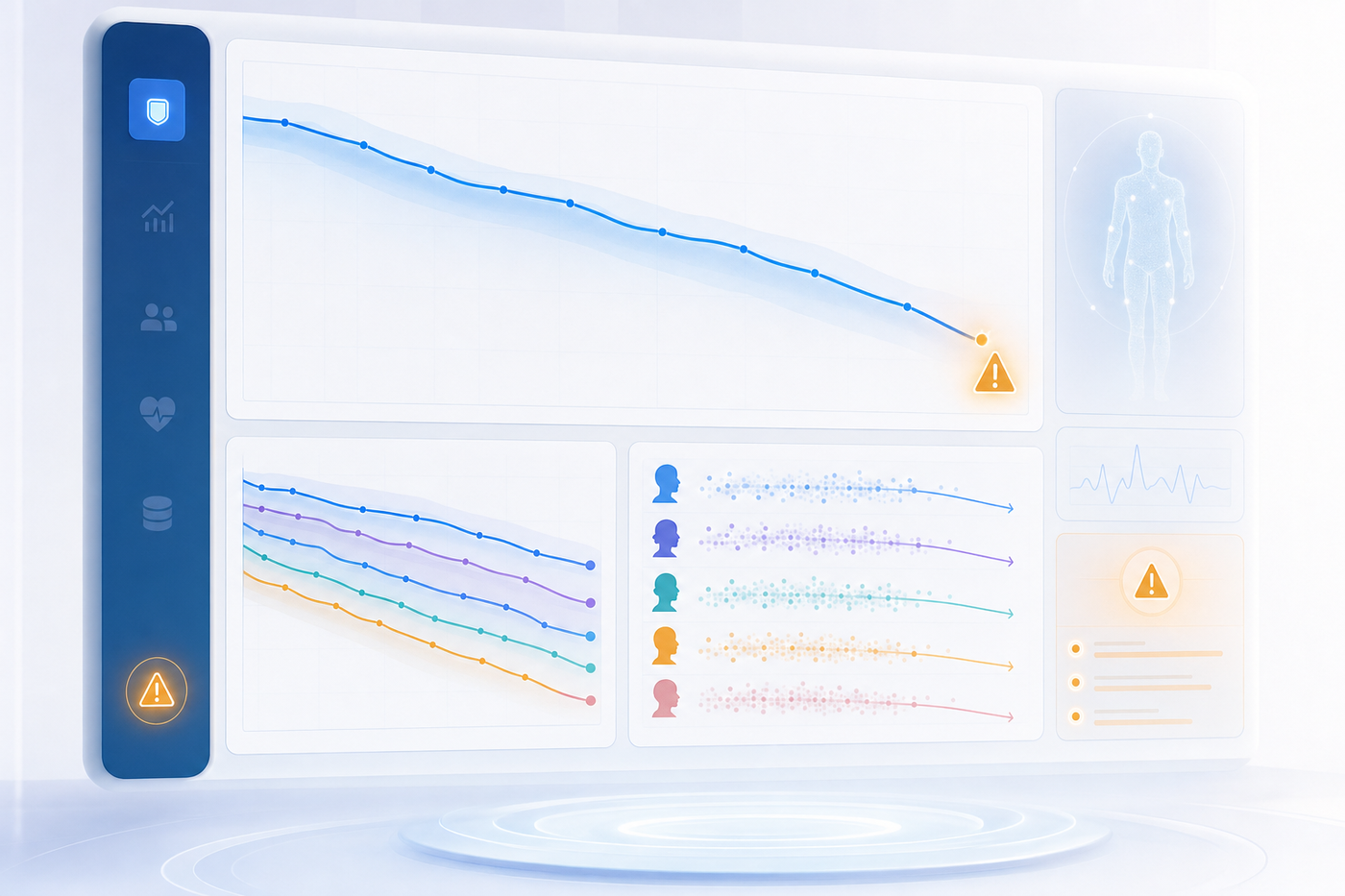
Healthcare AI failures follow a predictable pattern: a model performs well in controlled testing, gets deployed into a clinical workflow, and then quietly drifts as patient populations shift, coding practices change, or the underlying EHR system updates. Without governance infrastructure in place, no one catches the drift until something goes wrong.
The consequences are not abstract. A sepsis prediction model that degrades meaningfully over months is still running, still influencing triage decisions, still trusted by clinical staff who have no visibility into its declining performance. That gap between what the model is doing and what anyone believes it is doing is exactly where patient harm accumulates.
Three failure modes appear repeatedly across healthcare AI deployments:
- Bias that goes unmeasured: Models trained on data from one patient population produce systematically worse outputs for underrepresented groups. Without demographic parity tracking, health systems have no mechanism to detect when a readmission risk model performs meaningfully worse for Black patients than for white patients, a gap that compounds silently across every prediction cycle.
- Drift that goes undetected: Clinical environments change constantly. A billing code model trained on pre-pandemic data produces miscoded claims against updated ICD-11 categories. Without behavioral monitoring in production, the model runs for months generating revenue cycle errors no one can explain.
- Shadow deployments that go unregistered: Product and data science teams connect third-party AI APIs or spin up fine-tuned models without compliance review. By the time an audit surfaces one, it may have been processing protected health information for months with no documentation, no behavioral baseline, and no evidence of regulatory conformity.
Each failure mode is also a governance gap. Measuring bias, detecting drift, and tracking every deployed model are exactly what governance frameworks specify and enforce.
Building an AI governance committee and organizational structure
Effective AI governance in healthcare doesn't happen through policy documents alone. It requires a defined committee structure where accountability is assigned by role function, not job title.
Here's how to structure it:
- Model Owner: this defines the intended use case and risk tier at scoping; approves evaluation criteria before any model enters training; signs off on deployment readiness; owns post-deployment performance thresholds and drift monitoring; initiates decommission when compliance or performance conditions are breached.
- Governance Lead: this maps regulatory obligations (HIPAA, FDA SaMD guidance, EU AI Act where applicable) at the scoping stage; reviews documentation completeness before deployment; maintains the audit trail across the full model lifecycle; escalates compliance gaps to legal or the ethics committee.
- Ethics Committee: this reviews high-risk system designations and bias evaluation results before deployment; sets demographic parity and fairness thresholds the model owner enforces; approves or rejects deployment of systems with unresolved failure modes; conducts post-deployment reviews when incident flags are triggered.
Pre-deployment validation and testing requirements

Before any AI system goes live in a clinical or administrative setting, it needs to pass a defined battery of validation tests: not a general-purpose QA checklist, but healthcare-specific evaluation designed around the failure modes that matter most in regulated environments.
There are four categories of testing that governance frameworks should require at this stage.
- Clinical accuracy benchmarking against labeled datasets: the model's outputs are scored against ground-truth annotations from qualified clinicians, with acceptance thresholds set before testing begins (for example, requiring sensitivity above 90% for diagnostic support tools before deployment is approved).
- Bias and fairness evaluation across demographic subgroups: performance is measured separately across age, sex, race, and socioeconomic proxies to confirm that no subgroup receives systematically degraded outputs. A demographic parity gap exceeding 5% should trigger a hold, not a warning.
- Adversarial and edge-case stress testing: the system is probed with out-of-distribution inputs, incomplete records, and atypical patient presentations to surface failure modes that benchmark datasets won't catch.
- Integration and data pipeline validation: the model is tested end-to-end within the actual production environment, including EHR connections and any preprocessing steps, since a model that performs well in isolation can degrade when real data pipelines introduce format inconsistencies or missing fields.
Each test category should produce a documented result that feeds directly into the deployment readiness sign-off, giving the model owner and governance lead a structured evidence record instead of a narrative summary.
Bias detection and fairness monitoring throughout the AI lifecycle
Bias in healthcare AI does not appear only at deployment. It compounds across the full model lifecycle, from how training data is sampled to how outputs get acted on in clinical settings. A governance framework that only checks for fairness at launch will miss drift that develops months later as patient populations shift or care protocols change.
There are three stages where bias monitoring needs to be anchored:
- Pre-deployment evaluation: before a model goes live, run disaggregated performance analysis across demographic subgroups including race, age, sex, insurance status, and primary language. A model that performs well on aggregate accuracy metrics can still show meaningful sensitivity gaps between patient groups. In a diagnostic context, that means systematically missed findings for one population.
- Runtime fairness tracking: once deployed, monitor demographic parity and equalized odds metrics continuously. Set review triggers when disparity gaps exceed defined thresholds, for example flagging when false negative rates diverge by more than 5% across subgroups, so that performance gaps get caught before they scale.
- Incident-linked audits: when a clinical complaint or adverse outcome is logged, governance processes should trace it back to model outputs and flag whether a pattern of disparity is present in the surrounding data window.
What makes healthcare bias monitoring harder
Healthcare data carries structural biases that general-purpose fairness tooling was not designed to catch. A few factors compound the challenge:
- Underrepresentation in training data: historically marginalized groups are underrepresented in medical datasets, so a model can appear well-calibrated on held-out test sets while generalizing poorly to those groups in production.
- Proxy variables: protected attributes like race are often not recorded directly but are linked to features like zip code or insurance type that the model does use. Fairness checks that only look at labeled demographic fields will miss this.
- Shifting reference populations: a model trained on one hospital system's patient mix may encounter a meaningfully different population at a new deployment site, making static fairness baselines unreliable over time.
Post-market monitoring and performance drift detection
Post-deployment is where governance commitments get tested against reality.
Healthcare AI systems degrade in ways that static compliance documentation cannot catch. A sepsis prediction model trained on pre-pandemic patient populations may quietly lose predictive accuracy as care protocols shift. A clinical documentation tool may begin generating subtly different output distributions as the underlying LLM provider updates their base model. Neither failure announces itself.
There are three monitoring layers teams should have in place:
- Drift detection across input and output distributions, tracked continuously instead of at scheduled review intervals. If a model's input feature distributions shift more than a defined threshold from the training baseline, that's a signal worth investigating before it becomes a patient safety incident.
- Outcome correlation tracking, where model outputs are periodically compared against actual clinical outcomes. This closes the feedback loop that pure observability misses.
- Subgroup performance monitoring, watching whether performance degrades unevenly across patient demographics, age cohorts, or diagnostic categories. Aggregate accuracy metrics can mask meaningful disparity at the subgroup level.
The governance implication is documentation: each of these monitoring signals needs a defined owner, a response threshold, and a logged remediation record. Without that paper trail, a monitoring system that catches a problem still fails a regulatory audit if there's no evidence the organization acted on what it found.
Human oversight and AI literacy requirements
Healthcare AI systems that make or support clinical decisions require a human-in-the-loop who can actually interpret what the system is doing. That means staff need enough AI literacy to understand what a model can do, recognize where it fails, and contextualize its outputs before acting on them.
Two requirements follow from this directly. First, meaningful oversight: a clinician reviewing a sepsis prediction alert needs to know the model's confidence thresholds and known failure modes, beyond the score alone. Second, documented training: governance programs must log who received AI literacy training, when, and at what depth.
What adequate oversight looks like in practice
There are three conditions an oversight structure needs to meet:
- Qualified reviewers at decision points: staff who touch AI-assisted outputs hold enough domain and model knowledge to catch errors the system cannot self-report, such as a diagnostic model underperforming on underrepresented patient subgroups.
- Defined escalation paths: when a model's output falls outside expected confidence ranges, a clear path exists to flag, pause, or override the recommendation before it reaches a patient record.
- Audit trails for override decisions: every instance where a clinician overrides or accepts a high-stakes AI recommendation is logged, timestamped, and available for review.
Incident response and adverse event reporting
Even the best-governed AI systems will eventually produce a harmful output, misclassify a patient condition, or behave unexpectedly under distribution shift. The question is whether your organization can detect it fast and respond in a structured way.
Healthcare AI incident response has three core phases.
Detection and triage
Monitoring should flag anomalies automatically: output confidence drops below threshold, demographic parity gaps widen beyond acceptable ranges, or clinician override rates spike. When a flag triggers, the first step is triage across three severity levels.
- Critical: the model is producing outputs that directly influence active patient care decisions and the failure mode is confirmed. Suspend the system immediately, notify the model owner and governance lead within one hour, and log the suspension timestamp in the audit trail.
- High: a performance gap is detected but cannot yet be traced to a specific care event. Place the system under enhanced monitoring, increase the sampling rate for output review, and initiate investigation within 24 hours.
- Low: a threshold has been crossed but the gap is within a defined tolerance band that permits continued operation. Log the event, assign a reviewer, and set a resolution deadline of five business days.
Severity classification determines two downstream decisions: whether the system continues operating, and which stakeholders are notified. A sepsis model flagged as Critical requires immediate suspension and ethics committee notification. A billing code model flagged as Low stays online under heightened scrutiny while investigation runs in parallel.
Investigation and root cause
The investigation record must be structured, not narrative. Document four elements for every incident under review.
- Input record: the exact feature values the model received at inference time, including any preprocessing steps applied by the data pipeline. If the EHR system reformatted a lab value before it reached the model, that transformation is part of the record.
- Output record: the model's raw prediction, confidence score, and model version hash at the time of the incident. This prevents post-hoc version confusion when the investigation crosses a deployment boundary.
- Expected output: the clinician-validated ground truth for the case in question, sourced from chart review or clinical adjudication. This is what the model should have returned.
- Root cause classification: categorize the failure as data drift (input distribution shifted from the training baseline), labeling error (training or evaluation labels were incorrect), or deployment configuration issue (a pipeline change altered how inputs were processed). Each category has a different remediation path: drift requires retraining or recalibration, labeling errors require dataset audit and re-evaluation, and configuration issues require rollback and pipeline review.
Run the root cause classification against the surrounding data window, not just the flagged event. A single misclassification may be noise; ten in the same demographic subgroup over two weeks is a pattern worth escalating to the ethics committee.
Reporting and remediation
Under the EU AI Act, serious incidents involving high-risk AI systems must be reported to the relevant national supervisory authority. A serious incident is defined as one that results in death, serious health harm, or a material disruption to the intended function of the system. For healthcare AI, the threshold is lower in practice: any incident where a model output influenced a care decision that resulted in patient harm or a near-miss should be treated as reportable pending legal review.
The reporting record must include four components before the system returns to service.
- Incident description: what the model did, what the correct behavior should have been, and the date and time of detection and triage. Include the model version, deployment site, and affected patient population size.
- Root cause summary: the classification from the investigation phase, the supporting evidence, and the data window reviewed. If the root cause is unresolved at the time of reporting, state that explicitly and give the expected resolution date.
- Remediation steps and timeline: the specific actions taken (retraining, rollback, pipeline fix, threshold adjustment), who executed them, and when. Vague entries like "model was retrained" are not acceptable; the record must name the dataset used, the evaluation results post-retraining, and the sign-off from the model owner.
- Updated monitoring thresholds: the new threshold values that will govern ongoing post-market surveillance, and the rationale for why the previous thresholds failed to catch the incident earlier. If a false negative rate divergence of 6% across subgroups went undetected because the threshold was set at 8%, the remediated threshold must be lower, and that change must be documented.
A system that returns to service without all four components on record has not completed remediation. It has only restarted.
Documentation, audit trails, and evidence generation
Regulators and auditors don't take your word for it. When a health system's AI triage tool misclassifies a high-acuity patient, the first question from the Office for Civil Rights or a state health department isn't "what did your model intend?" It's "what records do you have?" Healthcare AI governance requires documentation that is continuous, structured, and tied directly to model behavior, not assembled retroactively when something goes wrong.
Here are the three documentation layers every governed healthcare AI system needs.
Model cards and system documentation
Before deployment, every model needs a record that captures intended use, training data sources and known gaps, performance benchmarks across demographic subgroups, and explicitly named failure modes. A model card that omits subgroup performance isn't a model card; it's a liability.
Decision logs and inference records
At runtime, every consequential decision should produce a timestamped log: the input, the output, the model version, and the confidence score. For clinical AI, "consequential" means any output that influences a diagnosis, treatment recommendation, triage priority, or billing code.
Drift and incident documentation
When performance degrades or an incident occurs, the audit trail must show what monitoring caught it, when, and what response followed. A gap between detection and response with no documented rationale is exactly the kind of evidence gap that regulators treat as a governance failure.
The practical challenge is that manual documentation at inference scale is not feasible. Teams running models across thousands of daily encounters need automated evidence generation baked into the deployment pipeline, not a documentation sprint before an audit.
Openlayer: unified evaluation, observability, and governance for healthcare AI
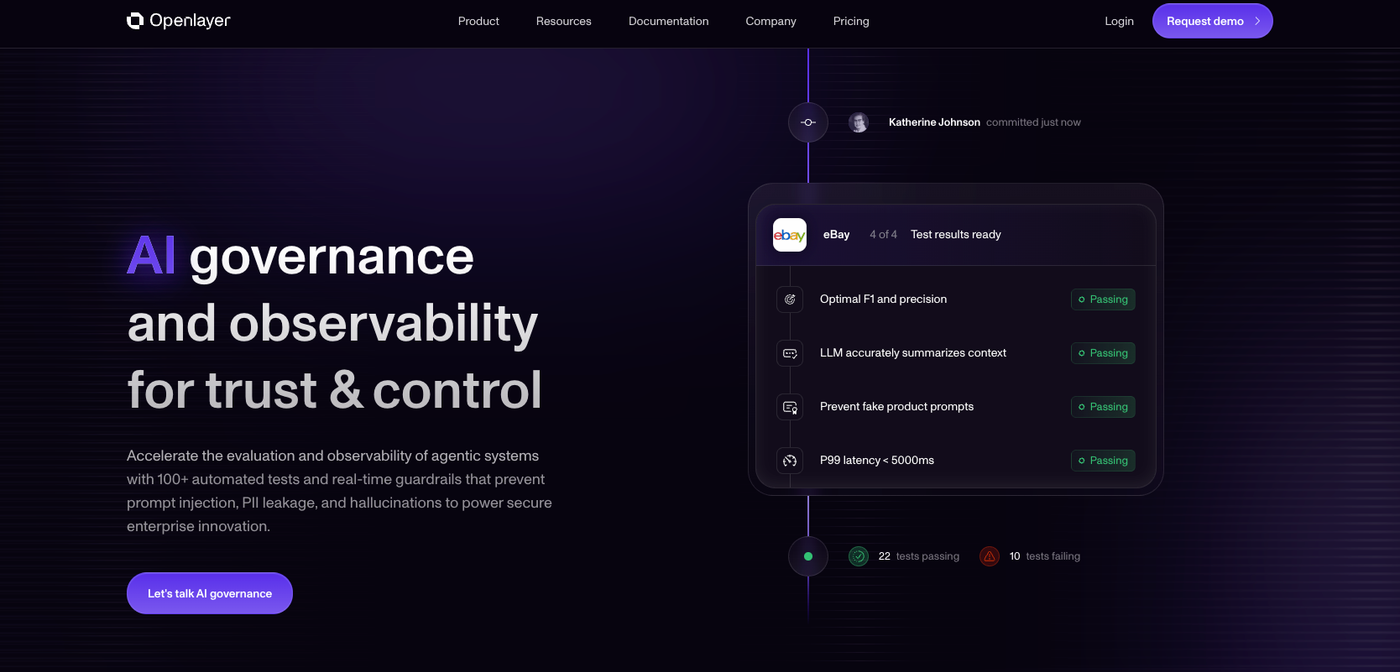
Healthcare AI governance calls for more than policy documents and audit checklists. It requires continuous enforcement across the full model lifecycle, from pre-deployment evaluation through live production monitoring.
Openlayer's unified evaluation, observability, and governance layer covers exactly that scope. Teams can run 100+ pre-built tests across safety, fairness, and clinical accuracy before any model ships, with LLM-as-a-judge scoring calibrated for high human correlation on output quality checks. Once deployed, real-time guardrails block unsafe or out-of-scope responses before they reach end users, and automated drift detection flags when model behavior deviates from its validated baseline.
For healthcare in particular, this matters across three governance pressure points:
- Audit readiness: every evaluation run, threshold decision, and guardrail trigger is logged automatically, giving compliance teams evidence trails without manual documentation overhead.
- Bias and fairness monitoring: demographic parity gaps exceeding configured thresholds, for example a 5% disparity across patient subgroups, trigger automated review before the gap compounds in production.
- Regulatory mapping: governance controls map to regulatory obligations, so teams aren't manually aligning framework requirements against model behavior.
Where tools like Credo AI or IBM watsonx cover policy documentation and risk classification, they do not monitor live model outputs or enforce behavioral thresholds at runtime. Openlayer adds that enforcement layer, blocking outputs that fall below quality or safety thresholds instead of logging them after the fact.
| Platform | Governance Coverage | Runtime Enforcement |
|---|---|---|
| Openlayer | Automated evidence generation, audit trails, regulatory mapping to EU AI Act and FDA obligations, demographic parity monitoring with configurable thresholds | Real-time guardrails block unsafe outputs before they reach end users, automated drift detection flags behavioral deviations from validated baseline |
| Credo AI | Policy documentation and risk classification for AI systems across the governance lifecycle | Does not monitor live model outputs or enforce behavioral thresholds at runtime |
| IBM watsonx.governance | Policy documentation and risk classification for AI systems across the governance lifecycle | Does not monitor live model outputs or enforce behavioral thresholds at runtime |
Final thoughts on healthcare AI governance execution
Governance becomes real when it can block a bad output before it reaches a clinician, instead of only logging it after the fact. Your compliance framework either enforces thresholds in production, or it generates documentation for the post-incident review. If you need to connect regulatory obligations to runtime controls that actually stop unsafe model behavior, we can walk through how that works. Start by identifying every deployed model, setting performance baselines, and configuring the monitoring triggers that catch drift before it scales into harm.
FAQ
Can you build healthcare AI governance without continuous behavioral monitoring?
No. Static documentation and pre-deployment testing cannot catch failures that only surface under real patient populations, like a sepsis model degrading measurably over months or a readmission risk model developing a meaningful performance gap across demographic groups. Governance requires automated drift detection and subgroup performance tracking in production, beyond policy documents alone.
AI governance for healthcare vs traditional software compliance: what's different?
Healthcare AI degrades silently under distribution shift (clinical protocols change, patient populations shift, EHR systems update) without throwing errors traditional monitoring can catch. Governance must track behavioral drift and demographic performance gaps continuously, map findings to HIPAA and FDA SaMD requirements, and maintain audit trails across the full model lifecycle instead of treating compliance as a one-time check.
What happens when healthcare AI systems run unregistered for months?
Shadow AI (models deployed without governance review) accumulates through three channels: data science teams fine-tuning models that bypass the registry, product teams connecting third-party LLM APIs without risk assessment, and business units adopting SaaS tools that process PHI without compliance sign-off. By the time an audit surfaces one, regulatory obligations around documentation, monitoring, and conformity assessment have already gone unmet, creating compounding compliance exposure.
How do you measure bias in healthcare AI after deployment?
Monitor demographic parity and equalized odds continuously across race, age, sex, insurance status, and language, setting review triggers when disparity gaps exceed thresholds like 5% false negative rate divergence between subgroups. Static fairness checks at launch miss drift that develops as patient populations shift, so governance frameworks should flag performance degradation before gaps scale.
When do EU AI Act high-risk healthcare obligations take effect?
GPAI provider obligations became enforceable in August 2025, meaning foundation models used in healthcare products are subject to audit now. High-risk system requirements (conformity assessments, human oversight mechanisms, post-market monitoring) carry an August 2026 deadline for medical applications that influence clinical decisions, classified as high-risk under Annex III.