Build vs. Buy AI Governance: How to Decide (July 2026)
Most enterprises reach a point where AI governance stops being theoretical and becomes an execution problem. You need model inventories, behavioral monitoring, evaluation evidence that satisfies auditors, and enforcement logic that actually blocks unsafe outputs before they reach users. The question is whether your team builds that infrastructure or whether you buy it. Build gives you control but demands ongoing engineering headcount. Buy gives you speed but introduces vendor dependency. Let's break down when each approach makes sense for your organization, especially if you're staring down the EU AI Act's August 2026 compliance deadline.
TLDR:
- Building AI governance in-house typically costs $800K to $1.2M annually and takes 12 to 18 months before producing audit-ready documentation
- In-house builds require four core capabilities: model inventory, continuous monitoring, evaluation pipelines, and runtime policy enforcement at the output layer
- Buying makes sense when your team lacks dedicated governance engineering capacity or faces an August 2026 EU AI Act compliance deadline
- Most governance tools stop at policy documentation; Openlayer enforces policies at runtime by blocking unsafe outputs before they leave the API boundary
What AI Governance Actually Requires to Build In-House
When enterprises decide to build AI governance in-house, the scope of what that actually requires tends to surprise even well-resourced teams. The instinct is to think of governance as documentation and process: policies written down, sign-offs obtained, checklists maintained. But what regulators and auditors expect, and what real AI risk demands, goes considerably further.
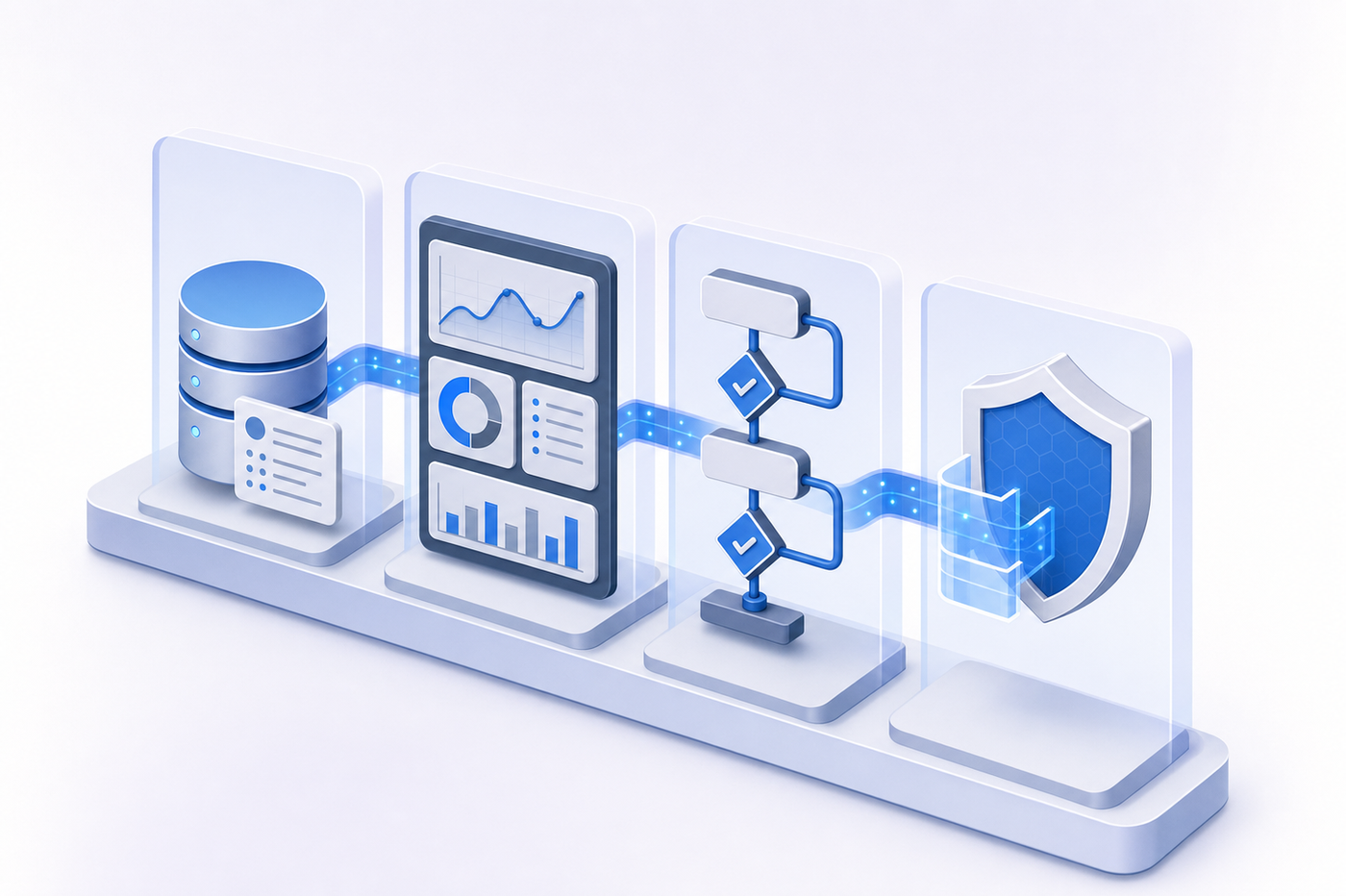
There are four core capability domains any in-house build must cover.
Model inventory and lineage tracking
Every AI system in production needs a registered entry that captures intended use, risk classification, training data provenance, model version, and the evaluation results that cleared it for deployment. Without this, you cannot answer the first question an auditor asks: what models are running, and what evidence exists that they were safe to deploy? Lineage tracking extends this further, linking each deployed artifact back to the specific training run, dataset version, and evaluation gate that produced it.
Continuous monitoring and drift detection
A model that passed evaluation at deployment will not stay within its behavioral envelope indefinitely. Continuous monitoring means tracking output quality, confidence distributions, and fairness metrics against thresholds set at deployment time. When groundedness scores fall below the floor, when demographic parity gaps widen beyond approved limits, or when input distributions shift outside the training boundary, the system should trigger an alert automatically, not surface the problem in a quarterly review.
Evaluation pipelines with audit-ready evidence
Evaluation cannot be a one-time pre-deployment exercise. In-house governance requires versioned, repeatable evaluation pipelines that produce structured pass/fail records, metric scores, and flagged failure modes as auditable artifacts. These records become the evidentiary foundation for conformity assessments, not informal confirmation that someone ran a test.
Policy enforcement at the output layer
Monitoring alone does not constitute governance. In-house builds must also enforce behavioral policies at the output layer, blocking outputs that violate defined safety or compliance thresholds before they reach downstream systems or end users. Detection without enforcement leaves the gap that regulators are looking to close.
Building and maintaining these four capabilities requires dedicated ML engineering, data engineering, and compliance engineering capacity. Teams that underestimate this scope tend to build the documentation layer and find, often during an incident or audit, that the enforcement and monitoring infrastructure was never completed.
Full Cost of Building AI Governance from Scratch
When enterprises scope a build-your-own AI governance program, the initial estimate almost always focuses on tooling. The actual cost is far wider.
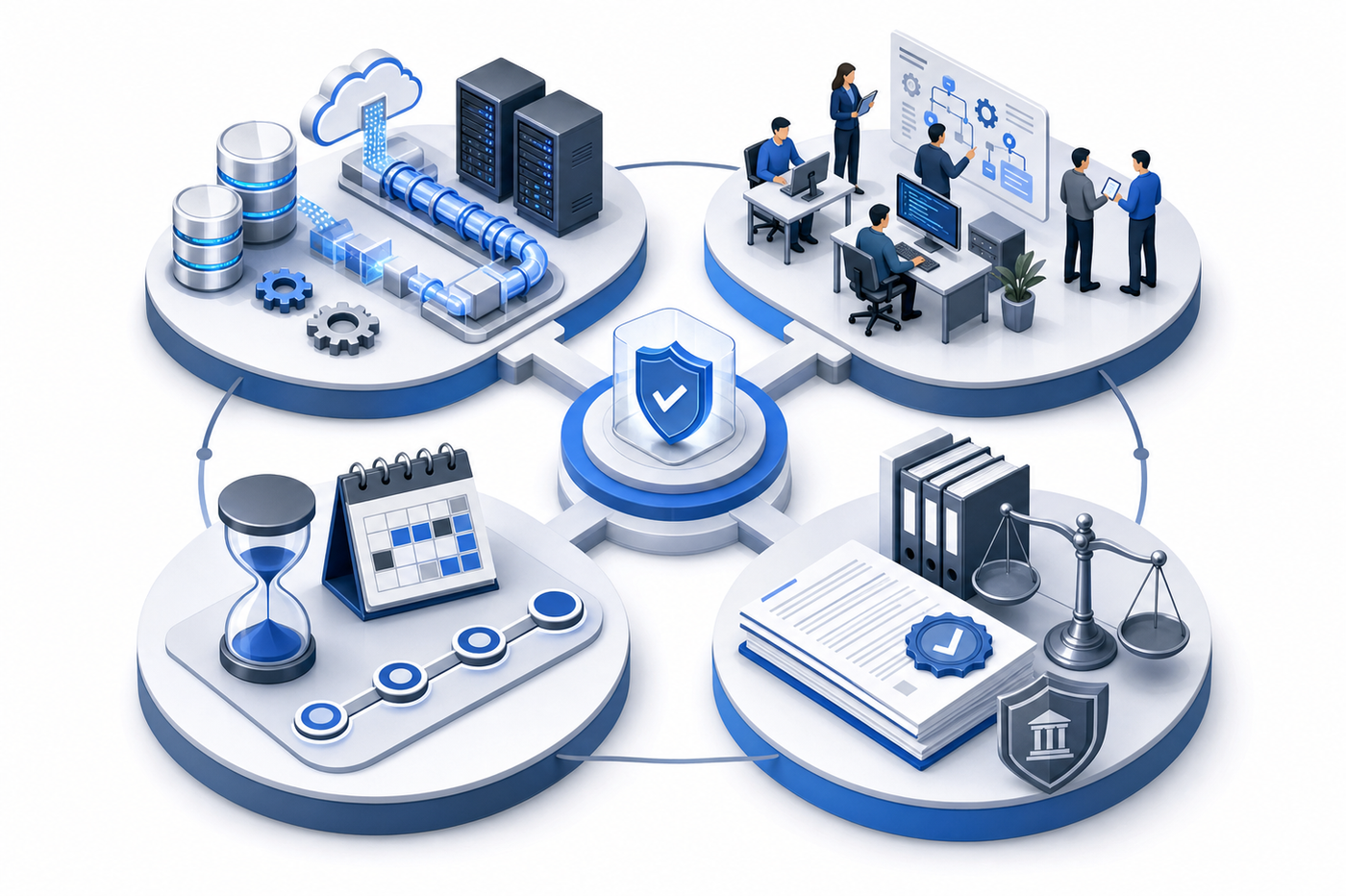
There are four major cost categories to account for:
- Engineering and infrastructure: A functional governance system requires data pipelines for model logging, evaluation frameworks, monitoring dashboards, alerting logic, and audit trail storage. Teams typically underestimate the integration surface; every model deployment point, every data source, every downstream system needs a connection.
- Staffing and ongoing maintenance: Governance tooling is not a one-time build. Regulatory requirements change, model behavior drifts, and new risk surfaces appear. You need dedicated engineers and compliance staff to keep the system current beyond the initial launch.
- Time to value: Internal builds routinely take 12 to 18 months before they cover even the core governance requirements. During that window, models may already be in production with no behavioral baseline on record.
- Regulatory currency: Keeping pace with the EU AI Act, NIST AI RMF, and ISO 42001 as they evolve requires ongoing legal and technical interpretation work, the kind a purchased solution's vendor absorbs as part of their product roadmap.
The hidden cost most teams miss is opportunity cost. Every engineer-month spent building a policy documentation layer is a month lost from model quality, feature development, or production reliability. Build decisions are procurement decisions and resource allocation decisions with a multi-year tail.
Total Cost of Buying an AI Governance Solution
Vendor pricing for AI governance tools rarely reflects the full cost of adoption. The sticker price covers licensing; the real expense accumulates in implementation, integration, and ongoing maintenance.
There are four cost categories worth accounting for before signing a contract:
- Licensing and subscription fees, which typically scale by user count, model count, or API call volume, meaning costs grow as your AI footprint grows.
- Implementation and integration costs, including engineering time to connect the tool to existing model registries, CI/CD pipelines, and data infrastructure, which can run months for complex enterprise environments.
- Ongoing maintenance, covering version upgrades, policy updates as regulations shift, and the internal headcount required to keep the system current.
- Compliance gap costs, meaning the expense of bolt-on tools or manual processes required when the purchased solution covers policy documentation but not runtime enforcement, leaving production monitoring to a separate vendor.
That last category is where build-vs-buy decisions get complicated. Many governance tools stop at the policy layer: they document controls, generate reports, and track model cards. If your organization also needs live behavioral monitoring, automated threshold enforcement, or audit-ready evidence generated at inference time, a documentation-only solution requires supplementing with separate observability tooling. The combined licensing and integration cost of two vendors frequently exceeds a single solution that covers both layers.
Before finalizing a buy decision, map your requirements against what the vendor actually enforces at runtime versus what it records after the fact. That distinction determines whether one contract is enough.
Risk Factors When Building AI Governance
Building AI governance in-house carries real risks that compound over time if teams underestimate the scope of the work.
There are four core risk areas to account for before committing to a build path.
- Scope creep and maintenance burden: What begins as a model registry and a few evaluation scripts tends to grow into a sprawling system requiring dedicated engineering headcount. Regulatory requirements shift, model architectures change, and every update to your monitoring logic must be re-tested, versioned, and validated.
- Coverage gaps at the edges: Internal builds often reflect the risks teams have already encountered, not the ones they haven't. Bias detection, LLM behavioral drift, multi-model pipeline tracing, and cross-framework compliance mapping are the areas that tend to get deferred and remain unaddressed when an audit arrives.
- Slow time-to-value: A governance system built from scratch typically takes six to twelve months before it produces audit-ready documentation. That window is a live compliance gap, particularly for organizations with August 2026 EU AI Act high-risk system deadlines approaching.
- Institutional knowledge concentration: When governance logic lives in custom code owned by one or two engineers, a departure or a reorg can leave the system without anyone who understands its design decisions, thresholds, or failure modes.
Risk Factors When Buying AI Governance
Vendor dependency is the first risk to account for. When your governance requirements change (new regulations, expanded model types, internal policy updates), a bought solution may not keep pace. Procurement cycles move slowly; vendors ship on their own roadmap, not yours.
Data privacy exposure comes next. Many commercial governance tools route model inputs, outputs, or metadata through vendor infrastructure. For organizations handling regulated data (health records, financial transactions, PII), that routing creates compliance surface area that may be hard to audit or contractually limit.
Customization ceilings matter too. Off-the-shelf governance tools are built for the median customer. If your risk taxonomy, threshold logic, or reporting format deviates from that median, you will hit walls. Workarounds accumulate; the gap between what the tool does and what your policy requires widens over time.
Finally, integration depth varies widely. A governance tool that cannot connect directly to your model registry, CI/CD pipeline, or incident management system produces documentation artifacts instead of live enforcement; policy on paper, not policy in production.
When Building Makes Sense for Your Organization
Building your own AI governance infrastructure is the right call in specific circumstances, and being clear about those conditions matters before committing substantial engineering resources.
The case for building is strongest when your organization has genuinely unique governance requirements that no vendor can meet. This shows up most often in:
- Highly regulated industries where audit trails must conform to internal legal standards that off-the-shelf tools cannot replicate without substantial customization anyway
- Organizations with existing ML infrastructure investments where a custom governance layer integrates more cleanly than a third-party tool requiring data egress or format translation
- Teams with the engineering capacity to own, maintain, and evolve the system as regulatory requirements shift
But the bar here is real. Building means owning the problem permanently, including keeping pace with regulatory changes like the EU AI Act's August 2026 high-risk system obligations, updating evaluation logic as model behavior changes, and maintaining audit evidence structures that satisfy external reviewers. That ongoing maintenance cost rarely appears in initial build estimates.
When Buying Makes Sense for Your Organization
Most enterprises reach a clear tipping point where internal build costs (engineering hours, tooling debt, ongoing maintenance) outweigh the speed and coverage a purpose-built solution provides from day one.
Buying tends to make sense when several conditions are true at once.
- Your governance requirements are broad and immediate, covering model registries, audit trails, bias testing, and regulatory mapping across multiple frameworks. Building each of those components takes months; a vendor solution ships them together.
- Your team lacks dedicated ML governance engineering capacity. Governance tooling is not a one-time build; it requires continuous updates as regulations evolve and model behavior changes in production.
- You are operating under a compliance deadline. The EU AI Act's high-risk financial-services obligations carry an August 2026 deadline. If your audit trail does not exist today, a build-first approach leaves almost no runway.
- You need runtime enforcement beyond documentation. Vendors like Openlayer go beyond policy layers by blocking unsafe outputs before they leave the API boundary, a capability that takes substantial engineering effort to replicate internally.
The tradeoffs are real, though. Vendor solutions introduce data residency questions if your models process regulated data in a third-party environment. Integration depth varies: governance-focused platforms like Credo AI and IBM watsonx cover policy documentation, risk classification, and audit trail generation well but stop at the documentation layer; they do not monitor live model outputs, enforce behavioral thresholds at the API boundary, or flag drift in production. Assessing a vendor means checking both what the governance layer covers and what happens after deployment.
Decision Framework by Organization Profile
Most organizations don't fall neatly into the "build" or "buy" column. The right answer depends on a few intersecting factors: how tightly regulated your industry is, how much internal ML engineering capacity you have, how many models you're running in production, and how quickly you need governance controls in place. Strategic frameworks for enterprise software decisions apply here with AI-specific constraints layered on top.
Here's a way to think through where your organization sits.
Build makes sense when
- Your use cases involve highly proprietary model architectures or fine-tuned models that off-the-shelf tools can't instrument without substantial custom work.
- Your security posture requires full data residency control and no third-party data egress, even for telemetry.
- You have a dedicated ML engineering team with bandwidth to own tooling development and ongoing maintenance beyond model work.
- Your governance requirements are stable and well-understood enough that you're not trying to keep pace with shifting regulatory frameworks.
Buy makes sense when
- You're operating under active regulatory pressure, such as EU AI Act high-risk obligations with an August 2026 deadline, and need audit-ready documentation now.
- Your team's core competency is building AI products, not building AI infrastructure, and tooling ownership competes directly with roadmap capacity.
- You're running multiple models across teams and need consistent evaluation and monitoring coverage without rebuilding instrumentation for each one.
- You need enforcement at the API boundary beyond logging after the fact, and building that enforcement layer internally would take quarters instead of weeks.
The hybrid profile
Some organizations find that neither pure path fits. A common pattern: internal tooling handles model registry and lineage, while a bought solution covers behavioral evaluation, runtime guardrails, and compliance reporting. The split usually follows the boundary between infrastructure your data org already owns and governance evidence your compliance team needs to produce on demand.
| Organization Profile | Recommended Approach | Primary Reason |
|---|---|---|
| Early-stage AI team, few models | Buy | Speed to coverage; engineering bandwidth preserved |
| Large enterprise, regulated industry | Buy or Hybrid | Audit deadlines, multi-model scale, enforcement gaps |
| ML-mature org, stable use cases | Build or Hybrid | Custom instrumentation needs, existing infra investment |
| High-security / air-gapped environment | Build | Data egress constraints rule out most SaaS options |
| Rapid scaling, many teams deploying models | Buy | Consistent governance coverage without per-team rebuild |
How Much Does It Cost to Build AI Governance In-House?
The real cost of building AI governance in-house goes well beyond the engineering hours to wire up a few dashboards. Organizations typically underestimate three distinct cost buckets when calculating enterprise AI total cost of ownership.
Initial Build Costs
Getting a governance system off the ground requires dedicated headcount and tooling across several workstreams:
- Hiring or retraining ML engineers, compliance specialists, and legal reviewers to scope requirements, write policy logic, and wire evaluation pipelines. A team of four to six specialists can run $800K to $1.2M annually in fully-loaded compensation alone.
- Acquiring or building evaluation infrastructure, including test frameworks, model registries, audit logging, and monitoring pipelines; often $200K to $500K in first-year tooling and infrastructure costs.
- Scoping regulatory obligations (EU AI Act, NIST AI RMF, ISO 42001) and translating them into enforcement rules, which typically requires external legal counsel at $300 to $600 per hour for specialized AI compliance work.
Ongoing Maintenance Costs
A governance system built against today's regulatory requirements will need continuous updates as frameworks evolve and model behavior changes in production. These maintenance costs are where build decisions most frequently get mispriced:
- Regulatory update cycles: when the EU AI Act adds guidance or NIST revises the AI RMF, every hard-coded policy rule needs review and likely revision.
- Model and pipeline changes: a new model version, a new data source, or a new deployment environment each requires re-validation of existing governance controls.
- Staffing continuity risk: if the two engineers who built the system leave, institutional knowledge walks out with them and replacement costs are steep.
The Hidden Opportunity Cost
The hours your ML and engineering teams spend building governance tooling are hours not spent on model development, product features, or the evaluation work that directly improves output quality. For most organizations, the opportunity cost of diverting senior engineering capacity toward infrastructure that vendors have already built and iterated on is the largest cost category, and the least visible in a build-vs-buy spreadsheet.
What Is Included in an AI Governance Solution?
Any serious AI governance solution needs to cover more than policy documentation. The actual work spans the full model lifecycle, from pre-deployment evaluation through live production monitoring, and the components that matter fall into a few distinct categories.
Core Components to Look For
There are four functional areas that a governance solution needs to cover to be genuinely useful at an enterprise level:
- Model registry and inventory: A centralized record of every model in production, including version history, intended use, risk classification, and ownership. Without this, you cannot answer basic audit questions about what is running, who approved it, or when it was last tested.
- Evaluation and testing infrastructure: Pre-deployment gates that check model behavior against defined criteria before anything reaches users. This includes bias and fairness checks, behavioral tests across input distributions, and performance benchmarks tied to the risk tier of the system in question.
- Runtime monitoring and enforcement: Live tracking of model outputs after deployment, with alerting when behavior drifts outside approved bounds. The distinction between tools that only log and tools that actively block non-compliant outputs is real and consequential. Logging gives you a record after harm occurs; enforcement prevents it.
- Audit trail and documentation generation: Structured records that map evaluation results, monitoring logs, and incident reports to the specific regulatory obligations they satisfy. For teams subject to the EU AI Act, NIST AI RMF, or ISO 42001, this is the layer that turns production data into evidence an auditor can review.
What Often Gets Left Out
Many point solutions cover one or two of these areas well and leave the others to manual process or separate tooling. A registry with no enforcement layer means models can drift unchecked after deployment. An evaluation framework with no audit trail means teams repeat compliance work every review cycle with nothing to show for prior effort. The governance value comes from the connection between these layers, not from any single one in isolation.
When Should a Company Build vs Buy AI Governance?
The decision comes down to a few concrete factors: regulatory exposure, internal capability, and how much of your governance logic is genuinely proprietary.
Build if your organization operates in a highly regulated industry with bespoke compliance requirements that off-the-shelf tools won't map to cleanly, has a mature ML engineering team that can own the infrastructure long-term, and needs governance logic deeply embedded in proprietary workflows where a vendor boundary would create friction.
Buy if your team lacks dedicated governance engineering capacity, needs to move faster than a build timeline allows, or operates across multiple regulatory frameworks where a vendor already maintains up-to-date coverage.
Most enterprises land somewhere in between: buying a foundation and customizing on top of it.
What Is the ROI of an AI Governance Solution?
Quantifying the return on an AI governance investment is genuinely hard, because the costs it prevents are largely invisible until something goes wrong. But the exposure is real, and the categories of value are measurable.
There are four main buckets to account for:
- Regulatory penalty avoidance: Under Article 99 of the EU AI Act, non-compliance with high-risk system obligations carries fines of up to €15 million or 3% of global annual turnover. For large enterprises, that ceiling can reach nine figures. A governance solution that keeps documentation, conformity assessment records, and monitoring logs audit-ready is directly offsetting that exposure.
- Incident cost reduction: AI failures in production carry costs that compound quickly across remediation, legal review, customer notification, and reputational damage. The faster a team can detect a behavioral failure, classify its severity, and produce an investigation record, the smaller the blast radius.
- Engineering time recovered: Without a governance layer, compliance prep tends to fall on ML engineers and data scientists in the weeks before an audit or deployment review. That work is high-friction, undocumented, and repeated for every model. A solution that generates audit trails continuously moves that burden from sprint-time scrambles to background automation.
- Shadow AI exposure: Unregistered models running without behavioral baselines represent a latent liability that grows silently. Every week a model operates outside governance coverage is a week of regulatory obligation going unmet, with no documentation to show for it.
The ROI calculus depends on your organization's risk tier, model count, and regulatory obligations. But for any enterprise deploying high-risk AI systems, the question stops being whether governance has positive ROI and becomes how much untracked exposure you are currently carrying.
How Long Does It Take to Build AI Governance from Scratch?
Most teams that attempt to build AI governance in-house underestimate the timeline by a wide margin. A realistic build takes 12 to 18 months before anything resembling a production-ready governance layer is in place, and that estimate assumes you already have engineers who understand model evaluation, policy enforcement, and audit trail design.
The work breaks into three phases, each with its own compounding complexity.
Phase 1: Foundation (Months 1 to 4)
The first phase covers the infrastructure nobody sees but everyone depends on: a model registry, a metadata schema, logging pipelines, and a baseline policy document. Teams routinely underestimate this phase because the work feels like plumbing. But the schema decisions made here, what gets logged, at what granularity, with what version tracking, determine whether the audit trail you generate two years later is actually usable. Getting this wrong means rebuilding it.
Phase 2: Evaluation and Enforcement (Months 5 to 10)
This is where most build efforts stall. Writing evaluation logic for one model type is tractable. Generalizing it across LLMs, classification models, and agentic workflows, while keeping thresholds configurable per use case, is an engineering problem that expands faster than headcount can absorb it. Teams that reach this phase often find themselves maintaining a growing library of one-off scripts instead of a coherent governance layer.
Phase 3: Compliance Mapping and Reporting (Months 11 to 18)
The final phase connects behavioral evidence to regulatory frameworks: mapping evaluation outputs to EU AI Act Annex IV documentation requirements, generating conformity assessment records, and producing reports auditors can actually read. This phase requires both engineering depth and regulatory literacy, a combination that is genuinely rare on a single team.
The 12 to 18 month estimate also assumes no major scope changes, no staff turnover, and no new regulatory requirements landing mid-build. All three of those assumptions tend to fail in practice.
How Openlayer Solves the Build vs Buy Decision
For enterprises that have weighed the build vs buy decision and concluded that a purpose-built solution makes more sense than an internal build, Openlayer sits at the intersection of evaluation, observability, and governance across the full AI lifecycle, from development through production.
The distinction worth calling out here is the gap between policy documentation and active enforcement. Many governance tools stop at the documentation layer: they help teams write policies, classify models, and generate audit records. Openlayer goes further by enforcing those policies at runtime, blocking outputs that violate defined thresholds before they leave the API boundary.
There are three areas where this shows up concretely:
- Evaluation coverage: Openlayer ships with 100+ pre-built tests covering quality, safety, fairness, and robustness. Teams can run these against model versions in CI/CD before any deployment decision is made, with results producing pass/fail records and metric scores that become the evidentiary record auditors review during conformity assessment.
- Production observability with behavioral thresholds: Once a model is deployed, Openlayer monitors live outputs against the same evaluation criteria used during development. If groundedness scores fall below a defined floor or demographic parity gaps exceed approved limits, alerts fire automatically. The monitoring layer does not require a separate integration or a third-party guardrails library.
- Automated compliance mapping: Openlayer maps evaluation results to specific regulatory obligations, so the audit trail is structured around what regulators ask for instead of what the model team happened to log. For teams subject to the EU AI Act's August 2026 high-risk system deadline, conformity assessment evidence is being collected continuously, not assembled retrospectively before an audit.
The tradeoff worth acknowledging: Openlayer is not a data governance tool and does not replace a dedicated risk register or enterprise GRC system. Teams with complex multi-framework compliance obligations will still need to own the policy layer. Openlayer enforces policies and generates evidence against them, but the policies themselves require human judgment and legal input to define.
Final Thoughts on Choosing Between Building and Buying AI Governance
Build costs extend well beyond the initial engineering sprint, and buy decisions require assessing whether a vendor actually enforces policy or just documents it. Your governance layer needs to produce structured evidence that maps to regulatory obligations, and it needs to do that continuously as models drift in production. Most teams lack the bandwidth to maintain custom governance tooling while also shipping models. We can walk through Openlayer's enforcement layer. The right answer depends on your regulatory exposure, your team's capacity, and how much of your governance logic is genuinely unique to your organization.
FAQ
Build vs buy AI governance: which is faster to implement?
Buying an AI governance solution delivers production-ready coverage in weeks, while building in-house takes 12 to 18 months before anything resembles a complete system. That gap matters when your EU AI Act high-risk system deadline is August 2026 and your audit trail doesn't exist yet.
What's the main cost difference between building and buying AI governance?
Building costs accumulate across four categories: engineering and infrastructure (data pipelines, monitoring dashboards, audit logging), dedicated staffing for ongoing maintenance, 12 to 18 month time-to-value before the system produces audit-ready documentation, and regulatory currency work to keep pace with evolving frameworks. Buying moves those costs to subscription fees, implementation integration, and ongoing maintenance, but the combined cost often depends on whether the vendor covers both policy documentation and runtime enforcement, or requires supplementing with separate observability tooling.
Can I build AI governance without dedicated ML governance engineers?
No. Building governance infrastructure requires dedicated ML engineering, data engineering, and compliance engineering capacity to maintain model registries, evaluation pipelines, continuous monitoring, and enforcement logic as regulatory requirements shift and model behavior drifts in production. Teams that underestimate this scope tend to build the documentation layer and find during an audit that the enforcement and monitoring infrastructure was never completed.
When does buying AI governance make more sense than building?
Buying makes sense when your governance requirements are broad and immediate (covering model registries, audit trails, bias testing, regulatory mapping), your team lacks dedicated ML governance engineering capacity, you're operating under a compliance deadline like the EU AI Act's August 2026 high-risk financial-services obligations, or you need runtime enforcement that blocks unsafe outputs before they leave the API boundary instead of just documentation after the fact.
What happens if I build AI governance but miss coverage at the edges?
Internal builds often reflect the risks teams have already encountered, not the ones they haven't. Bias detection, LLM behavioral drift, multi-model pipeline tracing, and cross-framework compliance mapping are the areas that tend to get deferred and remain unaddressed when an audit arrives. That coverage gap becomes a live compliance exposure, particularly for organizations with approaching regulatory deadlines.