AI Governance Best Practices: A Framework for Enterprise Leaders in June 2026
Three forces came together in 2025 and 2026 to move AI governance from a compliance footnote to a board-level priority. The EU AI Act's high-risk obligations became enforceable for financial services in August 2026, with Article 99 fines reaching €15 million or 3% of global annual turnover. NIST AI RMF, while still officially voluntary, became the de facto baseline in federal procurement and contractor agreements. And a string of documented failures (bias findings in hiring algorithms, the 2024 Air Canada chatbot liability ruling) pushed general counsel and regulators into the same room at the same time. The organizations that had been deferring governance found themselves facing audit requests they couldn't satisfy.
TLDR:
- The EU AI Act became enforceable for high-risk financial services systems in August 2026, and teams without complete AI inventories face audit requests they cannot satisfy.
- Shadow AI enters through three channels: unregistered fine-tuned models, third-party LLM APIs added without review, and off-the-shelf tools processing regulated data.
- Governance requires four roles with clear mandates: Model Owner, Governance Lead, and Ethics Committee, each owning specific checkpoints across scoping, deployment, and post-deployment review.
- High-risk systems need pre-deployment bias testing with defined thresholds (for example, flag if demographic parity gap exceeds 5%) and continuous production monitoring that blocks drift before harm accumulates.
- Openlayer connects evaluation, observability, and governance by enforcing thresholds at development, blocking unsafe outputs at deployment, and tracking 13 session-level metrics in production to generate audit trails automatically.
Why AI governance matters in 2026
Three forces came together in 2025 and 2026 to make AI governance a boardroom priority instead of a compliance footnote:
- The EU AI Act's high-risk system obligations became enforceable for financial services in August 2026.
- The NIST AI Risk Management Framework, while still officially voluntary, became a widely expected baseline in federal procurement and contractor agreements.
- And a string of documented failures, including AI hiring tools found to systematically disadvantage protected classes and the 2024 Air Canada ruling that held a company legally liable for its chatbot's hallucinated refund policy, pushed regulators and general counsel into the same room at the same time.
The result: organizations that had been deferring governance found themselves facing audit requests they couldn't satisfy.
The cost of deferred governance
Shadow AI deployment is where most of the exposure lives. Three channels account for the bulk of it:
- Data science teams spinning up unregistered fine-tuned models that bypass evaluation gates and never enter a model registry, leaving no behavioral baseline on record.
- Product teams connecting third-party LLM APIs at the feature level, often under time pressure, with no formal assessment of data handling or vendor compliance posture.
- Business units deploying off-the-shelf generative tools that process regulated data, such as PII or financial records, before legal or compliance functions are aware they're in use.
By the time an audit or incident surfaces one of these deployments, the model may have been running for months with no documentation, no monitoring, and no evidence of conformity. That gap is where regulatory exposure compounds fastest.
Core principles of effective AI governance
Effective AI governance rests on a few core principles that separate organizations building durable programs from those producing documentation that sits unused.
There are four principles worth anchoring any framework around:
- Accountability must be assigned to specific roles, not distributed across "the organization." Every AI system in production needs a named model owner who approves deployment readiness, owns drift thresholds, and initiates decommission when performance or compliance conditions are breached.
- Transparency means your team can explain what a system does, what data trained it, and where it fails, on demand. Not in theory. If that documentation does not exist for a live system, the system is ungoverned regardless of what your policy says.
- Risk-proportionality keeps governance from collapsing under its own weight. A low-stakes internal scheduling tool does not need the same review cycle as a credit decisioning model processing regulated data.
- Continuous oversight closes the gap between deployment and drift. A model approved six months ago may no longer behave the way it was approved to behave. Governance that stops at launch is not governance.
These principles apply across every major framework in circulation, whether you are working from NIST AI RMF, ISO 42001, the EU AI Act's obligations for high-risk systems, or internal policy. The frameworks differ in structure and emphasis, but the accountability, transparency, proportionality, and oversight requirements appear in all of them.
Regulatory environment: EU AI Act, NIST AI RMF, and ISO 42001
Three frameworks now set the terms for enterprise AI governance, and they pull in overlapping but distinct directions.
The EU AI Act is binding law. It classifies AI systems by risk tier and assigns enforceable obligations accordingly. High-risk systems in financial services face an August 2026 compliance deadline, while GPAI provider obligations became enforceable on August 2, 2025. Under Article 99, fines reach €35 million or 7% of total worldwide annual turnover for the most serious violations, whichever is higher.
NIST AI RMF and ISO 42001 are voluntary frameworks, but that distinction matters less than it sounds. Regulators and procurement teams increasingly treat them as de facto baselines. ISO 42001 provides a certifiable management system structure for AI; NIST AI RMF organizes governance activity across four functions: Govern, Map, Measure, and Manage.
Where these frameworks align is instructive:
- Documentation of intended use, risk classification, and known limitations is expected at every tier, across all three.
- Ongoing monitoring after deployment is not optional treatment for high-risk systems; it is the baseline expectation.
- Human oversight mechanisms must be defined before deployment, not retrofitted after an incident surfaces.
The gap most organizations face is not understanding what the frameworks require. It is translating those requirements into runtime controls that hold under audit. A policy document is not a governance program.
Building an AI system inventory and asset catalog

You cannot govern what you cannot see. Before policies, thresholds, or audit trails mean anything, an organization needs a complete picture of every AI system it runs. There are three specific channels through which untracked models typically enter an organization:
- Data science teams spinning up unregistered fine-tuned models that bypass evaluation gates and accumulate outside any governance perimeter.
- Product teams connecting third-party LLM APIs without risk review, often under time pressure, with no formal assessment of data handling or vendor compliance posture.
- Business units deploying off-the-shelf generative tools that process regulated data without compliance sign-off.
By the time an audit or incident surfaces one of these, the model may have been running for months with no behavioral baseline on record. That gap is where regulatory obligations go unmet: no documentation, no monitoring, no evidence of conformity.
What a complete AI asset catalog should capture
A well-structured inventory goes beyond a spreadsheet of model names. Each entry should describe the system concretely enough that an auditor who has never seen it could reconstruct what it does, who owns it, and whether it is being watched. There are six fields every entry needs:
- Intended use case and business function: the specific task the model performs and the decision or output it produces. For example, "a credit-scoring model that ingests income, employment history, and FICO scores to return an approval probability," not "supports loan decisions." Vague use-case descriptions do not satisfy EU AI Act technical documentation requirements and give auditors nothing to work with.
- Risk tier classification: the assigned tier (minimal, limited, high-risk, or unacceptable under the EU AI Act; low, medium, or high under NIST AI RMF), confirmed by the Governance Lead before development begins, not self-reported by the model owner at launch. The classification drives which controls attach to the system; an unconfirmed tier means those controls may never have been applied.
- Data inputs: listed data types (PII fields, financial records, protected-class attributes, health data), named sources, and any preprocessing steps that alter raw inputs before inference. If a model ingests a computed feature instead of raw data, the derivation logic is part of the input record: an auditor reviewing a bias finding will need it.
- Owning team and designated model owner: a named individual with a direct contact path, not a team alias or shared inbox. The model owner is accountable for evaluation sign-off, owns the drift thresholds in production, and is the person an auditor contacts when a question cannot be answered from documentation alone.
- Deployment environment and third-party dependencies: production versus staging, cloud provider, serving infrastructure, container image version, and any third-party LLM API calls with version pinning. An undocumented API dependency (a vendor-hosted model your system calls at inference time) is an untracked risk surface. If the vendor updates their model, your behavioral baseline changes with no record of why.
- Monitoring status and last evaluation date: active or inactive monitoring, which metrics are tracked and at what thresholds, the most recent evaluation date, and the scores that evaluation produced. A blank field here means drift has no reference point. The system may have changed materially since deployment with no signal that it happened.
A field left blank is not a neutral omission. An auditor reviewing an incomplete entry will treat it as evidence the control was never in place, not that it was overlooked at data entry time.
Risk classification and tiered governance controls
Not every AI system carries the same risk, and governance controls should scale accordingly. A chatbot that recommends playlists warrants far less oversight than one that flags loan applicants or recommends medical treatments. Tiered classification makes that distinction formal.
There are four tiers that most frameworks share:
- Minimal risk systems require only basic logging and periodic review, covering things like content recommendation engines or spam filters.
- Limited risk systems require transparency obligations, such as disclosing to users when they are interacting with an AI.
- High-risk systems require pre-deployment conformity assessments, bias testing, human oversight mechanisms, and continuous monitoring in production.
- Unacceptable risk systems are prohibited outright, covering uses like real-time biometric surveillance in public spaces or social scoring by governments.
Mapping controls to tiers
Once a system is classified, governance controls attach to that tier automatically. High-risk systems should trigger mandatory model cards, demographic parity audits before deployment, and drift monitoring thresholds in production. A reasonable starting point: flag for human review if demographic parity gap exceeds 5%, or if output quality scores fall below a defined threshold on a rolling window.
The classification decision itself needs an owner. Assign the Model Owner responsibility for proposing the risk tier at scoping, and the Governance Lead for confirming it against regulatory obligations before any development work begins. Without that handoff formalized, classification slips into a checkbox instead of a control point.
Implementing governance: roles, workflows, and approval gates
Governance frameworks only work when someone owns each piece. Abstract accountability ("the AI team is responsible") collapses the moment an incident occurs or an auditor asks who approved a deployment.
There are three roles that need clear, non-overlapping mandates.
- Model Owner: defines intended use and risk tier at scoping; approves evaluation criteria before training begins; signs off on deployment readiness; owns post-deployment performance and drift thresholds; initiates decommission when performance or compliance conditions are breached.
- Governance Lead: maps regulatory obligations at scoping; reviews documentation completeness before deployment; maintains the audit trail across the lifecycle; escalates compliance gaps to the ethics committee or legal function.
- Ethics Committee: reviews high-risk system designations and bias evaluation results before deployment; sets demographic parity and fairness thresholds the model owner enforces; approves or rejects deployment of systems with unresolved failure modes; conducts post-deployment reviews when incident flags are triggered.
Approval gates by lifecycle stage
Role clarity alone is insufficient without defined checkpoints where work stops until sign-off occurs. Here is a working structure across four stages.
| Stage | Gate owner | Exit criteria |
|---|---|---|
| Scoping | Governance Lead | Risk tier confirmed; regulatory obligations mapped |
| Pre-deployment | Ethics Committee | Bias evaluation reviewed; fairness thresholds set |
| Deployment readiness | Model Owner | Evaluation criteria passed; documentation complete |
| Post-deployment review | All three | Drift thresholds checked; incident flags resolved |
AI governance for agentic systems
Agentic AI systems introduce governance challenges that static model deployments simply do not have. A single user request can trigger a chain of LLM calls, tool invocations, database reads, and external API calls, each producing outputs that feed into the next step. By the time a final response reaches a user, five or six autonomous decisions may have already been made with no human in the loop.
Traditional governance frameworks were built around discrete model predictions. They assume a clean input-output boundary you can audit. Agentic systems break that assumption entirely.
There are three specific governance properties that agentic deployments require that go beyond standard model governance:
- Action traceability across multi-step chains, so every tool call, retrieval event, and intermediate LLM output is logged with enough context to reconstruct what the agent decided and why. Without this, a post-incident audit cannot determine where a failure originated.
- Scope enforcement at the action level, meaning the agent's permitted tools and data access are bounded by policy before execution, not reviewed after the fact. An agent authorized to query a CRM should not be able to write to it, even if the underlying API technically allows it.
- Behavioral drift detection across sessions, because an agent's behavior can shift as context windows fill, tool outputs change, or upstream models are updated. A weekly human review cycle is too slow to catch this; threshold-based automated monitoring is the floor, not the ceiling.
The accountability question also changes. When an agentic system causes a downstream error, the governance record must answer whether the failure was a model output problem, a tool integration problem, or a scope boundary violation. That distinction matters for remediation and for regulatory disclosure obligations under frameworks like the EU AI Act, which holds deployers accountable for outputs regardless of how many autonomous steps produced them.
Monitoring, testing, and continuous compliance
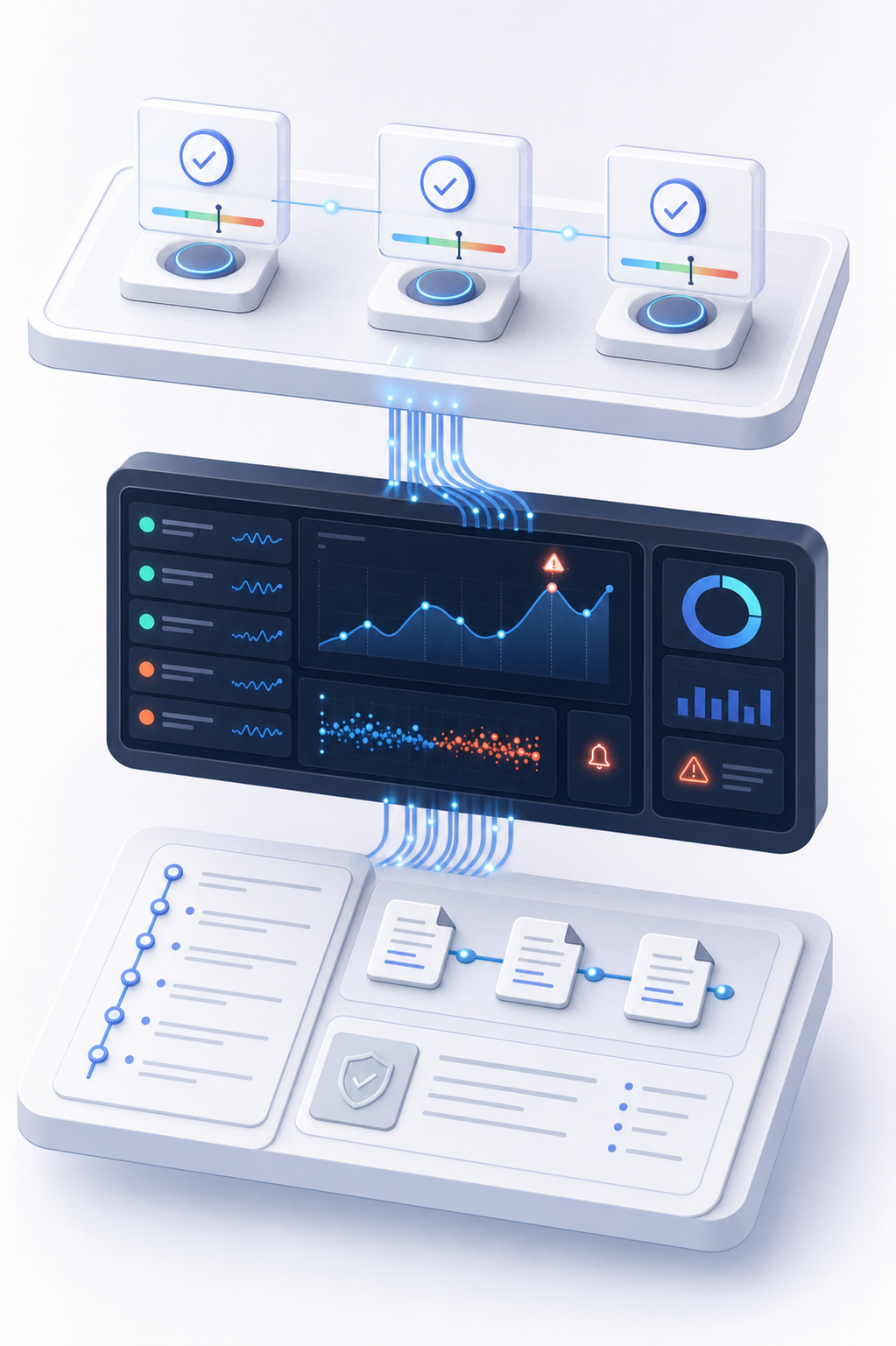
Governance frameworks set the rules. Monitoring is what keeps them accurate over time.
AI systems behave differently in production than they do at launch. Models drift as input distributions shift, edge cases surface that pre-deployment testing never covered, and third-party model providers update versions without announcement. A governance structure with no continuous monitoring layer is a policy document, not a control system.
There are three distinct layers worth building out here.
- Pre-deployment testing gates block models from reaching production until they meet defined thresholds across accuracy, fairness, and safety dimensions. For example, a credit-scoring model might require demographic parity gap below 5% and a false-negative rate under 8% before any deployment is approved.
- Runtime behavioral monitoring tracks live output quality against baselines set during evaluation. When outputs drift outside acceptable ranges, automated alerts or blocking rules engage before harm accumulates.
- Audit trail generation captures the full chain of evidence: what was tested, when, by whom, against which criteria, and what decisions followed. This is what regulators and auditors actually inspect.
Connecting monitoring to your AI inventory
Monitoring only works if you know what to monitor. This is where an up-to-date AI inventory earns its keep. Each registered model should carry its evaluation baseline, assigned risk tier, and monitoring thresholds as metadata. When a model update ships or a new version of a third-party API goes live, those baselines become the reference point for detecting behavioral change. Without that linkage, monitoring data is noise with no signal to compare against.
AI governance platforms: what most tools cover and where gaps remain
When assessing AI governance platforms, two tools consistently surface as the leading options: Credo AI and IBM watsonx.governance. Both focus on policy documentation, risk assessment workflows, and compliance reporting. Understanding where they stop clarifies what runtime enforcement and production monitoring actually require.
Credo AI provides a governance layer for AI systems, covering model cards, risk assessments, and compliance mapping to frameworks like the EU AI Act, NIST AI RMF, and ISO 42001. Its Lens platform tracks AI assets across an organization and generates policy documentation. The limitation: Credo AI does not monitor live model outputs in production, enforce behavioral thresholds at runtime, or block unsafe outputs before they reach users. It documents what governance policies require but delegates the enforcement of those policies to separate monitoring and observability tools.
IBM watsonx.governance covers AI governance within the broader IBM ecosystem, offering model risk management, factsheet generation, and compliance workflow automation. It integrates with watsonx.ai for model lifecycle tracking and provides audit trail documentation. The constraint: watsonx.governance does not provide active runtime guardrails or continuous behavioral drift detection outside the IBM stack. Teams running models in other environments or using third-party LLM APIs face integration gaps, and production enforcement still requires connecting external observability tooling.
Both platforms cover the governance documentation layer: what was approved, what risks were assessed, what policies apply. Where Credo AI and IBM watsonx.governance fall short is the runtime enforcement layer: continuous monitoring of live outputs against defined thresholds, blocking unsafe responses before they leave the API boundary, and automatically generating compliance evidence from production behavior instead of pre-deployment assessments. That enforcement gap is where most governance programs find their policy documents did not prevent the incident.
Shadow AI: discovery, risk assessment, and remediation
Shadow AI refers to AI systems deployed outside formal approval and oversight channels. The risks compound quickly: a model running without a behavioral baseline can accumulate regulatory exposure for months before anyone notices.
When these shadow AI systems are found, remediation follows a three-stage sequence:
- First, discovery: conduct a cross-functional audit spanning engineering, product, and business units to surface unregistered models.
- Second, risk tiering: assess each identified system against your governance framework's risk criteria, flagging any that process personal data, inform regulated decisions, or interact with external users.
- Third, remediation routing: low-risk systems get retroactively documented and registered; high-risk systems get suspended pending full evaluation.
The audit itself should produce a model inventory entry for every system found, capturing intended use, data inputs, deployment scope, and the owning team. That record becomes the baseline for ongoing monitoring and the evidence layer an auditor would expect to see.
Common implementation challenges and how to overcome them
Three challenges appear consistently across enterprise AI governance rollouts, regardless of org size or industry:
- Scope creep in model inventories: Teams often start with a narrow registry of "official" models, then realize shadow deployments (unregistered fine-tunes, third-party LLM API connections, off-the-shelf generative tools processing regulated data) have quietly accumulated outside any governance perimeter. By the time an audit surfaces one, it may have been running for months with no behavioral baseline on record.
- Governance-monitoring gaps: Many organizations build strong policy documentation but stop short of production enforcement. A policy that says "monitor for drift" is not the same as a system that flags when demographic parity gap exceeds 5% and blocks deployment until it is resolved.
- Role ambiguity at handoff points: When a model moves from development to deployment, accountability often falls between the model owner and the governance lead. Without explicit sign-off criteria, that handoff becomes the most common point of compliance failure.
The fix for all three follows the same logic: make the governance artifact the blocker, not the suggestion. Checklists that can be bypassed will be. Thresholds that are documented but not enforced do not reduce risk; they just create a paper trail that shows you knew the risk existed.
How Openlayer unifies evaluation, observability, and governance
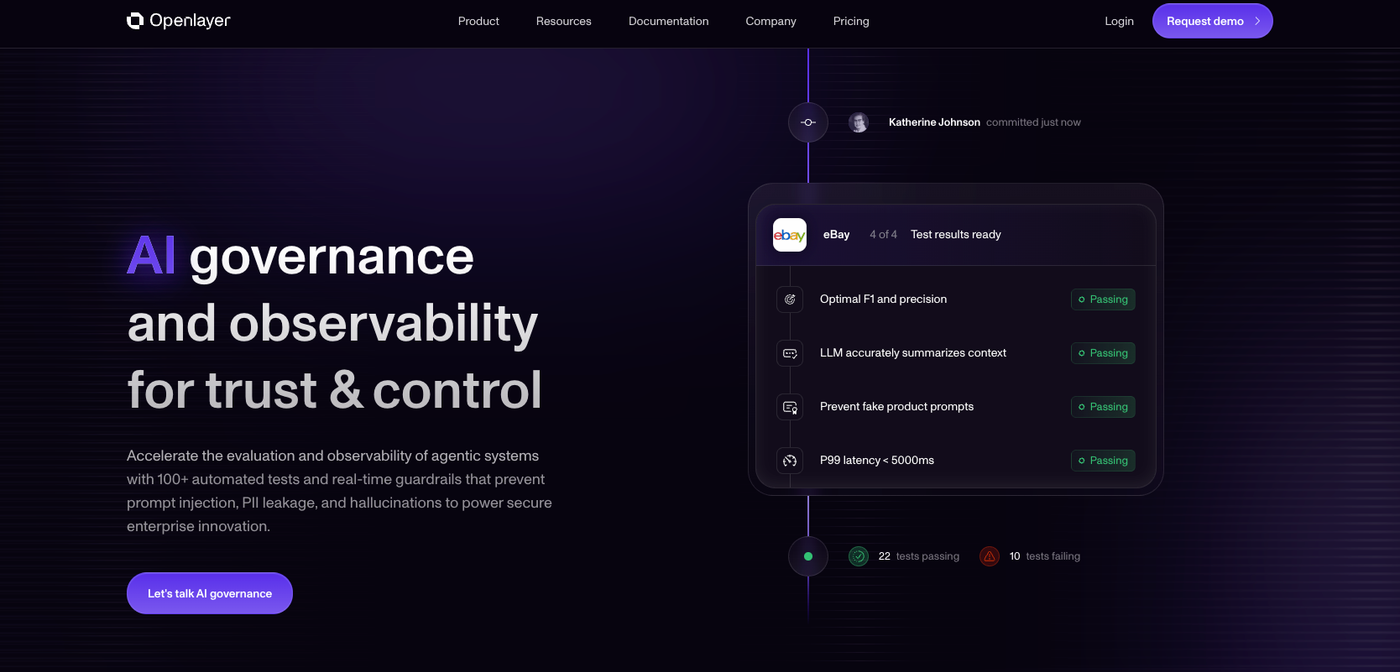
Most governance tools stop at documentation. They produce policy records, register models in an inventory, and generate audit reports. But when a deployed model starts producing biased outputs or drifts from its intended behavior, those tools have no mechanism to intervene.
Openlayer closes that gap by connecting evaluation, observability, and governance into a single workflow so the evidence your governance program needs is generated automatically as models run in production, not reconstructed after something goes wrong.
From development gates to production enforcement
There are three stages where Openlayer applies controls:
- At development, evaluation runs against 100+ pre-built tests covering fairness, safety, groundedness, and task performance, all before any model reaches deployment. Teams set thresholds (for example, block deployment if demographic parity gap exceeds 5%) and those gates are enforced automatically in CI/CD.
- At deployment, guardrails block unsafe outputs before they leave the API boundary. This is active enforcement, not logging after the fact.
- In production, 13 session-level metrics track behavioral drift, output quality, and safety signals continuously. When a metric crosses a defined threshold, the system flags it for review before a downstream incident surfaces the problem.
The audit trail that results from this workflow maps directly to regulatory obligations under frameworks like the EU AI Act and ISO 42001: documentation of evaluation criteria, deployment decisions, and ongoing monitoring is generated as a byproduct of normal operations, not assembled manually before an audit.
Final thoughts on AI governance that survives contact with production
The test of any governance program is whether it can answer an auditor's questions six months after a model ships. Who approved it? What data trained it? What drift thresholds were set, and did the system stay inside them? If your team can't reconstruct that chain of evidence on demand, the governance program exists on paper only. The organizations building durable programs treat monitoring and evaluation as part of the same workflow, not separate workstreams that produce incompatible artifacts. If you're trying to connect pre-deployment testing, runtime enforcement, and compliance documentation into something that actually scales, reach out and we'll show you how teams are doing it without rebuilding their entire stack.
FAQ
What is an AI governance framework?
An AI governance framework is a structured set of controls, processes, and accountability assignments that define how AI systems are classified, assessed, monitored, and maintained across their lifecycle. It includes risk classification systems, approval workflows, role assignments (model owner, governance lead, ethics committee), evaluation gates, monitoring thresholds, and evidence-capture mechanisms that map to regulatory obligations under frameworks like the EU AI Act, NIST AI RMF, or ISO 42001.
How does maintaining an AI inventory support responsible governance?
An AI system inventory creates visibility into every deployed model, preventing shadow AI from accumulating untracked regulatory exposure. When each system is registered with its risk tier, data inputs, monitoring thresholds, and designated owner, governance controls can be applied proportionally and audit trails become possible. You cannot monitor drift, enforce deployment gates, or map compliance obligations to systems you don't know exist.
AI governance framework NIST vs EU AI Act vs ISO 42001?
NIST AI RMF is a voluntary risk management framework organized around four functions (Govern, Map, Measure, Manage) widely adopted as a procurement baseline for federal contractors. The EU AI Act is binding law that classifies systems by risk tier and carries enforceable obligations with fines up to €35 million or 7% of global revenue. ISO 42001 provides a certifiable management system structure for AI governance. All three require documentation of intended use, ongoing post-deployment monitoring, and defined human oversight mechanisms.
Can I build AI governance without blocking deployments in production?
No. Governance programs that stop at policy documentation create liability windows where unsafe outputs reach users before anyone can intervene. Effective governance requires active enforcement at three stages: pre-deployment testing gates that block models failing defined thresholds, runtime guardrails that stop unsafe outputs before they leave the API boundary, and continuous production monitoring that flags behavioral drift automatically instead of waiting for downstream incidents to surface problems.
Best AI governance tool for agentic systems?
Agentic systems require three governance properties beyond standard model oversight: action traceability across multi-step chains so you can reconstruct what the agent decided and why, scope enforcement at the action level that blocks unauthorized tool calls before execution instead of logging them afterward, and behavioral drift detection across sessions since agent behavior changes as context windows fill or upstream models update. The governance tool must capture full tool-call traces, enforce least-privilege access policies at runtime, and apply session-level evaluation metrics beyond logging individual LLM responses.