OpenAI evals: A complete guide to evaluation frameworks in March 2026
You set up OpenAI evals to measure model accuracy on your test cases, but those test cases freeze assumptions about how your system will behave. Production breaks those assumptions with prompt injections, retrieval failures, and compliance edge cases that weren't in your JSONL files when you wrote them. Your evals might show 95% accuracy on question answering while your deployed model hallucinates citations, ignores guardrails, or drifts as user queries evolve. This guide walks through the OpenAI evals architecture, how to build custom evaluations for deterministic and model-graded tasks, and how to extend static test suites into continuous validation that catches the failures development-time evals miss.
TLDR:
- OpenAI evals is an open-source framework with 17,600 GitHub stars that creates reproducible tests for AI performance
- Simple-evals focuses on academic benchmarks like MMLU and MATH with minimal setup versus full evals' custom logic
- Model-graded evaluation uses GPT-4 as a judge for tasks where multiple valid answers exist like summarization
- RAG evals must test both retrieval accuracy and whether generation stays grounded in retrieved context
- Openlayer extends evals into production with 100+ automated tests, real-time security guardrails, and compliance mapping
What is OpenAI evals and why it matters for AI applications
OpenAI evals is an open-source framework that lets teams create structured tests to measure AI system performance on specific tasks. Instead of manual output reviews, evals define reproducible test cases with expected behaviors and measurable outcomes. The framework runs models against test inputs and compares outputs to reference answers or success criteria. You can test factual accuracy, instruction following, reasoning ability, or domain-specific performance. Each eval produces scores that track whether model or prompt changes improve results.
As of January 2026, the OpenAI evals framework has 17,600 stars and 2,900 forks on GitHub, reflecting how teams now treat testing as required when models affect revenue, compliance, or user trust.
The difference between OpenAI evals and OpenAI simple evals
OpenAI maintains two distinct evaluation repositories. The original openai/evals is a registry that includes hundreds of pre-built benchmarks spanning coding, math, reasoning, and domain knowledge. It supports custom logic and multi-step grading workflows. OpenAI simple-evals strips away that complexity. It focuses on well-known benchmarks like MMLU, MATH, HumanEval, and GPQA with minimal dependencies and a straightforward Python interface.
Choose openai/evals when you need extensive benchmark suites or custom grading logic. Choose simple-evals for standard academic benchmarks without configuration overhead.
How to install and set up OpenAI evals
Installing OpenAI evals requires Python 3.9 or later. Confirm your python version and then follow some basic steps to get OpenAI evals setup:
- First, run
pip install evalsto pull the latest stable release, or clone the GitHub repository directly if you need bleeding-edge features or plan to contribute custom evals back to the registry. The repository uses Git LFS to store large benchmark datasets. - After cloning, run
git lfs installandgit lfs pullto download eval files. Without this step, tests will reference stub pointers instead of actual data. - Next, set your OpenAI API key as an environment variable:
export OPENAI_API_KEY=your_key_here. The framework queries OpenAI models by default, so valid credentials are required before running any eval. - Finally, run
oaieval gpt-4 test-matchto verify setup. This command executes a simple matching eval against GPT-4. If the test completes and returns a score, your environment is ready.
Understanding the OpenAI evals architecture
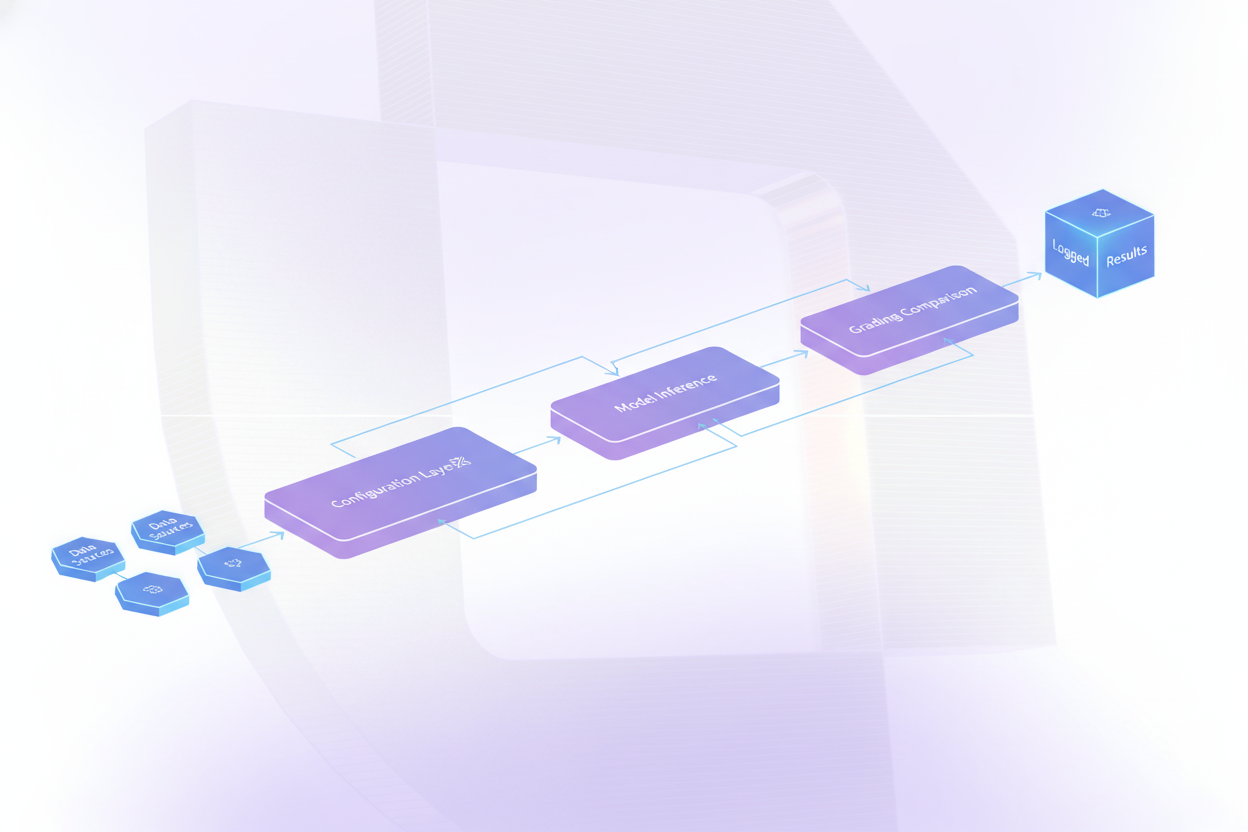
The evals framework separates data, logic, and configuration into discrete layers. Each eval references a data source that supplies test inputs and expected outputs through static JSON files, runtime samplers that generate cases, or external benchmark datasets. Eval configurations define which model to test, which completion functions to invoke, and which graders to apply. A grader compares model outputs against ground truth using exact match, fuzzy matching, or custom scoring logic.
When you run oaieval, the CLI reads the configuration, loads the data source, queries the model, and passes outputs to the grader. Results are logged with timestamps, model versions, and scores.
Building custom evals with the OpenAI evals framework

Custom evals start with a JSONL file where each line defines a single test case. Include an input field for the prompt and an ideal field for the expected output. For deterministic checks, ideal defines the exact match target. For open-ended tasks, it serves as a reference for model-graded comparison.
Create a YAML configuration in the evals/registry/evals directory. Specify your eval's class (Match, Includes, or ModelGraded), point to your JSONL dataset, and declare which grader to apply. Match evals check exact string equality, Includes evals pass if the output contains specific substrings, and ModelGraded evals send both the output and ideal answer to another model that scores quality. The table below covers the eval type, use cases, strengths, and limitations.
| Eval Type | Best Use Cases | Strengths | Limitations |
|---|---|---|---|
| Match | Factual QA, code output verification, structured data extraction where answers have single correct format | Fast execution, deterministic scoring, zero cost beyond model inference, perfect for regression testing | Fails when valid answers use different phrasing, punctuation, or formatting. Cannot handle creative or subjective tasks |
| Includes | Keyword verification, citation checking, required terminology presence, compliance phrase detection | More flexible than exact match while remaining deterministic, catches partial correctness, useful for guardrail validation | Misses semantic correctness, passes outputs that contain keywords in wrong context, vulnerable to keyword stuffing |
| ModelGraded | Summarization quality, tone assessment, multi-step reasoning, creative writing, tasks with multiple valid answers | Captures detailed quality signals, scales human judgment, handles open-ended tasks where exact matching fails | Adds latency and cost from judge model calls, scores may vary between judge models, requires careful prompt engineering for consistent grading |
| Openlayer Production Testing | Runtime security validation, continuous compliance monitoring, drift detection, PII exposure prevention, prompt injection blocking | Runs 100+ automated tests on every production inference, provides real-time guardrails, generates audit-ready compliance evidence, detects issues that development evals miss | Requires integration into production infrastructure, best suited for enterprise deployments with governance requirements |
Using the OpenAI evals API for programmatic testing
The OpenAI evals SDK exposes Python classes that let you define and execute evaluations without touching YAML or the command line. Import the eval you need, instantiate it with your model and dataset, and call run() to execute the test suite programmatically. With this mechanism, you can loop through multiple models or prompt variations in a single script, launching parallel runs and collecting results in structured JSON. This approach replaces manual CLI invocations with automated pipelines that trigger on every code commit or model checkpoint.
You can retrieve results by reading the logged output files or querying your own data store if you pipe eval outputs to a database.
Model-graded evaluation techniques in OpenAI evals
Model-graded evaluation replaces hard-coded rules with another model that judges output quality (i.e., LLM-as-a-judge). Use this approach when correctness cannot be captured by exact matching: tasks like summarization, creative writing, tone, or multi-step reasoning where multiple valid answers exist. The ModelGraded class sends both the model output and reference answer to a judge model along with instructions. The judge returns a score or binary pass/fail. GPT-4 typically serves as the grader because it balances reasoning ability with cost, though you can swap in other models depending on latency and budget constraints.
Chain-of-thought prompts improve grading reliability. Instruct the judge to explain its reasoning before assigning a score which can reduce arbitrary scores and make failure analysis easier.
Testing agents and agentic workflows with OpenAI evals
Agents make decisions across multiple turns, invoke external tools, and maintain state between interactions. Single-turn evals that measure one input-output pair miss the sequential reasoning and tool orchestration that define agent behavior. This is why you should track tool invocation sequences, verify that agents retrieve correct information before answering, and confirm reasoning chains align with expected logic. Session-level assessment grades each step independently instead of treating the entire workflow as a single pass-fail outcome.
Tool selection accuracy becomes a discrete metric. It's recommended that you create evals which expect specific tool calls at specific points and flag failures when an agent skips retrieval or invokes a calculator for non-numeric tasks.
OpenAI evals for RAG system evaluation
RAG systems fail when retrieval pulls irrelevant context or generation ignores retrieved facts. Standard evals that measure only output quality miss these failure modes. Tests on RAG systems should measure whether retrieval found the right documents and whether generation stayed grounded in them. For teams comparing best AI evaluation tools across different providers, RAG-specific testing criteria often determine which platform fits production requirements.
There are three primary tests to assess RAG systems:
- Context relevancy measures whether retrieved chunks match query intent. When evaluted chunks, you should score each retrieved passage against the question using semantic similarity or model-graded relevance. Flag cases where top results contain tangential information.
- Groundedness checks whether generated statements are supported by retrieved context. Extract factual claims from output, then verify each appears in source material.
- Needle-in-a-haystack tests measure whether models locate specific facts buried in long documents.
Integrating OpenAI evals into continuous integration pipelines
There is no reason that you should let sub-optimal models into production. You can prevent this by integration evals into CI pipelines which turns those evals into quality gates that run on every commit. To do this, configure GitHub Actions or GitLab CI to execute your eval suite when code changes touch model definitions, prompt templates, or inference logic. Parse the output JSON for scores and fail the build if any test drops below the defined threshold. This approach extends traditional testing practices from software engineering into AI model validation.
Version control eval configurations alongside model code. Store YAML files and datasets in the same repository so that each commit references the exact test suite used to validate it. Tag releases with eval results to create an audit trail linking model versions to measured performance.
Common evaluation metrics for AI systems
There are several common evaluation metrics for AI systems that you can measure through OpenAI evals tests:
- Exact match and string similarity form the baseline for deterministic tasks. Exact match passes when output equals the reference answer character for character. String similarity softens that threshold with edit distance or token overlap, catching near misses caused by punctuation or whitespace.
- BLEU and ROUGE measure text generation quality by comparing n-gram overlap between outputs and references. BLEU favors precision, while ROUGE favors recall. Both work for summarization and translation but degrade when multiple valid phrasings exist.
- Accuracy and F1 apply to classification and extraction tasks. F1 balances precision and recall when class distribution is skewed or false positives and false negatives carry different costs.
- Latency tracks response time from query to answer. Measure P50, P95, and P99 to capture tail behavior.
- Human alignment scores grade subjective qualities like tone and helpfulness. Model-graded evaluations automate these assessments at scale.
How Openlayer extends OpenAI evals for enterprise AI governance
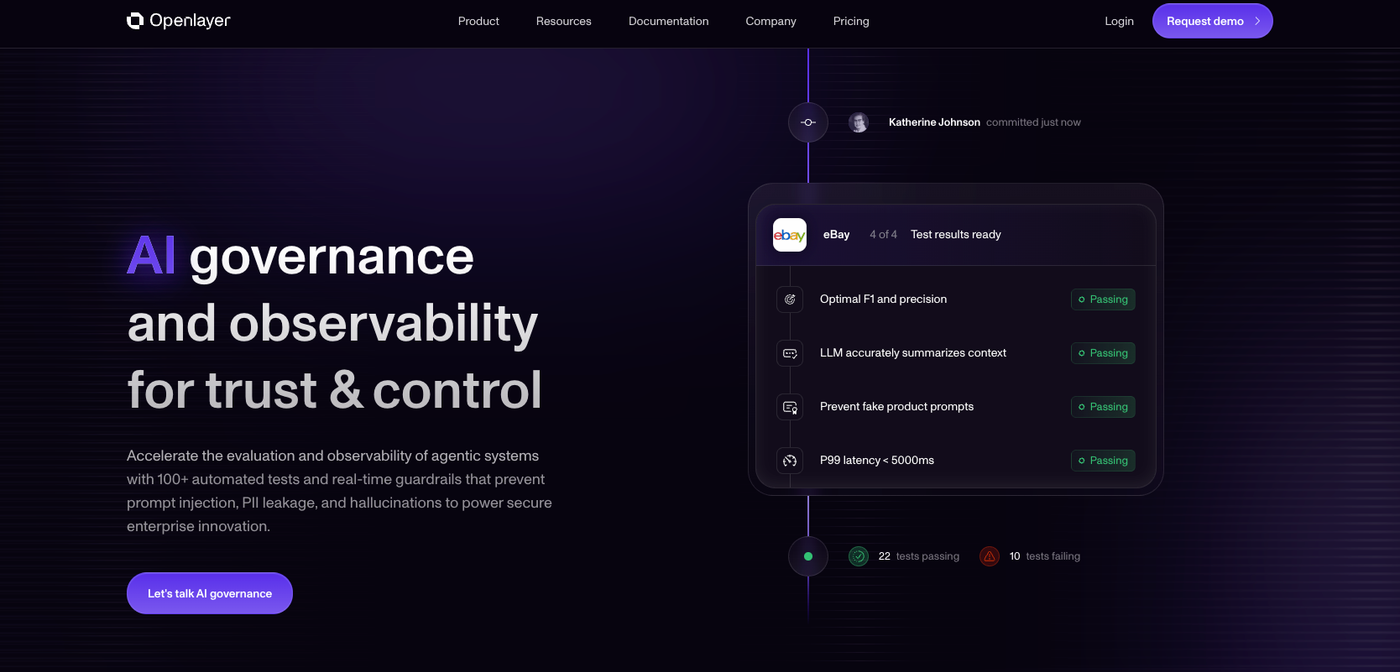
OpenAI evals validates models during development, but production introduces new challenges: runtime security, continuous compliance, and governance at scale. Openlayer extends evaluation into production.
Where OpenAI evals runs test suites on demand, Openlayer runs 100+ automated tests covering hallucinations, bias, toxicity, and PII exposure on every production inference. Real-time guardrails block prompt injections and data exfiltration before they reach downstream systems. And, continuous monitoring detects drift, anomalies, and regressions across deployed models. Openlayer tracks performance changes that evals conducted weeks earlier would miss while automated compliance mapping connects test results to frameworks like EU AI Act, NIST RMF, and ISO 42001. Each test run generates audit-ready evidence that regulators and internal reviews require.
Final thoughts on OpenAI evals for model validation
Development testing with OpenAI evals catches quality issues before deployment, but production AI faces runtime threats and regulatory requirements that static test suites can't handle. You need continuous monitoring that detects drift, automated guardrails that block attacks, and compliance mapping that connects test results to frameworks like ISO 42001. Openlayer extends evaluation into operations with real-time validation on every inference, so your models stay reliable at enterprise scale.
FAQ
How do I install OpenAI evals on my system?
Run pip install evals with Python 3.9 or later, then install Git LFS and run git lfs pull to download benchmark datasets. Set your OpenAI API key as an environment variable and run oaieval gpt-4 test-match to verify your setup works.
What's the main difference between openai/evals and simple-evals?
The openai/evals repository includes hundreds of pre-built benchmarks with custom grading logic and multi-step workflows, while simple-evals focuses exclusively on standard academic benchmarks like MMLU and HumanEval with minimal dependencies and a straightforward interface.
When should I use model-graded evaluation instead of exact matching?
Use model-graded evaluation when tasks like summarization, creative writing, or multi-step reasoning have multiple valid answers that exact matching cannot capture. A judge model (typically GPT-4) scores output quality by comparing it against reference answers using reasoning instead of hard-coded rules.
Can I run OpenAI evals automatically on every code commit?
Yes, configure GitHub Actions or GitLab CI to execute your eval suite when commits touch model code or prompt templates. Parse the output JSON for scores and fail the build if any test drops below your defined threshold, creating a quality gate that validates changes before deployment.
How does Openlayer extend OpenAI evals for production environments?
OpenAI evals validates models during development, while Openlayer runs 100+ automated tests on every production inference with real-time guardrails that block prompt injections and PII exposure. Openlayer also provides continuous drift detection and automated compliance mapping to frameworks like EU AI Act and NIST RMF with audit-ready evidence.