RAG Groundedness Evaluation Guide (Feb 2026)
Your legal RAG system pulls the correct policy document, but the LLM's response cites a clause number that doesn't exist in the retrieved text. This is the failure mode that RAG groundedness evaluation prevents: outputs that sound authoritative but fabricate details not present in source documents. Perfect retrieval gives you nothing if your generator ignores the evidence and invents facts. In this blog, we are covering how to decompose responses into testable claims, run LLM-as-judge scoring at scale, set the right thresholds for your domain, and catch groundedness regressions in CI/CD before they hit users.
TLDR:
- Groundedness verifies each claim in your RAG output traces to retrieved documents, not hallucinations.
- The RAG triad (context relevance, groundedness, answer relevance) catches distinct failure modes.
- LLM-as-judge scores groundedness at scale, reaching 80% agreement with human evaluators.
- Set production thresholds above 0.85 for critical domains; monitor drift to catch regressions early.
- Openlayer runs native groundedness tests in CI/CD, blocking deployments when scores breach thresholds.
What is groundedness in RAG and why it matters
Groundedness measures whether each factual claim in your RAG system's output traces back to the retrieved context. When your LLM generates an answer, groundedness verifies the model stayed faithful to source documents instead of inventing information. Some teams call this faithfulness or attribution. The concept stays consistent: did the model cite what it retrieved, or did it hallucinate?
For enterprise RAG deployments, groundedness acts as your first line of defense against fabricated outputs, working alongside LLM guardrails to prevent harmful outputs. A chatbot answering customer questions with invented policy details creates liability. A research assistant citing nonexistent studies erodes trust. These failures happen when LLMs receive context but ignore it to generate plausible fiction.
Perfect retrieval doesn't guarantee groundedness if your generator ignores the documents you surfaced.
The RAG triad: understanding the three pillars of evaluation

RAG evaluation relies on three connected metrics that catch different failure modes:
- Context relevance measures whether your retrieval system found documents that relate to the user's question.
- Groundedness verifies the LLM stayed faithful to those retrieved documents when generating an answer.
- Answer relevance checks if the final output addresses what the user asked.
These three form what the industry calls the RAG triad. Each metric guards a distinct failure point in your pipeline, contributing to a complete set of LLM evaluation metrics. You can retrieve perfect documents but generate hallucinated answers. You can generate grounded responses that ignore the original question. You can retrieve irrelevant context and still produce coherent outputs that feel right but lack foundation.
Groundedness sits between retrieval and generation quality. It answers whether your LLM respects the evidence you provided.
How to calculate groundedness scores
Groundedness calculation involves two steps: claim extraction and verification. You decompose the LLM's response into individual factual statements, then check whether each claim appears in or can be inferred from the retrieved context. Here's how it works:
- The extraction step isolates testable assertions. "The policy covers damage from fire and theft" becomes two claims: one about fire coverage, one about theft coverage. Each gets verified independently against your context documents.
- Verification compares claims to source text, similar to needle in a haystack testing for context retrieval. Simple keyword matching fails when outputs paraphrase context. Semantic similarity models score whether a claim's meaning exists in the retrieved passages, returning values between 0 and 1 per claim.
Your final groundedness score aggregates individual claim scores. If three out of four claims trace to context, you score 0.75. This quantifies how much of your output stays faithful to retrieved evidence.
LLM-as-judge for groundedness evaluation
LLM-as-judge replaces manual verification by using one language model to score another's outputs. Instead of humans reading each generated answer against source documents, you prompt an evaluator model to assess whether claims trace to retrieved context. The method passes three inputs to your judge model: the original question, the retrieved context, and the generated answer. The judge identifies unsupported claims and returns a groundedness score with reasoning.
Judge models reach 80% agreement with human evaluators on groundedness tasks. Where human assessment caps at hundreds of examples weekly, LLM judges process thousands of production outputs daily.
The tradeoff is coverage versus perfect accuracy. Human reviewers catch attribution errors that models miss. But for continuous monitoring across enterprise RAG systems handling millions of queries, LLM-as-judge provides the only viable path to systematic quality control.
Common groundedness failure patterns
RAG systems fail groundedness in predictable ways:
- In invention, your LLM generates factual-sounding details that never appeared in retrieved documents. A legal assistant might cite a nonexistent clause number, or a support bot might reference features absent from your knowledge base.
- Contradiction failures occur when outputs conflict with source material. Your context states a policy expires in 30 days, but the response claims 60 days. The model saw correct information and altered it.
- Partial hallucination blends real and invented content. The LLM accurately cites three retrieved facts, then adds a fourth unsupported claim. These mixed outputs pass casual review because most content appears correct.
- Scope expansion happens when models extrapolate beyond what context supports. Your documents describe basic plan features, but the output makes claims about enterprise tiers never mentioned in retrieved passages.
Optimizing retrieval to improve groundedness
Measuring groundedness is one thing. But once you have that measure, you need a way to optimize retrieval so that groundedness improves. Better retrieval reduces groundedness failures before generation starts. When your system surfaces relevant, focused documents, your LLM has less opportunity to invent details or pull from irrelevant passages. Groundedness metrics reveal which retrieved documents your model ignores during generation. Below are a few things to consider that can help you optimize retrieval:
- Track which context chunks appear in outputs versus which sit unused in your prompt. Eliminating unused context can reduce tokens by 40%, cutting API costs while improving response quality.
- Document ranking matters more than volume. Retrieving 20 loosely related passages gives your LLM room to cherry-pick or hallucinate. Retrieving five highly relevant documents constrains generation to verified facts.
- Context utilization scores show what percentage of retrieved text influences outputs. Low utilization means your retriever surfaces noise. High utilization with low groundedness means your generator invents details despite good sources.
Automating groundedness testing in production
Measuring groundedness in a dev environment is one thing. But that measurement may change dramatically with scale. That's why production RAG systems require ongoing groundedness checks, not single evaluations. Automated testing identifies regressions when model updates or prompt changes degrade output quality. When considering how to automate groundedness testing in production, consider the following:
- Set groundedness thresholds matching your risk tolerance. Critical domains need scores above 0.85, while customer support might accept 0.75. Define pass/fail criteria before deployment so teams know when to block releases.
- Run groundedness tests on every production inference or sample representative traffic when full evaluation becomes cost-prohibitive. Test 10% of traffic initially, then adjust based on failure rates and budget constraints.
- Alert on threshold breaches and score trends. A sudden drop from 0.88 to 0.76 signals prompt drift, retrieval degradation, or dataset changes. Gradual declines indicate knowledge bases falling out of sync with user questions.
- CI/CD integration blocks deployments when scores fail. Test new model versions against held-out examples before promotion. Production monitoring catches issues testing missed, which is why LLM monitoring tools are critical for maintaining quality.
Measuring groundedness with Openlayer
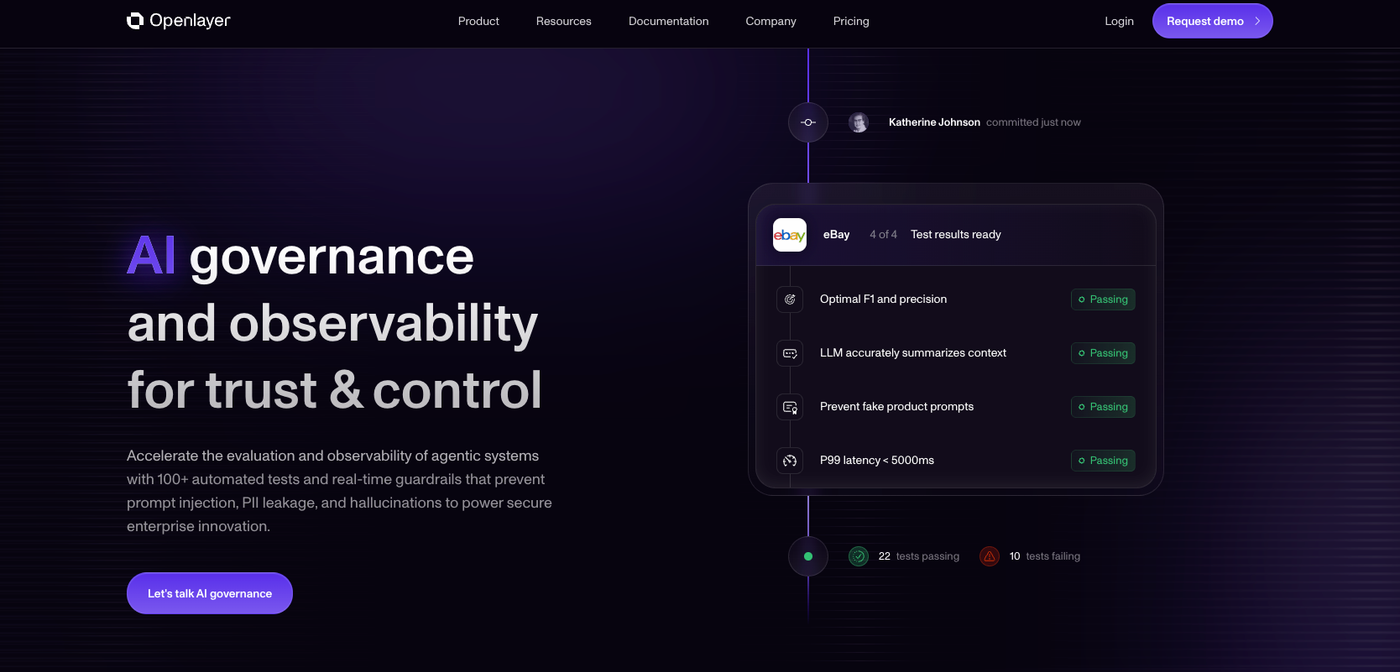
Openlayer provides native groundedness tests within our RAG evaluation suite. We implement LLM-as-judge scoring to assess how many factual statements in outputs trace to retrieved context, with CI/CD integration for continuous assessment across development and production environments.
Our GenAI testing platform runs groundedness checks on every model version or code commit, blocking deployments when scores fall below thresholds you define. Teams set acceptable groundedness ranges per use case, then monitor drift in real time. When a new retrieval strategy or prompt template degrades groundedness scores, tests fail before code reaches production, preventing issues that AI guardrails are designed to catch.
Final thoughts on RAG groundedness evaluation
Groundedness testing protects your RAG deployment from the failure mode that matters most: generating answers that ignore retrieved evidence. RAG groundedness scores quantify how much of each output traces back to source documents, catching hallucinations before they create liability or erode user trust. You can retrieve perfect context and still fail if your generator invents details, which is why groundedness sits between retrieval quality and answer relevance in the evaluation triad. Automate your checks in CI/CD, sample production traffic based on your risk tolerance, and alert when scores drift below acceptable ranges. Get in touch if you want to discuss automated groundedness testing for your system.
FAQ
What's the difference between groundedness and answer relevance in RAG evaluation?
Groundedness verifies that factual claims in your output trace back to retrieved documents, while answer relevance checks if the response addresses the user's original question. You can produce a perfectly grounded answer that ignores what the user asked, or a relevant answer that hallucinates facts not found in your context.
How do I set the right groundedness threshold for my RAG system?
Critical domains like legal or healthcare need scores above 0.85, while customer support applications might accept 0.75. Define thresholds based on your risk tolerance and use case requirements before deployment, then monitor for threshold breaches and score trends in production.
Can I measure groundedness without manual review at scale?
LLM-as-judge provides the only viable path to systematic groundedness checks across thousands of production outputs. While judge models reach 80% agreement with human evaluators versus perfect manual accuracy, automated scoring lets you process millions of queries that human review cannot cover.
Why does my RAG system show good retrieval scores but poor groundedness?
Perfect retrieval doesn't guarantee your generator respects the documents you surfaced. Your LLM might receive relevant context but ignore it to generate plausible fiction, contradict source material, or extrapolate beyond what the documents support. Track context utilization to see which retrieved passages your model actually uses during generation.
When should groundedness tests block my RAG deployment?
Run groundedness tests in CI/CD pipelines and block deployments when scores fall below your defined thresholds. Test every new model version or prompt template against held-out examples before promotion, then monitor production traffic continuously to catch regressions that pre-deployment testing missed.