LLM-as-judge: A complete guide to evaluation best practices in March 2026
Everyone talks about LLM-as-judge like it's a solved problem, but your production scores don't match your validation set. Judges favor the first answer in comparisons, reward verbosity over accuracy, and score their own model outputs higher than competitors. This guide shows you how to rotate positions to neutralize bias, decompose complex rubrics into discrete checks, and validate against human baselines until correlation exceeds 0.85.
TLDR:
- LLM-as-judge uses one model to score another's outputs on relevance, safety, or accuracy at scale.
- Judges carry biases like position and verbosity preference; rotate answers and cross-validate to fix.
- Chain-of-thought prompting and few-shot examples improve scoring reliability by over 85%.
- RAG evaluations test context relevance, groundedness, and answer quality to catch retrieval failures.
- Openlayer runs 100+ LLM-as-judge tests in both CI and production with built-in bias mitigation.
What is LLM-as-judge
LLM-as-judge refers to using one AI model to assess the outputs of another. Instead of relying on rigid metrics like BLEU or ROUGE that count token overlap, you provide an LLM with evaluation criteria and ask it to score responses based on qualities like relevance, coherence, or factual accuracy. The judge model returns a rating or label along with reasoning for its decision. Traditional metrics fail when you need to assess fluency, helpfulness, or safety. Human evaluation captures these dimensions but doesn't scale past a few hundred examples. LLM judges bridge that gap by approximating human judgment across thousands or millions of inferences at a fraction of the time and cost.
You define the rubric, supply the input and output, and the judge model applies consistent reasoning to each case. The result is repeatable, fast, and inexpensive enough to run continuously in both development and production environments.
Types of LLM-as-judge evaluation methods
LLM judges operate through three evaluation patterns, each matching different use cases:
- Pairwise comparison presents two candidate outputs to the judge and asks which performs better. You might compare two prompt variants or test a new model against a baseline. The judge selects a winner based on criteria like accuracy, tone, or safety. This method works well during A/B testing and prompt iteration because it reveals relative performance without absolute scores.
- Single-output scoring with reference scores one response against a known correct answer. The judge compares generated text to the reference and assigns an alignment score. Use this when ground truth exists: question-answering tasks, summarization with human-written examples, or classification with labeled data.
- Single-output scoring without reference judges outputs on criteria like helpfulness or coherence with no comparison anchor. The judge applies your rubric and returns a score or binary decision. This fits production monitoring and AI guardrails where reference answers don't exist but quality standards do: chatbot responses, creative generation, or open-ended agent actions.
The table below provides a quick overview of the evaluation methods, how they work, what they are best used for.
| Evaluation Method | How It Works | Best Used For | Requires Reference Data |
|---|---|---|---|
| Pairwise Comparison | Presents two candidate outputs to the judge and selects which performs better based on defined criteria like accuracy, tone, or safety | A/B testing between models, comparing prompt variants, benchmarking new releases against baselines during development | No |
| Single-Output Scoring With Reference | Compares generated response against a known correct answer and assigns an alignment score measuring how closely output matches ground truth | Question-answering tasks with verified answers, summarization against human-written examples, classification with labeled datasets | Yes |
| Single-Output Scoring Without Reference | Applies rubric criteria to judge outputs on qualities like helpfulness, coherence, or safety with no comparison anchor, returning scores or binary decisions | Production monitoring of chatbot responses, creative generation tasks, open-ended agent actions, real-time guardrails for policy enforcement | No |
Common biases in LLM-as-judge systems

LLM judges carry systematic biases that distort scoring accuracy. Position bias causes judges to favor responses appearing first or last in comparisons, independent of quality. Verbosity bias rewards longer answers even when shorter ones deliver better accuracy. Self-preference bias appears when a judge scores outputs from its own model family and inflates scores. Research shows GPT-4 aligns with human preferences over 80% of the time, but that remaining gap matters at scale. A 15% error rate across millions of production inferences means thousands of misclassified outputs slipping through validation or triggering false alerts.
Mitigation requires testing the judge itself. To do this, you should:
- rotate answer positions across evaluations to neutralize positional effects,
- normalize scores by response length,
- or penalize excessive verbosity in your rubric.
When using a judge to assess its own outputs, cross-validate with a second model from a different provider or benchmark against sampled human baselines to detect drift.
Best practices for building reliable LLM judges
Just picking another LLM to assess output isn't enough. You need to be intentional about how you are building in the capability of LLM-as-judge. Here are some best practices you can follow:
- Chain-of-thought prompting forces the judge to explain its reasoning before scoring. Asking "why before what" reduces arbitrary decisions and exposes flawed logic you can refine. Structure prompts to first analyze the output, then support a rating based on explicit criteria.
- Few-shot examples calibrate the judge to your standards. Include two to four annotated samples in the prompt showing ideal and flawed outputs with scores and explanations. This anchors the judge's scale and clarifies edge cases where criteria might conflict.
- Decompose complex rubrics into discrete dimensions. Instead of one "quality" score, separate accuracy, coherence, and safety into independent checks. Score each attribute, then aggregate. This prevents one strong trait from masking failures elsewhere and makes results easier to debug.
- Structured output formats improve parsing and reduce variance. Request JSON with numeric scores and text rationales instead of free-form responses. Limit ranges to prevent drift and apply smoothing across repeated evaluations of identical inputs to identify unstable judgments.
- Validate against human baselines throughout. Sample 200 to 500 representative cases, collect expert annotations, and measure agreement between judge and human scores. Iterate prompt wording and examples until correlation exceeds 0.85, then retest quarterly as your models and data evolve.
G-Eval and advanced scoring methods
G-Eval moves beyond fixed rubrics by automating the creation of evaluation criteria. Instead of manually writing scoring steps, the framework prompts an LLM to generate a chain-of-thought evaluation procedure tailored to your task. You supply a high-level description of quality dimensions, and the model produces specific checkpoints it will apply during judging.
Probability-weighted scoring replaces discrete ratings with distributions. Instead of forcing the judge to choose between 3 or 4 on a five-point scale, G-Eval samples token probabilities across all possible scores and computes an expected value. If a judge assigns 60% confidence to a 4 and 30% to a 5, the final score reflects that uncertainty at 4.3 instead of collapsing to a single integer.
This method counters score clustering, where simple prompts push most outputs toward the middle of your range. Basic judges rarely assign 1s or 5s even when warranted. Probability weighting captures subtle gradations and spreads scores across the full scale, revealing genuine quality differences that inform model selection and guardrail thresholds.
Finally, human correlation studies show G-Eval outperforms static prompt templates on coherence and fluency tasks. The approach requires more compute per evaluation but scales reliably when variance and precision matter more than raw throughput.
Using LLM-as-judge for RAG evaluation
RAG pipelines break at two points: retrieval surfaces irrelevant documents, or generation ignores what retrieval found. LLM judges verify both stages through three checks without requiring labeled test sets. Here's how it works:
- Context relevance scores whether each retrieved chunk contributes information needed to answer the query. Low scores mean retrieval wastes token budgets on unrelated passages that distract the generator.
- Groundedness extracts factual claims from generated text and verifies each against source documents. Unsupported statements flag hallucination even when correct context was available.
- Answer relevance compares final output to the original question, ignoring retrieved context. High groundedness with low answer relevance means the model cited sources accurately but missed the user's intent.
Running all three exposes failure modes across the chain. Poor context relevance points to retrieval configuration, weak groundedness to generation drift, and low answer relevance to instruction-following gaps.
Implementing LLM-as-judge in production
Production deployment requires splitting evaluation into synchronous guardrails and asynchronous quality checks using platforms for continuous testing of LLM applications. Real-time blocking decisions for prompt injection or PII must complete within your API's latency budget, typically under 200 milliseconds. Defer coherence and relevance scoring to batch pipelines that process logged outputs every few minutes. Here are some things to consider:
- Use smaller, faster judge models for blocking workflows and reserve GPT-4 or Claude for offline analysis.
- Cache evaluation prompts and results for identical inputs to reduce inference costs.
- Track judge model response times, error rates, and agreement with human audits to detect degradation.
- Set alerts when scores cross thresholds indicating regressions or safety violations, such as hallucination spikes or unexpected surges in blocked requests that signal attack patterns.
Openlayer's approach to LLM-as-judge
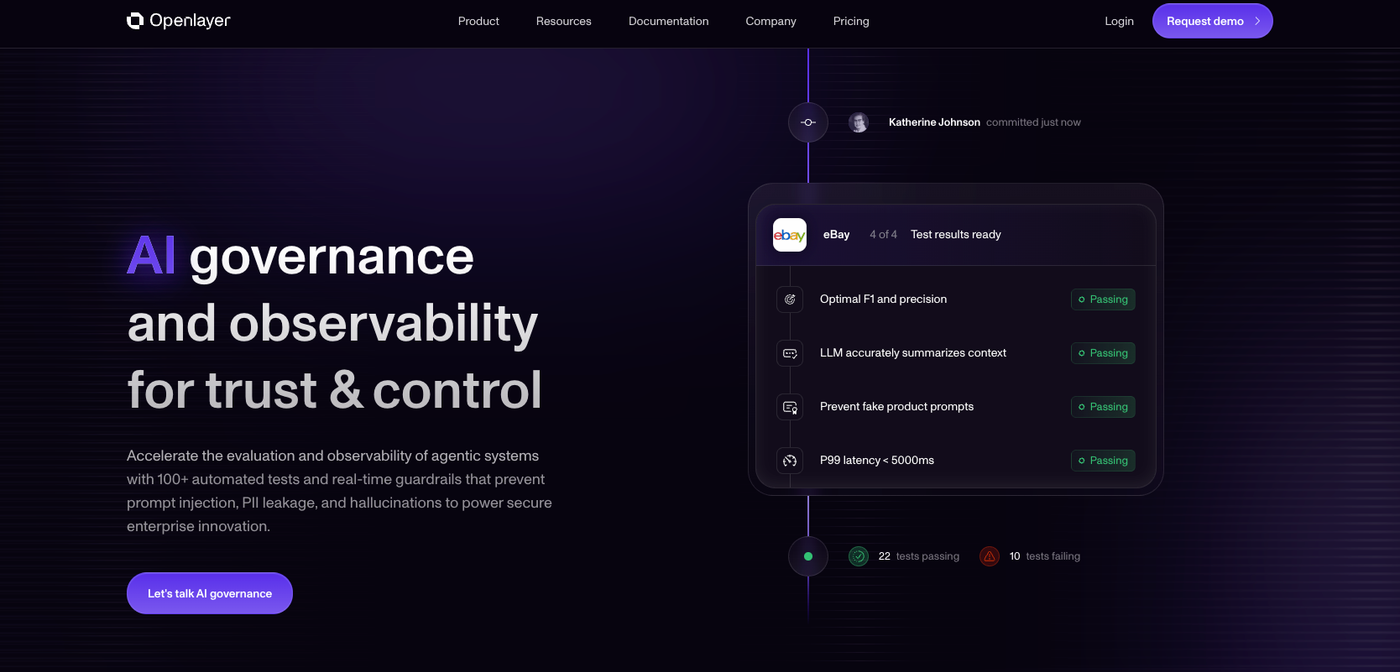
Openlayer embeds LLM-as-judge logic directly into its test library, turning evaluation patterns into ready-to-run primitives. You don't build prompts or tune rubrics. The system ships with 100+ tests that already apply chain-of-thought reasoning, structured output parsing, and bias mitigation across text, vision, tabular, and agent workflows.
RAG evaluations run out of the box. Context relevance, groundedness, and needle-in-a-haystack checks validate retrieval and generation without custom code. Each test returns scores and rationales you can trace back to specific documents or model behaviors.
The same tests operate in both development and production. Run them during CI to block regressions before merge using a GenAI testing platform, then schedule identical checks against live inference logs to catch drift. Real-time guardrails apply LLM judges synchronously to block prompt injections, PII leakage, and policy violations before responses reach users.
Human validation loops track judge reliability over time using LLM monitoring tools. Sample outputs, collect annotations, and measure agreement to surface when a judge drifts or criteria need revision.
Final thoughts on automated evaluation
Manual review doesn't scale past a few hundred examples, but shipping without validation creates risk you can't measure. LLM as a judge frameworks automate quality checks for relevance, safety, and accuracy across millions of inferences. Apply chain-of-thought reasoning, rotate answer positions to counter bias, and validate against human samples quarterly to keep your judges aligned with actual quality standards.
FAQ
What's the difference between LLM-as-judge and traditional evaluation metrics?
Traditional metrics like BLEU or ROUGE count token overlap and miss qualities like fluency, helpfulness, or safety. LLM judges apply reasoning to score outputs based on criteria you define, approximating human judgment at scale without the cost or time constraints.
How do you prevent position bias in pairwise comparisons?
Rotate answer positions across evaluations so the judge sees each response in both first and last positions. This neutralizes positional effects and forces the judge to base decisions on quality instead of order.
When should you use single-output scoring without reference instead of with reference?
Use scoring without reference when ground truth doesn't exist: chatbot responses, creative generation, or agent actions. Use scoring with reference when you have known correct answers for tasks like question-answering or labeled classification.
How many human-labeled examples do you need to validate an LLM judge?
Sample 200 to 500 representative cases with expert annotations, then measure agreement between judge and human scores. Iterate until correlation exceeds 0.85, and retest quarterly as models and data change.
What latency budget should you plan for real-time LLM judge guardrails?
Real-time blocking decisions for prompt injection or PII must complete within your API's latency budget, typically under 200 milliseconds. Use smaller, faster judge models for synchronous checks and reserve larger models like GPT-4 for asynchronous quality analysis.