Deepchecks reviews, pricing, and alternatives (December 2025)
You might have noticed that pre-deployment testing catches data drift and model issues, but wondered if that's enough for production AI systems. Deepchecks provides solid validation logic for ML engineers focused on development, yet organizations frequently review Deepchecks pricing and alternatives when they realize they need more than test suites. Real-time blocking of unsafe behavior, automated compliance mapping, and unified governance across multi-model estates become critical when you're operating at enterprise scale.
TLDR:
- Deepchecks offers pre-deployment validation but lacks real-time guardrails to block prompt injections or PII leakage
- Enterprise teams need runtime protection and automated compliance mapping to EU AI Act and NIST RMF
- Braintrust and LangSmith focus on evaluation and traces without security or governance capabilities
- Openlayer provides 100+ automated tests, real-time blocking, and continuous monitoring in one solution
What is Deepchecks and how does it work?
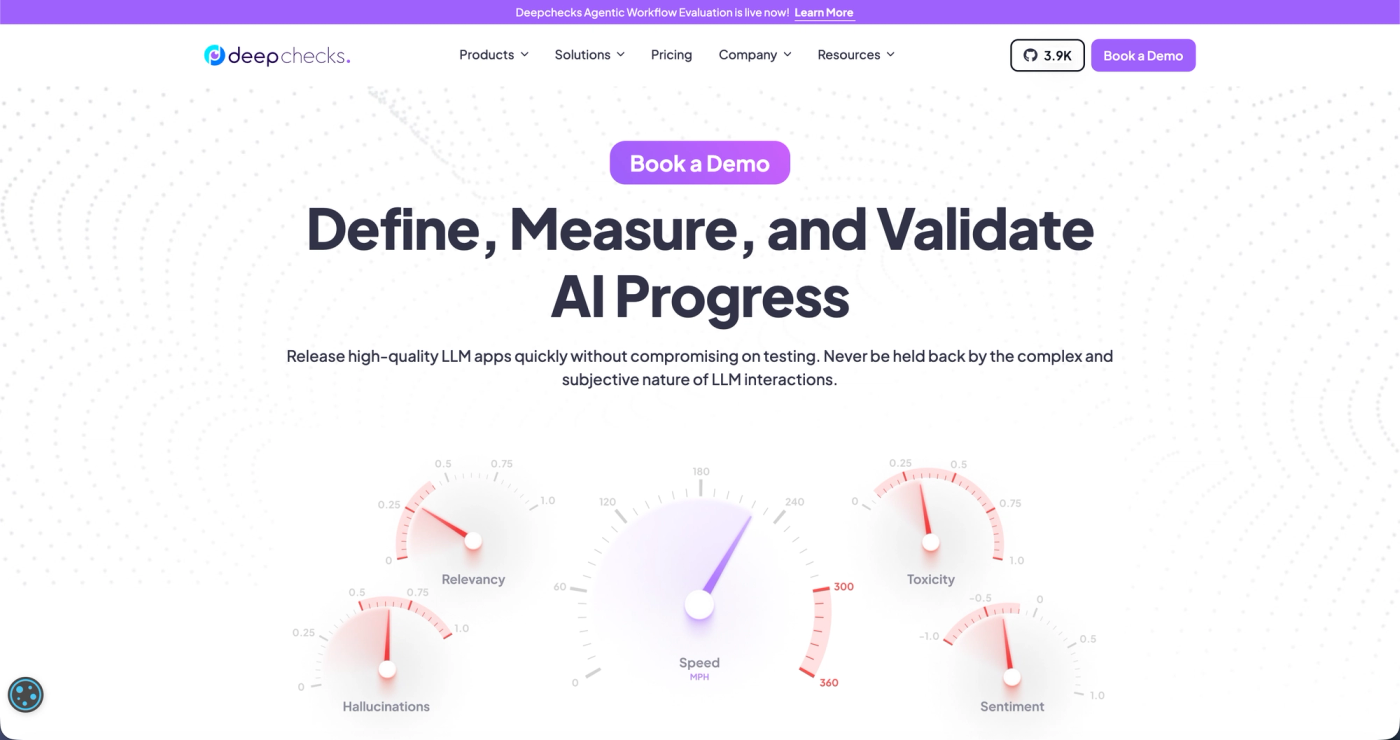
Deepchecks is an open-source Python package that tests and validates AI systems across the model lifecycle. It verifies data quality and model behavior before deployment and during production. Data scientists and ML engineers codify validation logic as test suites through the open-source repository, which provides pre-built checks alongside extensibility for custom validation rules.
The framework operates across three validation stages:
- It performs pre-deployment data integrity checks to catch schema drift, missing values, and distribution anomalies.
- It validates train-test splits to identify data leakage or sampling issues.
- It assesses model performance across accuracy, calibration, and robustness dimensions.
Deepchecks expanded into LLM evaluation, testing for bias, toxicity, and PII leakage. The solution offers both self-hosted open-source testing and a managed monitoring service for production.
Why consider Deepchecks alternatives?
Organizations often look at alternatives because Deepchecks lacks real-time security protections against prompt injections and data exfiltration. It does not provide automated compliance mapping to frameworks like EU AI Act or NIST RMF. System-level visibility across multi-model estates remains limited compared to enterprise-grade testing tools built for governance at scale. Deepchecks works well for teams needing structured pre-deployment test suites. Its flexible evaluation framework and built-in checks for data integrity and model validation serve ML engineers focused on development-stage testing.
But, teams deploying agentic systems at enterprise scale need runtime guardrails that actively block unsafe outputs, not surfacing issues after the fact. They also require unified governance across internal and third-party AI systems with continuous risk scoring and audit-ready evidence.
How we assessed the alternatives to Deepchecks
When looking at alternatives to Deepchecks, focus on capabilities that define enterprise-grade AI reliability across the full lifecycle from development through production. Our assessment criteria included:
- Evaluation depth: Pre-built tests for quality, safety, and security across text, vision, tabular, and agent workflows. Detection of hallucinations, bias, toxicity, and prompt injection vulnerabilities without manual test authoring.
- Production observability: Running identical evaluations on live inference data alongside offline datasets. Real-time monitoring and anomaly detection for continuous validation beyond pre-deployment checks.
- Security and compliance: Active prevention of prompt injections and PII leakage, not retroactive logging. Automated mapping to regulatory frameworks like EU AI Act, NIST RMF, and OWASP for regulated industries.
- Deployment flexibility: On-premises, private cloud, and hybrid options with API-first integration into CI/CD pipelines and data infrastructure.
Best overall alternative: Openlayer
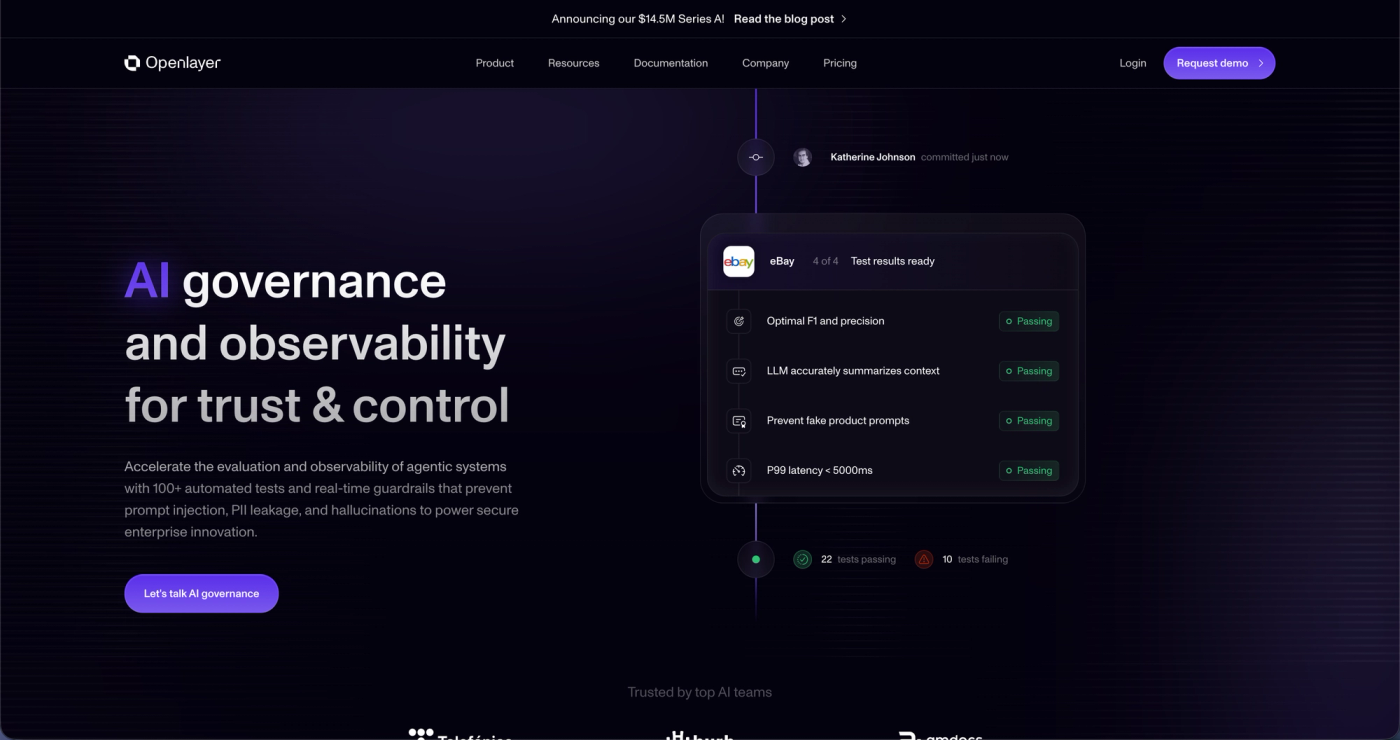
Openlayer is an AI governance and observability solution that accelerates evaluation and monitoring of agentic systems through 100+ automated tests and real-time guardrails. We prevent prompt injections, PII leakage, bias, toxicity, and hallucinations while providing oversight across ML and GenAI systems in both development and production.
Key features
- 100+ prebuilt behavioral tests across text, vision, tabular, audio, and multimodal systems with CI/CD integration
- Real-time guardrails that actively block prompt injections, PII/IP leakage, and malicious queries before reaching downstream systems
- Continuous monitoring with automated alerts, risk scoring, and AI observability for anomaly detection across millions of inferences
- Automated compliance mapping to EU AI Act, NIST RMF, ISO 42001, TRAIGA, and OWASP with audit-ready dashboards
Bottom line
Openlayer is great for enterprise teams in regulated industries deploying GenAI and agentic systems at scale who need unified evaluation, security, monitoring, and compliance in one solution. Openlayer extends pre-deployment testing with runtime protection, automated governance, and regulatory alignment that evolves validation from a development task into an enterprise control system.
Langfuse
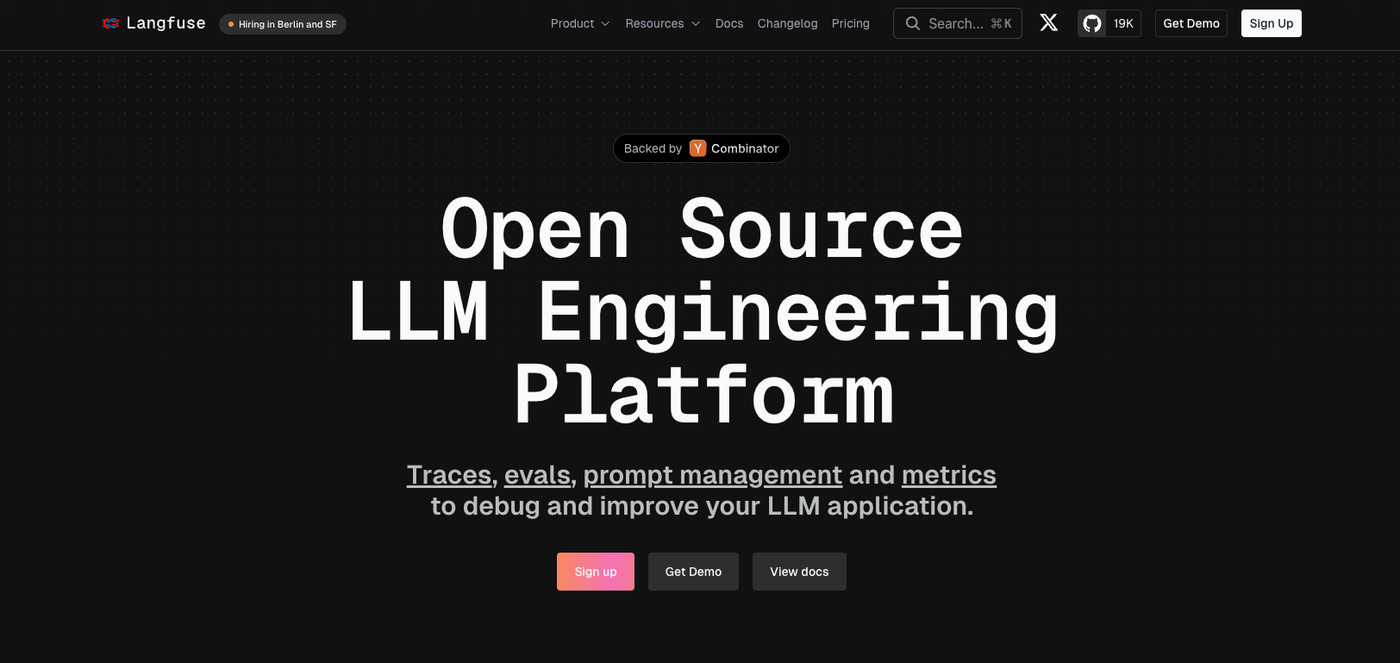
Langfuse is an open-source LLM observability solution that provides tracing for generative AI applications with session tracking and prompt version control.
Key features
Langfuse offers a number of features that are comparable to Deepchecks:
- Tracing and logging for LLM applications with session tracking
- Evaluation framework requiring user-defined metrics and scorers
- Prompt management with version control
- Self-hosting options with OpenTelemetry support
Limitations
Langfuse lacks pre-built test libraries, requiring manual implementation of safety and quality metrics. No real-time guardrails or enforcement.
Bottom line
Langfuse focuses on observability for debugging. Teams needing automated testing, real-time security, and compliance mapping will find Openlayer delivers governance at scale. It is good for teams building LLM applications who need developer-first tracing and are comfortable defining their own evaluation logic.
MLFlow
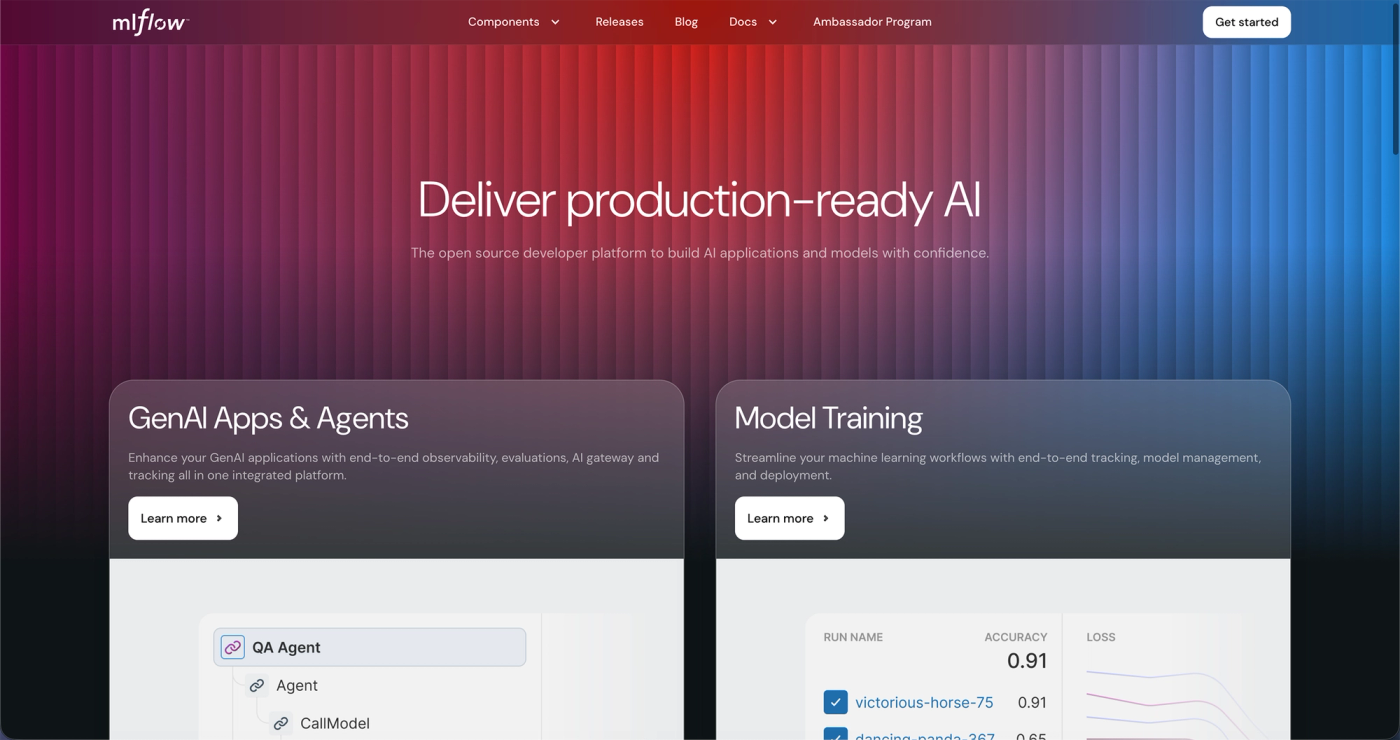
MLflow is an open-source experiment tracking and model registry tool that logs training runs, versions models, and manages deployment workflows.
Key features
MLflow offers a number of features that are comparable to Deepchecks:
- Experiment tracking that logs parameters, metrics, and artifacts across training runs
- Model registry and lineage management for versioning and promotion workflows
- Unity Catalog integration for basic governance controls
- Open-source architecture with self-hosted or managed deployment options
Limitations
MLflow doesn't have an automated test library, no runtime protection against prompt attacks or data exfiltration, and no regulatory mapping or audit-ready compliance views.
Bottom line
MLflow logs experiments well. Openlayer adds behavioral tests, security guardrails, and compliance automation for regulated enterprises. It is good for engineering teams early in MLOps adoption who need experiment tracking and model versioning without governance overhead.
LangSmith
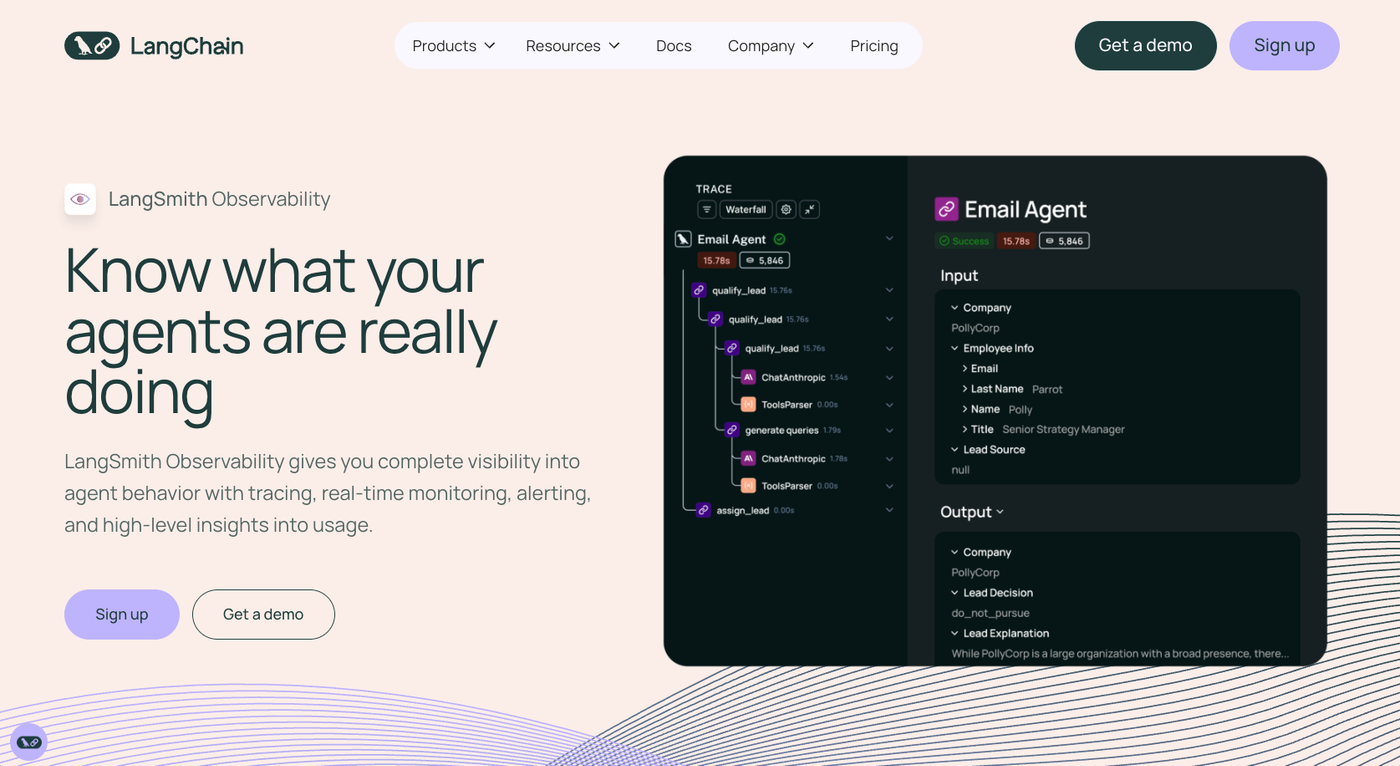
LangSmith provides tracing and evaluation for LLM prompts and chains within the LangChain ecosystem, focused on debugging and experimentation workflows for development teams.
Key features
LangSmith offers a number of features that are comparable to Deepchecks:
- Traces and logs for debugging LangChain pipelines
- Prompt and LLM evaluation capabilities
- Playground for testing prompt variations
- Dataset management for benchmarking
Limitations
LangSmith doesn't have any policy enforcement or framework alignment. Lacks real-time guardrails for production security.
Bottom line
LangSmith focuses on debugging. Openlayer adds risk scoring, compliance mapping, and stakeholder dashboards for enterprise governance requirements. It is good for development teams building LLM applications on LangChain who need granular debugging and prompt experimentation.
Feature comparison: Deepchecks vs top alternatives
| Feature | Openlayer | Langfuse | MLflow | LangSmith |
|---|---|---|---|---|
| Pre-built test library | 100+ tests across quality, safety, security | User-defined metrics required | Manual implementation | Limited evaluation templates |
| Real-time guardrails | Blocks prompt injection and PII leakage | No | No | No |
| Compliance mapping | EU AI Act, NIST RMF, ISO 42001, OWASP, LGPD | No | Unity Catalog basic controls | No |
| Production monitoring | Continuous anomaly detection with alerts | Tracing and logging | Experiment tracking only | Debugging focused |
| Security features | Runtime prevention and behavioral testing | Logging only | None | None |
| Self-hosting | On-premises, private cloud, hybrid | OpenTelemetry support | Open source | Cloud-hosted only |
| Multimodal support | Text, vision, tabular, audio, agents | Text only | Framework agnostic | Text only |
| CI/CD integration | Native with version tracking | Manual | Manual | Manual |
Why Openlayer is the best Deepchecks alternative
Deepchecks provides structured pre-deployment validation, but enterprise AI requires real-time prevention, not retrospective testing reports. Openlayer, on the other hand, actively blocks failures before they reach production. Our guardrails stop prompt injections and PII leakage in real time, while automated compliance mapping removes manual regulatory configuration. You get unified oversight across traditional ML, GenAI, and agents through a single control plane. Testing identifies problems. Governance prevents them.
Final thoughts on ML testing and validation
Pre-deployment checks catch data issues, but production AI needs active protection. If you're considering Deepchecks alternatives, consider whether you need just testing or full governance with real-time guardrails and compliance automation. We designed Openlayer to cover evaluation, security, and regulatory alignment in one system so your teams can deploy AI safely at scale.
FAQ
Why should you consider alternatives to Deepchecks?
Deepchecks lacks real-time security guardrails to block prompt injections and data exfiltration, provides no automated compliance mapping to frameworks like EU AI Act or NIST RMF, and offers limited system-level visibility for multi-model governance at enterprise scale.
What features should you consider first when comparing ML testing tools?
Put real-time guardrails that actively block unsafe outputs first, then prebuilt test libraries covering your modalities (text, vision, tabular, audio), continuous production monitoring with anomaly detection, and finally, automated compliance mapping to regulatory frameworks relevant to your industry.
When should you move from open-source testing to an enterprise solution?
Move to an enterprise solution when you're deploying multiple models in production across regulated environments, need unified governance across internal and third-party AI systems, or require audit-ready compliance evidence and real-time security controls instead of retrospective test reports.
How does runtime protection differ from pre-deployment testing?
Pre-deployment testing identifies issues before launch through validation checks and test suites, while runtime protection actively blocks unsafe behavior (prompt injections, PII leakage, malicious queries) in real time as your AI system processes live requests in production.
Can you monitor both traditional ML and GenAI systems in one platform?
Yes, platforms like Openlayer provide unified monitoring across traditional ML models, LLM applications, and agentic systems through a single control plane, while tools like Deepchecks focus primarily on pre-deployment validation for traditional ML and LangSmith specializes only in LangChain workflows.