Best AI Agent Evaluation Platforms (Feb 2026)
AI agents don't fail the same way LLMs do. They orchestrate multi-step workflows, invoke tools, and maintain state across extended interactions, which means reasoning chains can drift, tools can get misused, and context can degrade. An AI agent observability platform helps you trace full sessions, validate decision logic, and catch failures during development instead of production. You need to track how your agent selects tools, handles errors, and maintains consistency across steps. Without structured testing and session tracing, you're debugging blind. We've compared the platforms that give you the level of visibility you need.
TLDR:
- The market for AI observability will grow from $0.55B in 2025 to $2.05B by 2030 at 30.10% CAGR.
- AI agent evaluation tools test multi-step reasoning, tool selection, and error handling across sessions.
- Most platforms offer monitoring or testing but lack real-time security and automated compliance.
- Arize focuses on ML drift detection, Braintrust on LLM scoring, LangSmith on LangChain workflows.
- Openlayer provides 100+ prebuilt tests, CI/CD integration, and runtime guardrails for agents.
What are AI agent evaluation tools
AI agent evaluation is the systematic assessment of autonomous agents powered by LLMs. Unlike single-turn LLM calls, agents introduce new failure modes: reasoning chains that drift, tool misuse, and context that degrades over long sessions.
Evaluation tools for agents provide structured testing capabilities that go beyond measuring output quality. They validate decision logic, track state consistency across steps, and verify that agents handle errors gracefully. You need visibility into how an agent breaks down a task, which tools it selects, and whether it recovers when APIs fail or inputs change.
These tools also tackle observability. In production, you need to trace full agent sessions, not only individual calls. AI agent observability means capturing the entire reasoning path, including tool invocations, retries, and branching logic. Without this, debugging multi-step agent behavior becomes guesswork and fails the objective of testing in the first place: to catch issues during development, not after users encounter them.
How we ranked AI agent evaluation tools
We looked at each tool based on five criteria that determine whether you can reliably test and monitor agents in production:
- Testing comprehensiveness. Does the tool offer prebuilt tests for hallucinations, bias, toxicity, and adversarial inputs across multiple modalities? Can it validate multi-step reasoning and tool selection?
- Continuous monitoring. Can you trace full agent sessions in production, not only log individual calls? Does it detect drift and anomalies automatically?
- Security guardrails. Does it prevent prompt injection and PII leakage in real time, or just flag them after the fact?
- Compliance automation. Does it map your AI systems to regulatory frameworks like EU AI Act or NIST RMF without manual documentation?
- CI/CD integration. Can you run tests automatically on every commit, blocking deployments when critical tests fail?
Best overall AI agent evaluation tool: Openlayer
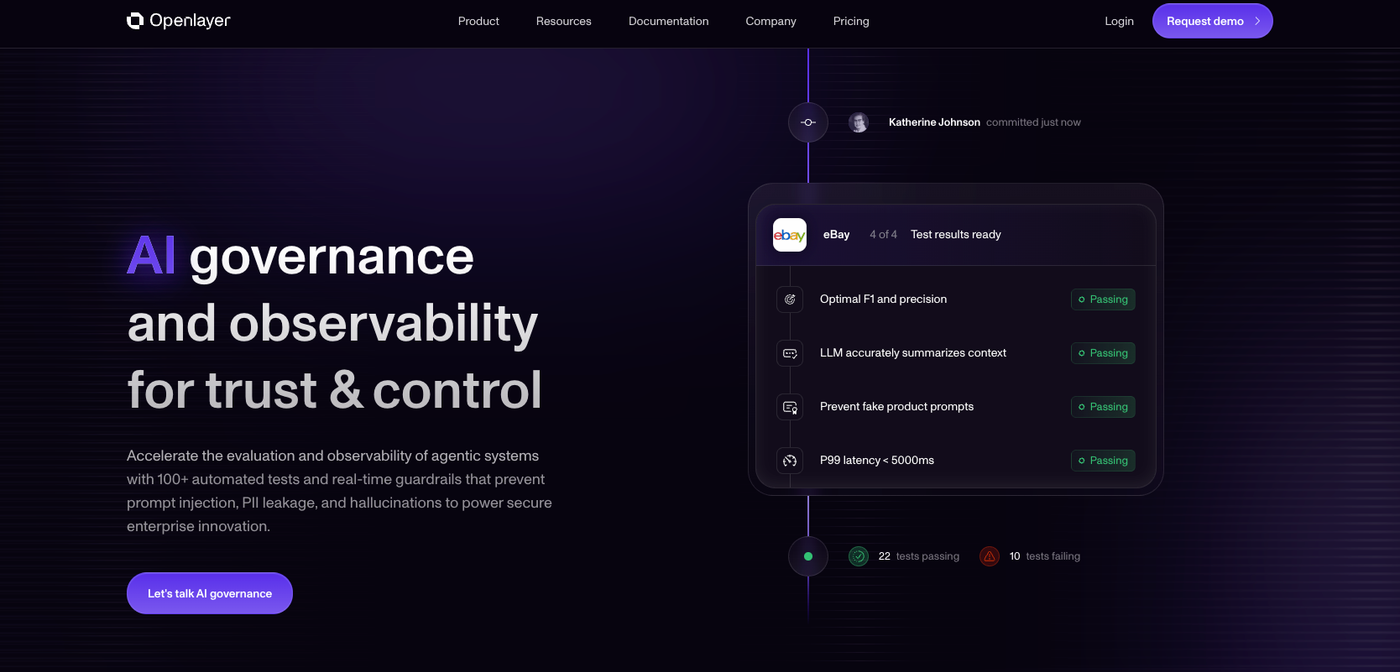
We built Openlayer to solve a core problem: you can't govern what you can't measure, and measurement alone doesn't prevent failures. LLM guardrails provide the foundation for preventing issues before they reach production. Our approach covers development testing, production monitoring, security guardrails, and automated compliance.
- Development testing. The integrated test library includes 100+ prebuilt evaluations across text, vision, tabular, audio, and agent workflows. Each test integrates directly into CI/CD pipelines, blocking deployments when critical checks fail.
- Security. Openlayer security operates at runtime. We prevent prompt injection and PII leakage before malicious queries reach downstream systems. This real-time blocking protects your infrastructure and user data.
- Compliance. We automatically map your AI systems to EU AI Act, NIST RMF, ISO 42001, OWASP, and LGPD frameworks automatically. Continuous risk assessments and evidence capture replace manual documentation.
- Production monitoring. This provides continuous anomaly detection with policy-based alerts. You get full session traces for agents, not solely individual call logs. This visibility into multi-step reasoning and tool invocations speeds up debugging when issues arise.
Braintrust
Braintrust offers evaluation and observability tools for LLM applications, with tracing and scoring capabilities for prompt engineering teams.
Key features
Braintrust offers a number of key features including:
- Trace capture for every prompt, tool call, and response with scoring capabilities
- Dataset management with golden dataset creation and version control
- Integration with popular AI frameworks and development workflows
- Automated evaluation scoring using LLM-as-judge methodologies
The downsides?
Braintrust handles LLM evaluation during development but doesn't extend to enterprise governance. There's no automated compliance mapping to regulatory frameworks. Security guardrails for prompt injection or PII leakage aren't included.
The bottom line
The tool works for teams iterating on prompts and assessing LLM outputs. For organizations needing continuous production AI monitoring, risk assessment, and compliance automation across agent workflows, you'll need additional tools to cover governance requirements.
Arize AI

The agentic AI monitoring market is expanding as organizations deploy autonomous systems. Arize monitors production AI/ML systems with a focus on model performance tracking. Their approach works for traditional AI/ML workflows but doesn't cover the full scope of AI governance.
Key features
- Model performance tracking with drift detection for supervised learning models where ground truth labels exist
- Root cause analysis for model degradation
- Data quality monitoring that detects distribution shifts
- Integration with ML infrastructure and cloud environments
The downsides
Arize has a number of downsides that you should take into consideration before selecting them as your AI monitoring solution:
- Their monitoring only really works for supervised learning scenarios. Multi-step agent reasoning needs session-level tracing and behavioral testing across tool invocations, which goes beyond drift detection.
- Compliance setup requires manual framework mapping. There's no automated evidence collection or risk scoring tied to governance requirements. Teams document compliance separately from monitoring workflows.
The bottom line
Arize lacks automated compliance and real-time security features. Agentic systems with tool access need guardrails that prevent issues before they happen, not only observability after deployment.
Galileo
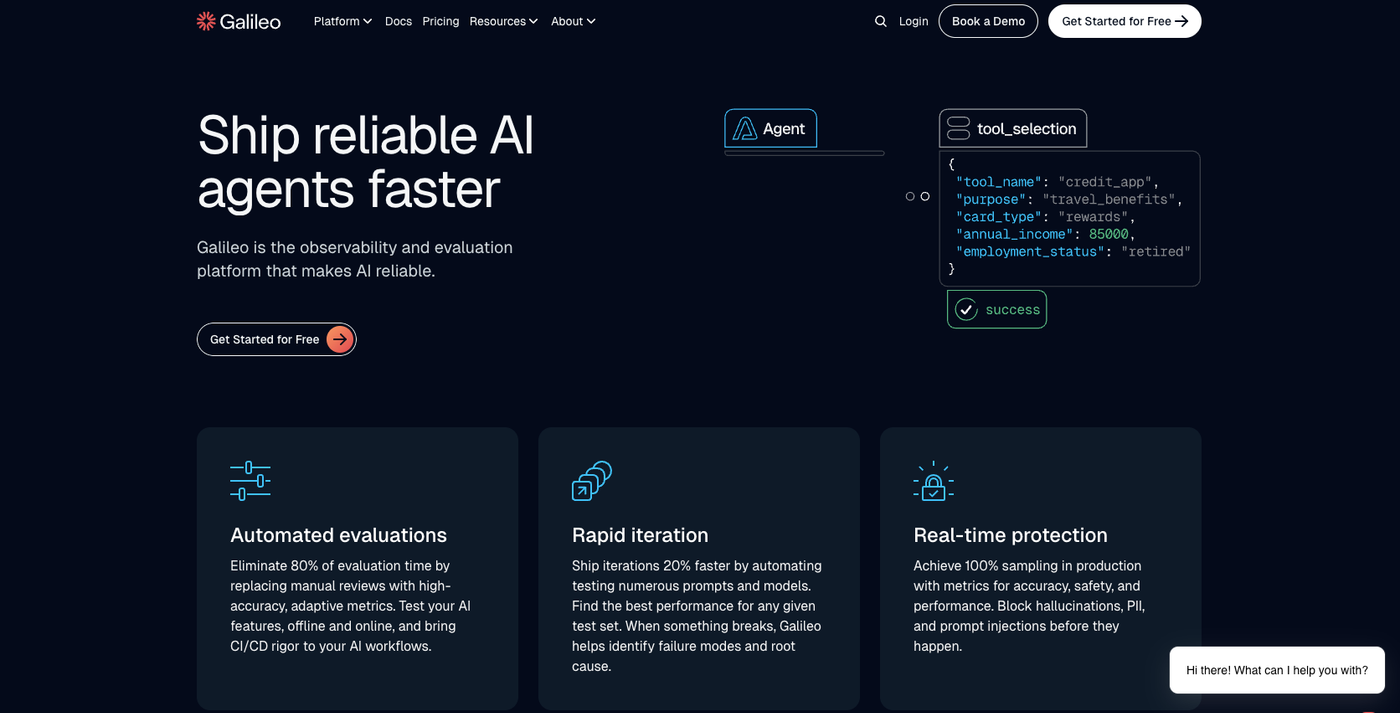
Galileo provides LLM observability and evaluation capabilities for teams deploying language models in production.
Key features
Galileo offers a number of key features as part of it's LLM observability platform:
- Hallucination detection and quality assessment for LLM outputs, helping identify when models generate incorrect information
- Performance monitoring across different model versions and configurations to track how changes affect results
- Integration with popular LLM frameworks and deployment environments
- Custom evaluation metrics and automated scoring capabilities
The downsides?
While Galileo is a feature-rich solution, it also has a number of drawbacks:
- Security features are limited. There's no real-time prevention of prompt injection or automated PII blocking. Threats are detected reactively rather than stopped before reaching your systems.
- Compliance automation isn't included. You'll need manual mapping to regulatory frameworks and separate documentation for evidence collection.
The bottom line
Galileo works for LLM evaluation during development and basic production monitoring. Teams needing security guardrails, compliance automation, and governance across agent workflows will require additional tooling.
LangSmith
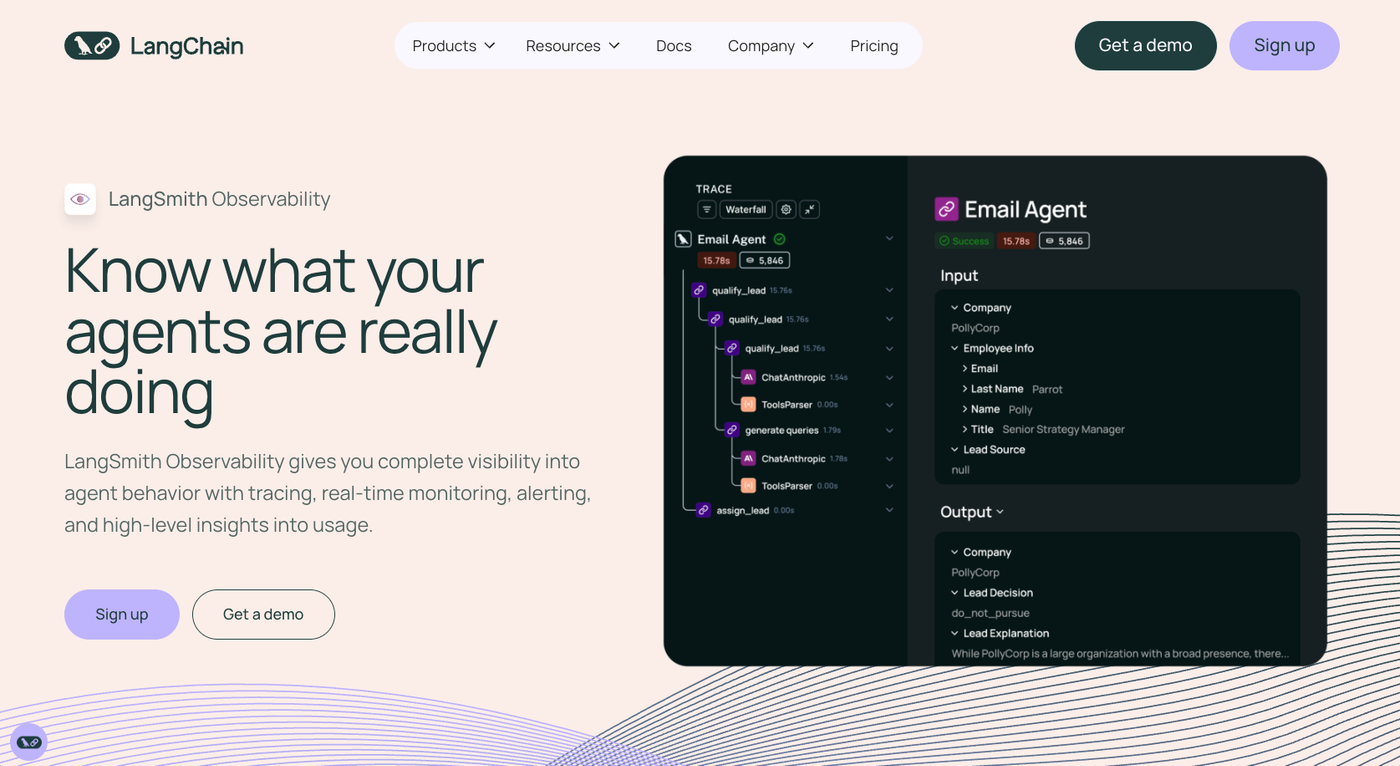
LangSmith delivers observability and evaluation for LangChain applications. Their strength is deep integration within that ecosystem, but coverage stops there.
Key features
LangSmith offers a number of key features in their observability solution:
- Prompt-level evaluation and performance tracking for LLM workflows
- Debugging capabilities with detailed trace analysis and visualization
- Dataset management with test case organization and versioning
- Integration with LangChain ecosystem and development tools
The downsides?
The tool works well if your stack is LangChain-native. For organizations deploying multiple agent frameworks, LangSmith creates vendor lock-in without providing a solution for your governance needs. And, security guardrails are absent. There's no real-time prevention of prompt injection or PII leakage. Compliance automation doesn't exist. You'll manually map to regulatory frameworks and collect evidence separately.
The bottom line
LangSmith serves LangChain-focused development teams. Enterprise governance, automated compliance, and security across diverse AI systems require different tooling.
Feature comparison table of AI agent evaluation tools
The table below summarizes how the major capabilities stack up across tools. Some of the key findings include:
- Arize handles ML monitoring but lacks governance automation.
- Braintrust and LangSmith serve development teams without extending to compliance or security.
- Galileo covers LLM evaluation but misses real-time guardrails.
| Capability | Openlayer | Arize AI | Braintrust | Galileo | LangSmith |
|---|---|---|---|---|---|
| Multimodal testing | ✓ 100+ tests | Limited | Text-focused | LLM-focused | LangChain only |
| Real-time security | ✓ Built-in | - | - | Limited | - |
| Automated compliance | ✓ 5+ frameworks | Manual | - | - | - |
| CI/CD integration | ✓ Native | Basic | ✓ Available | ✓ Available | ✓ LangChain |
| Production monitoring | ✓ Continuous | ✓ Core focus | Limited | Available | Basic |
| Enterprise features | ✓ Full suite | Monitoring-focused | Development-focused | LLM-focused | Ecosystem-limited |
Why Openlayer is the best AI agent evaluation tool
The agentic AI monitoring market stands at USD $0.55 billion in 2025 and will reach USD $2.05 billion by 2030, reflecting a 30.10% CAGR. This growth stems from organizations recognizing that agent evaluation requires specialized tooling beyond basic monitoring. Testing trends show organizations give more weight to continuous validation over periodic checks. The shift reflects a need for real-time security, automated compliance, and testing that integrates with CI/CD pipelines instead of requiring manual audits.
FAQ
What's the difference between AI agent evaluation and traditional LLM testing?
AI agent evaluation validates multi-step reasoning, tool selection, and state consistency across extended sessions, while traditional LLM testing focuses on single-turn output quality. Agents introduce failure modes like reasoning drift, tool misuse, and context degradation that require session-level tracing and behavioral testing beyond measuring individual responses.
How do I integrate agent evaluation into my CI/CD pipeline?
Connect your evaluation system to your version control system (GitHub, GitLab) so every commit triggers automated test runs. Configure critical tests as blocking checks that prevent deployment when they fail, catching issues like prompt injection vulnerabilities or reasoning errors before production release.
When should I choose real-time security guardrails over reactive monitoring?
Choose real-time guardrails when your agents access sensitive data, invoke external APIs, or handle user inputs that could contain malicious prompts. Real-time blocking prevents prompt injection and PII leakage before they reach downstream systems, while reactive monitoring only flags issues after they occur.
Can evaluation tools handle agents built with different frameworks?
Framework-agnostic platforms support agents regardless of implementation (LangChain, custom frameworks, or proprietary systems), while framework-specific tools create vendor lock-in. Check whether the solution traces sessions across multiple frameworks and provides consistent testing for diverse agent architectures.
What compliance frameworks can be automated for agentic AI systems?
Modern evaluation platforms automate mapping to EU AI Act, NIST RMF, ISO 42001, OWASP, and LGPD by performing continuous risk assessments and evidence capture. This replaces manual documentation with automated compliance tracking tied directly to your agent's runtime behavior and test results.
Final Thoughts on Looking at Autonomous AI system Evaluation
AI agent observability goes beyond tracking individual calls. You need session-level traces that show how agents break down tasks, select tools, and recover from failures. Security and compliance can't be afterthoughts. The right evaluation approach catches issues before deployment, not after users report problems.