What are embedding models? A complete guide for March 2026
When you're setting up a RAG pipeline, picking the best embedding model feels like choosing between dozens of nearly identical options. You see BGE-large-en-v1.5, all-mpnet-base-v2, text-embedding-3-small, and a hundred others, each with different dimensions, licenses, and benchmark scores. Some run locally, others require APIs, and the evaluation metrics don't always predict how they'll perform on your documents. We'll show you what sets these models apart, how to narrow your choices based on task requirements, and how to validate them before deploying.
TLDR:
- Embedding models convert text into numerical vectors that capture semantic meaning for RAG, search, and recommendations.
- Choose models based on task (multilingual, code, domain-specific) and dimensions (384-1024), balancing accuracy vs speed.
- Open-source options like BGE and E5 offer control; OpenAI's text-embedding-3 provides managed scaling with per-token costs.
- RAG systems need context relevancy and groundedness tests to prevent retrieval failures and hallucinations in production.
- Openlayer monitors embedding-based systems for drift, retrieval accuracy regression, and context quality degradation with real-time alerts.
What are embedding models?

Embedding models convert text, images, code, or other data into numerical vectors that capture semantic meaning. Instead of treating words as isolated strings, these models map content into a coordinate space where similar concepts cluster together. The vectors produced typically contain hundreds or thousands of dimensions. A sentence like "customer support chatbot" might become a 1,536-dimensional array of floating-point numbers. While humans can't visualize that geometry directly, the distances and angles between vectors encode relationships like synonymy, analogy, and topic relevance.
This tech powers retrieval-augmented generation (RAG), semantic search, recommendation engines, and clustering workflows.
How embedding models work
At the input layer, text gets broken into tokens, subword units that a neural network can process. The sentence "machine learning" might split into three tokens: "machine," "learn," and "ing." Each token receives an initial numeric representation before entering the model. The core of an embedding model is a trained neural network, often a transformer architecture. As tokens pass through multiple layers of attention mechanisms and feedforward networks, the model extracts patterns: syntax, context, topic, and intent. Each layer refines the representation until the final output encodes the semantic essence of the input.
The result is a single fixed-length vector. Two phrases with similar meaning produce vectors that sit close together in this high-dimensional space. Distance metrics like cosine similarity measure alignment between vectors, with scores near 1.0 indicating strong semantic overlap.
Types of embedding models
Embedding models differ by what they encode and at what granularity. They can be categorized into three primary buckets:
- Word embeddings like Word2Vec and GloVe map individual tokens into vectors, capturing synonym relationships but ignoring sentence-level context.
- Sentence and document embeddings encode entire passages into single vectors. Models like Sentence-BERT and E5 use transformer architectures to build context-aware representations that distinguish meaning when most words overlap. These embeddings power RAG pipelines, where you retrieve relevant chunks based on query similarity.
- Multimodal models process text, images, and audio within the same embedding space. CLIP from OpenAI learns joint representations where a photo of a dog and the caption "golden retriever" produce similar vectors, letting you search image databases with text queries.
Embedding models for RAG systems
Retrieval-augmented generation (RAG) pipelines rely on embedding models to convert queries and document chunks into vectors for semantic search. When a user asks a question, the system embeds it, retrieves the top-k closest chunks from a vector database, and injects them into the LLM prompt as grounding context. This reduces hallucinations by anchoring responses in your data instead of parametric memory alone. Chunk size affects precision: smaller chunks offer granular relevance but may lack context, while larger chunks capture narrative but dilute signal. Models trained on domain-specific corpora outperform general embeddings when terminology is specialized, and smaller models reduce indexing and query latency at scale.
Choosing the right embedding model
With all the choices you have for embedding models, it can be hard to decide which one to actually use. Here are some considerations as you think about selecting a specific embedding model:
- Start with your task requirements. If you need cross-language support, choose multilingual models like E5-multilingual or mBERT. For code search, CodeBERT or StarEncoder handle programming syntax better than text-only models. Domain matters: legal or medical corpora benefit from models fine-tuned on specialized terminology.
- Dimensionality shapes both accuracy and latency. Sentence Transformers range from 384 to 1024 dimensions, with all-MiniLM-L6-v2 at 384 and all-mpnet-base-v2 at 768. Smaller vectors speed up distance calculations and reduce storage costs in vector databases, while higher dimensions capture finer semantic distinctions.
- Deployment constraints matter. Hosted APIs like OpenAI text-embedding-3-small eliminate infrastructure overhead but incur per-token costs and introduce network latency. Self-hosted open-source models grant control and cost predictability but require GPU resources for real-time encoding.
Embedding Model Side-by-Side Comparison
| Model | Dimensions | License | Best For | Trade-offs |
|---|---|---|---|---|
| BGE-large-en-v1.5 | 1024 | MIT | High-accuracy retrieval, RAG pipelines | Larger size, GPU recommended |
| all-MiniLM-L6-v2 | 384 | Apache 2.0 | Fast prototyping, CPU inference | Lower recall on complex queries |
| E5-large-v2 | 1024 | Apache 2.0 | Commercial applications, balanced performance | Moderate resource requirements |
| text-embedding-3-small | 1536 | Proprietary | Low-latency API, cost optimization | Per-token costs, external dependency |
| text-embedding-3-large | 3072 | Proprietary | Maximum retrieval accuracy, production RAG | Higher API costs, network latency |
| paraphrase-multilingual-mpnet | 768 | Apache 2.0 | Cross-language search, 50+ languages | Lower performance on English-only tasks |
While there are a lot of embedding model options, all of them fall into one of two categories: open-source and commercial.
Open-source embedding models
Hugging Face hosts thousands of open-source embedding models under permissive licenses like Apache 2.0 and MIT. The BGE (BAAI General Embedding) family from the Beijing Academy of AI ranks consistently near the top of the MTEB leaderboard, with BGE-large-en-v1.5 delivering strong retrieval accuracy at 1024 dimensions. E5-large-v2 from Microsoft Research offers similar performance with Apache 2.0 licensing, making both safe for commercial use.
Smaller models trade accuracy for speed. all-MiniLM-L6-v2 produces 384-dimensional vectors and runs efficiently on CPU, suitable for prototyping or high-throughput pipelines where latency matters more than recall. Multilingual models like paraphrase-multilingual-mpnet-base-v2 support 50+ languages in a single embedding space.
All open-source models require you to host inference yourself, which means provisioning GPUs or CPUs, managing model versioning, and handling scaling as query volume grows.
Commercial embedding model options
OpenAI's text-embedding-3-small and text-embedding-3-large are available through a per-token API. Text-embedding-3-large improved MIRACL scores from 31.4% to 54.9% over text-embedding-ada-002, while MTEB scores climbed from 61.0% to 64.6%. Text-embedding-3-small optimizes for speed and cost, while text-embedding-3-large optimizes retrieval accuracy for production RAG pipelines.
Cohere's Embed v3 handles multilingual queries and adjustable dimensions. Voyage AI offers retrieval-optimized models with separate encoders for documents and queries. Google's Vertex AI Embeddings integrate with BigQuery for teams on GCP.
Commercial APIs scale automatically and include service-level agreements for regulated environments, but introduce usage costs and external dependencies.
Understanding the MTEB leaderboard
The Massive Text Embedding Benchmark tests models across 58 datasets spanning eight tasks: retrieval, classification, clustering, semantic similarity, reranking, pair classification, summarization, and bitext mining. Each task uses specific metrics like nDCG@10 for retrieval or Spearman correlation for similarity, producing an aggregate score that ranks models. Leaderboard position doesn't guarantee the embedding model's success in your application. A model excelling at Wikipedia retrieval may underperform on legal contracts or customer support logs. Domain shift, chunk length, and query phrasing all affect recall in production RAG systems.
It's recommended to use MTEB as a starting filter, then validate finalists on your data before committing.
Implementing embedding models in Python
The key to selecting the right embedding model for your application involves a lot of testing. Thankfully, Python makes it easy to quickly implement embedding models for testing.
First, install the sentence-transformers library for local models or the OpenAI SDK for hosted APIs. You can load a model from Hugging Face with SentenceTransformer('BAAI/bge-large-en-v1.5') and call .encode() on your text array. The library handles tokenization and batching.
from sentence_transformers import SentenceTransformer
model = SentenceTransformer('BAAI/bge-large-en-v1.5')
embeddings = model.encode(["query text", "document chunk"])
If you'd rather use OpenAPI's API, you can pass text to openai.embeddings.create() with text-embedding-3-small or text-embedding-3-large. Batch 100 to 2,000 inputs to reduce latency.
Just remember that for production, deployments cache repeated queries, precompute document embeddings offline, and serve models through containerized endpoints with GPU acceleration when volume exceeds API cost thresholds.
Vector databases and storage considerations
Databases are an important part of AI architecture when employing an embedding model. But different database approaches offer different challenges. For example, relational databases scan every row to compute distances, which becomes prohibitive when collections reach millions of vectors. That's why most AI engineers opt for vector databases with their embedding models. These databases store embeddings alongside metadata and accelerate similarity search through approximate nearest neighbor (ANN) indexing. ANN algorithms like HNSW (Hierarchical Navigable Small World) build graph structures where each vector connects to its nearest neighbors. Queries traverse the graph, pruning distant branches to return top-k results in milliseconds.
Popular vector databases include Pinecone (managed), Weaviate (open-source with hybrid search), Qdrant (Rust-based performance), and pgvector (PostgreSQL extension).
Testing and validating embeddings with Openlayer
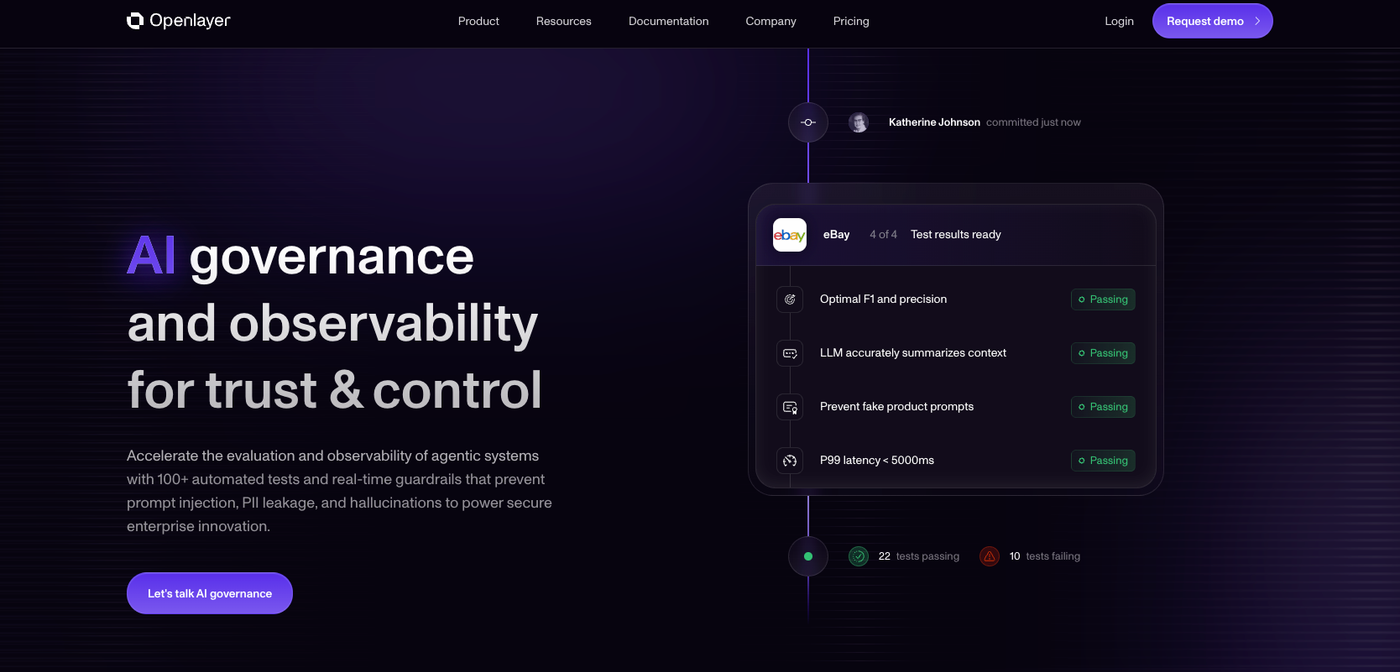
RAG pipelines fail when embeddings retrieve irrelevant context or drift degrades recall over time. Openlayer catches these failures before production through automated tests that validate every layer of your retrieval stack. Our test library includes RAG-specific checks for context relevancy, which measures how retrieved context aligns with the query, and groundedness, which verifies that LLM outputs cite retrieved chunks instead of inventing facts. Needle-in-a-haystack tests confirm your system surfaces precise information from large document stores. In production, we monitor embedding-based systems for drift in query patterns, retrieval accuracy regression, and changes in chunk relevance scores. When recall drops or context quality degrades, alerts fire immediately.
Final thoughts on working with embedding models
You need embedding models that match your specific retrieval task, beyond the top benchmark score. Start with open-source models from Hugging Face or commercial APIs from OpenAI, validate them on your data, and measure real retrieval accuracy before committing to production. Your chunk size, metadata strategy, and vector database choice all interact with model selection. If you're shipping RAG systems at scale, talk to us about how Openlayer validates every layer of your retrieval pipeline.
FAQ
How do I choose between open-source and commercial embedding models for my RAG pipeline?
Start with deployment constraints and budget. Open-source models like BGE-large or E5-large-v2 require GPU infrastructure but eliminate per-token costs, making them cost-effective at high query volumes. Commercial APIs like OpenAI's text-embedding-3 scale automatically with zero infrastructure overhead but incur usage fees that grow with traffic.
What dimensionality should I use for production embedding models?
Lower dimensions (384-512) reduce storage costs and speed up vector search, suitable for prototypes or latency-sensitive applications. Higher dimensions (768-1024) capture finer semantic distinctions and improve retrieval accuracy in specialized domains. Test both on your data; most teams find 768 dimensions balance performance and cost effectively.
How do I validate that my embedding model works for my specific domain?
Run retrieval tests on representative queries from your corpus. Measure recall@k to confirm the model surfaces relevant chunks, then validate that your LLM generates grounded responses from retrieved context. MTEB scores provide a starting filter, but domain-specific evaluation on your data determines production readiness.
When should I fine-tune an embedding model instead of using a pre-trained one?
Fine-tune when your domain contains specialized terminology that general models misinterpret: legal contracts, medical records, or proprietary product catalogs. If pre-trained models consistently retrieve irrelevant chunks or miss critical information during evaluation, fine-tuning on labeled query-document pairs can improve recall by 10-30%.
Can I mix multiple embedding models in the same RAG system?
Yes, but you'll need separate vector indexes for each model since embeddings from different models occupy incompatible vector spaces. Some teams use one model for user queries and another for internal document search, or deploy smaller models for real-time queries and larger models for batch processing where accuracy matters more than latency.