Galileo reviews, pricing, and alternatives (January 2026)


You're researching Galileo reviews because your team is outgrowing basic observability. Galileo provides solid tracing for LLM applications, but regulated industries need more than monitoring. You need automated testing across all model types, real-time guardrails that block risks before deployment, and compliance mapping that generates audit-ready evidence. This guide covers Galileo's strengths in GenAI observability, why teams assess alternatives, and which tools deliver the governance, security, and regulatory controls that enterprise AI requires.
TLDR:
- Galileo provides LLM evaluation and tracing but lacks traditional ML support and compliance automation.
- Alternatives like Langfuse and Braintrust offer observability without governance or regulatory mapping.
- Openlayer delivers 100+ automated tests, real-time guardrails, and automated EU AI Act/NIST compliance.
- Regulated enterprises need unified governance across ML, GenAI, and agents, not simply evaluation tools.
- Openlayer blocks prompt injections and PII leakage before reaching production systems.
What is Galileo and how does it work?
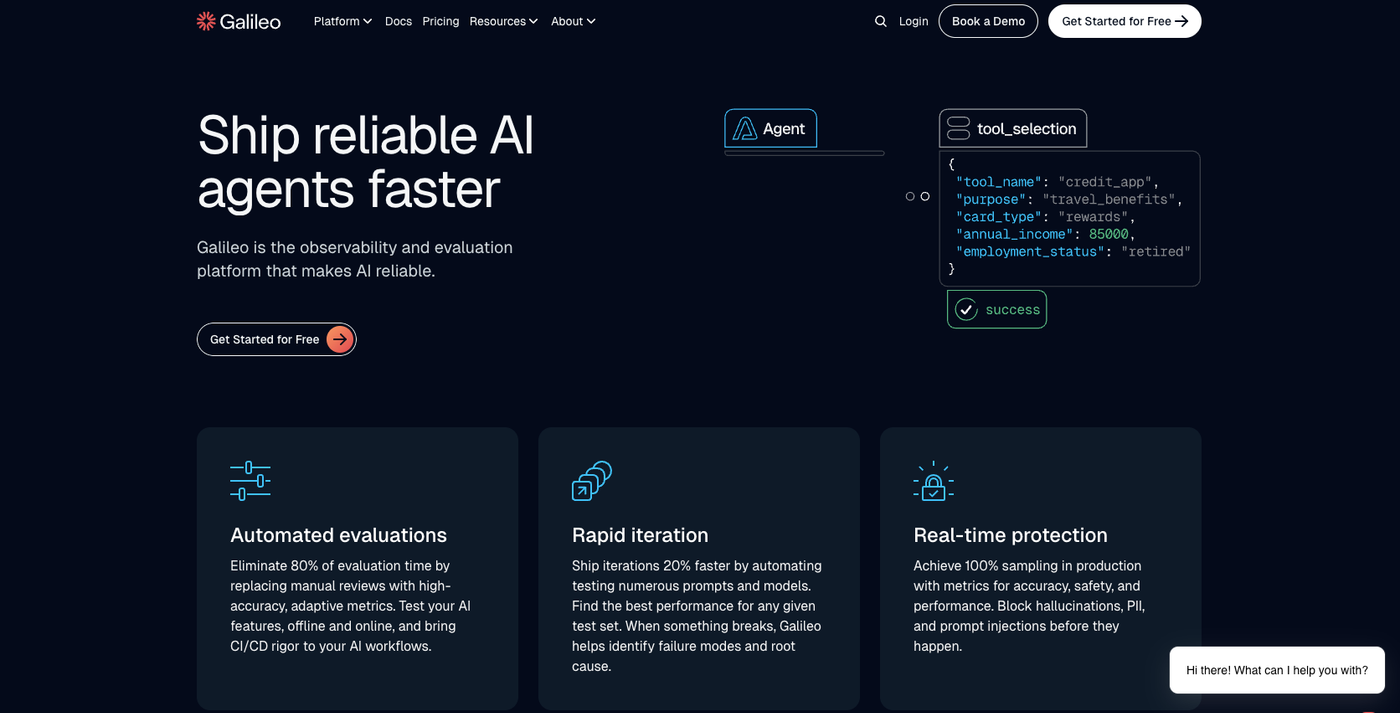
Galileo is an AI evaluation and observability tool for teams deploying LLMs and agents. It validates model behavior during development and monitors performance in production.
Key features
Galileo provides a number of features for AI observability:
- Automated evaluations run through proprietary Luna models that assess outputs across dimensions like factuality, coherence, instruction adherence, and context relevance. Teams use these assessments to benchmark model versions or prompt variations before deployment.
- The observability layer offers real-time tracing for AI applications, particularly those built on retrieval-augmented generation (RAG) architectures or multi-step agent workflows. You can track individual requests, inspect intermediate steps, and identify where failures occur across development and production environments.
- Galileo includes runtime guardrails that catch hallucinations, block prompt injection attempts, and filter problematic outputs before they reach end users. These checks assess each inference against configurable policies.
The bottom line
The product targets enterprise teams with deployed AI applications who need systematic evaluation across multiple models, ongoing production monitoring, or compliance evidence for AI systems operating at scale. However, only 31% of enterprises have comprehensive AI governance frameworks despite 78% acknowledging it as a top-three priority for 2025, creating a massive governance gap that evaluation tools alone cannot address.
Why Consider Galileo Alternatives?
Galileo serves enterprise AI teams building on agent frameworks like CrewAI and LangGraph, where its tracing capabilities provide visibility into multi-step workflows. Teams assess alternatives for three technical reasons:
- Broader ML coverage beyond GenAI. Organizations running traditional ML models alongside LLM systems need tools that handle tabular data, vision models, and classic machine learning workloads. Galileo's agent-focused design doesn't extend to these use cases.
- Automated compliance mapping. Regulated industries require tools that align AI projects with frameworks like EU AI Act, NIST RMF, or ISO 42001 without manual processes. Manual compliance creates bottlenecks when governing AI systems at scale. Enterprise governance budgets increased 24% in 2025, with 98% of companies planning further increases as AI risks become clearer.
- Real-time enforcement vs. post-hoc monitoring. Some requirements demand guardrails that block problematic outputs before they reach production, not alerts after deployment. Preventing PII leakage or blocking prompt injections requires enforcement, not detection alone.
Best Overall Galileo alternatives: Openlayer
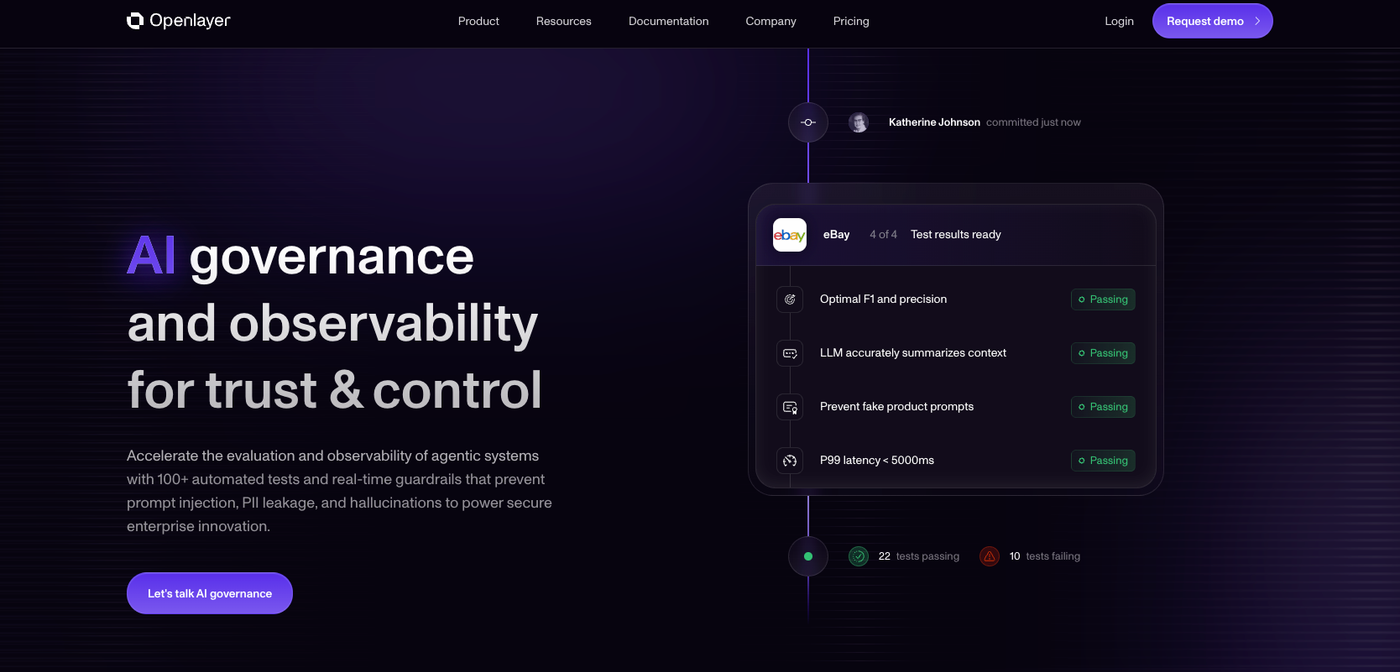
Openlayer delivers AI governance and observability across the entire AI lifecycle, from evaluation through production monitoring and automated compliance. We provide 100+ automated behavioral tests covering hallucinations, bias, toxicity, PII leakage, and adversarial robustness across text, vision, tabular, audio, and multimodal systems.
Key features
Openlayer provides a number of features that make it a good alternative to Galileo:
- Real-time security guardrails actively block prompt injections, data exfiltration, and PII leakage before reaching downstream systems.
- Continuous monitoring includes automated anomaly detection, drift tracking, and risk scoring tied to policy thresholds.
- Automated compliance mapping covers EU AI Act, NIST RMF, ISO 42001, OWASP, and LGPD with audit-ready evidence capture.
The bottom line
Openlayer is best suited for regulated enterprises deploying AI at scale who need unified governance, security, and compliance across ML, GenAI, and agentic systems. Openlayer provides the governance, automated testing, real-time security, and regulatory compliance that Galileo's evaluation-focused approach does not deliver.
Langfuse
Langfuse is an open-source observability and analytics platform built for LLM applications. The tool provides production tracing, prompt management, and evaluation workflows designed for teams building on frameworks like LangChain, LlamaIndex, and OpenAI.
Key Features
Langfuse provides a number of features that make it a good alternative to Galileo:
- Detailed trace inspection across prompts, model calls, and agent steps with nested span visualization
- Cost and latency tracking aggregated by user, session, or model version
- Dataset-based evaluation with custom scoring functions and LLM-as-judge patterns
- Prompt versioning and A/B testing with production deployment tracking
- OpenTelemetry integration for high-throughput logging without vendor lock-in
The Bottom Line
Good for engineering teams building on LangChain or similar frameworks who need deep debugging and trace inspection. Langfuse lacks pre-built test libraries for safety and robustness, does not detect drift or perform statistical anomaly detection, provides no runtime enforcement or guardrails, and offers no compliance framework mapping.
Braintrust
Braintrust provides evaluation and logging infrastructure for AI applications with a focus on datasets, scorers, and CI/CD gates. The tool targets teams running high-volume prompt experiments who need tight integration between offline evaluation and production logging.
Key features
Braintrust provides a number of features that make it a good alternative to Galileo:
- Flexible evaluation framework with custom scoring functions and LLM-as-judge patterns
- Fast trace storage via proprietary Brainstore optimized for high-throughput logging
- Automated regression detection in CI/CD pipelines with version comparison
- Dataset management with versioning and experiment tracking across prompt iterations
- Role-based access controls and team collaboration features
The bottom line
Good for teams running many prompt experiments who want tight integration between offline evaluation and production logging. Braintrust lacks prebuilt safety and robustness tests, does not provide real-time guardrails, offers no automated mapping to regulatory frameworks, and leaves governance implementation to users.
LangSmith
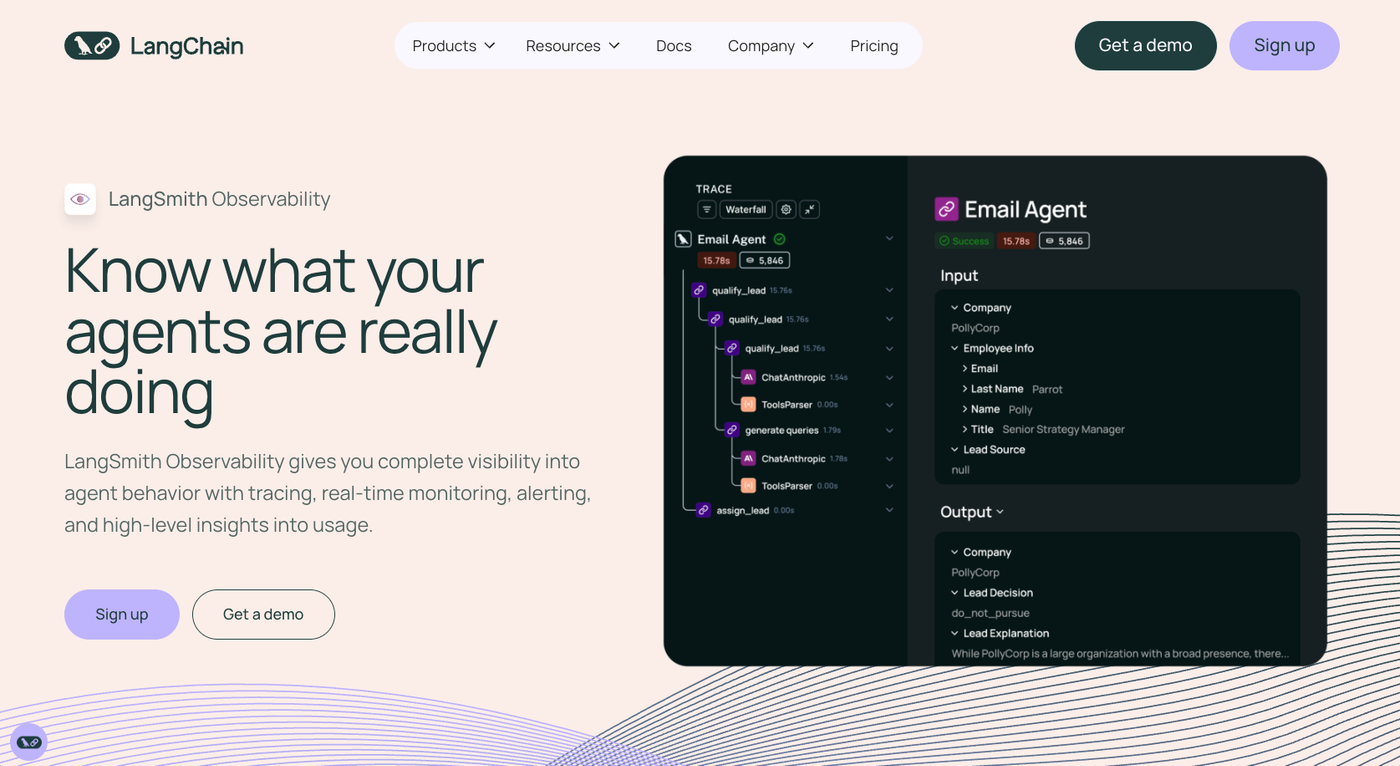
LangSmith is an evaluation and tracing tool tightly integrated with the LangChain ecosystem. The tool provides detailed observability for LangChain pipelines with prompt management, dataset evaluation, and production monitoring designed for teams standardized on LangChain workflows.
Key features
LangSmith provides a number of features that make it a good alternative to Galileo:
- Deep tracing for LangChain pipelines with step-by-step execution visibility
- Prompt-level and chain-level evaluations with custom scoring functions
- Version comparison and experimentation across prompt iterations
- Cost and latency monitoring aggregated by chain, user, or session
- Dataset management with annotation workflows for human feedback
- Team collaboration features with shared workspaces and access controls
The bottom line
Good for development teams standardized on LangChain who need native integration and detailed pipeline debugging. LangSmith lacks prebuilt safety and robustness tests, does not provide real-time guardrails or drift detection, offers no automated compliance mapping, and provides limited support for non-LangChain frameworks or traditional ML models.
Feature comparison: Galileo vs top alternatives
The table below compares Galileo against leading alternatives for evaluation, monitoring, and governance capabilities.
| Feature | Galileo | Openlayer | Langfuse | Braintrust | LangSmith |
|---|---|---|---|---|---|
| Automated test library | Luna model assessments | 100+ prebuilt tests | Custom scorers only | Custom scorers only | Custom evaluators |
| Real-time guardrails | Monitoring alerts | Active blocking | None | None | None |
| Continuous drift Detection | Limited | Yes | No | Pipeline regression only | No |
| Compliance framework mapping | Manual | Automated (EU AI Act, NIST, ISO 42001, OWASP, LGPD) | None | None | None |
| Multi-modal support | Text only | Text, vision, tabular, audio | Text only | Text only | Text only |
| Governance controls | Project organization | Risk scoring, approval workflows, evidence capture | None | RBAC only | Team workspaces |
Galileo and LangSmith focus on GenAI workflows with strong tracing but limited governance. Langfuse and Braintrust provide developer-friendly observability without compliance automation. Openlayer automates compliance mapping, enforces real-time security policies, and provides audit-ready evidence across the entire AI lifecycle.
Why Openlayer is the best Galileo alternative
Openlayer tackles a different need: regulated environments where evaluation alone isn't enough.
We provide 100+ automated tests that function as CI/CD primitives across text, vision, tabular, and audio systems. These tests validate safety, quality, and security without requiring custom evaluation logic. Every test runs in both development and production, creating continuous validation loops instead of pre-deployment checks alone. Our guardrails prevent prompt injections and PII leakage before they reach downstream systems. This differs from detection-based monitoring that alerts teams after incidents occur.
Automated compliance mapping changes testing into audit-ready evidence. We align AI projects to EU AI Act, NIST RMF, ISO 42001, OWASP, and LGPD without manual frameworks or documentation cycles. Risk scoring, approval workflows, and evidence capture operate continuously as AI systems evolve.
Openlayer unifies evaluation, security, monitoring, and AI governance in one system designed for enterprises operating under regulatory scrutiny.
Final thoughts on finding the right fit for your AI stack
Before finalizing your Galileo alternatives assessment, clarify whether you need observability or governance. Galileo excels at GenAI tracing, but teams in regulated industries need automated compliance frameworks and real-time security that prevents incidents instead of detecting them. Openlayer provides that layer across your entire AI lifecycle, from development through production monitoring.
FAQ
Why should you consider alternatives to Galileo?
Teams assess alternatives when they need broader ML coverage beyond GenAI (tabular, vision, classic ML), automated compliance mapping to frameworks like EU AI Act or NIST RMF, or real-time enforcement that blocks problematic outputs before production instead of monitoring after deployment.
What features should you look for first when comparing AI observability tools?
Give more weight to automated test libraries that cover safety and security without custom logic, real-time guardrails that prevent issues instead of detect them, continuous drift detection across production systems, and automated compliance mapping that generates audit-ready evidence without manual documentation. For a detailed comparison of tools, see our guide on best AI observability tools.
When should you move from evaluation-focused tools to governance platforms?
Move to governance platforms when operating in regulated industries, deploying AI systems that require audit trails, managing multiple AI projects across teams, or facing requirements to prove compliance with frameworks like EU AI Act, NIST RMF, or ISO 42001.
How does real-time enforcement differ from monitoring alerts?
Real-time enforcement blocks prompt injections, PII leakage, and policy violations before they reach downstream systems or end users. Monitoring alerts notify teams after incidents occur, creating response delays and potential exposure windows that enforcement prevents entirely.